Die Geheime Staatspolizei Im NS-Gau Thüringen 1933-1945
Total Page:16
File Type:pdf, Size:1020Kb
Load more
Recommended publications
-

Guides to German Records Microfilmed at Alexandria, Va
GUIDES TO GERMAN RECORDS MICROFILMED AT ALEXANDRIA, VA. No. 32. Records of the Reich Leader of the SS and Chief of the German Police (Part I) The National Archives National Archives and Records Service General Services Administration Washington: 1961 This finding aid has been prepared by the National Archives as part of its program of facilitating the use of records in its custody. The microfilm described in this guide may be consulted at the National Archives, where it is identified as RG 242, Microfilm Publication T175. To order microfilm, write to the Publications Sales Branch (NEPS), National Archives and Records Service (GSA), Washington, DC 20408. Some of the papers reproduced on the microfilm referred to in this and other guides of the same series may have been of private origin. The fact of their seizure is not believed to divest their original owners of any literary property rights in them. Anyone, therefore, who publishes them in whole or in part without permission of their authors may be held liable for infringement of such literary property rights. Library of Congress Catalog Card No. 58-9982 AMERICA! HISTORICAL ASSOCIATION COMMITTEE fOR THE STUDY OP WAR DOCUMENTS GUIDES TO GERMAN RECOBDS MICROFILMED AT ALEXAM)RIA, VA. No* 32» Records of the Reich Leader of the SS aad Chief of the German Police (HeiehsMhrer SS und Chef der Deutschen Polizei) 1) THE AMERICAN HISTORICAL ASSOCIATION (AHA) COMMITTEE FOR THE STUDY OF WAE DOCUMENTS GUIDES TO GERMAN RECORDS MICROFILMED AT ALEXANDRIA, VA* This is part of a series of Guides prepared -

State of Florida Resource Manual on Holocaust Education Grades
State of Florida Resource Manual on Holocaust Education Grades 7-8 A Study in Character Education A project of the Commissioner’s Task Force on Holocaust Education Authorization for reproduction is hereby granted to the state system of public education. No authorization is granted for distribution or reproduction outside the state system of public education without prior approval in writing. The views of this document do not necessarily represent those of the Florida Department of Education. 2 Table of Contents Introduction Definition of the Term Holocaust ............................................................ 7 Why Teach about the Holocaust............................................................. 8 The Question of Rationale.............................................................. 8 Florida’s Legislature/DOE Required Instruction.............................. 9 Required Instruction 1003.42, F.S.................................................. 9 Developing a Holocaust Unit .................................................................. 9 Interdisciplinary and Integrated Units ..................................................... 11 Suggested Topic Areas for a Course of Study on the Holocaust............ 11 Suggested Learning Activities ................................................................ 12 Eyewitnesses in Your Classroom ........................................................... 12 Discussion Points/Questions for Survivors ............................................. 13 Commonly Asked Questions by Students -

Jewish Genocide in Galicia
Jewish Genocide in Galicia Jewish Genocide in Galicia 2nd Edition With Appendix: Vernichtungslager ‘Bełżec’ Robin O’Neil Published by © Copyright Robin O’Neil 2015 JEWISH GENOCIDE IN GALICIA All rights reserved. The right of Robin O’Nei to be identified as the author of this work has been asserted in accordance with the Copyright, Designs and Patents Act 1988. No part of this publication may be reproduced, stored in a retrieval system, or transmitted, in any form or by any means, electronic, mechanical, photocopying, recording or otherwise, nor translated into a machine language, without the written permission of the publisher. Condition of sale This book is sold subject to the condition that it shall not, by way of trade or otherwise, be lent, re-sold, hired out or otherwise circulated in any form of binding or cover other than that in which it is published and without a similar condition including this condition being imposed on the subsequent purchaser. ISBN Frontispiece: The Rabka 4 + 1 - incorporating the original book cover of Rudolf Reder’s ‘Bełżec’, 1946. 2nd Edition Part 1 2016: The Rabka Four + 1. First published 2011 under the title ‘The Rabka Four’. Contents Academic Excellence In Murder......................................i Dedication....................................................................... ii Lives Remembered .........................................................iv Note on Language...........................................................vi The Hunting Grounds for the Rabka 4 + 1 (zbV) 1941-1944 .........................................................................x -

Perpetrators & Possibilities: Holocaust Diaries, Resistance, and the Crisis of Imagination
Georgia State University ScholarWorks @ Georgia State University History Theses Department of History 8-3-2006 Perpetrators & Possibilities: Holocaust Diaries, Resistance, and the Crisis of Imagination Eryk Emil Tahvonen Follow this and additional works at: https://scholarworks.gsu.edu/history_theses Part of the History Commons Recommended Citation Tahvonen, Eryk Emil, "Perpetrators & Possibilities: Holocaust Diaries, Resistance, and the Crisis of Imagination." Thesis, Georgia State University, 2006. https://scholarworks.gsu.edu/history_theses/14 This Thesis is brought to you for free and open access by the Department of History at ScholarWorks @ Georgia State University. It has been accepted for inclusion in History Theses by an authorized administrator of ScholarWorks @ Georgia State University. For more information, please contact scholarworks@gsu.edu. PERPETRATORS & POSSIBILITIES: HOLOCAUST DIARIES, RESISTANCE, AND THE CRISIS OF IMAGINATION by ERYK EMIL TAHVONEN Under the Direction of Jared Poley ABSTRACT This thesis examines the way genocide leaves marks in the writings of targeted people. It posits not only that these marks exist, but also that they indicate a type of psychological resistance. By focusing on the ways Holocaust diarists depicted Nazi perpetrators, and by concentrating on the ways language was used to distance the victim from the perpetrator, it is possible to see how Jewish diarists were engaged in alternate and subtle, but nevertheless important, forms of resistance to genocide. The thesis suggest this resistance on the part of victims is similar in many ways to well-known distancing mechanisms employed by perpetrators and that this evidence points to a “crisis of imagination” – for victims and perpetrators alike – in which the capability to envision negation and death, and to identify with the “Other” is detrimental to self-preservation. -

Destruction and Human Remains
Destruction and human remains HUMAN REMAINS AND VIOLENCE Destruction and human remains Destruction and Destruction and human remains investigates a crucial question frequently neglected in academic debate in the fields of mass violence and human remains genocide studies: what is done to the bodies of the victims after they are killed? In the context of mass violence, death does not constitute Disposal and concealment in the end of the executors’ work. Their victims’ remains are often treated genocide and mass violence and manipulated in very specific ways, amounting in some cases to true social engineering with often remarkable ingenuity. To address these seldom-documented phenomena, this volume includes chapters based Edited by ÉLISABETH ANSTETT on extensive primary and archival research to explore why, how and by whom these acts have been committed through recent history. and JEAN-MARC DREYFUS The book opens this line of enquiry by investigating the ideological, technical and practical motivations for the varying practices pursued by the perpetrator, examining a diverse range of historical events from throughout the twentieth century and across the globe. These nine original chapters explore this demolition of the body through the use of often systemic, bureaucratic and industrial processes, whether by disposal, concealment, exhibition or complete bodily annihilation, to display the intentions and socio-political frameworks of governments, perpetrators and bystanders. A NST Never before has a single publication brought together the extensive amount of work devoted to the human body on the one hand and to E mass violence on the other, and until now the question of the body in TTand the context of mass violence has remained a largely unexplored area. -

Diplomarbeit
DIPLOMARBEIT Titel der Diplomarbeit „Verbrechen der Einsatzgruppen - Strafverfolgung vor österreichischen Geschworenengerichten am Beispiel des Prozesses gegen Josef Wendl“ Verfasser Walter Kornfeld angestrebter akademischer Grad Magister der Philosophie (Mag. Phil.) Wien, 30. März 2012 Studienkennzahl lt. A 312 Studienblatt: Studienrichtung lt. Geschichte Studienblatt: Betreuer: Univ. –Doz. Dr. Bertrand Perz INHALTSVERZEICHNIS EINLEITUNG 1 1. DIE NACHKRIEGSJUSTIZ IN ÖSTERREICH 4 1.1. DIE ANFÄNGE - VERBOTSGESETZ UND KRIEGSVERBRECHERGESETZ 4 1.2. DIE VOLKSGERICHTE 9 1.3. JURISTISCHE VERFOLGUNG NACH 1955 – PROZESSE VOR GESCHWORENENGERICHTEN 12 1.4. WIE FUNKTIONIERT EIN GESCHWORENENGERICHT? 16 2. DIE EINSATZGRUPPEN – VON SICHERHEITSPOLIZEILICHEN AUFGABEN HIN ZUM MASSENMORD 17 2.1. ENTWICKLUNG DER EINSATZGRUPPEN - VON ÖSTERREICH ÜBER DAS SUDETENLAND NACH POLEN 17 2.2. AUFSTELLUNG UND VORBEREITUNG DER EINSATZGRUPPEN FÜR DEN EINSATZ IN DER UDSSR 18 2.3. BEFEHLE AN DIE EINSATZGRUPPEN 19 2.4. DER BEGINN DES EINSATZES IN DER UDSSR – GLIEDERUNG UND VORGEHEN DER EINSATZGRUPPEN 21 2.5. MARSCHWEG UND EINSÄTZE DER EINSATZGRUPPE B 26 2.6. MARSCHWEG UND EINSÄTZE DES EINSATZKOMMANDOS 8 28 2.6.1. Der Marschweg des Kommandos 28 2.6.2. Organisation des Kommandos 29 2.6.3. Einsätze des Kommandos bis Ende März 1942 29 3. TÖTUNG DURCH GAS – EXPERIMENTE ZUR „VERBESSERUNG DER TÖTUNGSTECHNIK“ 32 3.1. DIE ENTWICKLUNG DER GASWAGEN 33 3.2. MASSENMORD MIT GASWAGEN IM VERNICHTUNGSLAGER CHELMNO 37 4. TATORTE 39 4.1. MALY TROSTINEZ 39 4.2. MOGILEW 42 5. DIE MOTIVATION DER TÄTER – EIN ERKLÄRUNGSVERSUCH 44 6. EXKURS: ZUM BEFEHLSNOTSTAND 49 7. JURISTISCHE VERFOLGUNG VON NS-STRAFTATEN IN DER BUNDESREPUBLIK DEUTSCHLAND 52 7.1. STRAFVERFOLGUNG DER EINSATZGRUPPEN IN DER BRD 54 7.2. -
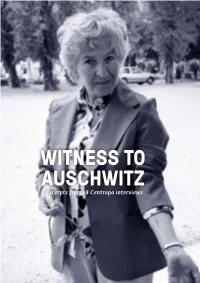
WITNESS to AUSCHWITZ Excerpts from 18 Centropa Interviews WITNESS to AUSCHWITZ Excerpts from 18 Centropa Interviews
WITNESS TO AUSCHWITZ excerpts from 18 Centropa interviews WITNESS TO AUSCHWITZ Excerpts from 18 Centropa Interviews As the most notorious death camp set up by the Nazis, the name Auschwitz is synonymous with fear, horror, and genocide. The camp was established in 1940 in the suburbs of Oswiecim, in German-occupied Poland, and later named Auschwitz by the Germans. Originally intended to be a concentration camp for Poles, by 1942 Auschwitz had a second function as the largest Nazi death camp and the main center for the mass extermination of Europe’s Jews. Auschwitz was made up of over 40 camps and sub-camps, with three main sec- tions. The first main camp, Auschwitz I, was built around pre-war military bar- racks, and held between 15,000 and 20,000 prisoners at any time. Birkenau – also referred to as Auschwitz II – was the largest camp, holding over 90,000 prisoners and containing most of the infrastructure required for the mass murder of the Jewish prisoners. 90 percent of Auschwitz’s victims died at Birkenau, including the majority of the camp’s 75,000 Polish victims. Of those that were killed in Birkenau, nine out of ten of them were Jews. The SS also set up sub-camps designed to exploit the prisoners of Auschwitz for slave labor. The largest of these was Buna-Monowitz, which was established in 1942 on the premises of a synthetic rubber factory. It was later designated the headquarters and administrative center for all of Auschwitz’s sub-camps, and re-named Auschwitz III. All the camps were isolated from the outside world and surrounded by elec- trified barbed wire. -

Law Reports of Trial of War Criminals, Volume VII, English Edition
LAW REPORTS ~......, o F Jl~IT&~jll!ID1§AI; llFFA1RS TRIALS OF WAR CRIMINALS Selected and prepared by THE UNITED NATIONS WAR C RIM ESC 0 M M IS S ION VOLUME VII LONDON PUBLISHED FOR THE UNITED NATIONS WAR CRIMES COMMISSION BY HIS MAJESTY'S STATIONERY OFFICE 194 8 Price 5S. od. net LAW REPORTS OF TRIALS OF WAR CRIMINALS SELECTED AND PREPARED BY THE UNITED NATIONS WAR CRIMES COMMISSION One of the aims of this series of Reports is to relate in summary form the course of the most important of the proceedings taken against persons accused ofcommitting war crimes during the Second World War, apart from the major war criminals tried by the Nuremberg and Tokyo International Military Tribunals, but including those tried by United States Military Tribunals at Nuremberg. Of necessity, the trials reported in these volumes are examples only, since the trials conducted before the various Allied Courts number well over a thousand. The trials selected for reporting, however, are those which are thought to be of the greatest interest legally and in which important points of municipal and international law arose and were settled.. Each report, however, contains not only the outline of the proceedings in the trial under review, but also, in a separate section headed" Notes on the Case ", such comments of an explanatory nature on the legal matters arising in that trial which it has been thought useful to include. These notes provide also, at suitable points, general summaries an.d analyses of the decisions of the courts on specific points of law derived primarily from a study of relevant trials already reported upon in the series. -
"Teaching About the Holocaust and the History of Genocide in the 21St
DGIV/EDU/INSET/Donau (2000) 4 "Teaching about the Holocaust and the history of genocide in the 21 st century" 90th European Teachers Seminar Donaueschingen, Germany, 6-10 November 2000 Report Council for Cultural Co-operation In-Service Training Programme for Educational Staff Strasbourg, January 2001 The Council of Europe was founded in 1949 to achieve greater unity between European parliamentary democracies. It is the oldest of the European political institutions and has forty-three member states, 1 including the fifteen members of the European Union. It is the widest intergovernmental and inter-parliamentary grouping in Europe, and has its headquarters in the French city of Strasbourg. Only questions related to national defence are excluded from the Council of Europe's work, and the Organisation has activities in the following areas: democracy, human rights and fundamental freedoms; media and communication; social and economic affairs; education, culture, heritage and sport; youth; health; environment and regional planning; local democracy and legal co-operation. The European Cultural Convention was opened for signature in 1954. This international treaty is also open to European countries that are not members of the Council of Europe, enabling them to take part in the Organisation's Programmes on education, culture, sport and youth. So far, forty- seven states have acceded to the European Cultural Convention: the Council of Europe's forty- three member states plus Belarus, Bosnia-Herzegovina, Holy See and Monaco. The Council for Cultural Co-operation (the CDCC) is responsible for the Council of Europe's work on education and culture . Four specialised committees - the Education Committee, the Higher Education and Research Committee, the Culture Committee and the Cultural Heritage Committee - help the CDCC to carry out its tasks under the European Cultural Convention. -

Medical Ethics in the 70 Years After the Nuremberg Code, 1947 to the Present
wiener klinische wochenschrift The Central European Journal of Medicine 130. Jahrgang 2018, Supplement 3 Wien Klin Wochenschr (2018) 130 :S159–S253 https://doi.org/10.1007/s00508-018-1343-y Online publiziert: 8 June 2018 © The Author(s) 2018 Medical Ethics in the 70 Years after the Nuremberg Code, 1947 to the Present International Conference at the Medical University of Vienna, 2nd and 3rd March 2017 Editors: Herwig Czech, Christiane Druml, Paul Weindling With contributions from: Markus Müller, Paul Weindling, Herwig Czech, Aleksandra Loewenau, Miriam Offer, Arianne M. Lachapelle-Henry, Priyanka D. Jethwani, Michael Grodin, Volker Roelcke, Rakefet Zalashik, William E. Seidelman, Edith Raim, Gerrit Hohendorf, Christian Bonah, Florian Schmaltz, Kamila Uzarczyk, Etienne Lepicard, Elmar Doppelfeld, Stefano Semplici, Christiane Druml, Claire Whitaker, Michelle Singh, Nuraan Fakier, Michelle Nderu, Michael Makanga, Renzong Qiu, Sabine Hildebrandt, Andrew Weinstein, Rabbi Joseph A. Polak history of medicine Table of contents Editorial: Medical ethics in the 70 years after the Nuremberg Code, 1947 to the present S161 Markus Müller Post-war prosecutions of ‘medical war crimes’ S162 Paul Weindling: From the Nuremberg “Doctors Trial” to the “Nuremberg Code” S165 Herwig Czech: Post-war trials against perpetrators of Nazi medical crimes – the Austrian case S169 Aleksandra Loewenau: The failure of the West German judicial system in serving justice: the case of Dr. Horst Schumann Miriam Offer: Jewish medical ethics during the Holocaust: the unwritten ethical code From prosecutions to medical ethics S172 Arianne M. Lachapelle-Henry, Priyanka D. Jethwani, Michael Grodin: The complicated legacy of the Nuremberg Code in the United States S180 Volker Roelcke: Medical ethics in Post-War Germany: reconsidering some basic assumptions S183 Rakefet Zalashik: The shadow of the Holocaust and the emergence of bioethics in Israel S186 William E. -

Auschwitz Concentration Camp
THE HOLOCAUST AND HISTORY The KnoWll, the Unknown, the Disputed, and the Reexamined EDITED BY Michael Berenbaum and Abraham1. Peck Published in association with the United States Holocaust Memorial Museum Washington, D.C. Indiana University Press Bloomington and Indianapolis 27. FRAN CISZEK PIPER Auschwitz Concentration Camp HOW IT WAS USED IN THE NAZI SYSTEM OF TERROR AND GENOCIDE AND IN THE ECONOMY OF THE THIRD REICH Creation of the Camp, Its Physical Development and Methods of Extermination Millions of human beings in occupied Europe perished as a result of the " purposeful activities of different agencies of the Third Reich. The Nazi extermination policy rested on far-reaching plans for the Germanization of Eastern Europe and demographic restructuring of the rest of Europe.! The implementation of these plans was supposed to lead to the complete annihilation of theJews and Gypsies and to the partial elimination of Slavs, most especially the Poles. Concentration camps, and death camps forJews, along with an extensive.system of court and police institutions were the tools for implementing these plans. The concentration camps in particular were the central instrument of terror against the nations of occupied Europe. In the last phase of the war they were one of the places where hundreds of thousands were exploited for slave labor. The largest of these was the Auschwitz-Birkenau camp. Established by the Nazis in occupied Polish territory, it combined in one complex both types of these camps. The concentration camp in Oswi~cim (renamed Auschwitz by the Germans) was set up in May 1940 at the initiative oflocal German police authorities in Silesia, where mass arrests of Polish nationals had been carried out since the beginning of the German occupation. -

7. the Holocaust
7. The Holocaust The more we come to know about the Holocaust, how it came about, how it was carried out, etc., the greater the possibility that we will become sensitized to inhumanity and suffering whenever they occur. EVA FLEISCHNER OVERVIEW Chapter 7 focuses on the deliberate murder of one third of all the Jews in the world. The Nazis singled out children, women, and men for destruction solely because of their ancestry. Winston Churchill called that act “a crime without a name.” In the years that followed people have given that crime various names. In the United States, it is referred to as the Holocaust, a word people have been using since ancient times. “The word ‘holocaust’ means complete destruction by burning; all matter is totally consumed by the flames,” writes Paul Bookbinder. “Although the word is of Greek origin, it has become synonymous with the destruction of European Jews by the Germans during the Second World War. The crematoria of Auschwitz brought the word ‘holocaust’ to mind, and in its sound the enormity of the horror of those days was confirmed.”1 The Holocaust 307 Over the years, Auschwitz has become a symbol of the Holocaust. It represents the thousands of camps through which millions of Europeans died. Israel Gutman, the Director of the Center for Holocaust Research at Yad Vashem in Israel, estimates that about 85 to 90 percent of all those murdered at Auschwitz were Jews. Among the others were Russian prisoners of war and “Gypsies.” Most were selected for immediate death. The rest were kept alive for slave labor.