NEW MEDIA STUDIES Word Count
Total Page:16
File Type:pdf, Size:1020Kb
Load more
Recommended publications
-
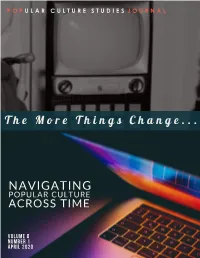
Volume 8, Number 1
POPULAR CULTURE STUDIES JOURNAL VOLUME 8 NUMBER 1 2020 Editor Lead Copy Editor CARRIELYNN D. REINHARD AMY DREES Dominican University Northwest State Community College Managing Editor Associate Copy Editor JULIA LARGENT AMANDA KONKLE McPherson College Georgia Southern University Associate Editor Associate Copy Editor GARRET L. CASTLEBERRY PETER CULLEN BRYAN Mid-America Christian University The Pennsylvania State University Associate Editor Reviews Editor MALYNNDA JOHNSON CHRISTOPHER J. OLSON Indiana State University University of Wisconsin-Milwaukee Associate Editor Assistant Reviews Editor KATHLEEN TURNER LEDGERWOOD SARAH PAWLAK STANLEY Lincoln University Marquette University Associate Editor Graphics Editor RUTH ANN JONES ETHAN CHITTY Michigan State University Purdue University Please visit the PCSJ at: mpcaaca.org/the-popular-culture-studies-journal. Popular Culture Studies Journal is the official journal of the Midwest Popular Culture Association and American Culture Association (MPCA/ACA), ISSN 2691-8617. Copyright © 2020 MPCA. All rights reserved. MPCA/ACA, 421 W. Huron St Unit 1304, Chicago, IL 60654 EDITORIAL BOARD CORTNEY BARKO KATIE WILSON PAUL BOOTH West Virginia University University of Louisville DePaul University AMANDA PICHE CARYN NEUMANN ALLISON R. LEVIN Ryerson University Miami University Webster University ZACHARY MATUSHESKI BRADY SIMENSON CARLOS MORRISON Ohio State University Northern Illinois University Alabama State University KATHLEEN KOLLMAN RAYMOND SCHUCK ROBIN HERSHKOWITZ Bowling Green State Bowling Green State -

6 YEARS Written and Directed by Hannah Fidell
! 6 YEARS Written and Directed by Hannah Fidell ! Starring Taissa Farmiga and Ben Rosenfield 80 minutes, color, U.S.A. Sales Contact: ICM/ Jessica Lacy JLacy@icmpartners.com / (310) 550-4316 SUBMARINE/ Josh Braun josh@submarine.com / (212) 625-1410 Press Contact: BRIGADE / Gerilyn Shur gerilyn@brigademarketing.com / 917-551-5838 SYNOPSIS A young couple in their early 20s, Dan and Melanie, have known each other since childhood. Now their 6-year romantic relationship is put to the test when Dan receives an attractive job offer from the record label with whom he interns, and he must choose between a move forward and a future with Mel. Growth and temptation happen – but will their relationship remain part of their future? Writer/director Hannah Fidell explores the struggles of young love as it begins to face the next steps into adulthood. Taissa Farmiga and Ben Rosenfield give warm, genuine performances as Mel and Dan, alongside Lindsay Burdge (star of Fidell’s A TEACHER) as a colleague of Dan’s who entices him in more ways than one. HANNAH FIDELL DISCUSSES 6 YEARS I wrote 6 Years focusing on the relationship of two young adults. Who hasn’t had a first love? And who hasn’t gone through a breakup with said first love? (for those of you who are married to that first person...please ignore…) More than anything though, I modeled Dan and Mel’s world on my group of friends in college. Although, the fighting and the physical violence, that was pure fiction. The script was in great hands with Taissa and Ben. -

The Final Girl Grown Up: Representations of Women in Horror Films from 1978-2016
Claremont Colleges Scholarship @ Claremont Scripps Senior Theses Scripps Student Scholarship 2017 The inF al Girl Grown Up: Representations of Women in Horror Films from 1978-2016 Lauren Cupp Scripps College Recommended Citation Cupp, Lauren, "The inF al Girl Grown Up: Representations of Women in Horror Films from 1978-2016" (2017). Scripps Senior Theses. 958. http://scholarship.claremont.edu/scripps_theses/958 This Open Access Senior Thesis is brought to you for free and open access by the Scripps Student Scholarship at Scholarship @ Claremont. It has been accepted for inclusion in Scripps Senior Theses by an authorized administrator of Scholarship @ Claremont. For more information, please contact scholarship@cuc.claremont.edu. THE FINAL GIRL GROWN UP: REPRESENTATIONS OF WOMEN IN HORROR FILMS FROM 1978-2016 by LAUREN J. CUPP SUBMITTED TO SCRIPPS COLLEGE IN PARTIAL FULFILLMENT OF THE DEGREE OF BACHELOR OF ARTS PROFESSOR TRAN PROFESSOR MACKO DECEMBER 9, 2016 Cupp 2 I was a highly sensitive kid growing up. I was terrified of any horror movie I saw in the video store, I refused to dress up as anything but a Disney princess for Halloween, and to this day I hate haunted houses. I never took an interest in horror until I took a class abroad in London about horror films, and what peaked my interest is that horror is much more than a few cheap jump scares in a ghost movie. Horror films serve as an exploration into our deepest physical and psychological fears and boundaries, not only on a personal level, but also within our culture. Of course cultures shift focus depending on the decade, and horror films in the United States in particular reflect this change, whether the monsters were ghosts, vampires, zombies, or aliens. -

GWST 37(04).Book(GWST a 305169.Fm)
Women’s Studies, 37:411–427, 2008 Copyright © Taylor & Francis Group, LLC ISSN: 0049-7878 print / 1547-7045 online DOI: 10.1080/00497870802050019 GWST0049-78781547-7045Women’s StudiesStudies, Vol. DO37, No. 4, Mar 2008: YOUpp. 0–0 WANT TO WATCH? A STUDY OF THE VISUAL RHETORIC OF THE POSTMODERN HORROR FILM DoJody You Keisner Want to Watch? JODY KEISNER University of Nebraska—Omaha, Omaha, Nebraska This article explores the psychological and social effects of horror (slasher) movies, focusing on the 2003 thriller feardotcom. The question, “Why do we watch?” is investigated, using narrative and philosophical theories to analyze this and slasher films’ far-reaching cultural implications. The visual rhetoric of the post- modern horror movie is also analyzed in relation to its value as a social text, specifically questioning the validity of the Final Girl as an archetype for feminine power. Slasher film critics such as Carol Clover, Daniel Linz, Edward Donnerstein, Fred Molitor and Barry Sapolsky disagree about whether or not slasher films are primarily misogynistic texts and if the most recent depictions of the Final Girl can be read as a step towards feminine empowerment. This article uses narrative theory to interrogate the construction and grammer of the slasher film, among other things, investigating who the male and female audiences are encouraged to identify with while watching. I am irresistibly drawn to horror movies and simultaneously repulsed by them. For years I have been watching “men” in various forms of physical or mental deformation chase a predominantly young, adolescent population of victims through dark homes and cornfields, wielding knifes, chainsaws, drills, axes, and other weapons of destruction. -

The Final Girl in 1980’S Slasher Films and Halloween (2018) As a Representation of Ideals and Social Issues in 1980S’ America As Well As Contemporary America
Lindved 1 Martin Lindved Anne Bettina Pedersen Engelsk Almen 1 June 2020 Could it be that One Monster has created Another? –The Final Girl in 1980’s Slasher Films and Halloween (2018) as a Representation of Ideals and Social Issues in 1980s’ America as well as Contemporary America. Table of Contents INTRODUCTION .................................................................................................................2 The Reagan Era in Films of the 1980s ..................................................................................5 The Origin and History of the Slasher Film ........................................................................9 The Making of Halloween ...................................................................................................12 Definition of the Slasher Film .............................................................................................13 The Final Girl as a Male Surrogate ....................................................................................18 The Final Girl as a Feminist Icon .......................................................................................20 ANALYSIS ............................................................................................................................24 The Final Girls of the 1980s’ Slasher Films .................................................24 Final Girls from Halloween ...........................................................................25 Laurie .........................................................................................26 -
Thesis Final
Women in Slashers Then and Now: Survival, Trauma, and the Diminishing Power of the Close-Up by Shyla Fairfax A Thesis Submitted to the Faculty of Graduate and Post Doctoral Affairs in partial fulfillment of the requirements for the degree of Master of Film Studies Carleton University Ottawa, Ontario © 2014 Shyla Fairfax Abstract This thesis will reconsider the role of the Final Girl in slasher cinema throughout time, disproving popular notions of her as either a teenage boy incarnate or a triumphant heroine. Instead, an examination of her facial close-ups will make evident that despite her ability to survive, the formal structure of the film emphasizes her ultimate destruction, positioning her instead as a traumatized survivor, specifically of male violence. My research will therefore use close film analysis and feminist film theory to ask how the close-ups develop character as well as narrative, what significance they hold in relation to the structure of the slasher, and most importantly, how they both speak to and challenge gender stereotypes. My methodology will include the comparative analysis of older films to their recent remakes. ii iii Acknowledgements This thesis has been made possible thanks to the excellent guidance of my thesis supervisor, Andre Loiselle. I would also like to note my appreciation for all the support I received throughout this process from my loved ones - my mother, my grandmother, my fiance, and my in-laws. Lastly, I would like to thank my thesis examiners, Charles O’Brien and Ummni Khan, as well as the entire Film Studies faculty who essentially taught me everything I know about cinema. -

Final Girls and Terrible Youth: Transgression in 1980S Slasher Horror
Journal of Popular Film and Television ISSN: 0195-6051 (Print) 1930-6458 (Online) Journal homepage: http://www.tandfonline.com/loi/vjpf20 Final Girls and Terrible Youth: Transgression in 1980s Slasher Horror Sarah Trencansky To cite this article: Sarah Trencansky (2001) Final Girls and Terrible Youth: Transgression in 1980s Slasher Horror, Journal of Popular Film and Television, 29:2, 63-73, DOI: 10.1080/01956050109601010 To link to this article: http://dx.doi.org/10.1080/01956050109601010 Published online: 02 Apr 2010. Submit your article to this journal Article views: 689 View related articles Citing articles: 4 View citing articles Full Terms & Conditions of access and use can be found at http://www.tandfonline.com/action/journalInformation?journalCode=vjpf20 Download by: [VCU Libraries Serials] Date: 24 October 2016, At: 08:12 64 JPF&T-Journal of Popular Film and Television consist of a monster or maniac stalking slashers fit that description perfectly. 17, and wimps,” the unprivileged andor killing a succession of people, Women are repeatedly killed, appar- “other” groups of society that are usually teenagers, are considered even ently in conformance to the monster’s excluded from Carpenter’s imaginary less deserving of study. They are “at the attempt at repressing the dangerous audience. bottom of the horror heap” (Clover 20) sexuality they exhibit (during the The most consistent element in critically, “the most disreputable form obligatory nude scene) or seek out slasher sequels is the Final Girl, the of the horror film” (Pinedo 71), and during the course of the film. Thus, the surviving female Carol J. Clover although a few slashers from the 197Os, Hellraiser series, in which a girl is speaks of in her examination of horror such as Halloween or The Texas Chain- stalked after finding a symbolic Pan- and gender Men, Women, and Chin- saw Massacre, have been examined for dora’s box, “share[s] with the slasher saws. -

To Download the Independent October 2015 (.PDF)
In print October 2015 - Volume 20, Issue 8 the 1st Friday FREE of each month Online at SUindependent.com PLEASE RECYCLE Now in our 20th Year... See Zion Rocktoberfest on page 3 of Zion~Springdale Guide Section ALSO THIS ISSUE: NINE MUST-SEE FILMS AT UTah’s ART IN KAYENTA FESTIVAL HORROR-FEST & THE GUERILLA RED ROCK FILM FESTIVAL CELEBRATES 16TH ANNIVERSARY SHORTS SHOWCASE RETURN - See page 7 - See page 8 - See page 7 will be a pretty busy month for me, including performing at the Live United Live: The Camping World Music Festival on Oct. 10, October 2015 Volume 20, Issue 8 opening up for Howard Jones. It’s quite a unique opportunity, and I’m very grateful to have received the call. I’ve been dusting off some old tunes and learning a few new publisher’s ones, and I plan to put on a show at the level of this big event. I hope you’ll all come out. October also marks the leaves EDITORIAL ............................2 WELLNESS ..........................13 PERSPECTIVE changing colors for most of southern Utah, OPINION .............................3 MOVIE REVIEWS .................18 by Josh Warburton but which has already begun up in Brian SOUTHERN EXPOSURE ..........5 Now that I’ve moved all my Head and the other mountain areas. I BOOK REVIEWS ..................20 belongings to my new home in Springdale, encourage all of you to take a trip up to THEATER ...............................6 Brian Head, Pine Valley, Cedar Breaks or ALBUM REVIEWS ................21 I have the monumental task of organizing EVENTS ................................7 and consolidating even more. This is the Zion Canyon to experience southern Utah’s CLIP-N-SAVE SECTION .........22 second time in three years I have downsized fall colors in full effect. -
“Once with a Knitting Needle, Once with a Hanger”: Reckoning with and Reworking Carol J
“Once with a Knitting Needle, Once with a Hanger”: Reckoning with and Reworking Carol J. Clover’s Final Girl in Halloween (1978) and Halloween (2018) PEYTON BRUNET In the three decades following the publication of Carol J. Clover’s seminal essay “Her Body, Himself: Gender in the Slasher Film,” an entire generation of horror fans, filmmakers, and scholars have entered the world with fresh eyes and ideas about how gender functions in the slasher subgenre. Many of these fans have never known a world without the Final Girl, or, more accurately, without Clover’s conception of the Final Girl. The sole female survivor has long been a staple of the horror genre, but it was not until the 1987 publication of “Her Body, Himself” in Representations that this archetype entered public discourse and came to be known by Clover’s term: the Final Girl. Though most casual horror fans have likely never heard Clover’s name, it is not a stretch to say that it is her definition of the Final Girl that remains at the forefront of every discussion of the figure and her characteristics. To briefly summarize Clover’s Final Girl: she is not sexually active, unlike her friends, though she does not always have to be entirely chaste; she is far more watchful and cautious than the raucous, carefree teens who surround her; and when backed into an often literal corner, she is able to defend herself using whatever is available to her (204). Above all, however, she is “inevitably female” (201), but nevertheless a figure of gender ambivalence and complexity. -

The Archetypes of "Bogeyman" and "Final Girl" Within the Slasher Horror Sub-Genre: an Enquiry Into Socio-Cultural Values
The Archetypes of "Bogeyman" and "Final Girl" within the Slasher Horror sub-genre: An enquiry into socio-cultural values Gareth Wentzel 1289381 Submitted in partial fulfillment of the requirements for the degree Master in Arts In the Department of Film and Television Faculty of Humanities University of the Witwatersrand March 2017 The Archetypes of "Bogeyman" and "Final Girl" within the Slasher Horror sub-genre: An enquiry into socio-cultural values Acknowledgements I would like to thank my wife, Tracy Wentzel, for all her support and motivation throughout this process. Without your love and encouragement this would not have been possible. Thank you for reading multiple drafts and for putting up with my moods during this process. I would like to thank my mentor and friend, Lloyd Power Hicks, who not only motivated me to apply for my masters, but encouraged me every day to keep working hard in this industry and not give up during the hard times. Rest in peace my friend. I would like to thank my wonderful family. To my father, Peter Wentzel, for helping me financially with this degree and for pushing me when the going got tough. To my mom, Vyvienne Blackie, for your support and encouragement. To my grandparents, Alice and Rodney Fitchett, who encouraged me to follow my passion. To my brother, Kyle Wentzel, and my sister, Jocelyn Blackie, thank you for encouraging me in your own special ways. To my sister in law, Sarah Wentzel, for keeping me motivated with her unique form of sarcasm. To my cousin, Craig Wentzel, for instilling a love of Horror films in me and for being a big part of my journey as a filmmaker. -
Slasher Films and Self-Harm: a Relationship of Self-Hatred and Trauma
Marshall University Marshall Digital Scholar Theses, Dissertations and Capstones 2020 Slasher Films and Self-Harm: A Relationship of Self-Hatred and Trauma Stevie Lee Steers steviesteers51@gmail.com Follow this and additional works at: https://mds.marshall.edu/etd Part of the Child Psychology Commons, Film and Media Studies Commons, and the Personality and Social Contexts Commons Recommended Citation Steers, Stevie Lee, "Slasher Films and Self-Harm: A Relationship of Self-Hatred and Trauma" (2020). Theses, Dissertations and Capstones. 1315. https://mds.marshall.edu/etd/1315 This Thesis is brought to you for free and open access by Marshall Digital Scholar. It has been accepted for inclusion in Theses, Dissertations and Capstones by an authorized administrator of Marshall Digital Scholar. For more information, please contact zhangj@marshall.edu, beachgr@marshall.edu. SLASHER FILMS AND SELF-HARM: A RELATIONSHIP OF SELF-HATRED AND TRUAMA A thesis submitted to the Graduate College of Marshall University In partial fulfillment of the requirements for the degree of Master of Arts In English by Stevie Lee Steers Approved by Dr. John K. Young, Committee Chairperson Dr. Margaret Sullivan Professor Ian Nolte Marshall University August 2020 ii © 2020 Stevie Lee Steers ALL RIGHTS RESERVED iii ACKNOWLEDGMENTS I would like to thank my father, Clyde Steers for showing me horror films as a child and inspiring a lifetime obsession with them. My sister also deserves my thanks for unwillingly listening to my late night discussions of the movies with dad to remember all the small details. I also want to thank Dr. John K. Young for supporting this project and working to ensure that I remembered where to place a comma. -

Queer Slashers
Wayne State University Wayne State University Dissertations January 2018 Queer Slashers Peter Marra Wayne State University, fb4664@wayne.edu Follow this and additional works at: https://digitalcommons.wayne.edu/oa_dissertations Part of the Film and Media Studies Commons Recommended Citation Marra, Peter, "Queer Slashers" (2018). Wayne State University Dissertations. 2049. https://digitalcommons.wayne.edu/oa_dissertations/2049 This Open Access Dissertation is brought to you for free and open access by DigitalCommons@WayneState. It has been accepted for inclusion in Wayne State University Dissertations by an authorized administrator of DigitalCommons@WayneState. QUEER SLASHERS by PETER MARRA DISSERTATION Submitted to the Graduate School of Wayne State University, Detroit, Michigan in partial fulfillment of the requirements for the degree of DOCTOR OF PHILOSOPHY 2018 MAJOR: ENGLISH (Film & Media Studies) Approved By: ____________________________________ Advisor Date ____________________________________ ____________________________________ ____________________________________ ____________________________________ DEDICATION For Jon, without whom this would not be possible ii TABLE OF CONTENTS Dedication.........................................................................................................................ii Introduction.......................................................................................................................1 Chapter 1 Strange Pleasure: 1940s Proto-Slasher Cinema...........................................26