Mid-Oligocene Rhinocerotidae from Bumbach (Switzerland)
Total Page:16
File Type:pdf, Size:1020Kb
Load more
Recommended publications
-

Download Download
European Journal of Taxonomy 753: 1–80 ISSN 2118-9773 https://doi.org/10.5852/ejt.2021.753.1389 www.europeanjournaloftaxonomy.eu 2021 · Tissier J. et al. This work is licensed under a Creative Commons Attribution License (CC BY 4.0). Monograph urn:lsid:zoobank.org:pub:8009DD3B-53B0-45C9-921E-58D04C9C0B48 New species, revision, and phylogeny of Ronzotherium Aymard, 1854 (Perissodactyla, Rhinocerotidae) Jérémy TISSIER 1,*, Pierre-Olivier ANTOINE 2 & Damien BECKER 3 1,3 Route de Fontenais 21, JURASSICA Museum, 2900 Porrentruy, Switzerland & Chemin du musée 4, Université de Fribourg, Department of Geosciences, 1700 Fribourg, Switzerland. 2 Place Eugène Bataillon, Institut des sciences de l’évolution de Montpellier-CNRS-IRD-RPHE, Université de Montpellier, 34095 Montpellier, France. * Corresponding author: jeremy.tissier123@gmail.com 2 Email: pierre-olivier.antoine@umontpellier.fr 3 Email: damien.becker@jurassica.ch 1 urn:lsid:zoobank.org:author:7418361D-FAA0-4D7D-AE4A-80B5C9288B31 2 urn:lsid:zoobank.org:author:61FBD377-963B-4530-A4BC-0AB4CBCAD967 3 urn:lsid:zoobank.org:author:E1D8E6B2-6F92-4B0B-A772-4F5C561851DB Abstract. Ronzotherium is one of the earliest Rhinocerotidae in Europe, which fi rst appeared just after the Eocene/Oligocene transition (Grande Coupure), and became extinct at the end of the Oligocene. It is a large-sized rhinocerotid, with a special position in the phylogeny of this group, as being one of the earliest-branching true Rhinocerotidae. However, its intra-generic systematics has never been tested through computational phylogenetic methods and it is basically unknown. Its taxonomical history has gone through numerous complications, and thus we aim to provide here a complete revision of this genus, through phylogenetic methods. -

From the Late–Middle Eocene of Eastern Thrace
G Model PALEVO-993; No. of Pages 15 ARTICLE IN PRESS C. R. Palevol xxx (2017) xxx–xxx Contents lists available at ScienceDirect Comptes Rendus Palevol www.sci encedirect.com General Palaeontology, Systematics and Evolution (Vertebrate Palaeontology) First occurrence of Palaeotheriidae (Perissodactyla) from the late–middle Eocene of eastern Thrace (Greece) Première occurrence de Palaeotheriidae (Perissodactyla) du Miocène moyen–tardif de Thrace orientale (Grèce) a,b,∗ a Grégoire Métais , Sevket Sen a CR2P, Paléobiodiversité et Paléoenvironnements, UMR 7207 (CNRS, MNHN, UPMC), Sorbonne Université, Muséum national d’histoire naturelle, 8, rue Buffon, 75005 Paris, France b Department of Ecology and Evolutionary Biology, University of Kansas, 66045 Lawrence, Kansas, USA a b s t r a c t a r t i c l e i n f o Article history: A detailed assessment of postcranial fossils collected at Balouk Keui (Thrace, Greece) in the Received 11 July 2016 mid-19th Century by the naturalist Auguste Viquesnel enabled us to identify the material Accepted after revision 10 January 2017 as pertaining to Palaeotherium sp., cf. P. magnum, which constitutes the easternmost occur- Available online xxx rence of the genus during the Eocene. We have constrained the geographic and stratigraphic provenance of the fossil by reassessing information about Viquesnel’s itinerary and observa- Handled by Lars vanden Hoek Ostende tions. Although the exact age of the fossil remains uncertain, the occurrence of a palaeothere in the Thrace Basin during the Eocene indicates a wider geographic distribution for the Keywords: genus, which had previously been restricted to western and central Europe. The palaeothere Palaeotherium of Balouk Keui confirms that the palaeogeographic range of this group included the Balkans Thrace during the middle–late Eocene. -

Aix-En-Provence June 7Th-12Th, 2010
View metadata, citation and similar papers at core.ac.uk brought to you by CORE provided by RERO DOC Digital Library 8th Meeting of the European Association of Vertebrate Palaeontologists Aix-en-Provence June 7th-12th, 2010 Abstract Volume Abstract Volume 8th EAVP Meeting, Aix-en-Provence 2010 Fieldtrip 2 - Saturday, June 12th The "Parc Naturel Regional du Luberon": A palaeontological paradise Loïc Costeur1 & Christine Balme2 1Naturhistorisches Museum Basel, Augustinergasse 2, 4001 Basel, Switzerland (loic.costeur@bs.ch) 2Parc Naturel Regional du Luberon, 60 Place Jean Jaurès, 84400 Apt, France Introduction The Parc Naturel Régional du Luberon represents a geographical zone limited to the North by the Ventoux and Lure massifs and to the East and South by the Durance River. It is a sedimentary basin that accumulated several thousand meters of marine and continental sediments. Today, sediments from the Late Jurassic to the Recent oucrop (Fig. 1). The diversity of the landscapes reflects the variety of rocks exposed there (from coal, to limestones, marls, sandstones, sands, clays or plattenkalke, etc.), as well as the dynamics of particular structures, such as Oligocene massive salt diapirs in the East side near Manosque. The area is protected since 1987 because of this great geological richness and because many palaeontological sites with a worldwide fame are spread all over the "Parc Naturel Regional du Luberon", just to cite two of them: the Aptian stratotype or La Débruge, a reference level of the Palaeogene mammal biochronological timescale. The "Parc Naturel Regional du Luberon" has the duty to protect these sites against despoilers and to pursue scientific work to improve the geological and palaeontological knowledge of the region. -

Linxia Basin: an Ancient Paradise for Late Cenozoic Rhinoceroses in North China
Vol.24 No.2 2010 Paleomammalogy Linxia Basin: An Ancient Paradise for Late Cenozoic Rhinoceroses in North China DENG Tao * Institute of Vertebrate Paleontology and Paleoanthropology, CAS, Beijing 100044 he Linxia Basin is located and sometimes partially articulated several hundred skulls of the late on the triple-junction of the bones of large mammals, which often Cenozoic rhinoceroses are known from Tnortheastern Tibetan Plateau, occur in dense concentrations. Many the Linxia Basin. In addition, more western Qinling Mountains and the new species of the Late Oligocene abundant limb bones and isolated teeth Loess Plateau. The basin is filled with Dzungariotherium fauna, the Middle of rhinoceroses are found in this basin, 700−2000 m of late Cenozoic deposits, Miocene Platybelodon fauna, the Late especially from the Late Miocene mainly red in color and dominated by Miocene Hipparion fauna, and the Early red clay deposits. Rhinoceroses were lacustrine siltstones and mudstones, and Pleistocene Equus fauna have been over 70% in diversity during the Late the Linxia sequence represents the most described from the Linxia Basin since Oligocene, and they were dominant in complete and successive late Cenozoic 2000, including rodents, lagomorphs, population during the Late Miocene. section in China. The localities in the primates, carnivores, proboscideans, In the Middle Miocene and Early Linxia Basin are notable for abundant, perissodactyls and artiodactyls. Pleistocene faunas, rhinoceroses were relatively complete, well-preserved, Among these mammalian fossils, important members. Late Oligocene The Late Oligocene fauna of findings in Europe (Qiu and Wang, is estimated at 24 tons, and another the Linxia Basin comes from the 2007). -

Earliest Record of Rhinocerotoids (Mammalia: Perissodactyla) from Switzerland: Systematics and Biostratigraphy
1661-8726/09/030489-16 Swiss J. Geosci. 102 (2009) 489–504 DOI 10.1007/s00015-009-1330-4 Birkhäuser Verlag, Basel, 2009 Earliest record of rhinocerotoids (Mammalia: Perissodactyla) from Switzerland: systematics and biostratigraphy DAMIEN BECKER 1 Key words: Rhinocerotidae, Amynodontidae, Hyracodontidae, Early Oligocene, north-central Jura Molasse, Switzerland ABSTRACT Earliest rhinocerotoids from Switzerland are reviewed on the basis of dental Epiaceratherium magnum and E. aff. magnum could indicate a new speciation remains from the earliest Oligocene north-central Jura Molasse localities of within the Epiaceratherium lineage around the top of MP22. The rhinocer- Bressaucourt (MP21/22) and Kleinblauen (top MP22). The record in Bress- otoid associations of Bressaucourt with Ronzotherium – Cadurcotherium on aucourt is restricted to Ronzotherium and Cadurcotherium, representing the western side of the southernmost Rhine Graben area, and Kleinblauen Switzerland’s oldest, well-dated post-“Grande Coupure” large mammal as- with Epiaceratherium – Ronzotherium – Eggysodon on the eastern side, re- sociation, the only occurrence of Cadurcotherium, and the earliest occurrence spectively, reveal a possible environmental barrier constituted by the Early of rhinocerotoids in Switzerland. The correlation with high-resolution stra- Oligocene Rhenish sea and its eventual connection with the Perialpine sea. tigraphy of this locality permitted a dating of the fauna to ca. 32.6 Ma, less This one could have separated an arid area in central-eastern France from than a million years after the “Grande Coupure” event. The rhinocerotoids of a humid area in Switzerland and Germany. These results, combined with the Kleinblauen are represented by Epiaceratherium, Ronzotherium and Eggyso- repartition of similar rhinocerotoid associations in Western Europe, also give don. -

OLIGOCENE MAMMALS from ROMANIA Remains of Oligocene
THE OLIGOCENE FROM THE TRANSYLVANIAN BASIN, P. 301-312. Cluj-Napoca, 1989. OLIGOCENE MAMMALS FROM ROMANIA C. RADULESCU*, P. SAMSON* Nine species of Oligocene mammals representing three orders and six families are known from Romania. The main area of interest is the Transylvanian basin which yielded the majority of finds of large mammals. Lower Oligocene mammals include "Ronzotherium" kochi (lower Stampian, Ronzon level), Entelodon aff. deguilhemi (lower Stampian, Villebramar level or somewhat older), Kochictis cen tennii, Entelodontidae indet. cf. Pamentelodon sp., Anthracotherium sp. (large size) (upper Stampian,? La Ferte-"Alais level); a new species of indricothere, Benarathe rium gabuniai n. sp. (upper Stampian, ? Etampes level) is described and its rela tionships discussed. Upper Oligocene mammals include Anthracotherium sp. (me dium size), an indricothere (Paraceratherium prohorovi) and a new species of amynodontid. Other mammalian remains are recorded from the Petro~ani basin and adjacent area: Entelodon magnus, Hateg basin, lower Oligocene (lower Stam pian, Ronzon level) and Anthracotherium sp. (large size), Petro~ani basin (coal layers), upper Oligocene (Chattian). No micromammals has been reported from Romariia. Key words: macromammals, Oligocene, Transylvania, Romania, systematics, chro nology. 1. Introduction. Remains of Oligocene macromammals are known in Romania from two areas of unequal importance. The most significant fossils were dis covered in the northweastern part of the Transylvanian basin. Some other remains were described from the Hateg and Petro$ani basins. In the present paper the geologic age of the mammalian fossils is reviewd in the light of recent stratigraphic interpretations (foraminifera, ostracoda, nannoplankton, mollusca, fossil flora) (see references in A. R u s u , 1977, 1983). -

Mammalia: Perissodactyla) from Switzerland: Systematics and Biostratigraphy
Swiss J. Geosci. DOI 10.1007/s00015-009-1330-4 Birkhäuser Verlag, Basel, 2009 Earliest record of rhinocerotoids (Mammalia: Perissodactyla) from Switzerland: systematics and biostratigraphy DAMIEN BECKER 1 Key words: Rhinocerotidae, Amynodontidae, Hyracodontidae, Early Oligocene, north-central Jura Molasse, Switzerland ABSTRACT Earliest rhinocerotoids from Switzerland are reviewed on the basis of dental Epiaceratherium magnum and E. aff. magnum could indicate a new speciation remains from the earliest Oligocene north-central Jura Molasse localities of within the Epiaceratherium lineage around the top of MP22. The rhinocer- Bressaucourt (MP21/22) and Kleinblauen (top MP22). The record in Bress- otoid associations of Bressaucourt with Ronzotherium – Cadurcotherium on aucourt is restricted to Ronzotherium and Cadurcotherium, representing the western side of the southernmost Rhine Graben area, and Kleinblauen Switzerland’s oldest, well-dated post-“Grande Coupure” large mammal as- with Epiaceratherium – Ronzotherium – Eggysodon on the eastern side, re- sociation, the only occurrence of Cadurcotherium, and the earliest occurrence spectively, reveal a possible environmental barrier constituted by the Early of rhinocerotoids in Switzerland. The correlation with high-resolution stra- Oligocene Rhenish sea and its eventual connection with the Perialpine sea. tigraphy of this locality permitted a dating of the fauna to ca. 32.6 Ma, less This one could have separated an arid area in central-eastern France from than a million years after the “Grande -

Mammalia, Perissodactyla) from the Oligocene of Europe
Postprint of the manuscript published in Journal of Systematic Palaeontology : Becker, D., Antoine, P.-O., Maridet, O., 2013. A new genus of Rhinocerotidae (Mammalia, Perissodactyla) from the Oligocene of Europe. Journal of Systematic Palaeontology 11, 947–972. doi: 10.1080/14772019.2012.699007 A new genus of Rhinocerotidae (Mammalia, Perissodactyla) from the Oligocene of Europe Damien Beckera∗, Pierre-Olivier Antoineb and Olivier Maridetc aSection d’archeologie´ et pal´eontologie, Republique´ et Canton du Jura, Office Cantonal de la Culture, Hotelˆ des Halles, PO Box 34, CH-2900, Porrentruy, Switzerland; bInstitut des Sciences de l’Evolution, Universit´e Montpellier 2, Place Eugene` Bataillon, F-34095 Montpellier, France; cKey Laboratory of Evolutionary Systematics of Vertebrates, Institute of Vertebrate Paleontology and Paleoanthropology, Chinese Academy of Sciences, 142 Xizhimenwai Dajie, PO Box 643, Beijing 100044, PR China ∗Corresponding author. Email: damien.becker@jura.ch A newly discovered, well-preserved skull and associated fragment of a juvenile mandible from the Early Oligocene locality of Poillat (Canton Jura, NW Switzerland), bearing close affinities with the rhinocerotid Protaceratherium albigense (Roman, 1912), are attributed to a new small-sized representative of early diverging Rhinocerotinae, Molassitherium delemontense gen. et sp. nov. Other specimens from Western Europe, formerly questionably referred to Epiaceratherium Abel, 1910, are assigned to this new genus. Comparison with the previously described Protaceratherium Abel, 1910 (including type mate- rial) and a phylogenetic analysis highlight the mismatch of Protaceratherium minutum (Cuvier, 1822) and Protaceratherium albigense (Roman, 1912). Given the topology of the most parsimonious tree, a basal split within Rhinocerotidae coincides with the well-supported divergence of the Elasmotheriinae and Rhinocerotinae clades. -

Download Full Article in PDF Format
Rhinocerotidae and Chalicotheriidae (Perissodactyla, Tapiromorpha) Pierre-Olivier ANTOINE Institut des Sciences de l’Évolution de Montpellier, UMR 5554 CNRS/UM/EPHE, UR226 IRD, c.c. 64, Université de Montpellier, Place Eugène Bataillon, F-34095 Montpellier cedex 05 (France) pierre-olivier.antoine@umontpellier.fr Sevket SEN CR2P UMR 7207 (MNHN, CNRS, UPMC, Sorbonne Universités), Département Histoire de la Terre, Muséum national d’Histoire naturelle, case postale 38, 57 rue Cuvier, F-75231 Paris cedex 05 (France) sen@mnhn.fr Published on 24 June 2016 urn:lsid:zoobank.org:pub:256C1778-4D62-46B2-A292-95CB584FCC37 Antoine P.-O. & Sen S. 2016. — Rhinocerotidae and Chalicotheriidae (Perissodactyla, Tapiromorpha), in Sen S. (ed.), Late Miocene mammal locality of Küçükçekmece, European Turkey. Geodiversitas 38 (2): 245-259. http://dx.doi. org/10.5252/g2016n2a6 ABSTRACT Here we describe mandibular, dental, and postcranial remains referable to Rhinocerotidae and Chalicotheriidae (Perissodactyla) originating from the vertebrate localities of Küçükçekmece East and Küçükçekmece West, in Thrace (European Turkey). The four rhinocerotids recognized comprise the early diverging Ronzotherium sp. (one lower molar, reworked from Oligocene deposits; Küçükçek- mece West), the two-horned rhinocerotine Ceratotherium neumayri (Osborn, 1900), and two small chilothere aceratheriines: Chilotherium schlosseri (Weber, 1905) and Persiatherium sp. A chalicotheri- ine chalicotheriid, Kalimantsia sp., is documented by two tooth fragments and an unfused second phalanx of -
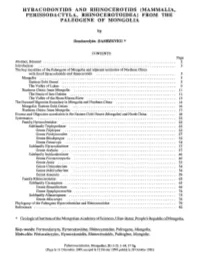
From the Paleogene of Mongolia
HYRACODONTIDS AND RHINOCEROTIDS (MAMMALIA, PERISSODACTYLA, RHINOCEROTOIDEA) FROM THE PALEOGENE OF MONGOLIA by Demberelyin DASHZEVEG· CONTENTS Page Abstract, Resulue ............. , .......... ,................................................ 2 Introduction ......................... , ................................. "., ............. 3 The key localities of the Paleogene of Mongolia and adjacent territories of Northern China with fossil hyracodontids and rhinocerotids .......................... , . 5 Mongolia ........................................................................... 5 Eastern Gobi Desert ........................................ ,...................... 5 The Valley of Lakes ............................................................... 9 Northern China: Inner Mongolia .............. , ........................ , .... , ......... '. 11 The Basin of Irell Dabasu .......... , .......... , .................................. " 11 Tbe Valley of tbe Shara MUfun River ................................................. 13 The EoceneJOligocene Boundary in Mongolia and Northern China ................................. 14 Mongolia: Eastern Gobi Desert . .. .. .. .. .. 16 Northern China: Inner Mongolia ......................................................... 17 Eocene and Oligocene correlation in the Eastern Gobi Desert (Mongolia) and North China .............. 18 Systenlatics .......................... , ........ , ...................................... " 22 Family Hyracodolltidae ............................................................ -

Diaceratherium Lemanense (Rhinocerotidae) from Eschenbach (Eastern Switzerland): Systematics, Palaeoecology, Palaeobiogeography
N. Jb. Geol. Paläont. Abh. 2009, vol. 254/1-2, p. 5–39, Stuttgart, October/November 2009, published online 2009 Diaceratherium lemanense (Rhinocerotidae) from Eschenbach (eastern Switzerland): systematics, palaeoecology, palaeobiogeography Damien Becker, Porrentruy, Toni Bürgin, St. Gallen, Urs Oberli, St. Gallen and Laureline Scherler, Fribourg With 9 figures and 10 tables BECKER, D., BÜRGIN, T., OBERLI, U. & SCHERLER, L. (2009): Diaceratherium lemanense (Rhino- cerotidae) from Eschenbach (eastern Switzerland): systematics, palaeoecology, palaeobiogeography. – N. Jb. Geol. Paläont. Abh., 254: 5–39; Stuttgart. Abstract: This paper describes a juvenile rhinocerotid skull from Eschenbach (eastern Switzerland). Computed tomography revealed the presence of the unerupted adult teeth P4 and M3 and enabled their three dimensional virtual reconstruction. The morphological features of this skull (postglenoid and posttympanic apophyses in contact, deep nasal notch, very slight occipital elevation, molar lingual cingulum absent, strong molar crochet) ascribe it to an evolved form of Diaceratherium lemanense (POMEL 1853) when compared with other European specimens. The diacerathere lineage is restricted to the Western European basins, except for the occurrences of the primitive D. cf. lamilloquense in the late Oligocene deposits of Nong Ya Plong (Thailand, Asia) and Diaceratherium askazansorense in the early Miocene of the Askazansor Formation (south-western Betpakdala, southern Kazakhstan, Asia). The Eschenbach locality represents a new biostratigraphical pinpoint at the Aquitanian (early Miocene), probably at the base of the MN2a Mammal Zone (Granitischer Sandstein Formation, upper part of the Lower Freshwater Molasse, USM, eastern Swiss Molasse Basin). A review of the European diacerathere record is proposed from the First Appearance Data of D. lamilloquense (MP29, La Milloque) to the Last Appearance Data of D. -

Reassessing the Earliest Oligocene Vertebrate Assemblage of Monteviale (Vicenza, Italy)
Journal of Systematic Palaeontology ISSN: 1477-2019 (Print) 1478-0941 (Online) Journal homepage: http://www.tandfonline.com/loi/tjsp20 Reassessing the earliest Oligocene vertebrate assemblage of Monteviale (Vicenza, Italy) Luca Pandolfi, Giorgio Carnevale, Loic Costeur, Letizia Del Favero, Mariagabriella Fornasiero, Elena Ghezzo, Leonardo Maiorino, Paolo Mietto, Paolo Piras, Lorenzo Rook, Gabriele Sansalone & Tassos Kotsakis To cite this article: Luca Pandolfi, Giorgio Carnevale, Loic Costeur, Letizia Del Favero, Mariagabriella Fornasiero, Elena Ghezzo, Leonardo Maiorino, Paolo Mietto, Paolo Piras, Lorenzo Rook, Gabriele Sansalone & Tassos Kotsakis (2017) Reassessing the earliest Oligocene vertebrate assemblage of Monteviale (Vicenza, Italy), Journal of Systematic Palaeontology, 15:2, 83-127, DOI: 10.1080/14772019.2016.1147170 To link to this article: http://dx.doi.org/10.1080/14772019.2016.1147170 Published online: 16 Mar 2016. Submit your article to this journal Article views: 95 View related articles View Crossmark data Full Terms & Conditions of access and use can be found at http://www.tandfonline.com/action/journalInformation?journalCode=tjsp20 Download by: [Universita Studi la Sapienza], [Luca Pandolfi] Date: 10 January 2017, At: 06:14 Journal of Systematic Palaeontology, 2017 Vol. 15, No. 2, 83À127, http://dx.doi.org/10.1080/14772019.2016.1147170 Reassessing the earliest Oligocene vertebrate assemblage of Monteviale (Vicenza, Italy) Luca Pandolfi a*, Giorgio Carnevaleb, Loic Costeurc, Letizia Del Faverod, Mariagabriella Fornasierod,