CACTACEAE“ Einzuordnen Sind, Ist Der Klemmrücken
Total Page:16
File Type:pdf, Size:1020Kb
Load more
Recommended publications
-
Bibliography of Selected Literature Published Since 2010 for Rhipsalis.Com
Bibliography of Selected Literature Published Since 2010 for Rhipsalis.com Compiled by Jorge Quiñónez. Thanks to MHJ Barfuss !"hoeless Mike#$ and %. Hofa&ker for their help. This bibliography was first published on ()(*)+,(* and last updated on +)-)+,(.. The newest entries in this update are printed in bold and are from the later half of +,(* to +)-)+,(.. %kunne TC/ %kah 0%/ Nwabunike 2%/ Nworu C"/ 3kereke 45/ 3kereke NC 6 3keke 7C. +,(8. %nti9 inflammatory and anti&an&er a&tivities of e;tra&t and fra&tions of Rhipsalis neves-armondii Ca&ta&eae$ aerial parts. Cogent Biology +,(8$/ +< (+=>+-. http<))d;.doi.org)(,.10*,)+==(+,+-.2,(8.12=>+-. %lmeida 3JG/ Cota9"@n&hez JH, 6 0aoli %%". +,(=. The systemati& signifi&an&e of floral morphology/ ne&taries/ and ne&tar &on&entration in epiphyti& &a&ti of tribes Hylocereeae and Rhipsalideae Ca&ta&eae$. Perspectives in Plant Ecology, Evolution and Systematics (-< +--A+88. B32< d;.doi.org)(,.10(8)C.ppees.2,(=.08.,,( Bauer D. 6 Korotkova N. +,(8. Eine neue Rhipsalis aus Brasilien A Rhipsalis barthlottii. Kakteen und andere Su ulenten 8> (($< +*(9+87. Bautista9"an Juan %/ Cibri@n9Tovar J, "alomé9%bar&a F7/ "oto9Hern@ndez/ DM 6 Be la Cruz9Be la Cruz E. +,17. Composi&ión GuHmi&a del aroma de tallos y frutos de Rhipsalis baccifera J. Miller$ "tearn! Revista "itotecnia #exicana I, ($< I-9-4. http<))www.redaly&.org)html)8(,)8(,-,-I.,,>) Bo&kemühl J 6 Bauer D. +,(+. Kildformen der Schlumbergera truncata. 402? >,< (.9=,. Bockemühl J. 2018. Rhipsalis hoelleri Barthlott & N. P. Taylor. EPIG 81: 16-18. Braga JM% 6 7reitas M. -

Chromosome Numbers in Some Cacti of Western North America-V Author(S): Donald J
Chromosome Numbers in Some Cacti of Western North America-V Author(s): Donald J. Pinkava, Marc A. Baker, Bruce D. Parfitt, Mark W. Mohlenbrock and Richard D. Worthington Source: Systematic Botany, Vol. 10, No. 4 (Oct. - Dec., 1985), pp. 471-483 Published by: American Society of Plant Taxonomists Stable URL: http://www.jstor.org/stable/2419140 Accessed: 10-11-2015 17:03 UTC Your use of the JSTOR archive indicates your acceptance of the Terms & Conditions of Use, available at http://www.jstor.org/page/ info/about/policies/terms.jsp JSTOR is a not-for-profit service that helps scholars, researchers, and students discover, use, and build upon a wide range of content in a trusted digital archive. We use information technology and tools to increase productivity and facilitate new forms of scholarship. For more information about JSTOR, please contact support@jstor.org. American Society of Plant Taxonomists is collaborating with JSTOR to digitize, preserve and extend access to Systematic Botany. http://www.jstor.org This content downloaded from 156.40.216.1 on Tue, 10 Nov 2015 17:03:23 UTC All use subject to JSTOR Terms and Conditions SystematicBotany (1985), 10(4): pp. 471-483 K Copyright1985 by the American Society of Plant Taxonomists Chromosome Numbers in some Cacti of Western North America- V DONALD J. PINKAVA, MARC A. BAKER, BRUCE D. PARFITT, and MARK W. MOHLENBROCK Department of Botany and Microbiology,Arizona State University, Tempe, Arizona 85287 RICHARD D. WORTHINGTON Department of Biological Sciences, Universityof Texas, El Paso, Texas 79968 ABSTRACT. Documentedmeiotic and mitoticchromosome numbers and behaviorare reported for62 taxarepresenting 11 generaof Cactaceae from the southwestern United States and northern Mexico.Chromosome numbers for 12 speciesand six naturalinterspecific hybrids are firstcounts. -
Shaun's Cacti
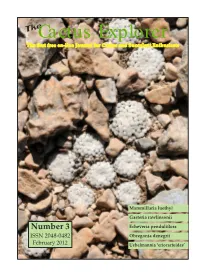
TheCactus Explorer The first free on-line Journal for Cactus and Succulent Enthusiasts Mammillaria luethyi Gasteria rawlinsonii Number 3 Echeveria penduliflora ISSN 2048-0482 Obregonia denegrii February 2012 Uebelmannia ‘eriocactoides’ The Cactus Explorer ISSN 2048-0482 Number 3 February 2012 In thIs EdItIon Regular Features Articles Introduction 3 Gasteria rawlinsonii in the Baviaanskloof 26 News and Events 4 Mammillaria luethyi. In search of a botanical Thank you John (Pilbeam) 8 jewel from Mexico 30 Recent New Descriptions 13 My search for Obregonia denegrii 37 Lophophora alberto-vojtechii 16 Melocactus on two Caribbean Islands 43 In the Glasshouse 18 Why Echeveria penduliflora? 47 Journal Roundup 22 Travel with the cactus expert (2) 50 The Love of Books 24 Uebelmannia pectinifera var. eriocactoides 54 Society Page 64 Expedition to Socotra, 1967 58 Retail Therapy 65 The No.1 source for on-line information about cacti and succulents is http://www.cactus-mall.com New link for Gymnocalycium enthusiasts (French): http://gymnocalycium.free.fr/index.php Cover Picture: Mammillaria luethyi PH914.06, possibly several plants or a small cluster. See the article on Page 30. Photo: Paul Hoxey. Invitation to Contributors Please consider the Cactus Explorer as the place to publish your articles. We welcome contributions for any of the regular features or a longer article with pictures on any aspect of cacti and succulents. The editorial team is happy to help you with preparing your work. Please send your submissions as plain text in a ‘Word’ document together with separate jpeg or tiff images with the maximum resolution available, at least 1200 x 800 pixels. -

Diversidad De Cactus En El Salvador Presentación
DIVERSIDAD DE CACTUS DE EL SALVADOR DIVERSIDAD DE CACTUS DE EL SALVADOR Licenciado José Gabriel Cerén López Licenciada Jenny Elizabeth Menjívar Cruz Herbario Nacional MHES Museo de Historia Natural de El Salvador Doctor Salvador Arias Jardín Botánico, Instituto de Biología, UNAM, México COLEccIÓN DE HISTORIA NATURAL Volumen 3 Dr. Ramón Rivas Secretario de Cultura de la Presidencia Primera edición Secretaría de Cultura de la Presidencia San Salvador, El Salvador, 2015 ISBN 978-99923-908-5-6 © Dirección Nacional de Parimonio Cultural y Natural, 2015 Fotografías: José Gabriel Cerén López y Jenny Menjívar Textos: José Gabriel Cerén López, Jenny Elizabeth Menjívar Cruz y Ángel Salvador Arias Montes Revisión de textos: Eunice Ester Echeverría Diagramación y portada: Santiago Arnulfo Pérez 583.56 C414d Cerén López, José Gabriel, 1977- Diversidad de cactus de El Salvador / José Gabriel Cerén López, sv Jenny Elizabeth Menjívar Cruz, Ángel Salvador Arias Montes --1a ed-- San Salvador, El Salv. : Museo de Historia Natural de El Salvador, 2015. 152 p. : il. ; 23 cm. -- (Colección de historia natural; v.3) ISBN 978-99923-908-5-6 1. Cactus. 2. Plantas suculentas (El Salvador). 3.Flora del desierto. 4. Historia natural. I. Menjívar Cruz, Jenny Elizabeth, 1979-, coaut. II. Arias Montes, Ángel Salvador, 1962-, coaut. III. Título. AGRADECIMIENTOS Expresamos nuestro agradecimiento a la Secretaria de Re- laciones Exteriores de México y a la embajada de México en El Salvador por permitirnos realizar el convenio de intercambio con el Jardín Botánico del Instituto de Biología de la Univer- sidad Nacional Autónoma de México (UNAM), para realizar esta investigación. Al Dr. David Gernandt, Jefe del Herbario MEXU, por facilitar la revisión y consulta de muestras salva- doreñas depositadas en este herbario. -

La Familia Cactaceae En Tabasco, México
Artículo de investigación La familia Cactaceae en Tabasco, México The Cactaceae family in Tabasco, Mexico Manuel J. Campos Díaz1 , Carlos Manuel Burelo Ramos1,3 y Salvador Arias2 Resumen: Antecedentes y Objetivos: En el sureste de México los estudios florísticos, y en particular los que tratan sobre las Hylocereeae, son escasos. Se pre- senta un estudio florístico taxonómico de las Cactaceae en Tabasco para conocer la riqueza y distribución de sus especies, se generó un listado de especies nativas y cultivadas y se presenta una clave de identificación de las especies para Tabasco. Métodos: Se consultaron los herbarios CSAT, MEXU, UJAT y XAL, así como literatura taxonómica pertinente para tener una aproximación de la diver- sidad de Cactaceae en Tabasco. Se realizó trabajo de campo en todos los tipos de vegetación del estado para obtener las muestras necesarias; éstas se depositaron en el herbario UJAT. Con el material colectado y los ejemplares revisados en los herbarios, se realizaron claves de identificación para los géneros y especies registrados. Resultados clave: En Tabasco se registran siete géneros y 14 especies de cactáceas, seis de las cuales representan nuevos registros para el estado. El género Selenicereus es el más diverso, mientras que el bosque tropical perennifolio y el municipio Tacotalpa presentaron la mayor riqueza de espe- cies. Conclusiones: Las cactáceas en Tabasco se encuentran pobremente representadas en comparación con los estados del centro-norte de México; sin embargo, con los estados de Campeche y Yucatán se observa una notoria similitud en cuanto a la riqueza de especies. Palabras clave: endemismo, epífitas, florística, Hylocereeae, nuevos registros. -

Yaxha, Petén, Guatemala TREE CACTI
TREE CACTI Selenicereus testudo (Karw. ex Zucc.) Buxb. Cactaceae Yaxha, Petén, Guatemala TREE CACTI September 2018 AUTOR Nicholas Hellmuth EDITION IN SPANISH Vivian Díaz Marcella Sarti Elena Siekavizza EDITION ENGLISH VERSION María José Rabanales PHOTOGRAPHY Nicholas Hellmuth David Arrivillaga Erick Flores ART AND DESIGN DIRECTOR Andrea Sánchez Díaz DIAGRAMMING OF SPANISH VERSION Andrea Sánchez Díaz DIAGRAMMING OF ENGLISH VERSION Carlos Marroquín LOCAL KNOWLEDGE OF PLANTS AND ANIMALS Moisés Daniel Pérez Díaz This report was made with the cooperation of the administrators of the Yaxha, Nakum and Naranjo National Park to share knowledge about the neotropical flora and fauna that exists in this area of Guatemala. This material can be used by students, teachers, and researchers to communicate the potential of Yaxha, Nakum and PHOTOGRAPH FROM COVER: Naranjo Park for research and tourism. It also includes a learning Selenicereus testudo. (Karw. ex Zucc.) Buxb. Turtle Pitaya. Photo by: Nicholas Hellmuth, FLAAR Mesoamerica, Yaxha, tool for biodiversity conservation for any person and organization. Nakum and Naranjo Park, Petén, Guatemala. Camera: Canon EOS-1Ds Mark II. Lens: EF100mm Macro USM. Settings: 1/10 sec; f/18; ISO 200. PHOTOGRAPH FROM CREDITS PAGE: Selenicereus testudo. (Karw. ex Zucc.) Buxb. Turtle cactus next to Tillandsia. Photo by: Nicholas Hellmuth, FLAAR Mesoamerica, Yaxha, Nakum and Naranjo Park, Petén. Camera: Nikon D5. Lens: Nikon AF-S NIKKOR 800mm FL ED VR. Settings: 1/250 sec; f/13; ISO 800. CONTENT Presentation letter 04 Yaxha, Nakum and Naranjo National Park 05 Preface 06 Cacti in humid areas 08 Photo sequences and night flowers 10 The moment it starts to open 11 Botanical description 17 Photography tips 18 Acknowledgments 19 How to get to Yaxha? 21 Cited bibliography 22 How to cite this report? 24 SERIE PHOTOGRAPHY FROM CONTENT PAGE: Selenicereus testudo. -

Connoisseurs' Cacti
ThCe actus Explorer The first free on-line Journal for Cactus and Succulent Enthusiasts White Sands Park Matucana comacephala Number 4 Rebutia pulvinosa ISSN 2048-0482 Echeveria nebularum May 2012 Maihueniopsis glochidiata The Cactus Explorer ISSN 2048-0482 Number 4 May 2012 In thIs EdItIon Regular Features Articles Introduction 3 Some notes on Wigginsia corynodes 26 News and Events 4 Gymnocalycium bayrianum 35 Recent New Descriptions 8 A Visit to Cajas Bajo, Bolivia 37 In the Glasshouse 16 The Largest Echinocereus in the World(?) 40 Journal Roundup 20 Does Mammillaria yucatanensis still exist? 46 The Love of Books 22 Matucana myriacantha and M. comacephala 50 Society Page s 70 A Visit to Isla Esteban 58 Plants and Seeds for Sale 74 Travel with the Cactus Expert (3) 62 Books for Sale 76 Echeveria nebularum at a heady height 66 The two photos in the Echeveria laui article credited to J. Peck (The Cactus Explorer 2 p. 37) should have been credited to M. Lesan. The No.1 source for on-line information about cacti and succulents is http://www.cactus-mall.com Cover Picture Echinocereus triglochidiatus at White Sands National Monument. Photo by Daiv Freeman. See his article on page 40 . Invitation to Contributors Please consider the Cactus Explorer as the place to publish your articles. We welcome contributions for any of the regular features or a longer article with pictures on any aspect of cacti and succulents. The editorial team is happy to help you with preparing your work. Please send your submissions as plain text in a ‘Word’ document together with jpeg or tiff images with the maximum resolution available. -
A Checklist of Vascular Epiphytes of El Cometa Lagoon, Pantanos De Centla Biosphere Reserve, Mexico
OPEN ACCESS The Journal of Threatened Taxa is dedicated to building evidence for conservaton globally by publishing peer-reviewed artcles online every month at a reasonably rapid rate at www.threatenedtaxa.org. All artcles published in JoTT are registered under Creatve Commons Atributon 4.0 Internatonal License unless otherwise mentoned. JoTT allows unrestricted use of artcles in any medium, reproducton, and distributon by providing adequate credit to the authors and the source of publicaton. Journal of Threatened Taxa Building evidence for conservaton globally www.threatenedtaxa.org ISSN 0974-7907 (Online) | ISSN 0974-7893 (Print) Short Communication A checklist of vascular epiphytes of El Cometa Lagoon, Pantanos de Centla Biosphere Reserve, Mexico Derio Antonio Jiménez-López, Candelario Peralta-Carreta, Jonathan V. Solórzano, Gerardo Luis Cervantes-Jiménez & Marco Antonio Domínguez-Vázquez 26 October 2018 | Vol. 10 | No. 11 | Pages: 12589-12597 10.11609/jot.3794.10.11.12589-12597 For Focus, Scope, Aims, Policies and Guidelines visit htp://threatenedtaxa.org/index.php/JoTT/about/editorialPolicies#custom-0 For Artcle Submission Guidelines visit htp://threatenedtaxa.org/index.php/JoTT/about/submissions#onlineSubmissions For Policies against Scientfc Misconduct visit htp://threatenedtaxa.org/index.php/JoTT/about/editorialPolicies#custom-2 For reprints contact <info@threatenedtaxa.org> Publisher & Host Partners Member Threatened Taxa Journal of Threatened Taxa | www.threatenedtaxa.org | 26 October 2018 | 10(11): 12589–12597 A checklist of vascular epiphytes of El Cometa Lagoon, Pantanos de Centla Biosphere Reserve, Mexico 1 2 3 ISSN 0974-7907 (Online) Derio Antonio Jiménez-López , Candelario Peralta-Carreta , Jonathan V. Solórzano , Communication Short ISSN 0974-7893 (Print) Gerardo Luis Cervantes-Jiménez 4 & Marco Antonio Domínguez-Vázquez 5 1,5 Insttuto de Ciencias Biológicas, Universidad de Ciencias y Artes de Chiapas, Libramiento Norte Poniente 1150, OPEN ACCESS Col. -
Systematics of Harrisia (Cactaceae) Alan R
University of South Florida Scholar Commons Graduate Theses and Dissertations Graduate School January 2012 Systematics of Harrisia (Cactaceae) Alan R. Franck University of South Florida, afranck@mail.usf.edu Follow this and additional works at: http://scholarcommons.usf.edu/etd Part of the American Studies Commons, Molecular Biology Commons, Plant Sciences Commons, and the Systems Biology Commons Scholar Commons Citation Franck, Alan R., "Systematics of Harrisia (Cactaceae)" (2012). Graduate Theses and Dissertations. http://scholarcommons.usf.edu/etd/4044 This Dissertation is brought to you for free and open access by the Graduate School at Scholar Commons. It has been accepted for inclusion in Graduate Theses and Dissertations by an authorized administrator of Scholar Commons. For more information, please contact scholarcommons@usf.edu. Systematics of Harrisia (Cactaceae) by Alan R. Franck A dissertation submitted in partial fulfillment of the requirements for the degree of Doctor of Philosophy Department of Cell Biology, Microbiology, and Molecular Biology College of Arts and Sciences University of South Florida Major Professor: James R. Garey, Ph.D. Bruce J. Cochrane, Ph.D. Diane Te Strake, M.A. Richard P. Wunderlin, Ph.D. Date of Approval: 8 June 2012 Keywords: biogeography, monograph, nomenclature, phylogeny, taxonomy Copyright © 2012, Alan R. Franck DEDICATION This work is dedicated to several supportive persons: Peggy L. Brandewie; Maurice Franck; Douglas D. Springer; Annette Franck; Thomas Brandewie; Andrew L. Franck and family; Melanie L. Chamberlain; Andrew Clark; Jeff Hobensack; Christopher Monday; Franck, Brown, Springer, Combs, Brandewie, and Chamberlain families; Kris Sutter and Shawn Moorman; Matt Weigel; J. J. Oakleaf; Gene Russell Rann and Dave Catalfino; and friends. -
Conference Programme and Abstracts
Conference Programme and Abstracts enue etc. x Caryophyllales 2015 September 14-19, 2015 Conference Programme Caryophyllales 2015 – Conference Programme and Abstracts Berlin September 14-19, 2015 © The Caryophyllales Network 2015 Botanic Garden and Botanical Museum Berlin-Dahlem Freie Universität Berlin Königin-Luise-Straße 6-8 WLAN Name: conference 14195 Berlin, Germany Key: 7vp4erq6 Telephon Museum: +49 30 838 50 100 2 Programme overview Pre-conference Core conference Workshops Time slot * Sept 13, 2015 (Sun) Sept 14, 2015 (Mon) Sept 15, 2015 (Tue) Sept 16, 2015 (Wed) Sept 17, 2015 (Thu) Sept 18, 2015 (Fri) Session 3: Session 7: Floral EDIT Platform Herbarium management: 9.00-10.30 Opening session Caryophyllaceae (1) morphology (Introduction) JACQ Coffee break & Coffee break & Coffee break & 10.30-11.00 Coffee break Coffee break Poster session Poster session Poster session Herbarium Sileneae Session 1: Session 4: Session 8: EDIT Platform 11.00-12.30 management biodiversity Adaptive evolution Caryophyllaceae (2) A wider picture (hands-on) JACQ informatics 12.30-14.00 Lunch break Lunch break Lunch break Sileneae Session 2: Session 5: Session 9: EDIT Platform 14.00-15.30 Xper2 biodiversity Amaranthaceae s.l. Portulacinae Different lineages (hands-on) informatics Coffee break & Coffee break & 15.30-16.00 Coffee break Coffee break Coffee break Poster session Poster session Session 6a/b: Tour: Garden & EDIT Platform 16.00-17.30 Caryophyllaceae (3) Closing session Xper2 Dahlem Seed Bank (hands-on) / Aizoaceae Tour: Herbarium, 17:30-18:45 Museum, Library 18:30 19:00 Ice-breaker Conference dinner * exact timing see programme Caryophyllales 2015 September 14-19, 2015 Conference Programme Sunday, Sept. -

Kiefer 113-136
Nyffeler, R; Eggli, U (2010). A farewell to dated ideas and concepts: molecular phylogenetics and a revised suprageneric classification of the family Cactaceae. Schumannia, 6:109-149. Postprint available at: http://www.zora.uzh.ch University of Zurich Posted at the Zurich Open Repository and Archive, University of Zurich. Zurich Open Repository and Archive http://www.zora.uzh.ch Originally published at: Schumannia 2010, 6:109-149. Winterthurerstr. 190 CH-8057 Zurich http://www.zora.uzh.ch Year: 2010 A farewell to dated ideas and concepts: molecular phylogenetics and a revised suprageneric classification of the family Cactaceae Nyffeler, R; Eggli, U Nyffeler, R; Eggli, U (2010). A farewell to dated ideas and concepts: molecular phylogenetics and a revised suprageneric classification of the family Cactaceae. Schumannia, 6:109-149. Postprint available at: http://www.zora.uzh.ch Posted at the Zurich Open Repository and Archive, University of Zurich. http://www.zora.uzh.ch Originally published at: Schumannia 2010, 6:109-149. A farewell to dated ideas and concepts – molecular phylogenetics and a revised suprageneric classification of the family Cactaceae Reto Nyffeler & Urs Eggli Abstract: The advent of molecular analytical methods starting in the early 1990s allows now the use of a completely new and independent character set for the evaluation of traditional morphology-based classification systems. Today, we have at hand some two dozens of molecular phylogenetic studies on cacti that have been published during the past decade. These investigations offer various hypotheses about interrelationships among different groups of cacti and form the basis for a revised suprageneric classification system of the family Cactaceae as proposed here. -

Tissue Culture of Ornamental Cacti Review
540 Scientia Agricola http://dx.doi.org/10.1590/0103-9016-2015-0012 Review Tissue culture of ornamental cacti Eugenio Pérez-Molphe-Balch1, María del Socorro Santos-Díaz2, Rafael Ramírez-Malagón3, Neftalí Ochoa-Alejo4* 1Autonomous University of Aguascalientes – Center of Basic ABSTRACT: Cacti species are plants that are well adapted to growing in arid and semiarid re- Sciences – Dept. of Chemistry, Av. Universidad, 940, C.P. gions where the main problem is water availability. Cacti have developed a series of adapta- 20131 − Aguascalientes, Ags − México. tions to cope with water scarcity, such as reduced leaf surface via morphological modifications 2Autonomous University of San Luis Potosí/Faculty of including spines, cereous cuticles, extended root systems and stem tissue modifications to Chemical Sciences, Av. Manuel Nava, 6, C.P. 78210 − San increase water storage, and crassulacean acid metabolism to reduce transpiration and water Luis Potosí, S.L.P − México. loss. Furthermore, seeds of these plants very often exhibit dormancy, a phenomenon that helps 3University of Guanajuato – Division of Life Sciences, Irapuato- to prevent germination when the availability of water is reduced. In general, cactus species Salamanca Campus, Ex Hacienda El Copal, km 9, C.P. 36500 exhibit a low growth rate that makes their rapid propagation difficult. Cacti are much appreciated − Irapuato, Gto − México. as ornamental plants due to their great variety and diversity of forms and their beautiful short-life 4Cinvestav-Irapuato Unit – Plant Genetic Engineering flowers; however, due to difficulties in propagating them rapidly to meet market demand, they Dept., and Biotechnology and Biochemistry Dept., km 9.6 are very often over-collected in their natural habitats, which leads to numerous species being libramiento norte carretera Irapuato-León, C.P.