Institut for Litteratur, Kultur Og Medier
Total Page:16
File Type:pdf, Size:1020Kb
Load more
Recommended publications
-

Abbysinia/Ethiopia: State Formation and National State-Building Project
Abbysinia/Ethiopia: State Formation and National State-Building Project Comparative Approach Daniel Gemtessa Oct, 2014 Department of Political Sience University of Oslo TABLE OF CONTENTS No.s Pages Part I 1 1 Chapter I Introduction 1 1.1 Problem Presentation – Ethiopia 1 1.2 Concept Clarification 3 1.2.1 Ethiopia 3 1.2.2 Abyssinia Functional Differentiation 4 1.2.3 Religion 6 1.2.4 Language 6 1.2.5 Economic Foundation 6 1.2.6 Law and Culture 7 1.2.7 End of Zemanamesafint (Era of the Princes) 8 1.2.8 Oromos, Functional Differentiation 9 1.2.9 Religion and Culture 10 1.2.10 Law 10 1.2.11 Economy 10 1.3 Method and Evaluation of Data Materials 11 1.4 Evaluation of Data Materials 13 1.4.1 Observation 13 1.4.2 Copyright Provision 13 1.4.3 Interpretation 14 1.4.4 Usability, Usefulness, Fitness 14 1.4.5 The Layout of This Work 14 Chapter II Theoretical Background 15 2.1 Introduction 15 2.2 A Short Presentation of Rokkan’s Model as a Point of Departure for 17 the Overall Problem Presentation 2.3 Theoretical Analysis in Four Chapters 18 2.3.1 Territorial Control 18 2.3.2 Cultural Standardization 18 2.3.3 Political Participation 19 2.3.4 Redistribution 19 2.3.5 Summary of the Theory 19 Part II State Formation 20 Chapter III 3 Phase I: Penetration or State Formation Process 20 3.0.1 First: A Short Definition of Nation 20 3.0.2 Abyssinian/Ethiopian State Formation Process/Territorial Control? 21 3.1 Menelik (1889 – 1913) Emperor 21 3.1.1 Introduction 21 3.1.2 The Colonization of Oromo People 21 3.2 Empire State Under Haile Selassie, 1916 – 1974 37 -
The Elite and the Quest for Peace, Democracy and Development in Ethiopian: Lessons to Be Learnt
Western Michigan University ScholarWorks at WMU International Conference on African Center for African Development Policy Development Archives Research 8-2001 The Elite and the Quest for Peace, Democracy and Development in Ethiopian: Lessons to be learnt Merera Gudina Addis Ababa University and The Institute of Social Studies, The Hague, Netherlands Follow this and additional works at: https://scholarworks.wmich.edu/africancenter_icad_archive Part of the African Studies Commons, and the Economics Commons WMU ScholarWorks Citation Gudina, Merera, "The Elite and the Quest for Peace, Democracy and Development in Ethiopian: Lessons to be learnt" (2001). International Conference on African Development Archives. 6. https://scholarworks.wmich.edu/africancenter_icad_archive/6 This Paper is brought to you for free and open access by the Center for African Development Policy Research at ScholarWorks at WMU. It has been accepted for inclusion in International Conference on African Development Archives by an authorized administrator of ScholarWorks at WMU. For more information, please contact wmu- scholarworks@wmich.edu. The Elite and the Quest for Peace, Democracy and Development in Ethiopian: Lessons to be learnt Merera Gudina, AAU & ISS Introduction Donald N. Levine (1974), author of Greater Ethiopia: The Evolution of a Multi-ethnic Society , who has popularized Carlo Conti-Rossin's description of Ethiopia as 'un museo di popoli' - 'a museum of peoples' (pp. 19-20) has credited the evolution of multi-ethnic Ethiopia as an 'Amhara thesis', 'Oromo anti-thesis' and the 'Ethiopian synthesis'. Whatever the merits of his historical analysis and the anthropological fascination thereof for the making of Ethiopia, at a point in time his work did go to the press, the country moved to a crisis of major proportion whose resultant effect was a revolutionary reconstitution of both state and society that relegated the country's ancien regime to the museum of history. -

Tha Battle of Adwa.Book
THE BATTLE OF ADWA THE BATTLE OF ADWA REFLECTIONS ON ETHIOPIA’S HISTORIC VICTORY AGAINST EUROPEAN COLONIALISM Edited by Paulos Milkias & Getachew Metaferia Contributors Richard Pankhurst Zewde Gabra-Selassie Negussay Ayele Harold Marcus Theodore M. Vestal Paulos Milkias Getachew Metaferia Maimire Mennasemay Mesfin Araya Algora Publishing New York © 2005 by Algora Publishing All Rights Reserved www.algora.com No portion of this book (beyond what is permitted by Sections 107 or 108 of the United States Copyright Act of 1976) may be reproduced by any process, stored in a retrieval system, or transmitted in any form, or by any means, without the express written permission of the publisher. ISBN: 0-87586-413-9 (softcover) ISBN: 0-87586-414-7 (hardcover) ISBN: 0-87586-415-5 (ebook) Library of Congress Cataloging-in-Publication Data — The Battle of Adwa: reflections on Ethiopia’s historic victory against European colonialism / edited by Paulos Milkias, Getachew Metaferia. p. cm. Includes bibliographical references and index. ISBN 0-87586-413-9 (trade paper: alk. paper) — ISBN 0-87586-414-7 (hard cover: alk. paper) — ISBN 0-87586-415-5 (ebook) 1. Adwa, Battle of, Adwa, Ethiopia, 1896. I. Milkias, Paulos. II. Metaferia, Getachew. DT387.3.B39 2005 963'.043—dc22 2005013845 Front Cover: Printed in the United States This book is dedicated to all peoples of the world who have stood up to colonial subjugation and courageously sacrificed their lives for the love of freedom and liberty ETHIOPIAN TITLES Afe-Nigus — (“Mouthpiece of the Emperor”) equivalent to the U.S. “Chief Justice.” Asiraleqa — (“Commander of 10”) Corporal, as a military title. -

Ethiopia) by Tsegay Berhe Gebrelibanos, Lecturer, Addis Ababa University; Phd Stipendait (NTNU), Norway
An Ethno-Historical Survey of the Irob Agri- Pastoralists of North Eastern Tigray (Ethiopia) by Tsegay Berhe GebreLibanos, Lecturer, Addis Ababa University; PhD stipendait (NTNU), Norway Abstract Eastern Tigray had experienced a long series of population movements and displacements over centuries. This explains the current peopling of diverse Saho-Speaking (Irob, Hazo, Dabrimeta, etc.),Afar and Tigrigna speaking communities in 'Agama' area. The Irob community is particularly at the crossroads of different ethno - religious milieu of the Red Sea hinterland though confined to the northeastern escapment. Irob land is very small area with a small population of about 20,000 yet stills a striking micro-model of intensive ethno-historical interactions, which characterize the area of 'Agama' as a whole. The Irob have become a bi- lingual community with Saho and Tigrigna being spoken by most of them. Almost all Irobs feel a special sense of community with the Tigrayans and strongly deny ancestral affinities with their Saho neighbors sharing the same language. On the otherhand, though Irob nomenclature has been largely Tigreanized, interestingly still their usually long genealogies bear names of mixed Saho, Tigrayan - Christian and Muslim are abound. The Irob were assorted into three clan organizations: Adgada Are', Buknayto Are', and Hassaballa Are' from north to south. In terms of religion, most Adyada - Hassaballa adhered to Orthodox Christianity while the Buknayto remains distinctly Catholics. Irob socio-political organization has yet to be studied. However, it appears to have been based on an egalitarian system where power larglely rested in the public assembly which in turn delegated it to the council of elders. -

Hoa Alexandra M Dias V2.Pdf
Title State and Societal Challenges in the Horn of Africa: Conflict and processes of state formation, reconfiguration and disintegration Editor Alexandra Magnólia Dias Revision Wendy Graça (wendyg@sapo.pt) Cover Image Ana Elisa Cascão Publisher Center of African Studies (CEA) ISCTE-IUL, University Institute of Lisbon Digital Edition ISBN: 978-972-8335-23-6 Uri: http://hdl.handle.net/10071/5061 Lisbon, 2013 CONTENTS INTRODUCTION: UNDERSTANDING CONFLICT AND PROCESSES OF STATE FORMATION, RECONFIGURATION AND DISINTEGRATION IN THE HORN OF AFRICA ALEXANDRA MAGNÓLIA DIAS 3 FROM BELEAGUERED FORTRESSES TO BELLIGERENT CITIES MANUEL JOÃO RAMOS 14 THE SECURITY ISSUES BEHIND THE ETHIOPIAN INTERVENTION IN SOMALIA (2006-2009) ELSA GONZÁLEZ AIMÉ 32 SECURITY STAKES AND CHALLENGES IN THE HORN OF AFRICA PATRICK FERRAS 48 AFRICAN PEACE AND SECURITY ARCHITECTURE (APSA) SUBSIDIARITY AND THE HORN OF AFRICA: THE INTERGOVERNMENTAL AUTHORITY ON DEVELOPMENT (IGAD) RICARDO REAL P. DE SOUSA 59 SOMALIA AS A MARKET FOR PRIVATE MILITARY AND SECURITY COMPANIES: DEFINITIONS, AGENTS AND SERVICES PEDRO BARGE CUNHA 78 INTERNATIONAL INTERVENTION AND ENGAGEMENT IN SOMALIA (2006-2013): YET ANOTHER EXTERNAL STATE RECONSTRUCTION PROJECT? ALEXANDRA MAGNÓLIA DIAS 90 THE LEGACY OF POWER SHARING IN KENYA: LITERATURE CHALLENGES AND RESEARCH AGENDA’S INVISIBILITIES ALEXANDRE DE SOUSA CARVALHO 108 STILL CAUGHT IN THE MIDDLE: NUBA POLITICAL STRUGGLE AND FAILURE OF COMPREHENSIVE PEACE AGREEMENT IN SUDAN ALEKSI YLÖNEN 126 RESOURCE-BASED CONFLICT IN SOUTH SUDAN AND GAMBELLA (ETHIOPIA): WHEN WATER, LAND AND OIL MIX WITH POLITICS ANA ELISA CASCÃO 143 AUTHORS' BIO & ABSTRACTS 166 State and Societal Challenges in the Horn of Africa: Conflict and processes of state formation, reconfiguration and disintegration. -
An Annotated Late Eighteenth Century Map of Ethiopia
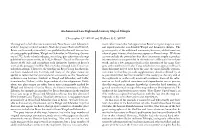
An Annotated Late Eighteenth Century Map of Ethiopia Christopher CLAPHAM and Wolbert G.C. SMIDT The map with which this note is concerned, ‘Neue Karte von Habessinien insert information that had appeared on Bruce’s original map, but were und der Angraenzenden Laendern, Nach der grossen Karte des Ritters I. not copied onto the less detailed Weigel and Schneider edition. The Bruce von Kinnaird, entworfen’,1 was published by the well-known firm great majority of the additional comments, however, add information, of cartographic publishers, Weigel and Schneider, in Nürnberg, Germa- often of great interest, that does not appear on Bruce’s map. While we ny, in 1792. As the subtitle indicates, it is in large part taken from the map cannot exclude the possibility that these comments simply reproduce published two years earlier, in 1790, in Bruce’s Travels to Discover the information that was provided in the main text of Bruce’s five volume Source of the Nile, and reproduces such distinctive features of Bruce’s work, and in a few instances (such as the insertion of the name Gor- work as the passage of the Blue Nile or Abbay through Lake T’ana in an gora at the north end of Lake T’ana, which does not appear on Bruce’s unbroken stream. However, the wording on Bruce’s map has through- map) this must indeed have been the case, the most plausible explana- out been translated into German, and many of the place names are tion must be that they provide supplementary details collected by an spelled to reflect German pronunciation or custom, so that ‘Gooderoo’ as yet unidentified German traveller in the country at the very end of in Bruce’s map becomes ‘Guderu’ in Weigel and Schneider, and ‘Galla’ the eighteenth or in the early nineteenth centuries. -

Local History of Ethiopia : Wel
Local History of Ethiopia Wel Wel - Wemetu © Bernhard Lindahl (2005) KCG86 Wel Wel, see Welwel JDK51 Welabu 09°34'/42°38' 1946 m, north-west of Jijiga 09/42 [Gz] JDK.. Welabu sub-district (centre in 1964 = Aneno) 09/42 [Ad Pa] cf Mida Welabo HE... Welaha 12/39? [x] Emperor Susneyos in one of his later expeditions against Lasta /in 1632?/ proceeded from Dänqäz to Welaha. There his army was attacked by a peasant leader Bihono. The forces of Ras Se'elä Krestos and a nobleman Gäbrä Krestos were put to flight, and escaped only by abandoning their tents, carpets and other articles. [7th Int. Conf. of Ethiopian Studies 1984 p 217] JDJ91 Welale (mountain) 09°52'/41°43' 819 m 09/41 [Gz] Welamo, Walamo, a subdivision of the main ethnic group Ometo (West Sidama); Welamo (Wellamo) as a name is in later time considered to be better replaced by the name Wolayta (Wolayyta), see Welayta. HCK52 Welamo (Walamo, Uollamo, Uolamo, Ualeita) 06/37 [+ Ad WO Gz] (mountain) 06°50'/37°37' 2012 m Coordinates would give map code HCK51 Welamo (area) Most of Welamo was conquered by King Yishaq (1414-1429). The area resisted several attacks of the Shewan forces of Emperor Menilek but was finally conquered in 1894. Four or five armies entered from several directions. The largest came from the north and was commanded by the Emperor himself. HCK52 Welamo awraja (Wolamo, Wollamo, Walamo), see also Welayita awraja The awraja governor before 1974, Dejazmach Wolde Semaiat, received money from the World Bank in connection with the Welamo Agricultural Development Unit, WADU, in order to improve the local infrastructure, including the road network. -

Oromo Peoplehood: Historical and Cultural Overview
University of Tennessee, Knoxville TRACE: Tennessee Research and Creative Exchange Sociology Publications and Other Works Sociology 3-2-2010 Oromo Peoplehood: Historical and Cultural Overview Asafa Jalata University of Tennessee - Knoxville, ajalata@utk.edu Follow this and additional works at: https://trace.tennessee.edu/utk_socopubs Part of the African Studies Commons, Other International and Area Studies Commons, Race, Ethnicity and Post-Colonial Studies Commons, and the Sociology Commons Recommended Citation Jalata, Asafa, "Oromo Peoplehood: Historical and Cultural Overview" (2010). Sociology Publications and Other Works. https://trace.tennessee.edu/utk_socopubs/6 This Article is brought to you for free and open access by the Sociology at TRACE: Tennessee Research and Creative Exchange. It has been accepted for inclusion in Sociology Publications and Other Works by an authorized administrator of TRACE: Tennessee Research and Creative Exchange. For more information, please contact trace@utk.edu. OROMO PEOPLEHOOD: HISTORICAL AND CULTURAL OVERVIEW BY: ASAFA JALATA In the formation and development of individual or collective identity, the social condition is an objective agent, arising from economic, political, social and cultural aspects which are characteristic of the growth and history of the society in question. If one argues that the economic aspect is fundamental, one can assert that identity is in a certain sense the expression of an economic reality. This reality, whatever the geographical context and the path of development of the society, is defined by the level of productive forces (the relationship between man and nature) and by the means of production (the relations between men [and women] and between classes) within this society. -

Debre Tabor - Delo Wereda © Bernhard Lindahl (2005)
Local History of Ethiopia Debre Tabor - Delo wereda © Bernhard Lindahl (2005) Debre Tabor, Mount Tabor of the Bible, (figuratively:) the Transfiguration HEK05 Debre Tabor (Debra T., old name Samara) 11/38 [Gz Pa WO Gu] MS: 11°51'/38°05' = HEK06, 2945 m at the gibbi Gz: 11°51'/38°01' = HEK05, 2706 m Distance 666 km from Addis Abeba. Centre in 1964 of Debre Tabor awraja and Farta wereda and Debre Tabor sub-district. Within a radius of 10 km there are at km 7E Hiruy (Waher, Uaher) (village) 2628 m 8E Amija (Amigia) 10SE Meken Kenia (village) 10SE Semana Giyorgis (S. Ghiorghis) (village) 10SE Amejera Abbo (Ameggera Abbo) (village) 2S Fahart (area) 7SW Grariya Giyorgis (Graria Georgis) (village) 7SW Amba Maryam (A. Mariam) (with church) 6NW Aringo (village) 2515/2574 m 5N Limado (hill) 5?NE Gafat (historical place, cf under its own name) 8NE Guntur (village) ?NE Samara (former ketema) 2706/2782 m ?? Anchim (Anchem) (battle site) ?? Tala Levasi 2558 m Debre Tabor is situated in an amphitheatre of hills. It bears the name of the nearby mountain, which in early medieval times was called Debre Tabor for its resemblance to Mount Tabor in Palestine. On top of the mountain is the Yesus Church, famous for its wood-carvings. The wall paintings are modern. [Jäger 1965 p 75] 1500s The name is known for the first time from the reign of Lebne Dengel, before 1540. 1700s In the last quarter of the 1700s, a man by the name of Ali Gwangul emerged as a powerful figure. He initiated what came to be known as the Yejju dynasty. -

Local History of Ethiopia Xiquala - Yejube © Bernhard Lindahl (2005)
Local History of Ethiopia Xiquala - Yejube © Bernhard Lindahl (2005) X.. (in Somali-derived names), see H.. X.. (in old Portuguese spellings), see Sh.. HDE44 Xiquala (ancient spelling), see Zikwala Ya.., see also Ye.. ya'a (O) assembly of an Abba Gada GD... Yaa (Ya'a) sub-district 09/34 [Ad] (centre in 1964 = Kober Kober) HFF60 Yaawo (Ya'awo) 14°11'/39°25' 2784 m 14/39 [Gz] (with church Medhane Alem), south-west of Adigrat HDL62 Ya Ya, see Yaya JDD80 Yaba (area, with well) 08/42 [WO] yabal: yabaal (Som) germinate, sprout, blossom, bud HBS86 Yabal (Iabal) (mountain) 05°17'/38°06' 1831 m 05/38 [WO Gz] yabala (O) boat HBS46 Yabalo, see Yabelo JCP59 Yabalo (Iabalo, Giabolo, Jabalo)07°44'/41°34' 1126 m 07/41 [+ Gz WO] Yabarre, ethnic group of agriculturalists east of Jijiga yabba (O) slope, steep ground JEB60 Yabbi (Iabbi) (area) 11/40 [+ WO] yabbu (O) 1. thick; 2. facial expression, frown JDH01 Yabdo (Iabdo) 09°08'/40°49' 1665 m 09/40 [+ WO Gz] see under Asbe Teferi HBS90 Yabe (Iabe) 05°25'/37°32', near map code HCD00 05/37 [+ WO Gz] HBE88 Yabello (wildlife sanctuary) 03/37 [Ca WO] HBS46 Yabelo (Yavello, Iavello,Yaballo, Yabello, Yabele) 04/38 [Gz Br WO Gu] Yabelo (Yavelo, Yeabelo, Yabalo), Gz: 04°53'/38°05' 1857 m (Swe: Javello) MS: 04°55'/38°05' = HBS45, 1820 m Local name Obda at least for the mountain. With sub-post office under Shashemene and old fort and Norwegian mission station to the north-east. Centre at least in 1956-1980 of Arero awraja and in 1964 of Yabelo awraja. -

Ethiopia in the Modern World Haile Seiassie from Triumph to Tragedy
8 ETHIOPIA IN THE MODERN WORLD HAILE SEIASSIE FROM TRIUMPH TO TRAGEDY Liberation When Mussolini declared war on Britain and France on lO June 1940, Britain moved quickly to punish him where he was most vulnerable his African Empire. For a brief period, it was Britain that was punished, but less than a year later Africa Orientale Italiana was under British occupation, Ethiopia had been liberated, and Haile Selassie was back on his throne. It was not superiority in manpower which enabled British Com monwealth forces to prevail in 1941. The Italians had far more manpower in East Africa than Britain: 84,000 men, 7,000 officers, and a locally recruited colonial army of 200,000. 1 British Commonwealth forces were scraped together from many sources: Sudan, India, Kenya, South Africa2, Northern Rhodesia, Australia, as well as British regiments that had come directly from fighting in Egypt and a few men from other Middle Eastern locations. Advancing from three directions they overcame Italian regulars and native levies. Not all of the latter remained loyal to Italy. The support - and welcome - British Commonwealth troops received from Ethiopian Patriot forces was essential to their success. But success was not preordained and could never have been taken for granted. There were frustra tions and complications. The m~or portion of Africa Orientale Italiana was actually overrun in just four months. From life as an obscure exile in Bath, Haile Selassie suddenly returned to the center of a major historical drama. He arrived in Khartoum on 24 June 1940, having been flown via Malta, Cairo and Wadi-HaIfa on orders of Winston Churchill, who overruled the objec tions of the British governor-general and colonial service officers in Sudan who did not want to have an Emperor on their hands. -

The Journal of Oromo Studies the Journal of Oromo Studies
THE JOURNAL OF OROMO STUDIES THE JOURNAL OF OROMO STUDIES EDITOR Bichaka Fayissa, Middle Tennessee State University, USA CONTRIBUTING EDITORS Lemmu Baissa, SUNY Institute of Technology at Utica'Rome, USA Asfaw Beyene, San Diego State Unive~sity,USA Belletech Deressa, Global Mission, USA Demissew Ejara, University of Massachusetts, USA Mohammed Hassen, Georgia State University, USA Bonnie K Holcomb, Geo~geWashington Unive~sity,USA Asafa Jalata, The University of Tennessee, USA Addisu Tolesa, Indiana University, USA EDITORIAL ADVISORY BOARD Ma~ioI Aguilar, University of St Anmews, Scotland George Banti, University of Rome, Italy Paul Baxter, University of Manchester, UK Mekuria Bulcha, University of Uppsala, Sweden Bichaka Fayissa, Middle Tennessee State University, USA Bahiru Gametchu, Medical College of Wisconsin, USA Richard Hayward, University of London, UK Jan Hultin, University of Goteborg, Sweden Said Samatar, Rutgers University, USA Sidney Waldron, SUNY Cortland, USA THE JOURNAL OF OROMO STUDIES VOLUME 11, NUMBERS 1 AND 2, JULY 2004 THE JOURNAL OF OROM0 Y SUDlES P 0 Box 189 MTSU Ihddle Te~esseeState Umversity Muvfreesboro. TN 37132-0189 TheJoumaZ qf Oramo Studies (70s) is a multi-disciplinary international journal of' the Oromo Studies Association, and it publishes original research and book reviews on Oromo studies and other related issues twice a year JOS welcomes contributions in all areas of Oromo studies and related fields The acceptance of articles for publication is made by the editor based upon comments and recommendations