Leaf Surface Anatomy in Some Woody Plants, Northeastern Mexico 1827
Total Page:16
File Type:pdf, Size:1020Kb
Load more
Recommended publications
-

December 2012 Number 1
Calochortiana December 2012 Number 1 December 2012 Number 1 CONTENTS Proceedings of the Fifth South- western Rare and Endangered Plant Conference Calochortiana, a new publication of the Utah Native Plant Society . 3 The Fifth Southwestern Rare and En- dangered Plant Conference, Salt Lake City, Utah, March 2009 . 3 Abstracts of presentations and posters not submitted for the proceedings . 4 Southwestern cienegas: Rare habitats for endangered wetland plants. Robert Sivinski . 17 A new look at ranking plant rarity for conservation purposes, with an em- phasis on the flora of the American Southwest. John R. Spence . 25 The contribution of Cedar Breaks Na- tional Monument to the conservation of vascular plant diversity in Utah. Walter Fertig and Douglas N. Rey- nolds . 35 Studying the seed bank dynamics of rare plants. Susan Meyer . 46 East meets west: Rare desert Alliums in Arizona. John L. Anderson . 56 Calochortus nuttallii (Sego lily), Spatial patterns of endemic plant spe- state flower of Utah. By Kaye cies of the Colorado Plateau. Crystal Thorne. Krause . 63 Continued on page 2 Copyright 2012 Utah Native Plant Society. All Rights Reserved. Utah Native Plant Society Utah Native Plant Society, PO Box 520041, Salt Lake Copyright 2012 Utah Native Plant Society. All Rights City, Utah, 84152-0041. www.unps.org Reserved. Calochortiana is a publication of the Utah Native Plant Society, a 501(c)(3) not-for-profit organi- Editor: Walter Fertig (walt@kanab.net), zation dedicated to conserving and promoting steward- Editorial Committee: Walter Fertig, Mindy Wheeler, ship of our native plants. Leila Shultz, and Susan Meyer CONTENTS, continued Biogeography of rare plants of the Ash Meadows National Wildlife Refuge, Nevada. -

Ehretia Anacua / Condalia Hookeri Forest Texas Ebony – Anacua / Brasíl Forest (From International Vegetation Classification, Natureserve 2012)
6 Major Physiographic Zones of the Lower Rio Grande Valley, Texas (from Hathcock et al. 2014, in press) South Texas Refuge Complex STRC MISSION To restore, enhance, and protect the natural diversity of the Lower Rio Grande Valley of Texas Two-Pronged Approach Acquisition -- land/easements • Create corridors* • Conserve unique biota • Very high, immediate priority Restoration -- mature riparian woodlands • Create corridors* • Augment and enhance habitat blocks • Long-term ecosystem sustainability STRC Restoration Program • Facilitate succession • 5,000 ha planted since mid-1980’s • Early sites direct-seeded/low-density (<600 plants/ha) transplants • Currently 200 ha/year @ 1,000-2,000 plants/ha (50-60 species) • Additional 3,000 ha slated for future Seedlings in “Mini” (6” x 1.5”) Plant Bands Texas ebony Ebanopsis ebano all-thorn goat-bush Castela erecta Evaluation of Effectiveness Traditional • Focus on maximum area/numbers of plants • 1st-Year Survivorship (re-plant?) • No long-term data Current • Increased focus on similarity to natural climax communities • Poor results observed anecdotally at many past sites • Possible to evaluate 15 to 25-year-old sites Study Methods • Non-Systematic, Qualitative Surveys – 2 distinct association-level mature woodland communities – noted dominant species within 4 vertical strata • Belt-Transect Surveys – 9 Sites (3 direct-seed, 5 transplant, 1 control) – counted all individual woody plants within 2 to 3-m belt Ebenopsis ebano – Ehretia anacua / Condalia hookeri Forest Texas Ebony – Anacua / Brasíl -

Research Advances on Leaf and Wood Anatomy of Woody Species
rch: O ea pe es n A R t c s c Rodriguez et al., Forest Res 2016, 5:3 e e r s o s Forest Research F DOI: 10.4172/2168-9776.1000183 Open Access ISSN: 2168-9776 Research Article Open Access Research Advances on Leaf and Wood Anatomy of Woody Species of a Tamaulipan Thorn Scrub Forest and its Significance in Taxonomy and Drought Resistance Rodriguez HG1*, Maiti R1 and Kumari A2 1Universidad Autónoma de Nuevo León, Facultad de Ciencias Forestales, Carr. Nac. No. 85 Km. 45, Linares, Nuevo León 67700, México 2Plant Physiology, Agricultural College, Professor Jaya Shankar Telangana State Agricultural University, Polasa, Jagtial, Karimnagar, Telangana, India Abstract The present paper make a synthesis of a comparative leaf anatomy including leaf surface, leaf lamina, petiole and venation as well as wood anatomy of 30 woody species of a Tamaulipan Thorn Scrub, Northeastern Mexico. The results showed a large variability in anatomical traits of both leaf and wood anatomy. The variations of these anatomical traits could be effectively used in taxonomic delimitation of the species and adaptation of the species to xeric environments. For example the absence or low frequency of stomata on leaf surface, the presence of long palisade cells, and presence of narrow xylem vessels in the wood could be related to adaptation of the species to drought. Besides the species with dense venation and petiole with thick collenchyma and sclerenchyma and large vascular bundle could be well adapted to xeric environments. It is suggested that a comprehensive consideration of leaf anatomy (leaf surface, lamina, petiole and venation) and wood anatomy should be used as a basis of taxonomy and drought resistance. -

Phytochemical and Pharmacological Study of the Eysenhardtia Genus
plants Review Phytochemical and Pharmacological Study of the Eysenhardtia Genus Abraham Garcia-Campoy 1 , Efrén Garcia 2 and Alethia Muñiz-Ramirez 3,* 1 Laboratorio de Investigación de Productos Naturales, Escuela Superior de Ingeniería Química e Industrias extractivas Instituto Politécnico Nacional, Av. Instituto Politécnico Nacional S/N, Unidad Profesional Adolfo López Mateos, Ciudad de Mexico CP 07708, Mexico; abrahamhgc27@hotmail.com 2 Laboratorio de Química Supramolecular y Nanociencias, Instituto Politécnico Nacional, Acueducto S/N, Barrio la laguna Ticomán, Ciudad de Mexico CP 07340, Mexico; efren1003@yahoo.com.mx 3 CONACYT-IPICYT/CIIDZA, Camino a la Presa de San José 2055, Col. Lomas 4 Sección, San Luis Potosí S.L.P CP 78216, Mexico * Correspondence: alethia.muniz@ipicyt.edu.mx Received: 29 July 2020; Accepted: 18 August 2020; Published: 31 August 2020 Abstract: The participation of natural products in health care has been remarkable, and today they continue to play a key role in the discovery and development of new treatments. Phytochemical studies together with pharmacological tests have managed to integrate bioactive agents as an alternative solution to reduce or regulate the problems caused by diseases. The Eysenhardtia genus is a family of plants that are rich in secondary metabolites, which have shown potential activity in the control and mitigation of urinary disorders, diabetes, oxidative stress, protein glycosylation, microbial infections, inflammation, pain or discomfort, muscle contractions, cytotoxicity, or as a cellular or neuronal signaling modulator. These conditions generally appear in comorbid diseases, which motivated the bibliographic review associated with the plant. This document presents the beneficial actions produced by Eysenhardtia extracts and/or bioactives to inhibit, control, or reduce the complications or discomfort of degenerative diseases and thus generate new therapeutic alternatives. -
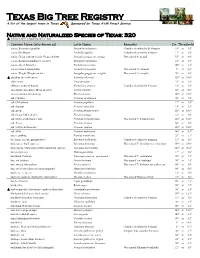
Texas Big Tree Registry a List of the Largest Trees in Texas Sponsored by Texas a & M Forest Service
Texas Big Tree Registry A list of the largest trees in Texas Sponsored by Texas A & M Forest Service Native and Naturalized Species of Texas: 320 ( D indicates species naturalized to Texas) Common Name (also known as) Latin Name Remarks Cir. Threshold acacia, Berlandier (guajillo) Senegalia berlandieri Considered a shrub by B. Simpson 18'' or 1.5 ' acacia, blackbrush Vachellia rigidula Considered a shrub by Simpson 12'' or 1.0 ' acacia, Gregg (catclaw acacia, Gregg catclaw) Senegalia greggii var. greggii Was named A. greggii 55'' or 4.6 ' acacia, Roemer (roundflower catclaw) Senegalia roemeriana 18'' or 1.5 ' acacia, sweet (huisache) Vachellia farnesiana 100'' or 8.3 ' acacia, twisted (huisachillo) Vachellia bravoensis Was named 'A. tortuosa' 9'' or 0.8 ' acacia, Wright (Wright catclaw) Senegalia greggii var. wrightii Was named 'A. wrightii' 70'' or 5.8 ' D ailanthus (tree-of-heaven) Ailanthus altissima 120'' or 10.0 ' alder, hazel Alnus serrulata 18'' or 1.5 ' allthorn (crown-of-thorns) Koeberlinia spinosa Considered a shrub by Simpson 18'' or 1.5 ' anacahuita (anacahuite, Mexican olive) Cordia boissieri 60'' or 5.0 ' anacua (anaqua, knockaway) Ehretia anacua 120'' or 10.0 ' ash, Carolina Fraxinus caroliniana 90'' or 7.5 ' ash, Chihuahuan Fraxinus papillosa 12'' or 1.0 ' ash, fragrant Fraxinus cuspidata 18'' or 1.5 ' ash, green Fraxinus pennsylvanica 120'' or 10.0 ' ash, Gregg (littleleaf ash) Fraxinus greggii 12'' or 1.0 ' ash, Mexican (Berlandier ash) Fraxinus berlandieriana Was named 'F. berlandierana' 120'' or 10.0 ' ash, Texas Fraxinus texensis 60'' or 5.0 ' ash, velvet (Arizona ash) Fraxinus velutina 120'' or 10.0 ' ash, white Fraxinus americana 100'' or 8.3 ' aspen, quaking Populus tremuloides 25'' or 2.1 ' baccharis, eastern (groundseltree) Baccharis halimifolia Considered a shrub by Simpson 12'' or 1.0 ' baldcypress (bald cypress) Taxodium distichum Was named 'T. -

Final Lower Rio Grande Valley and Santa Ana National Wildlife
Final Lower Rio Grande Valley and Santa Ana National Wildlife Refuges Comprehensive Conservation Plan September 1997 (Reprint March 1999) U.S. Fish and Wildlife Service U.S. Department of the Interior Cover Artwork by Brian Cobble Table of Contents VISION........................................................................................................................................... 5 Executive Summary................................................................................................................... 6 1.0 Introduction and Regional Setting................................................................................. 8 1.1 LRGV Challenges............................................................................................... 8 2.0 Planning Perspectives and Considerations................................................................ 9 2.1 National Wildlife Refuge System ................................................................... 9 2.2 The Service & Ecosystem Management ...................................................... 9 2.3 Refuge Complex and Management Districts........................................... 10 2.4 Laguna Atascosa NWR -- A Partner with LRGV NWR............................ 10 2.5 Planning Perspectives.................................................................................... 10 2.6 The Issues.......................................................................................................... 11 2.7 The Need for Action........................................................................................ -
CHAPTER ONE INTRODUCTION 1.1 Background of the Study
CHAPTER ONE INTRODUCTION 1.1 Background of the study Throughout history, natural products have continued to play significant role as medicines and serve as repository of numerous bioactive compounds that serve as important leads in drug discovery (Dias et al., 2012). The significance of natural product based medicines is demonstrated by the reliance of more than half of the world’s population on natural products for their primary health care (Ekeanyanwu, 2011). The role of natural products in meeting the health needs of the Nigerian population has been stressed in many studies (Sofowora, 1982; Osemene et al., 2013). These natural products are rarely used solely for a particular disease condition. In some cases, a particular herbal product may be used for the treatment of related disease conditions or disease conditions with similar pathogenesis. There are situations where single herbal product is used for numerous unrelated disease conditions and for general body healing – this is the category where traditional use of Millettia aboensis falls. The contribution of natural products in disease control has been well acclaimed; however, the use of many plant based medicines for the treatment of disease conditions is yet to be fully accepted due to lack of scientific evidence on their efficacy and safety (Firenzuoli and Gori, 2007). The knowledge and uses of some medicinal plants are still based on cultural or folkloric believes. The full therapeutic potentials of herbal products would optimally be harnessed when their efficacy and toxicity are clearly validated and documented using scientific procedures. 1 Millettia aboensis is one of the plants considered to be an all-purpose plant in most parts of Africa because of the multiplicity of its use (Banzouzi et al., 2008). -

Draft Environmental Assessment for the Rio Grande City Station Road
DRAFT FINDING OF NO SIGNIFIGANT IMPACT (FONSI) RIO GRANDE CITY STATION ROAD IMPROVEMENT PROJECT, RIO GRANDE CITY, TEXAS, RIO GRANDE VALLEY SECTOR, U.S. CUSTOMS AND BORDER PROTECTION DEPARTMENT OF HOMELAND SECURITY U.S. BORDER PATROL, RIO GRANDE VALLEY SECTOR, TEXAS U.S. CUSTOMS AND BORDER PROTECTION DEPARTMENT OF HOMELAND SECURITY WASHINGTON, D.C. INTRODUCTION: United States (U.S.) Customs and Border Protection (CBP) plans to upgrade and lengthen four existing roads in the U.S. Border Patrol (USBP) Rio Grande City (RGC) Station’s Area of Responsibility (AOR). The Border Patrol Air and Marine Program Management Office (BPAM-PMO) within CBP has prepared an Environmental Assessment (EA). This EA addresses the proposed upgrade and construction of the four aforementioned roads and the BPAM-PMO is preparing this EA on behalf of the USBP Headquarters. CBP is the law enforcement component of the U.S. Department of Homeland Security (DHS) that is responsible for securing the border and facilitating lawful international trade and travel. USBP is the uniformed law enforcement subcomponent of CBP responsible for patrolling and securing the border between the land ports of entry. PROJECT LOCATION: The roads are located within the RGC Station’s AOR, Rio Grande Valley (RGV) Sector, in Starr County, Texas. The RGC Station’s AOR encompasses approximately 1,228 square miles, including approximately 68 miles along the U.S.-Mexico border and the Rio Grande from the Starr/Zapata County line to the Starr/Hidalgo County line. From north to south, the four road segments are named Mouth of River to Chapeno Hard Top, Chapeno USIBWC Gate to Salineno, Salineno to Enron, and 19-20 Area to Fronton Fishing, and all of these segments are located south of Falcon International Reservoir (Falcon Lake), generally parallel to the Rio Grande. -

El Matorral Espinoso Tamaulipeco En México
Plantas características del matorral espinoso tamaulipeco en México Molina-Guerra V.M., Mora-Olivo A., Alanís-Rodríguez, E., Soto-Mata, B., Patiño-Flores, A.M. 2019. Plantas características del matorral espinoso tamaulipeco en México. Editorial Univer- sitaria de la Universidad Autónoma de Nuevo León. Monterrey, México. 114 Pp. Plantas características del matorral espinoso tamaulipeco en México Víctor Manuel Molina-Guerra Arturo Mora-Olivo Eduardo Alanís-Rodríguez Brianda Elizabeth Soto-Mata Ana María Patiño-Flores Universidad Autónoma de Nuevo León Molina Guerra, Víctor Manuel [...y otros] Plantas características del matorral tamaulipeco en México. Contenido Monterrey, Nuevo León, México : Universidad Autónoma de Nuevo León, 2019. (Tendencias) 116 páginas ; 16x21 cm Presentación 13 Matorral desértico – Clasificación – Tamaulipas, México Clasif. LC: SB317.A69 M4 2019 Clasif.DD: 581.6 M4 2019 Prólogo 15 ISBN: 978-607-27-1168-6 -------------------------------------------------------------------------------------------------------------------------- Introducción 17 Rogelio G. Garza Rivera El matorral espinoso tamaulipeco 19 Rector Carmen del Rosario de la Fuente García Secretaria General Fichas botánicas 23 Celso José Garza Acuña Secretario de Extensión y Cultura Antonio Ramos Revillas Achatocarpaceae 25 Director de Editorial Universitaria Paulothamnus spinescens 26 Primera edición 2019 © Universidad Autónoma de Nuevo León Asparagaceae 27 © Facultad de Ciencias Forestales Yucca filifera 28 © Víctor Manuel Molina Guerra, Arturo Mora Olivo, -

Atocha Wooden Bed Post, Tag #85413
Mel Fisher’s Treasures – On-Line Research Archives Document ©2019 MOTIVATION, INC Atocha Wooden Bed Post, Tag #85413 By James Sinclair, MA Perhaps one of the more unique finds from the Atocha over the past permit period is that of a turned wooden bed post. Turned Lignum Vitae Bed Post, tag #85413, found by the Dare on 10-18-2014 Length: 144.8 cm. Width: 9.5 cm. Min. Width: 15 mm Weight 8.4 kg. This fragment of opulent furniture was located not far from the Primary Cultural Deposit. The Wood was so hard that when first located crew believed that the object might be modern. The first order of investigation was to identify the type of wood that the bed post was made of. For wood identification we have used the services of; Alden Identification Service 3560 Brookeside Drive Chesapeake Beach, MD 20732 http://woodid.homestead.com/ais.html Property of Motivation, Inc. – PuBlished on Mel Fisher’s Treasures On-Line Research Archives Page 1 of 3 Mel Fisher’s Treasures – On-Line Research Archives Document ©2019 MOTIVATION, INC Dr. Alden identified our post as Lignum Vitae (from Latin “Tree of Life”) a portion of the report follows: 1 - Furniture Lignum-vitae Guaiacum sp. Lignum-vitae (Guaiacum spp. L. /Zygophyllaceae), also known as Guayacan or Gai"ac, is composed of aBout 5 species of slow growing shruBs and trees in the Caltrop Family (Zygophyllaceae), native to subtropical and tropical regions of Central and South America. The five recognized species are: 1. Guaiacum angustifolium Engelm. -Texas Lignum-vitae (Texas, Northeastern Mexico) 2. -

Central Texas Bee-Friendly Plants
Central Texas Bee-Friendly Plants Common Name Scientific Name Category Blooming Season Abelia Abelia x grandiflora Shrub Spring - Fall Agarita Mahonia trifoliolata Shrub Feb. - April Anise Hysoop Agastache foeniculum Vegetable garden June - Sept. Arugula Eruca sativa Vegetable garden Spring Aster Symphyotrichum sp. Flowering plant Aug. - Oct. Autumn Sage Salvia greggii Flowering plant Spring - Fall Baby Blue Eyes Nemophila merziesil Flowering plant Early Spring Basil "African Blue" Ocimum Vegetable garden Late Summer Bee Balm (Horsemint, Bergamot) Monarda Shrub Spring - Summer Bee Bee Tree Tedredium danielli Shrub or Tree July, Aug. Bee Bush Aloysia gratissima Shrub Spring - Summer Bitterweed Helenium amarum Flowering plant Summer - Fall Black Willow Salix nigra Tree Spring Black-eyed Susan Rudbeckia hirta Flowering plant June - Aug. Blackfoot Daisy Melampodium leucanthum Flowering plant Early Spring Blue Beard Spirea Caryopteris "Bluebeard" Flowering plant Summer - Fall Blue Curls Phacelia congesta Flowering plant Spring Bluebonnet Lupinus texensis Flowering plant Spring Bluemist Flower Eupatorium Flowering plant Summer - Fall Borage (Starflower) Borage officinalis Vegetable garden Summer Bottlebrush Tree Callistemon rigidus Shrub Spring Bradford Pear Tree Pyrus calleryana Tree Spring Bulbine Bulbine orfrutescens Flowering plant Spring Butterfly Bush Budddelia davidii Shrub Spring Carolina Jasmine Gelsemium sempervirens Vine Spring Catnip Nepeta cateria Flowering plant Summer Cherry Laurel Prunus caroliniana Shrub or Tree Spring Chinese Cabbage Brassica rapa Vegetable garden Summer Clover, All Trifolium Flowering plant Spring - Summer Columbine (yellow) Aquilegia chrysantha Flowering plant Spring - Summer Coral Vine Anigonon Leptopuus Vine Spring - Fall Common Name Scientific Name Category Blooming Season Coreopsis (Tickseed) Coreopsis lanceolata Flowering plant Summer - Fall Cosmos Cosmos bipinnatus Flowering plant Summer - Fall Crape Myrtle Lagerstroemia Shrub or Tree Spring - Fall Crossvine. -

Phytochemical Investigation of Three Leguminosae Plants for Cancer Chemopreventive Agents
UNIVERSITY OF NAIROBI COLLEGE OF BIOLOGICAL AND PHYSICAL SCIENCES DEPARTMENT OF CHEMISTRY PHYTOCHEMICAL INVESTIGATION OF THREE LEGUMINOSAE PLANTS FOR CANCER CHEMOPREVENTIVE AGENTS BY IVAN GUMULA A THESIS SUBMITTED IN FULFILLMENT OF THE REQUIREMENTS FOR THE AWARD OF THE DEGREE OF DOCTOR OF PHILOSOPHY (PhD) IN CHEMISTRY OF THE UNIVERSITY OF NAIROBI 2014 ii DEDICATION This work is dedicated to my family iii ACKNOWLEDGEMENTS First of all, I would like to thank the University of Nairobi for admitting me as a Doctoral student. I wish to extend my heartfelt gratitude to my supervisors; Prof. Abiy Yenesew, Dr. Solomon Derese and Prof. Isaiah O. Ndiege whose close supervision coupled with resourceful guidance/advice enriched me with the knowledge, skills and attitude resulting in the success of this research. I am grateful to the German Academic Exchange Services (DAAD) and the Natural Products Research Network for Eastern and Central Africa (NAPRECA) for financial support during my studies. I appreciate the help extended to me by Dr. Matthias Heydenreich of the University of Potsdam in spectroscopic/spectrometric analyses of some of the compounds reported in this thesis. Special thanks go to the Swedish Institute for sponsoring my research visit to the University of Gothenburg. I am indebted to my host supervisor, Prof. Máté Erdélyi, and the Halogen Bond Research Group of the Department of Chemistry and Molecular Biology, at the University of Gothenburg for his unwavering support and guidance in isolation and spectroscopic techniques and analysis. My sincere gratitude is extended to Dr. John P. Alao and Prof. Per Sunnerhagen of the Department of Chemistry and Molecular Biology at the University of Gothenburg for carrying out cytotoxicity assays.