The Mark Discordia Singles Tournament Seeding Round 2 Question Set 2: 60 Tossups
Total Page:16
File Type:pdf, Size:1020Kb
Load more
Recommended publications
-
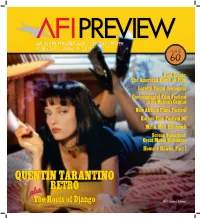
Quentin Tarantino Retro
ISSUE 59 AFI SILVER THEATRE AND CULTURAL CENTER FEBRUARY 1– APRIL 18, 2013 ISSUE 60 Reel Estate: The American Home on Film Loretta Young Centennial Environmental Film Festival in the Nation's Capital New African Films Festival Korean Film Festival DC Mr. & Mrs. Hitchcock Screen Valentines: Great Movie Romances Howard Hawks, Part 1 QUENTIN TARANTINO RETRO The Roots of Django AFI.com/Silver Contents Howard Hawks, Part 1 Howard Hawks, Part 1 ..............................2 February 1—April 18 Screen Valentines: Great Movie Romances ...5 Howard Hawks was one of Hollywood’s most consistently entertaining directors, and one of Quentin Tarantino Retro .............................6 the most versatile, directing exemplary comedies, melodramas, war pictures, gangster films, The Roots of Django ...................................7 films noir, Westerns, sci-fi thrillers and musicals, with several being landmark films in their genre. Reel Estate: The American Home on Film .....8 Korean Film Festival DC ............................9 Hawks never won an Oscar—in fact, he was nominated only once, as Best Director for 1941’s SERGEANT YORK (both he and Orson Welles lost to John Ford that year)—but his Mr. and Mrs. Hitchcock ..........................10 critical stature grew over the 1960s and '70s, even as his career was winding down, and in 1975 the Academy awarded him an honorary Oscar, declaring Hawks “a giant of the Environmental Film Festival ....................11 American cinema whose pictures, taken as a whole, represent one of the most consistent, Loretta Young Centennial .......................12 vivid and varied bodies of work in world cinema.” Howard Hawks, Part 2 continues in April. Special Engagements ....................13, 14 Courtesy of Everett Collection Calendar ...............................................15 “I consider Howard Hawks to be the greatest American director. -

His Girl Friday (1940)
Conversations about great films with Diane Christian & Bruce Jackson HOWARD HAWKS (30 May 1896, Goshen, Indiana—26 December 1977, Palm Springs, California, aftermath of a fall) directed 47 films (and was producer on most of them) and wrote 24 screenplays. The last film he directed was Rio Lobo 1970; his first was Road to Glory 1926. Some of the others were: Man's Favorite Sport? (1964), Hatari! (1962), Rio Bravo (1959), Land of the Pharaohs (1955), Gentlemen Prefer Blondes (1953), I Was a Male War Bride (1949), A Song Is Born (1948), Red River (1948), The Big Sleep (1946), To Have and Have Not (1944), Sergeant York (1941), Only Angels Have Wings (1939), Bringing Up Baby (1938), Come and Get It (1936), Barbary Coast (1935), Twentieth Century (1934), Scarface (1932), and The Dawn Patrol (1930). He won an honorary Oscar in 1975. BEN HECHT (28 February 1894, New York City—18 April 1964, NYC, HIS GIRL FRIDAY (1940). 92 min thrombosis) wrote or co-wrote 128 screenplays, half of them uncredited. Produced and directed by Howard Hawks Some of them are Cleopatra (1963), Mutiny on the Bounty (1962), Walk on Based on the play, “The Front Page,” by Ben Hecht the Wild Side (1962), A Farewell to Arms (1957), Miracle in the Rain and Charles MacArthur (1956), The Court-Martial of Billy Mitchell (1955), The Man with the Screenplay by Charles Lederer Golden Arm (1955), Guys and Dolls (1955), Rope (1948), The Miracle of Cinematography by Joseph Walker the Bells (1948), Ride the Pink Horse (1947), Kiss of Death (1947), Duel in the Sun (1946), Notorious (1946), Gilda (1946), Spellbound (1945), Cary Grant ...Walter Burns Lifeboat (1944), The Outlaw (1943), Gone with the Wind (1939), Wuthering Rosalind Russell ...Hildegaard 'Hildy' Johnson Heights (1939), Stagecoach (1939), Angels with Dirty Faces (1938), Ralph Bellamy ...Bruce Baldwin Barbary Coast (1935), Viva Villa! (1934), Scarface (1932), and The New Gene Lockhart ...Sheriff Peter B. -

Contemporary Maghrebi-French Cinema and Its Audiences
Postcolonial Popcorn: Contemporary Maghrebi-French Cinema and its Audiences by Alexander Hastie A Thesis Submitted in Partial Fulfilment of the Requirements for the Degree of Doctor of Philosophy Department of Geography The University of Sheffield December 2017 Abstract This thesis is a study of popular contemporary postcolonial cinema, through readings of three recent Maghrebi-French films. The research is comprised of the films Days of Glory (2006), Outside the Law (2010) and Free Men (2011), which narrate unfamiliar colonial stories in familiar ways. The films are a significant part of a cultural and commercial ‘shift’ toward more mainstream filmmaking in France, and therefore provide a fascinating and complex point of entry into the study of popular postcolonial cinema. By incorporating the popular into the postcolonial, the primary contribution of this thesis is that it extends the scope of postcolonial cultural criticism, in order to highlight how such an engagement functions to interrupt hegemonic imaginaries of colonial space, memory and gender. Informed by a postcolonial critique, this thesis deploys textual analysis in order to investigate how the films are textually constituted across and through different cultural frameworks, questioning what this means for conceptualising postcolonialism. Primarily investigating the ways in which the films rewrite colonial histories using the genre conventions of Hollywood, this thesis attends to issues pertinent to postcolonial France. The thesis therefore identifies some of the key relationships to space that are narrated throughout the films, in which geographies of belonging and exclusion for Maghrebi- French people are articulated through popular aesthetics. An important part of articulating place is memory, and so this thesis also examines how occluded memories are mobilised and energised at the intersection with more familiar historical imaginaries, showing how this multidirectional relationship works to situate colonial histories in ways that are disruptive of World War Two imaginaries. -

A Case Study of Gregg Toland and Citizen Kane
Volume 5, Issue 1 February 2012 Authorship and the Director of Photography: A Case Study of Gregg Toland and Citizen Kane PHILIP COWAN, Manchester Metropolitan University ABSTRACT The artistic contribution of Directors of Photography to the films that they shoot, in narrative mainstream cinema, have been historically ignored in favour of the director-centred auteur theory. In order to address this imbalance a new approach to attributing authorship in film needs to be implemented, which acknowledges co-authorship in collaborative film-making. By taking established auteur methodologies Philip Cowan, himself a practicing Director of Photography, analyses the work of Gregg Toland, who has long been recognised for his technical contribution to Citizen Kane (Welles, 1941), but only by analysing his previous work can one actually realise the depth of his influence on the visualisation of Kane. KEYWORDS Film, cinematography, authorship, Gregg Toland, Citizen Kane, Orson Welles Gregg Toland and the cinematographer’s plight Gregg Wesley Toland, born in 1904, became one of the most respected Directors of Photography in Hollywood during the 1930s and 40s. He started his career as an assistant to cinematographer George Barnes, who would later shoot Rebecca (Hitchcock, 1940). By 1931 Toland had graduated to cinematographer at Goldwyn Studios. Throughout the 30s he developed his own style of shooting, on films including Les Miserables (Boleslawski, 1935), Mad Love (Freund, 1935), The Road to Glory, (Hawks, 1936), Dead End (Wyler, 1937), Wuthering Heights (Wyler, 1939), The Grapes of Wrath (Ford, 1940), and The Long Voyage Home (Ford, 1940). In 1941 he shot the film that many film critics and theorists consistently regard as the best American film ever made, Citizen Kane (Welles, 1941). -

El Sueño Eterno
El sueño eterno (THE BIG SLEEP) P PHILIP Nº 138 (OCTUBRE 2006) MARLOWE SINOPSIS El detective privado Philip Marlowe es contratado por la familia Stern- wood para resolver un caso de chantaje. A raíz de esto se verá envuelto en una trama mucho más compleja en un mundo de violencia, gansters y asesinatos. FICHA ARTÍSTICA Philip Marlowe .......................................................... Humphrey Bogart Vivian Sternwood ............................................................ Lauren Bacall Carmen Sternwood ....................................................... Martha Vickers Eddie Mars .......................................................................John Ridgely General Sternwood ..................................................... Charles Waldron Bernie Ohls .....................................................................Regis Toomey FICHA TÉCNICA Duración....................... 114 min. Dirección .............. Howard Hawks Fotografía ................... Sid Hickox Nacionalidad ................... E.E.U.U Productora ........ Warner Brothers Montaje ............... Christian Nyby Año de Producción .............. 1946 Productor ............. Howard Hawks Música ..................... Max Steiner (B/N) Guión Faulkner, Brackett y Furthman Direcc. Artística .. Carl Jules Weyl de la novela de Raymond Chandler Vestuario ................. Leah Rhodes EL DIRECTOR: HOWARD HAWKS Howard Hawks fue grandísimo director que se prodigó en varios géneros del cine, destacando especialmente por sus comedias. Antes de introducirse en -

January 28, 2014 (Series 28: 1) Josef Von Sternberg, UNDERWORLD (1927, 80 Minutes)
January 28, 2014 (Series 28: 1) Josef von Sternberg, UNDERWORLD (1927, 80 minutes) Academy Award—1929—Best Writing, Original Story: Ben Hecht Directed by Josef von Sternberg Written by Howard Hawks (scenario) and Ben Hecht (story) Produced by B.P. Schulberg Cinematography by Bert Glennon Second Unit Director Henry Hathaway Presenters Jesse L. Lasky and Adolph Zukor George Bancroft...'Bull' Weed Evelyn Brent...'Feathers' McCoy Clive Brook…Rolls Royce Wensel Fred Kohler...'Buck' Mulligan JOSEF VON STERNBERG (b. Jonas Sternberg, May 29, 1894 in Vienna, Austria-Hungary [now Austria]—d. December 22, 1969 (age 75) in Hollywood, Los Angeles, California) directed 35 films, including 1957 Jet Pilot, 1953 Ana-ta-han, 1952 Macao, 1946 Duel in the Sun, 1941 The Shanghai Gesture, 1939 Sergeant Madden, 1938 The Great Waltz, 1937 I, Claudius (unfinished), 1935 Crime and Punishment, 1935 The Devil Is a Favorite Sport?, 1962 Hatari!, 1959 Rio Bravo, 1955 Land of the Woman, 1934 The Scarlet Empress, 1932 Blonde Venus, 1932 Pharaohs, 1953 Gentlemen Prefer Blondes, 1952 Monkey Shanghai Express, 1931 An American Tragedy, 1931 Business, 1952 The Big Sky, 1949 I Was a Male War Bride, 1948 Dishonored, 1930 Morocco, 1930 The Blue Angel, 1929 A Song Is Born, 1948 Red River, 1946 The Big Sleep, 1944 To Thunderbolt, 1928 The Docks of New York, 1928 The Dragnet, Have and Have Not, 1943 The Outlaw, 1943 Air Force, 1941 1928 The Last Command, 1927 Underworld, 1927 Children of Ball of Fire, 1941 Sergeant York, 1940 His Girl Friday, 1939 Divorce, 1926 A Woman of the Sea, and 1925 The Salvation Only Angels Have Wings, 1938 Bringing Up Baby, 1936 Come Hunters. -

Online Versions of the Goldenrod Handouts Have Color Images & Hot
Online versions of the Goldenrod Handouts have color images & hot links September 4, 2018 (XXXVII:2) http://csac.buffalo.edu/goldenrodhandouts.html Howard Hawks (and Richard Rossen): SCARFACE (1932, 93 min) DIRECTED BY Howard Hawks (Richard Rossen, co-director) WRITTEN BY Armitage Trail (based on the novel by), Ben Hecht (screen story), Seton I. Miller (continuity), John Lee Mahin (continuity), W.R. Burnett (continuity), Seton I. Miller (dialogue), John Lee Mahin (dialogue), W.R. Burnett (dialogue), Howard Hawks (uncredited) PRODUCED BY Howard Hawks (uncredited), Howard Hughes (uncredited) MUSIC BY Adolph Tandler (uncredited) CINEMATOGRAPHY Lee Garmes, L. William O'Connell FILM EDITING BY Edward Curtiss, Lewis Milestone (uncredited) VISUAL EFFECTS Howard A. Anderson (process photography) Selected for National Film Registry by the National Film Shark, and La foule hurle in 1932; Today We Live (1933) and Preservation Board, 1994 Barbary Coast (1935); The Road to Glory and Come and Get It in 1936. He would direct the comedy classic His Girl Friday in CAST 1940, and he would be nominated for a Best Director Oscar for Paul Muni...Tony Camonte Sergeant York (1941) in 1942. In the 1940s, he would also direct Ann Dvorak...Cesca Camonte such films as: Ball of Fire (1941) and The Outlaw (1943); To Karen Morley...Poppy Have and Have Not (1944) and The Big Sleep (1946); Red River Osgood Perkins...Johnny Lovo and A Song is Born (1948); and I Was a Male War Bride (1949). C. Henry Gordon...Police Inspector Guarino He would continue in the 1950s with films such as: The Big Sky George Raft.. -
20.1998.1 Howard W. Hawks Elkhart County Marker Text Review Report 09/21/11
20.1998.1 Howard W. Hawks Elkhart County Marker Text Review Report 09/21/11 Marker Text: Born 1896 in house on this site into locally prominent family. Moved with parents to Neenah, Wisconsin 1899 and to Pasadena, California 1906. Hawks - director, producer, screenwriter - is recognized as one of Hollywood's greatest filmmakers. His more than forty-six movies include fine examples of traditional film genres, both comedy and drama. Died 1977. Report: Although the text of the Howard Hawks marker is accurate and offers insights into the filmmaker’s birthplace and subsequent moves, further information could be added to create a more detailed picture of his early life and his involvement in cinema. More importantly, as it stands now, the marker does not adequately convey the significance of Hawks’s film career. Hawks was a versatile director who worked in a wide array of genres. The marker could be re-written to more clearly communicate his accomplishments and contributions in the motion picture business. This report will provide further information regarding Hawks’s participation in the filmmaking process, his collaboration with many well-known actors, actresses, and writers, and some of his films. The marker text’s claim that Hawks was born in 1896 into a locally prominent family is correct. The U.S. Federal census of 1900 marks his birth date as May 1896 and lists Hawks at age four at the time of the census.1 Seminal biographies on the filmmaker, including Todd McCarthy’s Howard Hawks: The Grey Fox of Hollywood (1997) and Joseph McBride’s -

Criterion Pictures USA Inc
Criterion Pictures USA Inc. - CPLUSA_Titles Page 1 01-Oct-21 Select: !\fstatus\=1 and NOT ONEOF(\FDCODE\,"28,29,30,31,32,33,34")!! : : CPLUSA_TITLES CODE Title Name RunMinYear Subject Rating F00385 One Hundred Rifles 110 1969 Restricted TAR068 12:08 Bucharest 89 2006 Not Rated F102711 12 Rounds 107 2009 PG-13 F132043 12 Rounds 2: Reloaded 94 2013 Restricted F131472 12 Years a Slave 133 2013 Restricted UBK412 12 Years a Slave 24 2015 F031298 127 Hours 93 2010 Restricted F02210 Thirteen Rue Madeleine 95 1946 General F02209 Thirteenth Letter 85 1951 Not Rated A71094 14 Days in Paradise 87 2007 UBX208 14 Tanks and a Shipwreck 47 2013 TAR008 16 Years of Alcohol 102 2003 Restricted 201571 1917: Revolution in Russia 28 1988 General 1BRE01 1929-1941: The Great Depression 25 1990 1BRE02 1945-1989: The Cold War 25 1991 YWU809 2.0: Point of No Return 44 2016 UHV106 2,000 - Foot Tower 48 2008 196569 20 Animals That Will Kill You 0 2013 F07174 20 Dates 88 1999 Restricted S0002366 The 2000s: A New Reality 176 2015 General S0002404 20th Century History, Season 1 50 1990 196735 21st Century Sex Slaves 0 2012 YXQ507 24-Hour Watch 45 2013 YWU511 24 Hours After Asteroid Impact 0 0 General YWU612 24 Hours After Hiroshima 0 2010 General F030875 27 Dresses 110 2008 PG-13 F30275 28 Days Later 112 2003 Restricted F030643 28 Weeks Later 100 2007 Restricted F06597 Twenty Ninth Street 101 1991 Restricted YXQ210 3,000-Pound Coke Bust 45 2010 TRO621 30 Girls and 30 Days 80 2013 TRO525 30 Minutes Or Less 5 2001 F099109 365 Nights in Hollywood 77 1935 YWU716 The -

Series 30:2) Howard Hawks, BRINGING up BABY (1938, 102 Minutes
3 February 2015 (Series 30:2) Howard Hawks, BRINGING UP BABY (1938, 102 minutes) 1990 National Film Preservation Board, National Film Registry Directed by Howard Hawks Written by Dudley Nichols (screenplay) and Hagar Wilde (screenplay, from the story by) Produced by Howard Hawks Music by Roy Webb Cinematography by Russell Metty Film Editing by George Hively Art Direction by Van Nest Polglase Costume Design by Jimmie Dundee Music by Roy Webb Leopard trained by Olga Celeste Katharine Hepburn ... Susan Cary Grant ... David Charles Ruggles ... Major Applegate Walter Catlett ... Slocum Barry Fitzgerald ... Mr. Gogarty Prefer Blondes, 1952 The Big Sky, 1949 I Was a Male War May Robson ... Aunt Elizabeth Bride, 1948 A Song Is Born, 1948 Red River, 1946 The Big Fritz Feld ... Dr. Lehman Sleep, 1944 To Have and Have Not, 1943 The Outlaw, 1941 Leona Roberts ... Mrs. Gogarty Sergeant York, 1940 His Girl Friday, 1939 Only Angels Have George Irving ... Mr. Peabody Wings, 1938 Bringing Up Baby, 1936 Come and Get It, 1936 The Tala Birell ... Mrs. Lehman Road to Glory, 1935 Barbary Coast, 1934 Twentieth Century, Virginia Walker ... Alice Swallow 1933 The Prizefighter and the Lady, 1933 Today We Live, 1932 John Kelly ... Elmer Scarface, 1930 The Dawn Patrol, 1929 Trent's Last Case, 1928 Ward Bond ... Motorcycle Cop at Jail A Girl in Every Port, 1926 Fig Leaves, and 1926 The Road to Jack Carson ... Circus Roustabout Glory. He has 26 writing credits, although most are uncredited. Nissa the Leopard ... Baby Some of them are 1983 Scarface (1932 screenplay), 1971 The French Connection, 1965 Red Line 7000, 1952 Monkey Business, Howard Hawks (director, producer) (b. -

Only Angels Have Wings” [Sólo Los Ángeles Tienen Alas] 1939
“–only Angels have wings” [Sólo los ángeles tienen alas] 1939 Ficha técnica general. Sumario: En un remoto puerto comercial sudamericano, el gerente de una empresa de transporte aéreo se ve obligado a arriesgar la vida de sus pilotos para ganar un importante contrato. Director: Howard Hawks Guion: Jules Furthman Reparto (las estrellas): Cary Grant como Geoff Carter Jean Arthur Bonnie Lee Reparto (otros protagonistas): Richard Barthelmess Bat MacPherson Rita Hayworth Judy MacPherson Thomas Mitchell Kid Dabb Reparto (los secundarios): Allyn Joslyn Les Peters Sig Ruman Dutchy Victor Kilian Sparks John Carroll Gent Shelton Don 'Red' Barry Tex Noah Beery Jr. Joe Souther Milisa Sierra Lily Lucio Villegas Doctor Pat Flaherty Mike Pedro Regas Pancho Pat West Baldy Manuel Álvarez Maciste The Singer Equipo y especificaciones técnicas: Producción: Columbia. Productor, Argumento original y Guion: HOWARD HAWKS. Guion: Jules Furthman. Fotografía: Joseph Walker. Fotografía aérea: Elmer Dyer. Efectos especiales: Roy Davidson y Edwin G. Hahn. Dirección artística: Lionel Banks. Diseño de vestuario: Robert Kalloch Maquillaje: Robert J. Schiffer Música: Dimitri Tiomkin. Dirección musical: M. W. Stoloff. Montaje: Viola Lawrence. Duración: 121 minutos; Longitud de película: 3.376,88 metros (12 rollos) Relación de aspecto: 1,37:1; Formato: 35 mm Fechas de producción: 20 de diciembre de 1938―24 de marzo de 1939 Estreno en Estados Unidos: 25 de mayo de 1939 (12 de mayo de 1939, en Nueva York) Estreno en España: 23 de septiembre de 1943, cine Callao. La filmografía -

Hollywood in the 1930S
Hollywood in the 1930s (September 26, 2005) • Howard Hawks, Bringing Up Baby (1938) • The introduction of sound (1927) • The Great Depression (starts 1929) • 1930s Hollywood Genres – Musical – Crime film – Screwball comedy • The studio system • The Hays code • Major directors (Howard Hawks, John Ford, Josef von Sternberg, and others) The Transition to Sound • The Jazz Singer (Oct 6, 1927) • The Lights of New York (1928): first “all- talkie” • US movie theaters converted for sound by the end of 1929 • A somewhat slower transition in Europe • Slower still in USSR and in Japan Economics of the Transition • Huge expenses of the conversion – Studios go into massive debt, 1928-1929 – Expanded involvement of Wall Street financiers in Hollywood • The Great Depression (starting Oct 1929) • Hollywood remains prosperous until 1932 • Cost-cutting and the studio system – Rationalization of expenses – Vertical integration of the film industry (production/ distribution/exhibition) New Genres (with some examples) • The musical – Busby Berkeley (42nd Street, Warner Bros, 1933) – Fred Astaire/Ginger Rogers (Swing Time, RKO, George Stevens,1936) • The Crime Film – Little Caesar (starring Edward G. Robinson, dir. Mervyn LeRoy, Warner Bros, 1930) – The Public Enemy (starring James Cagney, dir. William Wellman, 1931) • Screwball Comedy (1934-1944) The Hollywood Studio System • Vertical integration of the movie business • Comprehensive production facilities • Standardized, assembly-line mode of production • The 5 majors own their own theater chains • Blind