HUNGARY Birds-Butterflies-Dragonflies
Total Page:16
File Type:pdf, Size:1020Kb
Load more
Recommended publications
-

Die Libellenfauna Des Dörnlesees in Lingenau (Naturpark
Feurle, A. W. & Holzinger, W. E. (2017): Die Libellenfauna des Dörnlesees in Lingenau (Naturpark Nagelfluhkette), mit dem Erstnachweis der Gabel-Azurjungfer (Coenagrion scitulum, Odonata, Insecta) für Vorarlberg. inatura – Forschung online, 46: 6 S. Die Libellenfauna des Dörnlesees in Lingenau Nr. 46 - 2017 (Naturpark Nagelfluhkette), mit dem Erstnachweis der Gabel-Azurjungfer (Coenagrion scitulum, Odonata, Insecta) für Vorarlberg Alexander W. Feurle1 & Werner E. Holzinger2 1 MMag. Alexander W. Feurle, Schwarzen 365/4, A-6861 Alberschwende E-Mail: alexander.feurle@gmail.com 2 Priv.Doz. Mag. Dr. Werner E. Holzinger ÖKOTEAM - Institut für Tierökologie und Naturraumplanung OG Bergmanngasse 22, A-8010 Graz; E-Mail: holzinger@oekoteam.at Abstract A survey of the Odonata fauna of the pond Dörnlesee in Lingenau (Vorarlberg; coordinates (WGS84): 9,9106 E; 47,4536 N) car- ried out in 2017 revealed a total of 14 species. On 21 June 2017, we spotted a single male of the Dainty Damselfly (Coenagrion scitulum (Rambur, 1842)). This is the first confirmed record of this species in Vorarlberg. In Austria, Coenagrion scitulum is autochthonous in its eastern parts (Styria, Burgenland, Lower Austria and Vienna) and has been recorded in Salzburg recently. In addition, an unconfirmed record for Vorarlberg was published in 2002. It is a species with holo-mediterranean distribution and a distinct range expansion (due to climate change) towards Central Europe in recent decades, where it usually inhabits low alti- tudes. Our record of Coenagrion scitulum at 663 -

Dragonflies of La Brenne & Vienne
Dragonflies of La Brenne & Vienne Naturetrek Tour Report 13 - 20 June 2018 Dainty White-faced Darter (Leucorrhinia caudalis) male Yellow-spotted Emerald (Somatochlora flavomaculata) male Report and images by Nick Ransdale Naturetrek Mingledown Barn Wolf's Lane Chawton Alton Hampshire GU34 3HJ UK T: +44 (0)1962 733051 E: info@naturetrek.co.uk W: www.naturetrek.co.uk Tour Report Dragonflies of La Brenne & Vienne Tour participants: Nick Ransdale (leader) with six Naturetrek clients Summary This two-centre holiday in central-western France gave an excellent insight into not only the dragonflies but also the abundant butterflies, birds and other wildlife of the region. The first two days were spent in the southern Vienne before we moved to the bizarre landscape of the Pinail reserve, and finally to Mezieres where we spent three days in the Brenne - ‘land of a thousand lakes’. This year's tour started on the cool side at 17-18°C, but settled into a pattern that proved to be ideal for finding and photographing odonata. Due to the sharp eyes, flexibility and optimism of group members, the tour was a resounding success, scoring a total of 44 species (tour average 41), equalling the tour record. The emphasis here is always on getting good, diagnostic views for all participants, something we achieved for all but one species. It was a good year for 'sets' of species this year, with both pincertails, four emerald dragonflies and both whiteface species. Added to this were five fritillary butterfly species, both Emperors (Purple and Lesser Purple), and an outstanding two clearwing moths – both Hornet and Firey. -
Revised List of Odonata Recorded in the United Kingdom
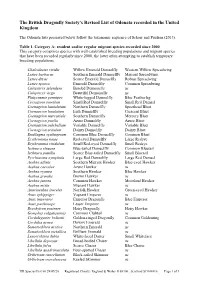
The British Dragonfly Society’s Revised List of Odonata recorded in the United Kingdom The Odonata lists presented below follow the taxonomic sequence of Schorr and Paulson (2013). Table 1. Category A: resident and/or regular migrant species recorded since 2000 This category comprises species with well-established breeding populations and migrant species that have been recorded regularly since 2000, the latter often attempting to establish temporary breeding populations. Chalcolestes viridis Willow Emerald Damselfly Western Willow Spreadwing Lestes barbarus Southern Emerald Damselfly Migrant Spreadwing Lestes dryas Scarce Emerald Damselfly Robust Spreadwing Lestes sponsa Emerald Damselfly Common Spreadwing Calopteryx splendens Banded Demoiselle nc Calopteryx virgo Beautiful Demoiselle nc Platycnemis pennipes White-legged Damselfly Blue Featherleg Ceriagrion tenellum Small Red Damselfly Small Red Damsel Coenagrion hastulatum Northern Damselfly Spearhead Bluet Coenagrion lunulatum Irish Damselfly Crescent Bluet Coenagrion mercuriale Southern Damselfly Mercury Bluet Coenagrion puella Azure Damselfly Azure Bluet Coenagrion pulchellum Variable Damselfly Variable Bluet Coenagrion scitulum Dainty Damselfly Dainty Bluet Enallagma cyathigerum Common Blue Damselfly Common Bluet Erythromma najas Red-eyed Damselfly Large Redeye Erythromma viridulum Small Red-eyed Damselfly Small Redeye Ischnura elegans Blue-tailed Damselfly Common Bluetail Ischnura pumilio Scarce Blue-tailed Damselfly Small Bluetail Pyrrhosoma nymphula Large Red Damselfly Large Red -

Journal Vol 26 No 2, October 2010
J. Br. Dragonfly Society, Volume 26 No. 2, October 2010 Journal of the CONTENTS DAVID CHELMICK - Studying British dragonflies in the British Dragonfly Society 1970s: the wilderness years .............................................. 57 Volume 26 Number 2 October 2010 BARRY NATTRESS - Folding wing behaviour in Cordulagaster boltonii (Donovan) ............................................................. 64 DAVID CHELMICK - Species Review 4: The Scarce Emerald Damselfly Lestes dryas Kirby with notes on the family Lestidae in the Western Palearctic ....................................66 JONATHAN. R. DIXON & DOROTHY E. GENNARD - The influence of meteorological conditions on the flight activity of the Blue-tailed Damselfly Ischnura elegans (Vander Linden), the Azure Damselfly Coenagrion puella (Linnaeus) and the Emerald Damselfly Lestes sponsa (Hansemann) ..... .............................................................................................. 83 ADRIAN J. PARR -. Migrant and dispersive dragonflies in Britain during 2009 ............................................................97 PAM TAYLOR & DAVE SMALLSHIRE - A change in status of the Dainty Damselfly Coenagrion scitulum (Rambur) in the United Kingdom ………....................................................107 Corrigendum ..........................................................................i The aims of the British Dragonfly Society (BDS) are to promote and encourage the study and conservation INSTRUCTIONS TO AUTHORS of Odonata and their natural habitats, especially in the -

Dragonflies of La Brenne & Vienne
Dragonflies of La Brenne & Vienne Naturetrek Tour Report 22 - 29 June 2011 Yellow-spotted Emerald, Somatochlora flavomaculata Report and image compiled by Nick Ransdale Naturetrek Cheriton Mill Cheriton Alresford Hampshire SO24 0NG England T: +44 (0)1962 733051 F: +44 (0)1962 736426 E: info@naturetrek.co.uk W: www.naturetrek.co.uk Tour Report Dragonflies of La Brenne & Vienne Tour leader: Nick Ransdale Participants: Vaughan Patterson Hilary Lawton Chris Benson Margaret Clayton Terry Clayton Summary This two-centre holiday in central-western France gave us an excellent insight into both the dragonfly fauna and abundant butterflies, birds and other wildlife of the region. After spending the first two days in the Vienne, we visited the myriad ponds of the Pinail Nature Reserve on our way to Bellebouche, where we spent three days in the Brenne, 'land of a thousand lakes'. This wide range of sites and habitats yielded a final total of 35 species of dragonflies, 40 species of butterflies, and 136 bird species, not to mention a wide range of other animals and plants, that the combined talents of the group helped to find and identify. The weather ranged from a cool 18°C on Day 2 to a sizzling 40°C plus on Day 6, curtailing walking (and odonata) activity somewhat! However, as the Brenne was a new area for all but one participant, we also took refuge in several of the newer bird hides that now grace the Brenne, enjoying great views of some of the Brennes' special birds. Day 1 Wednesday 22nd June Cool, sunny, 20°C The train from Paris arrived on time at Poitiers, at 16.53, where we all met up except for Hilary, who was meeting us at the hotel in Montmorillon. -

Dragonflies and Damselflies Have Emerged in the Country Park
The Dragons of Harrold-Odell Country Park The tale of a ferocious predator Article by Jaimie Barnes Every year, starting in late April, a monster lurks in the depths of the water ready to transform. This alien-like insect (ironically named a damselfly) will soon come to resemble its namesake. Slowly, in the early hours of the morning, a trek up the stem of a reed begins. At a point just right, catching the rays of the sun, it begins its transformation. CRACK! A small split in its thorax forms. Through the hole in the nymph's back, a new form of life is born. In colours of vibrant blue to deep red, the dainty damselfly emerges and pulls itself into adulthood. The only thing left behind from its childhood being the husk of the naiad (aquatic nymph) known as an exuvia. Exuvia can be collected on reeds where dragonflies and damselflies have emerged in the country park. They are a valuable resource for population surveys. The damselfly emerges earlier than its cousin, the dragonfly, which will begin its emergence in the next month. This head start means it can hunt and breed before being out competed or even eaten by its fellow dragonflies. Hovering like a helicopter (which it was the inspiration for) the damselfly watches its prey. The small flies that dart around are a key food source that gives the damselfly much needed energy. A quick dart forward; a fly is caught and eaten on a perch. Three dragonfly exuvia (left behind from the nymphs) Fast forwarding a few weeks and out from the depths of the Harrold-Odell Country Park lakes come much larger, more menacing creatures. -
THE CURRENT STATUS of ORTHOPTEROID INSECTS in BRITAIN and IRELAND by Peter G
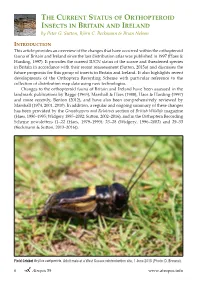
THE CURRENT STATUS OF ORTHOPTEROID INSECTS IN BRITAIN AND IRELAND by Peter G. Sutton, Björn C. Beckmann & Brian Nelson INTRODUCTION This article provides an overview of the changes that have occurred within the orthopteroid fauna of Britain and Ireland since the last distribution atlas was published in 1997 (Haes & Harding, 1997). It provides the current IUCN status of the scarce and threatened species in Britain in accordance with their recent reassessment (Sutton, 2015a) and discusses the future prognosis for this group of insects in Britain and Ireland. It also highlights recent developments of the Orthoptera Recording Scheme with particular reference to the collection of distribution map data using new technologies. Changes to the orthopteroid fauna of Britain and Ireland have been assessed in the landmark publications by Ragge (1965), Marshall & Haes (1988), Haes & Harding (1997) and more recently, Benton (2012), and have also been comprehensively reviewed by Marshall (1974, 2001, 2010). In addition, a regular and ongoing summary of these changes has been provided by the Grasshoppers and Relatives section of British Wildlife magazine (Haes, 1990‒1995; Widgery 1995‒2002; Sutton, 2002‒2016), and in the Orthoptera Recording Scheme newsletters (1‒22 (Haes, 1979‒1995); 23‒28 (Widgery, 1996‒2002) and 29‒33 (Beckmann & Sutton, 2013‒2016)). Field Cricket Gryllus campestris . Adult male at a West Sussex reintroduction site, 1 June 2013 (Photo: D. Browne). 6 Atropo s 59 www.atropos.info THE ORTHOPTEROID FAUNA The orthopteroid insects include some of the largest and most spectacular insects to be found in Britain and Ireland, such as the beautiful Large Marsh Grasshopper Stethophyma grossum . -

Cotswold Water Park Biodiversity Action Plan 2007 – 2016
Cotswold Water Park Biodiversity Action Plan 2007 – 2016 Cotswold Water Park Biodiversity Action Plan 2007 – 2016 Cotswold Water Park Biodiversity Action Plan 2007 – 2016 Cotswold Water Park Biodiversity Action Plan 2007 – 2016 COTSWOLD WATER PARK BIODIVERSITY ACTION PLAN 2007 - 2016 This document was published by the Cotswold Water Park Society on behalf of the CWP Nature Conservation Forum. The CWP Nature Conservation Forum is made up of representatives from the following organisations: Environment Agency RSPB Cotswold District Council Wildfowl & Wetlands Trust Cotswold Water Park Society Wiltshire County Council Gloucestershire County Council Wiltshire Ornithologocal Society Gloucestershire Wildlife Trust Wiltshire Wildlife Trust Natural England Funding for the review and production of the document was provided by: Natural England Environment Agency Four Pillars Hotels Section 106 Cotswold Water Park Joint Committee Thank you to all the following organisations and individuals who made a significant contribution to the review process: Aggregate Industries Gloucestershire Naturalists Society Richard Knight Bowmoor Sailing Club Gloucestershire Wildlife Trust RSPB British Dragonfly Society Hills Aggregates Strutt and Parker Bug Life Keith Bowley Tarmac Cotswold District Council Lechlade Bushy Leaze Thames Water Cotswold Sand & Gravel Lower Mill Estate Tom Groves Cotswold Water Park Society MC Cullimore Ltd University of Bath Down Ampney Parish Council MOD Defence Estates Wiltshire Bat Group Environment Agency Natural England Wiltshire Ornithological Society Gloucestershire Bat Group North Wiltshire District Council Wiltshire Wildlife Trust Gloucestershire County Council Plantlife Special thanks are due to the following individuals who gave a great deal of time, effort, suggestions and encouragement during the review process and all of whom have been instrumental in creating this document into its completed form. -

La Brenne at Leisure Holiday Report June 2018
La Brenne at Leisure 20th - 27th June 2018 Tour report Led by Jason Mitchell Black-necked Grebe © P England Camberwell Beauty © S & T Fox Greenwings Wildlife Holidays Tel : 01473 254658 Web : www.greenwings.co.uk Email : enquiries@greenwings.co.uk La Brenne at Leisure 2018 © Greenwings Introduction. Based in the quiet village of Mézières-en-Brenne, a little more than an hour from Poitiers, we were perfectly placed to spend a glorious week exploring the Parc Naturel Régional (PNR) de la Brenne. The guide for this trip, Jason Mitchell, knows the area extremely well, spending as he does, much of his time in this region. He was therefore in the perfect position to ensure our guests had an enjoyable time on this holiday. Equivalent to an Area of Outstanding Natural Beauty (AONB), the PNR of La Brenne is home to an extraordinarily diverse range of animals, plants and landscapes offering striking contrasts between expansive forests, meadows, heaths and the thousand lakes for which the region is famed. The wetlands in particular, are home to a wealth of wildlife with an especially diverse dragonfly fauna and this, coupled with a rich assemblage of other invertebrates and amphibians forms the basis of a complex food web supporting an impressive nine species of heron, not to mention more than 200 other bird species! Each day offered new treasures; from the emerald green rides of Lancosme Forest full of butterflies, to the clambering birds of the Bellebouche heronry, to the waterscapes of La Brenne’s thousand lakes. An exceptional week blessed by calm, sunny weather in the mid to high-twenties bursting with the best sights and sounds of La Brenne will live long in our memories. -

Journal of the British Dragonfly Society
J. Br. Dragonfly Society, Volume 26 No. 1, April 2010 Journal of the CONTENTS RICHARD A. BAKER - Robert John Tillyard (1881-1937) F.R.S. British Dragonfly Society an account of his life and legacy with special reference to Odonatology .........................................................................1 Volume 26 Number 1 April 2010 STEVE CHAM - Variations in the key features of exuviae of the Variable Damselfly Coenagrion pulchellum (Vander Linden) and the use of a score matrix to determine identification ......................................................................10 NORMAN W. MOORE - Remembering Encounters with Dragonflies from the 1930s to the Launching of the BDS in 1983 .....................................................................................29 DEREK K. JENKINS - Folding wing behaviour in the Golden- ringed Dragonfly Cordulegaster boltonii .........................32 PETER J. MILL - Species Review 3: The Large Red Damselfly Pyrrhosoma nymphula (Sulzer) with notes on its close relative the Greek Red Damselfly Pyrrhosoma elisabethae Schmidt ...............................................................................34 The aims of the British Dragonfly Society (BDS) are to promote and encourage the study and conservation INSTRUCTIONS TO AUTHORS of Odonata and their natural habitats, especially in the United Kingdom. • Authors are asked to study these instructions with care and to prepare their manuscripts The Journal of the British Dragonfly Society, published twice a year, contains articles on Odonata that have accordingly, in order to avoid unnecessary delay in the editing of their manuscripts. been recorded from the United Kingdom and articles on European Odonata written by members of the Soci- • Word processed manuscripts may be submitted in electronic form either on disk or by e-mail. ety. • Manuscripts should be one and a half spaced, on one side of the page only and with margins of at least 25mm on both sides and top and bottom. -

Lost Life: England's Lost and Threatened Species
Lost life: England’s lost and threatened species www.naturalengland.org.uk Lost life: England’s lost and threatened species Contents Foreword 1 Executive summary 2 Introduction 5 England’s natural treasures 7 From first life to the Industrial Revolution 12 Scale of loss to the present day 15 Regional losses 24 Threatened species 26 Our concerns for the future 36 Turning the tide 44 Conclusions and priorities for action 49 Acknowledgements 52 England’s lost species This panel lists all those species known to have been lost from England in recent history. Species are arranged alphabetically by taxonomic group, then by scientific name. The common name, where one exists, is given in brackets, followed by the date or approximate date of loss – if date is known. Dates preceded by a ‘c’ are approximate. Foreword No one knows exactly when the last Ivell’s sea anemone died. Its final known site in the world was a small brackish lagoon near Chichester on the south coast of England. When the last individual at this site died, probably in the 1980s, the species was lost forever: a global extinction event, in England, on our watch. We live in a small country blessed with a rich variety of wildlife – one in which the natural world is widely appreciated, and studied as intensely as anywhere in the world. Today this variety of life is under pressure from human activities as never before. As a result, many of our native species, from the iconic red squirrel to the much less familiar bearded stonewort, are in a fight for survival. -

Atlas of the Dragonflies of Britain and Ireland
á Cover photograph: Aeshna juncea Insets: Cordulegaster boltonii and Anax imperator (Photographs R Thompson) JOINT \ Institute of NATURE CONSERVATION Urrestrial COMMITTEE DEPARTMENri of ARTS. CULTURE sai cbr GAELTACHT 7 Ecology INSTITUTEOF TERRESTRIALECOLOGY LIBRARYSERVICE EDINBURGHLABORATORIES BUSHESTATE, PENICUIK MIDLOTHIANE26 OGB Atlas of the dragonflies of Britain and Ireland ITE research publication no. 9 R Merritt, N W Moore and B C Eversham Centre for Ecology and Hydrology London: HMSO Natural Environment Research Council @ NERC Copyright 1996 ISBN 0 11 701561 X Published in Great Britain by HMSO The Institute of Terrestrial Ecology (ITE) is a component research organisation within the Natural Environment Research Council. The Institute is part of the Centre for Ecology and Hydrology, and was established in 1973 by the merger of the research stations of the Nature Conservancy with the Institute of Tree Biology. It has been at the forefront of ecological research ever since. The six research stations of the Institute provide a ready access to sites and to environmental and ecological problems in any part of Britain. In addition to the broad 'environmental knowledge and experience expected of the modern ecologist, each station has a range of special expertise and facilities. Thus, the Institute is able to provide unparallelled opportunities for long-term, multidisciplinary studies of complex environmental and ecological problems. IIL undertakes specialist ecological research on subjects ranging from Micro-organisms to trees and mammals, from coastal habitats to uplands, Emil derelict land to air pollution. Understanding - the ecology of different species of natural and man-made communities plays an increasingly - important role in areas such as monitoring ecological aspects of agriculture, improving productivity in forestry, controlling pests, managing and conserving wildlife, assessing the causes and effects of pollution, and rehabilitating disturbed sites.