Insect-Plant Interrelationships 1 Ramesh Arora and Surinder Sandhu
Total Page:16
File Type:pdf, Size:1020Kb
Load more
Recommended publications
-
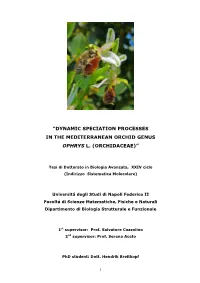
“Dynamic Speciation Processes in the Mediterranean Orchid Genus Ophrys L
“DYNAMIC SPECIATION PROCESSES IN THE MEDITERRANEAN ORCHID GENUS OPHRYS L. (ORCHIDACEAE)” Tesi di Dottorato in Biologia Avanzata, XXIV ciclo (Indirizzo Sistematica Molecolare) Universitá degli Studi di Napoli Federico II Facoltá di Scienze Matematiche, Fisiche e Naturali Dipartimento di Biologia Strutturale e Funzionale 1st supervisor: Prof. Salvatore Cozzolino 2nd supervisor: Prof. Serena Aceto PhD student: Dott. Hendrik Breitkopf 1 Cover picture: Pseudo-copulation of a Colletes cunicularius male on a flower of Ophrys exaltata ssp. archipelagi (Marina di Lesina, Italy. H. Breitkopf, 2011). 2 TABLE OF CONTENTS GENERAL INTRODUCTION CHAPTER 1: MULTI-LOCUS NUCLEAR GENE PHYLOGENY OF THE SEXUALLY DECEPTIVE ORCHID GENUS OPHRYS L. (ORCHIDACEAE) CHAPTER 2: ANALYSIS OF VARIATION AND SPECIATION IN THE OPHRYS SPHEGODES SPECIES COMPLEX CHAPTER 3: FLORAL ISOLATION IS THE MAIN REPRODUCTIVE BARRIER AMONG CLOSELY RELATED SEXUALLY DECEPTIVE ORCHIDS CHAPTER 4: SPECIATION BY DISTURBANCE: A POPULATION STUDY OF CENTRAL ITALIAN OPHRYS SPHEGODES LINEAGES CONTRIBUTION OF CO-AUTHORS ACKNOWLEDGEMENTS 3 GENERAL INTRODUCTION ORCHIDS With more than 22.000 accepted species in 880 genera (Pridgeon et al. 1999), the family of the Orchidaceae is the largest family of angiosperm plants. Recently discovered fossils document their existence for at least 15 Ma. The last common ancestor of all orchids has been estimated to exist about 80 Ma ago (Ramirez et al. 2007, Gustafsson et al. 2010). Orchids are cosmopolitan, distributed on all continents and a great variety of habitats, ranging from deserts and swamps to arctic regions. Two large groups can be distinguished: Epiphytic and epilithic orchids attach themselves with aerial roots to trees or stones, mostly halfway between the ground and the upper canopy where they absorb water through the velamen of their roots. -

A Brief Study on the Scoliidae in Iran (Insecta: Hymenoptera)
792 _____________Mun. Ent. Zool. Vol. 5, No. 2, June 2010__________ A BRIEF STUDY ON THE SCOLIIDAE IN IRAN (INSECTA: HYMENOPTERA) Majid Fallahzadeh* and Nazila Saghaei** * Department of Entomology, Islamic Azad University, Jahrom Branch, Fars, IRAN. E-mail: fallahzadeh@jia.aj.ir; mfalahm@yahoo.com ** Department of Plant Protection, Islamic Azad University, Marvdasht Branch, Fars, IRAN. [Fallahzadeh, M. & Saghaei, N. 2010. A brief study on the Scoliidae (Insecta: Hymenoptera) in Iran. Munis Entomology & Zoology, 5 (2): 792-795] ABSTRACT: The present paper mentions 9 species and subspecies belonging to 4 genera of the family Scoliidae (Insecta: Hymenoptera). They were collected from different parts of Fars province in the south of Iran. Of these, Dasyscolia ciliata ciliata (Fabricius, 1787) is new to the fauna of Iran and Near East. Additionally 4 species were recorded for the first time from Fars province. Synonyms and distributional data for each species are included. KEY WORDS: Distribution, Fars, Fauna, Hymenoptera, Iran, Scoliidae. The family Scoliidae belongs to the superfamily Vespoidea and contains approximately about 560 valid species, 220 subspecies distributed among 43 valid genera, 28 subgenera and 2 subfamilies (Osten, 2005b). They are solitary insect; both male and female are winged. They tend to be black, often marked with yellow or orange, and their wing tips are distinctively corrugated. The larvae are ectoparasitoids of the grubs of Scarabaeidae (Esmaili & Rastegar, 1954; Osten, 2000; Osten et al., 2003). The faunistic and taxonomic papers treated the family in Iran have been conducted by Tkalcu (1987), Esmaili & Rastegar (1954), Chahartaghi Abineh (2002). The Scoliid fauna of West Palaearctic was monographed by Osten (2000), who also provided geographic distribution and keys, for all taxa. -
Speciation, Pattern Recognition and the Maximization of Pollination: General Questions and Answers Given by the Reproductive Biology of the Orchid Genus Ophrys
Journal of Comparative Physiology A (2019) 205:285–300 https://doi.org/10.1007/s00359-019-01350-4 REVIEW Speciation, pattern recognition and the maximization of pollination: general questions and answers given by the reproductive biology of the orchid genus Ophrys Hannes F. Paulus1 Received: 21 March 2019 / Revised: 17 May 2019 / Accepted: 18 May 2019 / Published online: 28 May 2019 © The Author(s) 2019 Abstract Pollination syndromes evolved under the reciprocal selection of pollinators and plants (coevolution). Here, the two main methods are reviewed which are applied to prove such selection. (i) The indirect method is a cross-lineage approach using phylogenetical trees to understand the phylogeny. Thus, features of single origin can be distinguished from those with multiple origins. Nearly all pollination modes originate in multiple evolutionary ways. (ii) The most frequent pollinators cause the strongest selection because they are responsible for the plant’s most successful reproduction. The European sexually decep- tive orchid genus Ophrys provides an example of a more direct way to prove selection because the attraction of a pollinator is species specifc. Most members of the genus have remarkably variable fowers. The variability of the signals given of by the fowers enables the deceived pollinator males to learn individual fower patterns. They thus avoid already visited Ophrys fowers, interpreting them as females rejecting them. As the males will not return to these individually recognizable fowers, the pollinators´ learning behavior causes cross-pollination and prevents the orchid’s self-pollination. Keywords Selection · Reproductive success · Ophrys · Learning behavior Introduction consideration have a look in Chittka and Thomson (2001) or Waser and Ollerton (2006). -

Flora Montiberica 74 (VII-2019) ISSN 1138-5952 – Eissn 1988-799X
FLORA MONTIBERICA Publicación periódica especializada en trabajos sobre la flora del Sistema Ibérico Vol. 74 Valencia, VII-2019 FLORA MONTIBERICA Publicación independiente sobre temas relacionados con la flora y la vegetación (plantas vasculares) de la Península Ibérica, especialmente de la Cordillera Ibérica y tierras vecinas. Fundada en diciembre de 1995, se publican tres volúmenes al año con una periodicidad cuatrimestral. Editor y redactor general: Gonzalo Mateo Sanz. Jardín Botánico. Universidad de Valencia. C/ Quart, 80. E-46008 Valencia. C.e.: Gonzalo.Mateo@uv.es Redactor adjunto: Javier Fabado Alós (Jardín Botánico, Universidad de Valencia) Redactor página web y editor adjunto: José Luis Benito Alonso (Jolube Consultor Botánico y Editor, Jaca. www.jolube.es). Edición en Internet: www.floramontiberica.org, donde están las normas de publicación. Flora Montiberica.org es la primera revista de botánica en español que ofrece de forma gratuita todos sus contenidos a través de la red. Consejo editorial: Antoni Aguilella Palasí (Universidad de Valencia) Juan A. Alejandre Sáenz (Herbarium Alejandre, Vitoria) Vicente J. Arán Redó (Consejo Superior de Investigaciones Científicas, Madrid) Manuel Benito Crespo Villalba (Universidad de Alicante) Fermín del Egido Mazuelas (Universidad de León) José María de Jaime Lorén (Universidad Cardenal Herrera−CEU, Moncada) Emilio Laguna Lumbreras (Departamento de Medio Ambiente. Gobierno de la Comunidad Valenciana) M. Felisa Puche Pinazo (Universidad de Valencia) Editan: Flora Montiberica (Valencia) y Jolube Consultor Botánico y Editor (Jaca) ISSN papel: 1138–5952 — ISSN edición internet: 1988–799X Depósito Legal: V-5097-1995 Impreso en España por Quares Los contenidos de Flora Montiberica están indexados en: Desde 2014 los contenidos de Flora Montiberica están indexados en base de datos de resúmenes Scopus de la editorial Elsevier. -

Polinizadores ···---··· Teacher’S & Environmental Educator’S Guide
SOS Polinizadores ···---··· Teacher’s & environmental educator’s guide •1• General catalogue of official publications: http://publicacionesoficiales.boe.es Editorial CSIC: http://editorial.csic.es (email: publ@csic.es) Authors: Laura Jiménez, Clara Vignolo y Raquel Alsedo Text revision: Felipe Castilla English translation: Carlos Mota Layout & artwork: Pelopantón © CSIC Non-commercial publication e-NIPO: 694-18-006-2 This publication is included in the publishing programme of the former Ministry of Econ- omy, Industry and Competitiveness and published by the Ministry of Science, Innovation and Universities (in pursuance of the ministry restructuring set forth in Royal Decree 355/2018, of 6th June). The pictures contained herein shall be used for teaching purposes only. Dear teacher or environmental education: Thank you for reading these few lines, it means you are interested in pollinators. Our objective is that you are eager to pique this same curiosity among your students after reading them. SOS Polinizadores (SOS Pollinators) is a project aimed at promoting knowledge and study of pollinating insects in their ecosystems among both teachers and students, as well as their effect and impact on our lives and the threats faced by them. To that end, we propose a series of activities integrated in the school curriculum of primary and secondary education, respectively. They can also be implemented by professionals of environmental education in the context of non-formal education. Its methodological basis relies on enquiry-based learning, scientific thinking constituting the backbone thereof. By following this way of working, the students learn to look to nature, to ask themselves and to design ways to answer them, by reasoning and arguing the outcome thereof. -

Dottorato Di Ricerca
Università degli Studi di Cagliari DOTTORATO DI RICERCA IN SCIENZE E TECNOLOGIE DELLA TERRA E DELL'AMBIENTE Ciclo XXXI Patterns of reproductive isolation in Sardinian orchids of the subtribe Orchidinae Settore scientifico disciplinare di afferenza Botanica ambientale e applicata, BIO/03 Presentata da: Dott. Michele Lussu Coordinatore Dottorato Prof. Aldo Muntoni Tutor Dott.ssa Michela Marignani Co-tutor Prof.ssa Annalena Cogoni Dott. Pierluigi Cortis Esame finale anno accademico 2018 – 2019 Tesi discussa nella sessione d’esame Febbraio –Aprile 2019 2 Table of contents Chapter 1 Abstract Riassunto………………………………………………………………………………………….. 4 Preface ………………………………………………………………………………………………………. 6 Chapter 2 Introduction …………………………………………………………………………………………………. 8 Aim of the study…………………………………………………………………………………………….. 14 Chapter 3 What we didn‘t know, we know and why is important working on island's orchids. A synopsis of Sardinian studies……………………………………………………………………………………………………….. 17 Chapter 4 Ophrys annae and Ophrys chestermanii: an impossible love between two orchid sister species…………. 111 Chapter 5 Does size really matter? A comparative study on floral traits in two different orchid's pollination strategies……………………………………………………………………………………………………. 133 Chapter 6 General conclusions………………………………………………………………………………………... 156 3 Chapter 1 Abstract Orchids are globally well known for their highly specialized mechanisms of pollination as a result of their complex biology. Based on natural selection, mutation and genetic drift, speciation occurs simultaneously in organisms linking them in complexes webs called ecosystems. Clarify what a species is, it is the first step to understand the biology of orchids and start protection actions especially in a fast changing world due to human impact such as habitats fragmentation and climate changes. I use the biological species concept (BSC) to investigate the presence and eventually the strength of mechanisms that limit the gene flow between close related taxa. -

Die Dolchwespen Der Griechischen Insel Kreta (Hymenoptera: Scoliidae) 1029-1036 © Biologiezentrum Linz/Austria; Download Unter
ZOBODAT - www.zobodat.at Zoologisch-Botanische Datenbank/Zoological-Botanical Database Digitale Literatur/Digital Literature Zeitschrift/Journal: Linzer biologische Beiträge Jahr/Year: 2010 Band/Volume: 0042_2 Autor(en)/Author(s): Schedl Wolfgang Artikel/Article: Die Dolchwespen der griechischen Insel Kreta (Hymenoptera: Scoliidae) 1029-1036 © Biologiezentrum Linz/Austria; download unter www.biologiezentrum.at Linzer biol. Beitr. 42/2 1029-1036 19.12.2010 Die Dolchwespen der griechischen Insel Kreta (Hymenoptera: Scoliidae) W. SCHEDL Abstract: Dagger Wasps of the Greek Island of Crete (Hymenoptera: Scoliidae). The author shows informations about scoliids of Crete from 1914 till 2010 in 10 species of Scoliinae (Campsomerini et Scoliini) with exact localities, temporal and ecological data, as possible. Most of the data are derived from Middle and Western Crete, very often from sandhills near the beaches but also from the mountains till 1250 m NN. Adults have been registrated from the middle of April till to the end of October. Nothing is known about the hosts of the ectoparasiting Scoliids larvae in Crete, probably larvae of Scarabaeidae beetles as in other regions of this dagger wasps. K e y w o r d s : Greece, Crete, Dagger Wasps, Hymenoptera Einleitung Aus Interesse an der Symphyten-Fauna von Kreta war der Autor fünf Mal 1971, 1980, 2003, 2006 und 2010 im Frühjahr auf Kreta z. T. mit Botanikern der Universität Inns- bruck, die letzten drei Male mit seiner Frau als Begleiterin. Natürlich habe ich auch auf andere Insektentaxa geschaut u.a. auf Dolchwespen, die ich auch in anderen Teilen des Mittelmeergebietes und in Mitteleuropa beachtet habe (SCHEDL 2006, GUSENLEITNER & al. -

The Life, Publications and New Taxa of Qabir Argaman
UC Davis UC Davis Previously Published Works Title The life, publications and new taxa of Qabir Argaman (Carol Nagy) Permalink https://escholarship.org/uc/item/07h5x3d7 Authors Kimsey, LS Brothers, DJ Publication Date 2016 DOI 10.3897/JHR.50.7973 Peer reviewed eScholarship.org Powered by the California Digital Library University of California JHR 50: 141–178 (2016)The life, publications and new taxa of Qabir Argaman( Carol Nagy) 141 doi: 10.3897/JHR.50.7973 REVIEW ARTICLE http://jhr.pensoft.net The life, publications and new taxa of Qabir Argaman (Carol Nagy) Lynn S. Kimsey1, Denis J. Brothers2 1 Department of Entomology & Nematology, University of California, Davis, CA 95616, USA 2 School of Life Sciences, University of KwaZulu-Natal (Pietermaritzburg), Private Bag X01, Scottsville, 3209 South Africa Corresponding author: Lynn S. Kimsey (lskimsey@ucdavis.edu) Academic editor: Michael Ohl | Received 30 January 2016 | Accepted 8 May 2016 | Published 27 June 2016 http://zoobank.org/FD22EC27-0365-467E-B699-34D6CD0F9B8B Citation: Kimsey LS, Brothers DJ (2016) The life, publications and new taxa of Qabir Argaman (Carol Nagy). Journal of Hymenoptera Research 50: 141–178. doi: 10.3897/JHR.50.7973 Abstract This biography of the Hungarian/Romanian/Israeli hymenopterist Qabir Argaman (= Carol Nagy) pro- vides a list of his publications (except for newspaper articles) and the new taxa and new replacement names he proposed. Dr. Argaman began his career in Hungary, publishing under the name Carol Nagy. He later moved to Romania and finally moved to Israel, where he assumed the name Qabir Argaman. In total, he published 84 articles on the order Hymenoptera and described 348 new taxa (2 families, 11 subfamilies, 58 tribes, 153 genera or subgenera, and 125 species or subspecies) in 15 families, as well as 1 new species of Scarabaeidae (Coleoptera). -

Why Are There So Many Bee-Orchid Species? Adaptive Radiation by Intraspecific Competition for Mnemonic Pollinators
Preprints (www.preprints.org) | NOT PEER-REVIEWED | Posted: 17 October 2019 doi:10.20944/preprints201910.0204.v1 Why are there so many bee-orchid species? Adaptive radiation by intraspecific competition for mnemonic pollinators Michel Baguette1,2, Joris Bertrand3, Virginie M. Stevens2, Bertrand Schatz4 1Museum National d’Histoire Naturelle, Institut Systématique, Evolution, Biodiversité, UMR 7205, F-75005 Paris, France 2Centre National de la Recherche Scientifique and Université Paul Sabatier Toulouse III, SETE Station d’Ecologie Théorique et Expérimentale, UMR 5321, F-09200 Moulis, France 3 LGDP (Laboratoire Génome et Développement des Plantes) UMR5096, Université de Perpignan Via Domitia - CNRS, F-66860 Perpignan, France 4 CEFE (Centre d'Ecologie Fonctionnelle et Evolutive) UMR 5175, CNRS – Université de Montpellier – Université Paul Valéry – EPHE, 1919 Route de Mende, 34293 Montpellier, France ABSTRACT Adaptive radiations occur mostly in response to environmental variation through the evolution of key eco-morphological innovations that allow emerging species to occupy new ecological niches. However, rapid phenotypic evolution and the evolution of key novelties are likely to also occur when a couple or few species are engaged into narrow ecological interactions. To demonstrate coevolution is a difficult task; only elusive evidences confirm that coevolution is a driver of speciation and diversification. Here we propose that the adaptive radiation of the Mediterranean orchid genus Ophrys, which gave rise to ca. 350 species since the apparition of the genus is due to the particular co-evolutionary dynamics between these plants and their pollinators. We suggest that the pollination by sexual swindle used by Ophrys orchids is the main driver of this coevolution. -
Budapest 1996
ANNALES HISTORICO-NATURALES MUSEI NATIONALIS HUNGARICI Volume 88. Budapest. 1996 pp. 171-222. Generic synopsis of Scoliidae (Hymenoptera, Scolioidea) Q. ARGAMAN Ministry of Agriculture, Department of Plant Protection and Inspection P.O. Box 78, Bet Dagan, 11-50250, Israel ARGAMAN, Q. (1996): Generic synopsis of Scoliidae (Hymenoptera, Scolioidea). - Annls hist.-nat. Mus. neun. hung. 88: 171-222. Abstract - The classification and nomenclature of Scoliidae is reviewed and a comprehensive key to genera is presented. A new subfamily (Colpinae), together with 21 new tribes (Agombardini, As- coliini, Austroscoliini, Bctremiini, Carinoscoliini, Colpacampsomerini, Colpini. Curtaurgini, Da- syscoliini. Dielidini. Discoliini, Dobrobetini, Hangasornini. Heterelini, Lisocini, Megascoliini, Pseudotrielidini, Tetrascitonini, Trisciloini, Triscoliini, Ycasbraini) are described. In order to ac commodate natural groups of species, there are 62 new genera proposed (Agombarda, Bagonasuna, Batalanga, Borongorba, Burgamurga, Buzatlana, Citberaysa, Curlaurga, Dobrobeta, Elpáholta, Fiharbuxa, Gondiconda, Hangasorna, Haralambia, Hayderiba, Hitfoidra, Iforborha, Iksalonca, II- kamilka, Jupadora, Katapolda, Kokarevta, Kukkiya, Laskariska, Lobhargita, Molzinarda, Mooki- tena, Murahutka, Naysebwa, Niyaranta, Nokbibula, Noybarilta, Onkoknoa, Ordatirga, Orlovinga, Oscaiosca, Paconzitva, Pardesiya, Pupunluiga, Rahosmula, Ri/iamlika, Rostopasca, Rucarcana, Sisakrosa, Sobolpiha, Stiboranna, Sugorpilfa, Susaynata, Tatusdayca, Titbisayda, Tonsoygala, Torbesula, Turlurayca, -
Adaptive Radiation by Intra-Specific Competition for Mnesic Pollinators Michel Baguette, Joris Bertrand, Virginie Marie Stevens, Bertrand Schatz
Why are there so many bee-orchid species? Adaptive radiation by intra-specific competition for mnesic pollinators Michel Baguette, Joris Bertrand, Virginie Marie Stevens, Bertrand Schatz To cite this version: Michel Baguette, Joris Bertrand, Virginie Marie Stevens, Bertrand Schatz. Why are there so many bee-orchid species? Adaptive radiation by intra-specific competition for mnesic pollinators. Biological Reviews, Wiley, 2020, 95 (6), pp.1630-1663. 10.1111/brv.12633. hal-02995675 HAL Id: hal-02995675 https://hal.archives-ouvertes.fr/hal-02995675 Submitted on 27 Apr 2021 HAL is a multi-disciplinary open access L’archive ouverte pluridisciplinaire HAL, est archive for the deposit and dissemination of sci- destinée au dépôt et à la diffusion de documents entific research documents, whether they are pub- scientifiques de niveau recherche, publiés ou non, lished or not. The documents may come from émanant des établissements d’enseignement et de teaching and research institutions in France or recherche français ou étrangers, des laboratoires abroad, or from public or private research centers. publics ou privés. Why are there so many bee-orchid species? Adaptive radiation by intra-specific competition for mnesic pollinators Michel Baguette1,2,*, Joris A. M. Bertrand3, Virginie M. Stevens2, and Bertrand Schatz4 1Institut Systématique, Evolution, Biodiversité (ISYEB), UMR 7205 Museum National d’Histoire Naturelle, CNRS, Sorbonne Université, EPHE, Université des Antilles, F-75005 Paris, France 2Centre National de la Recherche Scientifique and Université Paul Sabatier Toulouse III, SETE Station d’Ecologie Théorique et Expérimentale, UMR 5321, F-09200 Moulis, France 3LGDP (Laboratoire Génome et Développement des Plantes) UMR5096, Université de Perpignan Via Domitia -CNRS, F-66860 Perpignan, France 4CEFE (Centre d'Ecologie Fonctionnelle et Evolutive) UMR 5175, CNRS – Université de Montpellier – Université Paul Valéry – EPHE, 1919 Route de Mende, 34293 Montpellier, France *Author for correspondence at address 1 (E-mail: baguette@mnhm.fr; Tel.:+ 33 6 26 03 38 11). -

Redes De Interacción Entre Flores E Himenópteros En Dos Comunidades Costeras
Ecosistemas 27(2): 102-114 [Mayo-Agosto 2018] Doi.: 10.7818/ECOS.1409 Artículo publicado en Open Access bajo los términos AEET de Creative Commons attribution Non Comercial License 3.0. eREVIScTA CoIENTÍFsICA DiEs ECOLtOGeÍA Y MmEDIO AaMBIENs TE ASOCIACIÓN ESPAÑOLA MONOGRÁFICO: ISSN 1697-2473 / Open access DE ECOLOGÍA TERRESTRE Pérdida de polinizadores: evidencias, causas y consecuencias disponible en www.revistaecosistemas.net Redes de interacción entre flores e himenópteros en dos comunidades costeras. Efectos de la pérdida de hábitat R. Beltrán 1,*, A. Traveset 1 (1) Institut Mediterrani d’Estudis Avançats (CSIC-UIB), Terrestrial Ecology Group, C/ Miquel Marqués 21, 07190-Esporles, Mallorca, Balearic Islands, Spain * Autor de correspondencia: R. Beltrán [rafel.beltran.mas@hotmail.com] > Recibido el 20 de marzo de 2017 - Aceptado el 05 de julio de 2017 Beltrán, R., Traveset, A. 2018. Redes de interacción entre flores e himenópteros en dos comunidades costeras. Efectos de la pérdida de hábitat. Ecosistemas 27(2): 102-114. Doi.: 10.7818/ECOS.1409 La polinización es un proceso clave para el funcionamiento del ecosistema. La crisis ambiental está afectando a los polinizadores en todo el mundo. Profundizar más en el estudio de la estructura y dinámica de las redes de polinización nos puede dar información sobre la conservación de las es - pecies y sobre su importancia como servicio ecosistémico. En este trabajo se analizaron las redes de polinización de himenópteros en dos localidades costeras de la isla de Mallorca, una de ellas afectada por una importante pérdida de hábitat. Se obtuvieron una serie de parámetros que describen la estructura de las redes de interacciones tanto a nivel de comunidad como a nivel de especie.