Post-Human Nightmares
Total Page:16
File Type:pdf, Size:1020Kb
Load more
Recommended publications
-

Metropolis and Millennium Actress by Sara Martin
View metadata, citation and similar papers at core.ac.uk brought to you by CORE provided by Diposit Digital de Documents de la UAB issue 27: November -December 2001 FILM FESTIVAL OF CATALUNYA AT SITGES Fresh from Japan: Metropolis and Millennium Actress by Sara Martin The International Film Festival of Catalunya (October 4 - 13) held at Sitges - the charming seaside village just south of Barcelona, infused with life from the international gay community - this year again presented a mix of mainstream and fantastic film. (The festival's original title was Festival of Fantastic Cinema.) The more mainstream section (called Gran Angular ) showed 12 films only as opposed to the large offering of 27 films in the Fantastic section, evidence that this genre still predominates even though it is no longer exclusive. Japan made a big showing this year in both categories. Two feature-length animated films caught the attention of Sara Martin , an English literature teacher at the Universitat Autònoma de Barcelona and anime fan, who reports here on the latest offerings by two of Japan's most outstanding anime film makers, and gives us both a wee history and future glimpse of the anime genre - it's sure not kids' stuff and it's not always pretty. Japanese animated feature films are known as anime. This should not be confused with manga , the name given to the popular printed comics on which anime films are often based. Western spectators raised in a culture that identifies animation with cartoon films and TV series made predominately for children, may be surprised to learn that animation enjoys a far higher regard in Japan. -

The Significance of Anime As a Novel Animation Form, Referencing Selected Works by Hayao Miyazaki, Satoshi Kon and Mamoru Oshii
The significance of anime as a novel animation form, referencing selected works by Hayao Miyazaki, Satoshi Kon and Mamoru Oshii Ywain Tomos submitted for the degree of Doctor of Philosophy Aberystwyth University Department of Theatre, Film and Television Studies, September 2013 DECLARATION This work has not previously been accepted in substance for any degree and is not being concurrently submitted in candidature for any degree. Signed………………………………………………………(candidate) Date …………………………………………………. STATEMENT 1 This dissertation is the result of my own independent work/investigation, except where otherwise stated. Other sources are acknowledged explicit references. A bibliography is appended. Signed………………………………………………………(candidate) Date …………………………………………………. STATEMENT 2 I hereby give consent for my dissertation, if accepted, to be available for photocopying and for inter-library loan, and for the title and summary to be made available to outside organisations. Signed………………………………………………………(candidate) Date …………………………………………………. 2 Acknowledgements I would to take this opportunity to sincerely thank my supervisors, Elin Haf Gruffydd Jones and Dr Dafydd Sills-Jones for all their help and support during this research study. Thanks are also due to my colleagues in the Department of Theatre, Film and Television Studies, Aberystwyth University for their friendship during my time at Aberystwyth. I would also like to thank Prof Josephine Berndt and Dr Sheuo Gan, Kyoto Seiko University, Kyoto for their valuable insights during my visit in 2011. In addition, I would like to express my thanks to the Coleg Cenedlaethol for the scholarship and the opportunity to develop research skills in the Welsh language. Finally I would like to thank my wife Tomoko for her support, patience and tolerance over the last four years – diolch o’r galon Tomoko, ありがとう 智子. -

Post-Human Nightmares
Post-Human Nightmares Mark Player 13 May 2011 A man wakes up one morning to find himself slowly transforming into a living hybrid of meat and scrap metal; he dreams of being sodomised by a woman with a snakelike, strap-on phallus. Clandestine experiments of sensory depravation and mental torture unleash psychic powers in test subjects, prompting them to explode into showers of black pus or tear the flesh off each other's bodies in a sexual frenzy. Meanwhile, a hysterical cyborg sex-slave runs amok through busy streets whilst electrically charged demi-gods battle for supremacy on the rooftops above. This is cyberpunk, Japanese style : a brief filmmaking movement that erupted from the Japanese underground to garner international attention in the late 1980s. The world of live-action Japanese cyberpunk is a twisted and strange one indeed; a far cry from the established notions of computer hackers, ubiquitous technologies and domineering conglomerates as found in the pages of William Gibson's Neuromancer (1984) - a pivotal cyberpunk text during the sub-genre's formation and recognition in the early eighties. From a cinematic standpoint, it perhaps owes more to the industrial gothic of David Lynch's Eraserhead (1976) and the psycho-sexual body horror of early David Cronenberg than the rain- soaked metropolis of Ridley Scott's Blade Runner (1982), although Scott's neon infused tech-noir has been a major aesthetic touchstone for cyberpunk manga and anime institutions such as Katsuhiro Otomo's Akira (1982- 90) and Masamune Shirow's Ghost in the Shell (1989- ). In the Western world, cyberpunk was born out of the new wave science fiction literature of the sixties and seventies; authors such Harlan Ellison, J.G. -

Sogo Ishii : De La Guitare Électrique Au Marteau-Piqueur
Document generated on 09/28/2021 7:03 a.m. 24 images Sogo Ishii De la guitare électrique au marteau-piqueur Ariel Esteban Cayer Son + Vision Number 174, October–November 2015 URI: https://id.erudit.org/iderudit/79648ac See table of contents Publisher(s) 24/30 I/S ISSN 0707-9389 (print) 1923-5097 (digital) Explore this journal Cite this article Cayer, A. E. (2015). Sogo Ishii : de la guitare électrique au marteau-piqueur. 24 images, (174), 36–37. Tous droits réservés © 24/30 I/S, 2015 This document is protected by copyright law. Use of the services of Érudit (including reproduction) is subject to its terms and conditions, which can be viewed online. https://apropos.erudit.org/en/users/policy-on-use/ This article is disseminated and preserved by Érudit. Érudit is a non-profit inter-university consortium of the Université de Montréal, Université Laval, and the Université du Québec à Montréal. Its mission is to promote and disseminate research. https://www.erudit.org/en/ SOGO ISHII De la guitare électrique au marteau-piqueur par Ariel Esteban Cayer Crazy Thunder Road (1980) n franche opposition au formalisme plus classique de cinéastes sera à Ishii ce que le No Wave new yorkais est au Jim Jarmusch des tels que Kiyoshi Kurosawa, Naomi Kawase ou Hirokazu débuts : une influence tant esthétique qu’idéologique. Il s’agit en E Kore-eda, toute une branche du cinéma japonais contem- fait d’un véritable mode de vie, inspiré par les sonorités de futurs porain se démarque par son dynamisme désinvolte et chaotique, collaborateurs tels que Sheena and The Rokkets, The Roosters, ainsi que par la frénésie de sa mise en scène. -

CONTEMPORARY COMMUNICATION, the CULTURE of MANGA Christiana Constantopoulou Manga and Anime
French Journal For Media Research – n° 6/2016 – ISSN 2264-4733 ------------------------------------------------------------------------------------ CONTEMPORARY COMMUNICATION, THE CULTURE OF MANGA Christiana Constantopoulou Professeure de Sociologie de la Communication Université Panteion, Athènes - Grèce Manga and Anime The popularity of anime and manga has helped westerners gain a broader understanding of Japanese culture. Manga is a generic term for all graphic novels and comic books originally published in Japan. Manga is read either in serialized comic books, monthly magazines, or graphic novels. All formats are available in English translation, graphic novels, however, are the most common and can be found in both major bookstore chains and local comic shops. The graphic novels are usually presented in "manga-style," meaning a right-to-left format. The word Manga, when translated directly, means “whimsical drawings”. Manga are typically 'comic books' as the West understands them; rather, they represent pieces of Japanese culture and history. The 'manga' style has an extensive history, beginning sometime in the 10th century; scrolls from that period depict animals as part of the 'upper class', behaving as a typical human would in similar situations. Such scrolls would go on to be known as the Chōjū giga or “The Animal Scrolls”. Scrolls found later on in the 12th century would depict images of religion such as the Gaki Zoshi (Hungry Ghost Scrolls) and the Jigoku zoshi (Hell Scrolls). While both dealt with various aspects of religion, unlike “The Animal Scrolls”, these provided a more instructive viewpoint, rather than a comedic style. Manga are more significant, culturally, than Western comic books (though many fill the same role). -

JPNS5003 Understanding Manga and Anime (Semester 2)
09/25/21 JPNS5003 Understanding Manga and Anime | Oxford Brookes Reading Lists JPNS5003 Understanding Manga and View Online Anime (Semester 2) 82 items Key texts: Weekly schedule (39 items) Week 1: An Introduction to Anime (2 items) The castle of Cagliostro - Hayao Miyazaki, Yuji Ohno, 2005 Audio-visual document The Castle of Cagliostro - Hayao Miyazaki, 2000 Audio-visual document Week 2: An Introduction to Manga (6 items) Dororo: Vol.1 - Osamu Tezuka, c2008 Book Dororo: Vol.2 - Osamu Tezuka, c2008 Book Dororo: Vol.3 - Osamu Tezuka, c2008 Book Osamu Tezuka's Metropolis - Taro ̄ Rin, Osamu Tezuka, Fritz Lang, 2009 Audio-visual document Osamu Tezuka's Metropolis - Osamu Tezuka, Fritz Lang, Taro ̄ Rin, 2003 Audio-visual document Metropolis - Osamu Tezuka, Taro ̄ Rin, Toshiyuki Honda, 2002 Audio-visual document Week 3: Manga for Boys and Girls (8 items) 1/7 09/25/21 JPNS5003 Understanding Manga and Anime | Oxford Brookes Reading Lists From Eroica with love: Vol.1 - Aoike Yasuko, Tony Ogasawara, 2004 Book From Eroica with love: Vol.2 - Aoike Yasuko, Tony Ogasawara, 2005 Book From Eroica with love: Vol.3 - Aoike Yasuko, Tony Ogasawara, 2005 Book Slam dunk: Vol. 1: Sakuragi - Takehiko Inoue, 2008 Book Slam dunk: Vol. 2: New power generation - Takehiko Inoue, 2009 Book Slam dunk: Vol. 3: The challenge of the common shot - Takehiko Inoue, 2009 Book Slam dunk: Vol. 4: Enter the hero!! - Takehiko Inoue, 2009 Book Revolutionary girl Utena: the movie - Kunihiko Ikuhara, Chiho Saito, 2000 Audio-visual document Week 4: Manga for Adults (5 items) Lone Wolf and Cub: Vol.1: The assassin's road - Kazuo Koike, Goseki Kojima, 2000 Book | Follow the link to access a scan of the chapter 'Son for hire, sword for hire' Lone Wolf and Cub: Vol.2: The gateless barrier - Kazuo Koike, Goseki Kojima, 2000 Book Lone Wolf and Cub: Vol.3: The flute of the fallen tiger - Kazuo Koike, Goseki Kojima, 2000 Book Lone Wolf and Cub: Vol.4: The bell warden - Kazuo Koike, Goseki Kojima, 2000 Book Salaryman Kintaro: Vols. -

Early Oshii. from Patlabor to Ghost in the Shell : a Scientist Jumped, and Became a Woman
Early Oshii. From Patlabor to Ghost in the Shell : a scientist jumped, and became a woman. Camille Akmut January 20, 2020 Abstract Before Mamoru Oshii gained international acclaim with the 1995 Ghost in the Shell movie, he had already developed many of its themes in the two Patlabor movies (1989 and 1993, respectively). Here we introduce the first of these with a thesis (the fall of the programmer mirrors the birth of the gender- ambiguous cyborg) as well as notes from the history of computer science and technology. "Patlabor for me was a major film in many ways, and I think it became my turning point. I know I am what I am today because of Patlabor."{ he declared himself. 1 Introduction : Patlabor 1, a scientist learns to die \The scientific mission of the philosopher is to learn to die", Canguilhem told us via proxy, the Stoics, in "Life and Death". || Context for the time period of Patlabor 1 's release has already been provided, though not specifically related to it, and not entirely satisfying. For many decades, (...) the more ethnocentric characters of Japanese manga/anime pop culture were [held] too exotic to ever interest the average American. In the 1960s Japanese TV imports like Astro Boy were banished to the remotest time slots (...). A video store may have had one Kurosawa movie in its foreign section. But in the 1990s the growing hip-hop, pluralistic culture embraced Japanese cultural forms as an alternative to western iconography, creating an international street cyberpunk. Kung fu masters, samurai, and ninjas were no longer archaic historical artifacts, but cool modern conventions. -

Stylistic Comparison: Western and Japanese Animation
Stylistic Comparison: Western and Japanese Animation Bota, Ante Master's thesis / Diplomski rad 2020 Degree Grantor / Ustanova koja je dodijelila akademski / stručni stupanj: University of Zadar / Sveučilište u Zadru Permanent link / Trajna poveznica: https://urn.nsk.hr/urn:nbn:hr:162:576409 Rights / Prava: In copyright Download date / Datum preuzimanja: 2021-09-25 Repository / Repozitorij: University of Zadar Institutional Repository of evaluation works Sveučilište u Zadru Odjel za anglistiku Diplomski sveučilišni studij Engleskog jezika i književnosti; smjer: nastavnički (dvopredmetni) Ante Bota Stylistic Comparison: Western and Japanese Animation Diplomski rad Zadar, 2020. Sveučilište u Zadru Odjel za anglistiku Diplomski sveučilišni studij Engleskog jezika i književnosti; smjer: nastavnički (dvopredmetni) Stylistic Comparison: Western and Japanese Animation Diplomski rad Student/ica: Mentor/ica: Ante Bota Izv. prof. dr. sc. Rajko Petković Zadar, 2020. Izjava o akademskoj čestitosti Ja, Ante Bota, ovime izjavljujem da je moj diplomski rad pod naslovom Stylistic Comparison: Western and Japanese Animation rezultat mojega vlastitog rada, da se temelji na mojim istraživanjima te da se oslanja na izvore i radove navedene u bilješkama i popisu literature. Ni jedan dio mojega rada nije napisan na nedopušten način, odnosno nije prepisan iz necitiranih radova i ne krši bilo čija autorska prava. Izjavljujem da ni jedan dio ovoga rada nije iskorišten u kojem drugom radu pri bilo kojoj drugoj visokoškolskoj, znanstvenoj, obrazovnoj ili inoj ustanovi. Sadržaj mojega rada u potpunosti odgovara sadržaju obranjenoga i nakon obrane uređenoga rada. Zadar, 17. srpnja 2020. Table of contents 1. Introduction ........................................................................................................................ 1 2. The Origins of Animation .................................................................................................. 3 3. A Brief History of Western Animation .............................................................................. 4 3.1. -
Spatial Encounters of Fantasy and Punishment in the Deadman Wonderland Anime
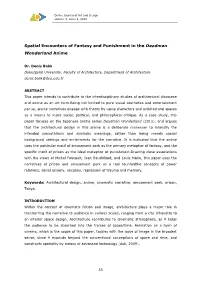
Online Journal of Art and Design volume 3, issue 3, 2015 Spatial Encounters of Fantasy and Punishment in the Deadman Wonderland Anime Dr. Deniz Balık DokuzEylül University, Faculty of Architecture, Department of Architecture deniz.balik@deu.edu.tr ABSTRACT This paper intends to contribute to the interdisciplinary studies of architectural discourse and anime as an art form.Being not limited to pure visual aesthetics and entertainment per se, anime narratives engage with theory by using characters and architectural spaces as a means to make social, political, and philosophical critique. As a case study, this paper focuses on the Japanese anime series Deadman Wonderland (2011), and argues that the architectural design in this anime is a deliberate maneuver to intensify the intended connotations and symbolic meanings, rather than being merely casual background settings and enrichments for the narrative. It is indicated that the anime uses the particular motif of amusement park as the primary metaphor of fantasy, and the specific motif of prison as the ideal metaphor of punishment.Drawing close associations with the views of Michel Foucault, Jean Baudrillard, and Louis Marin, this paper uses the narratives of prison and amusement park as a tool tounfoldthe concepts of power relations, social anxiety, uncanny, repression of trauma and memory. Keywords: Architectural design, anime, cinematic narrative, amusement park, prison, Tokyo. INTRODUCTION Within the context of cinematic fiction and image, architecture plays a major role in transferring the narrative to audience in various scales, ranging from a city silhouette to an interior space design. Architecture contributes to cinematic atmosphere, as it helps the audience to be absorbed into the frames of space/time. -

1144 05/16 Issue One Thousand One Hundred Forty-Four Thursday, May Sixteen, Mmxix
#1144 05/16 issue one thousand one hundred forty-four thursday, may sixteen, mmxix “9-1-1: LONE STAR” Series / FOX TWENTIETH CENTURY FOX TELEVISION 10201 W. Pico Blvd, Bldg. 1, Los Angeles, CA 90064 911tvshow@gmail.com PHONE: 310-969-5511 FAX: 310-969-4886 STATUS: Summer 2019 PRODUCER: Ryan Murphy - Brad Falchuk - Tim Minear CAST: Rob Lowe RYAN MURPHY PRODUCTIONS 10201 W. Pico Blvd., Bldg. 12, The Loft, Los Angeles, CA 90035 310-369-3970 Follows a sophisticated New York cop (Lowe) who, along with his son, re-locates to Austin, and must try to balance saving those who are at their most vulnerable with solving the problems in his own life. “355” Feature Film 05-09-19 ê GENRE FILMS 10201 West Pico Boulevard Building 49, Los Angeles, CA 90035 PHONE: 310-369-2842 STATUS: July 8 LOCATION: Paris - London - Morocco PRODUCER: Kelly Carmichael WRITER: Theresa Rebeck DIRECTOR: Simon Kinberg LP: Richard Hewitt PM: Jennifer Wynne DP: Roger Deakins CAST: Jessica Chastain - Penelope Cruz - Lupita Nyong’o - Fan Bingbing - Sebastian Stan - Edgar Ramirez FRECKLE FILMS 205 West 57th St., New York, NY 10019 646-830-3365 freckleasst@freckle-films.com FILMNATION ENTERTAINMENT 150 W. 22nd Street, Suite 1025, New York, NY 10011 917-484-8900 nyoffice@filmnation.com GOLDEN TITLE 29 Austin Road, 11/F, Tsim Sha Tsui, Kowloon, Hong Kong, China UNIVERSAL PICTURES 100 Universal City Plaza Universal City, CA 91608 818-777-1000 A large-scale espionage film about international agents in a grounded, edgy action thriller. The film involves these top agents from organizations around the world uniting to stop a global organization from acquiring a weapon that could plunge an already unstable world into total chaos. -
The Animated Movie Guide
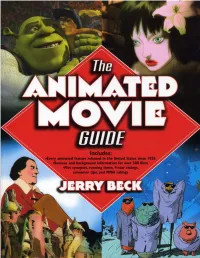
THE ANIMATED MOVIE GUIDE Jerry Beck Contributing Writers Martin Goodman Andrew Leal W. R. Miller Fred Patten An A Cappella Book Library of Congress Cataloging-in-Publication Data Beck, Jerry. The animated movie guide / Jerry Beck.— 1st ed. p. cm. “An A Cappella book.” Includes index. ISBN 1-55652-591-5 1. Animated films—Catalogs. I. Title. NC1765.B367 2005 016.79143’75—dc22 2005008629 Front cover design: Leslie Cabarga Interior design: Rattray Design All images courtesy of Cartoon Research Inc. Front cover images (clockwise from top left): Photograph from the motion picture Shrek ™ & © 2001 DreamWorks L.L.C. and PDI, reprinted with permission by DreamWorks Animation; Photograph from the motion picture Ghost in the Shell 2 ™ & © 2004 DreamWorks L.L.C. and PDI, reprinted with permission by DreamWorks Animation; Mutant Aliens © Bill Plympton; Gulliver’s Travels. Back cover images (left to right): Johnny the Giant Killer, Gulliver’s Travels, The Snow Queen © 2005 by Jerry Beck All rights reserved First edition Published by A Cappella Books An Imprint of Chicago Review Press, Incorporated 814 North Franklin Street Chicago, Illinois 60610 ISBN 1-55652-591-5 Printed in the United States of America 5 4 3 2 1 For Marea Contents Acknowledgments vii Introduction ix About the Author and Contributors’ Biographies xiii Chronological List of Animated Features xv Alphabetical Entries 1 Appendix 1: Limited Release Animated Features 325 Appendix 2: Top 60 Animated Features Never Theatrically Released in the United States 327 Appendix 3: Top 20 Live-Action Films Featuring Great Animation 333 Index 335 Acknowledgments his book would not be as complete, as accurate, or as fun without the help of my ded- icated friends and enthusiastic colleagues. -

Nippon Nights Press Release 0625
! " " ! PRESS CONTACT! Isabel Fondevila! isabel@roxie.com! 415.431.3611! ! THE ROXIE launches “NIPPON NIGHTS”, a Monthly Film Series! devoted to Japanese Cinema! San Francisco (6.24.14) – The Roxie Theater is proud to announce Nippon Nights, a new monthly series dedicated to Japanese cinema. The first season, titled “Neon Tokyo”, throws the spotlight on the popular genre of Anime. The series opens on July 16 with SHORT PEACE, a program of four shorts that includes the 2013 Oscar nominated short “Possessions” and Katsuhiro Otomo’s latest work “Combustible”. Nippon Nights is scheduled to continue in August and September, with AKIRA (on 35mm) directed by Katsuhiro Otomo, on Thursday, August 21st, and TAMALA 2010: A Punk Cat in Space & WAKE UP!! TAMALA directed by t.o.L on Thursday, September 25th.! “The Nippon Nights series was conceived in response to Roxie audience requests for Japanese cinema - particularly Anime films such as Akira and Tamala" said programmer Fuyumi Saito. "It was logical to kick off the series with a sampling of animated films that represent the Japanese mastery of this genre. In a wider sense, Nippon Nights is an effort to shine a light on the richness of Japanese cinema" Saito said. "We will dramatically bridge different styles, genres and generations throughout the series, giving local cinephiles the opportunity to further engage with Japanese cinema, history and culture."! Nippon Nights is curated by Japan native programmer Fuyumi Saito. The series is endorsed by the Consulate General of Japan in San Francisco and co-presented by CAAM. The promotional partner is btrax.! Admission: General $10, Senior $7.5 Shows start at 7:00 pm, except for AKIRA, on August 21st, which starts at 8:00pm.