Irish Political Review, April 2010
Total Page:16
File Type:pdf, Size:1020Kb
Load more
Recommended publications
-

Geschichte Des Hungerstreikes [Bearbeiten]
Der Hungerstreik ist eine Form des passiven Widerstands. Ein Einzelner oder eine Gruppe verweigern dabei die Nahrungsaufnahme mit dem bewussten Risiko, Schaden zu nehmen. Der Hungerstreik wurde weltweit schon früh als Form des politischen Widerstands praktiziert. Wie jede Streikaktion ist der politische Hungerstreik eine öffentliche Demonstration mit einem konkreten Ziel. Das unterscheidet den Hungerstreik vom Fasten, dessen Ziele entweder spirituell oder medizinisch gesteckt sind. Folgen [Bearbeiten] Ein Hungerstreik hat drastische Folgen, da die Nahrungsverweigerung bereits ab etwa drei bis vier Wochen zu ernsthaften, zum Teil bleibenden gesundheitlichen Schäden bis hin zum Tod führen kann. Einige hungerstreikende Menschen haben 50 bis 70 Tage überlebt. Bobby Sands, ein Mitglied der IRA, starb nach 66 Tagen. Holger Meins, Mitglied der Rote Armee Fraktion, starb nach 57 Tagen im Jahre 1974. Gelegentlich wird der Hungerstreik durch Zwangsernährung mittels Magensonde gebrochen. Geschichte des Hungerstreikes [Bearbeiten] Politischer Hungerstreik [Bearbeiten] Mahatma Gandhi in Indien verweigerte in den 1930er und 1940er Jahren mehrfach wochenlang die Nahrungsaufnahme, um sein Volk von einem Bürgerkrieg abzuhalten, zu dem es dann tatsächlich nicht kam. Louis Lecoin (1888-1971) trat in seinem 1958 begonnenen, auch von Albert Camus unterstützten Kampf für Legalisierung der Kriegsdienstverweigerung am 1. Juni 1961 in einen Hungerstreik, der bald von der großen Presse (besonders der satirischen Zeitung Canard enchaîné) unterstützt wurde. Am 22. Tag brach er das Fasten aufgrund eines Einlenkens von Premierminister Georges Pompidou ab, aber erst auf Androhung eines erneuten Hungerstreiks zwei Jahre später kam es zum Nachgeben der Regierung und schließlich im Dezember 1963 zum Erlass eines Gesetzes und zur Freilassung der inhaftierten Verweigerer. Seine Nominierung für den Friedensnobelpreis ließ er 1964 zugunsten von Martin Luther King zurückziehen. -
Centenary Timeline for the County of Cork (1920 – 1923)
CENTENARY TIMELINE FOR THE COUNTY OF CORK (1920 – 1923) – WAR OF INDEPENDENCE AND CIVIL WAR Guidance Note: This document provides hundreds of key dates with regard to the involvement of County Cork in the War of Independence and Civil War. These include the majority of the key occurrences of 1920 – 1923 including all major events from the County of Cork (including some other locations that involved people from County Cork), as well as key developments on the national level (or elsewhere in the country) during this timeframe (blue). All key ambushes, attacks and executions are included as well as events that saw the loss of life of Cork people, whether in Cork County or further afield. A number of notable events pertaining to Cork City (note: not all) are also included (green) and a details/link section is provided to indicate the source material. While every effort has been made to ensure the accuracy of information contained within this document, given the volume of material and variations in the historical record, there will undoubtedly be errors, omissions and other such issues. It is the intention of Cork County Council’s Commemorations Committee that this will remain a ‘live document’ and all suggested additional dates/amendments/etc. are most welcome, with this document being continually updated as appropriate. Cork County Council’s Commemorations Committee recognises and wishes to pay tribute to the excellent research already undertaken by some excellent scholars regarding this time period and looks forward to further correspondence from community groups and other interested persons. It is the purpose of this document to provide such dates that will assist local community groups in the organising of their local centenary events. -
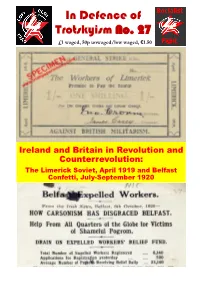
In Defence of Trotskyism No. 27 £1 Waged, 50P Unwaged/Low Waged, €1.50
In Defence of Trotskyism No. 27 £1 waged, 50p unwaged/low waged, €1.50 2 to ‘No Platform’ fascists but we never call on the Socialist Fight Where We capitalist state to ban fascist marches or parties; these laws would inevitably primarily be used against work- Stand (extracts) ers’ organisations, as history has shown. 1. We stand with Karl Marx: ‘The emancipation of the 14. We oppose all immigration controls. International working classes must be conquered by the working finance capital roams the planet in search of profit and classes themselves. The struggle for the emancipation imperialist governments disrupts the lives of workers of the working class means not a struggle for class and cause the collapse of whole nations with their privileges and monopolies but for equal rights and direct intervention in the Balkans, Iraq and Afghani- duties and the abolition of all class rule’ (The Interna- stan and their proxy wars in Somalia and the Demo- tional Workingmen’s Association 1864, General cratic Republic of the Congo, etc. Workers have the Rules). The working class ‘cannot emancipate itself right to sell their labour internationally wherever they without emancipating itself from all other sphere of get the best price. society and thereby emancipating all other spheres of 19. As socialists living in Britain we take our responsi- society’ (Marx, A Contribution to a Critique of Hegel’s bilities to support the struggle against British imperial- Philosophy of Right, 1843). ism’s occupation of the six north-eastern counties of 9. We are completely opposed to man-made climate Ireland very seriously. -

Centenary Timeline for the County of Cork (1920 – 1923) – War Of
CENTENARY TIMELINE FOR THE COUNTY OF CORK (1920 – 1923) – WAR OF INDEPENDENCE AND CIVIL WAR Guidance Note: This document provides hundreds of key dates with regard to the involvement of County Cork in the War of Independence and Civil War. These include the majority of the key occurrences of 1920 – 1923 including all major events from the County of Cork (including some other locations that involved people from County Cork), as well as key developments on the national level (or elsewhere in the country) during this timeframe (blue). All key ambushes, attacks and executions are included as well as events that saw the loss of life of Cork people, whether in Cork County or further afield. A number of notable events pertaining to Cork City (note: not all) are also included (green) and a details/link section is provided to indicate the source material. While every effort has been made to ensure the accuracy of information contained within this document, given the volume of material and variations in the historical record, there will undoubtedly be errors, omissions and other such issues. It is the intention of Cork County Council’s Commemorations Committee that this will remain a ‘live document’ and all suggested additional dates/amendments/etc. are most welcome, with this document being continually updated as appropriate. Cork County Council’s Commemorations Committee recognises and wishes to pay tribute to the excellent research already undertaken by some excellent scholars regarding this time period and looks forward to further correspondence from community groups and other interested persons. It is the purpose of this document to provide such dates that will assist local community groups in the organising of their local centenary events. -

The Catholic Church Versus the IRA Hunger Strikers of 1923
The Catholic Church versus the IRA Hunger Strikers of 1923 In the Ireland of 1922, a civil war tore through the land and in its path it ripped apart families and friendships. It also created a deeper wedge in an unstable society where the church grappled for top position in an emerging new state. The Irish Republican Army had fought a War of Independence against British rule for over three years and, led by the young enigmatic Michael Collins, it managed to push the British government to the negotiating table. Hopes of achieving a free and united Irish republic were dashed when negotiations resulted in six counties of the northern part of the island staying with Britain and the remaining 26 counties of the south gaining home rule under the guise of an Irish Free State. It split the Irish republican movement in two halves between those who favoured an Irish Free State and those who wanted to continue the fight for an Irish Republic. What followed was the most unsavoury of wars; a civil war. It was a short lived campaign but a bitter and bloody one. It was a war that saw brothers fighting against brothers and comrades who had fought together during the War of Independence now on opposing sides. The Irish Free State won the Civil War and as it came to an official end in May 1923, republican prisoners remained incarcerated. To protest at their continued imprisonment, IRA prisoners carried out a hunger strike. The act of Irish republican prisoners going on hunger strike had been used during the War of Independence and continued to be used during the Civil War when twenty three members of the women’s wing of the IRA, Cumann na mBan, who were imprisoned in Dublin’s Mountjoy jail, conducted a hunger strike in February 1923. -

Jimmy's Hall Presentation by Peter Anderson
Jimmy’s Hall Presentation by Peter Anderson (from Wikipedia) Jimmy's Hall is a 2014 British-Irish drama film directed by Ken Loach, The film tells the story of the return in Ireland in 1933 after deportation to the United States of Jimmy Gralton, who led the Revolutionary Workers' Group, a precursor of the Irish Communist Party, in Leitrim. It stars Irish actor Barry Ward, along with Simone Kirby and Jim Norton. The title refers to a rural dance hall built by Gralton to expound his political views. It was selected to compete for the Palme d'Or in the main competition section at the 2014 Cannes Film Festival. Reception Jimmy's Hall garnered generally positive critical reception. Review aggregation website Rotten Tomatoes gives the film a score of 71%. Another review aggregator, Metacritic, assigned the film a weighted average score of 60/100, based on 7 reviews from mainstream critics. Plot In 1932, after ten years in the United States, Jimmy Gralton returns to his native Ireland to help his mother run the family farm. A new government is in power in Ireland ten years after the end of the Civil War. To meet the needs of the young people of County Leitrim, Jimmy, in spite of his reluctance to cause upset to his old enemies (the Church and the local landowners), decides to reopen the 'Hall', a young people's centre, free and open to all, where the local young people meet to dance, study or talk. Success comes quickly, but the growing influence of Jimmy and his radical ideas is not to the taste of everyone in the village.