Feminist Critique of Posthuman Embodiment In
Total Page:16
File Type:pdf, Size:1020Kb
Load more
Recommended publications
-

Motoko Kusanagi: the Japanese Superwoman a Comparative Film Analysis of Rupert Sanders’ and Mamoru Oshii’S Ghost in the Shell
Motoko Kusanagi: the Japanese Superwoman A comparative film analysis of Rupert Sanders’ and Mamoru Oshii’s Ghost in the Shell Janina Ida Maria Ikäheimo Bachelor’s seminar and thesis (682285A) English philology, Faculty of Humanities University of Oulu Spring 2019 1 Abstrakti/Abstract Tässä kandintyössä tutkitaan Mamoru Oshiin ja Rupert Sandersin filmatisointeja Masamune Shirow’n Ghost in the Shell –mangasta. Hollywood on kuluneiden aikojen saatossa tuottanut useita uudelleenfilmatisointeja japanilaisista kulttiklassikoista: usein vaikka alkuperäinen elokuva ja päähenkilöt ovat japanilaisia, hahmot sekä miljöö vaihdetaan amerikkalaisiksi. Tarkastelen Ghost in the Shell -elokuvaa, joka on uudelleenfilmatisointi samannimisestä japanilaisesta animaatioelokuvasta. Elokuva sijoittuu yhä Japaniin, mutta pääosa näyttelijöistä on kaukaasialaisia. Ghost in the Shell oli aikanaan merkittävä elokuva vahvan aasialaisen naispäähenkilönsä johdosta. Päämääränäni on tutkia, miten elokuvissa näkyvä orientalismi ja oksidentalismi, eli idän ja lännen stereotypiat, sekä elokuvan näyttelijöiden etnisen taustan muuttaminen vaikuttavat päähenkilön hahmoon. Tutkin myös päähenkilön identiteettiä aasialaisena naisena, ja miten se muuttuu, kun näyttelijä vaihtuu amerikkalaiseen. Katsoin alkuperäisen vuonna 1995 ilmestyneen elokuvan japaninkielisellä ääniraidalla ja englanninkielisillä teksteillä, ja uuden, vuoden 2017 filmatisoinnin englanninkielisellä ääniraidalla. Hyödynnän tutkimuksessani artikkeleita liittyen animen historiaan, sekä rodun ja sukupuolen näkymiseen -

Gendered Cyborgs and Human Boundaries in Mamoru Oshii's
UNIVERSITY OF HAIFA FACULTY OF HUMANITIES DEPARTMENT OF ASIAN STUDIES Creatures on Borderlands: Gendered Cyborgs and Human Boundaries in Mamoru Oshii’s Ghost in the Shell Movies A seminar paper in the course Contemporary Japanese Popular Culture Submitted to: Dr. Michal Daliot-Bul 2014 Table of Content Introduction .......................................................................................................................... 1 Chapter 1: Representations of the Gendered Cyborg .............................................. 4 Chapter 2: Constructing the Human-Machine Hybrid ............................................. 9 Chapter 3: The Films as a Mirror of Japanism ........................................................ 15 Conclusion .......................................................................................................................... 18 Bibliography ...................................................................................................................... 20 Introduction They fascinate us because they are not like us and yet just like us. - Anne Balsamo, Technologies of the Gendered Body: Reading Cyborg Women. The idea of artificial life created from inanimate materials has always fascinated human beings. Since Science Fiction emerged as a genre, it extended to explore fears and desires that run deep within our cultures.Sophisticated dimensions were further added to the genrewith the invention of cybernetics in the 1960s and the subsequent emergence of cyberpunk in the 80s, but it could be argued -
“It Is Time to Become a Part of All Things”: Understanding Identity Outside of Humanist Ontology
“IT IS TIME TO BECOME A PART OF ALL THINGS”: UNDERSTANDING IDENTITY OUTSIDE OF HUMANIST ONTOLOGY A Thesis by KRISTOPHER LEE LONDON Submitted to the Graduate School at Appalachian State University in partial fulfillment of the requirements for the degree of MASTER OF ARTS December 2016 Department of English “IT IS TIME TO BECOME A PART OF ALL THINGS”: UNDERSTANDING IDENTITY OUTSIDE OF HUMANIST ONTOLOGY A Thesis by KRISTOPHER LEE LONDON December 2016 APPROVED BY: Başak Çandar, Ph.D. Chairperson, Thesis Committee Chris Meade, Ph.D. Member, Thesis Committee Germán Campos-Muñoz, Ph.D. Member, Thesis Committee Carl Eby, Ph.D. Chairperson, Department of English Max C. Poole, Ph.D. Dean, Cratis D. Williams School of Graduate Studies Copyright by Kristopher Lee London 2016 All Rights Reserved Abstract “IT IS TIME TO BECOME A PART OF ALL THINGS”: UNDERSTANDING IDENTITY OUTSIDE OF HUMANIST ONTOLOGY Kristopher Lee London B.A., University of North Carolina at Chapel Hill M.A., Appalachian State University Chairperson: Başak Çandar The following thesis analyzes two anime works by Japanese filmmaker Mamoru Oshii, Ghost in the Shell and Ghost in the Shell 2: Innocence, in order to theorize a way of being outside of humanist ontology through the subversive cyborg politics dramatized within the films. Both films reveal the failure of humanist paradigms in accounting for identity and provide an alternative, more holistic model of existence that emphasizes interconnectivity over human individualism that pivots on human’s self-made exclusivity. In Ghost in the Shell and Innocence, humanist paradigms are suggested to prescribe ready-made ways of perceiving and interacting with the world such that new ways of being are precluded. -

Japanese Cinema As Mass Art: an Export of Mass Cinema
Japanese cinema as mass art: an export of mass cinema by Alex Fucile B.A Hons A thesis submitted in partial fulfilment for the requirements of the degree of MA at the University of Central Lancashire 3/2011 Abstract The aim of the thesis is to examine the distribution and consumption of contemporary Japanese cinema in the UK. Through the study of aesthetics it seeks to identify the ways in which content and current distribution methods suit different markets. Noël Carroll’s definition of cinema and contemporary media as ‘mass art’ has informed the way in which the thesis notes variation in film content, and forms the core methodology. The selected texts range from the post-war period (1948) with films by directors such as Akira Kurosawa, to contemporary animation cinema such as the work of Mamoru Hosada (2009). The distribution methods of these films is of particular importance as the thesis links them to the export of Japanese identity. The films are available to a UK audience via a range of distribution methods such as officially distributed DVDs, online distribution, and art house cinema exhibitions. There is an emphasis on digital distribution throughout the thesis and this is reflected through the use of texts downloaded from the internet as well as digital sources such as university encyclopaedias and e- books. Each chapter is organised around a distinctive and specified market for Japanese cinema and includes detailed textual analysis of film examples. In the final chapter, on the popularity of Japanese animation (anime), the analysis is enhanced with empirical research into online consumption groups and internet communication, given these groups’ important role in the distribution of anime outside of Japan. -

Adapting Anime: Transnational Media Between Japan and the United States
ADAPTING ANIME: TRANSNATIONAL MEDIA BETWEEN JAPAN AND THE UNITED STATES Brian Ruh Submitted to the faculty of the University Graduate School in partial fulfillment of the requirements for the degree Doctor of Philosophy in the Department of Communication and Culture, Indiana University May 2012 Acceptance page Accepted by the Graduate Faculty, Indiana University, in partial fulfillment of the requirements for the degree of Doctor of Philosophy. Doctoral Committee ____________________________________ Barbara Klinger, Ph.D. ____________________________________ Gregory Waller, Ph.D. ____________________________________ Yeidy Rivero, Ph.D. ____________________________________ Scott O’Bryan, Ph.D. April 9, 2012 ii Acknowledgements I am very grateful to my Ph.D. committee – Barbara Klinger, Gregory Waller, Yeidy Rivero, and Scott O’Bryan – for supporting me (and putting up with me) for these last few years. My parents, Richard and Christine, and parents in law, Dan and Barbara Skinner, have been positive influences throughout this entire process, and I’m sure they’re all glad to see me finish. However, the person who may have borne the most stress through the entire process has been my loving wife Sarah. I’m so thankful to have her. I also need to acknowledge my two beautiful daughters Charlotte and Abby, the sources of both great joy and great delays in the writing process. And finally, hello to Jason Isaacs. iii Abstract Brian Ruh ADAPTING ANIME: TRANSNATIONAL MEDIA BETWEEN JAPAN AND THE UNITED STATES This dissertation examines Japanese animation, or anime, as an example of how a contemporary media product crosses national and cultural borders and becomes globalized. Bringing together the theories of Hiroki Azuma and Susan J. -
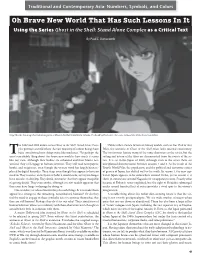
Using the Series Ghost in the Shell: Stand Alone Complex As a Critical Text
Traditional and Contemporary Asia: Numbers, Symbols, and Colors Oh Brave New World That Has Such Lessons In It Using the Series Ghost in the Shell: Stand Alone Complex as a Critical Text By Paul E. Dunscomb Major Motoko Kusanagi, the main protagonist of Ghost in the Shell: Stand Alone Complex. Produced by Production I.G. Source: Just Good Vibe at http://tinyurl.com/z3llxhn. he 2002 and 2004 anime series Ghost in the Shell: Stand Alone Com- Unlike other science fiction or fantasy worlds, such as Star Trek or Star plex portrays a world where the vast majority of human beings have Wars, the universe of Ghost in the Shell often lacks internal consistency. been transformed into things more like machines.1 Yet perhaps the The two movies feature many of the same characters as the series, but the Tmost remarkable thing about this brave new world is how much it seems setting and action of the films are disconnected from the events of the se- like our own. Although their bodies are enhanced and their brains net- ries. It is set in the Japan of 2030, although even in the series there are worked, they still engage in human activities. They still read newspapers, unexplained discontinuities between seasons 1 and 2. As the result of the books, and magazines, even though the written word has largely been re- Fourth World War, the population, and the political and economic center placed by digital barcodes. They sleep, even though they appear to have no of gravity of Japan, has shifted well to the south. -
Theorizing the Gynoid Double-Bind in Mamoru Oshii's Ghost in the Shell II
103 Death, Innocence, and the Cyborg DOI: 10.1515/abcsj-2017-0021 Death, Innocence, and the Cyborg: Theorizing the Gynoid Double-Bind in Mamoru Oshii’s Ghost in the Shell II: Innocence KWASU D. TEMBO University of Edinburgh Abstract In Donna Haraway’s “A Cyborg Manifesto” (1983), the author presents a discussion of the concept and praxis of the cyborg in emancipatory terms. Haraway presents the cyborg as a transgressive and latently mercurial figure that decouples and contravenes numerous exploitative ideological frameworks of repressive biopower that repress human being and reproduce the conditions of said repression. Using Mamoru Oshii’s Ghost in the Shell II: Innocence (2004) as a dialogic case study, this essay explores the manner in which the cyborg, particularly its figuration as female-gendered anthropic machine or gynoid in 20 th - and 21 st -century science fiction, simultaneously confirms and contradicts Haraway’s assessment of the concept of the cyborg. As to its methodology, this essay opens with a contextualizing excursus on the cyber-being in contemporary Western society and sociopolitics, with a view to offering a framework analysis of the figuration of the gynoid in Oshii’s Ghost in the Shell II: Innocence as a recent example of contemporary science fiction’s representation of the issues and debates inherent to the concept of the gynoid. Lastly, this essay performs a detailed close reading of Oshii’s text in relation to its exploration of themes of the conceptual emancipatory potential of the cyber-being and the paradoxically -

The Popular Culture of Computer Scientists : No Beginnings and No Endings
The popular culture of computer scientists : No beginnings and no endings. Camille Akmut July 24, 2019 Abstract Part 3 of 3 covers manga, anime and video games; But, this was never about popular culture... 1 Foreword No mere `cultural history', of doubtful use or importance1, in this paper we continue investigations of the subconscious of scientists in the tradition of Bachelard and other leading historians of science. This exceptional philosopher-historian of a background in mathematics had given their imagination and dreams a central role : highlighting them as integral parts of their scientific activities and endeavors, along with all the other parts of their lives that were either dismissed or underestimated; demonstrating their implications even onto their works themselves. | \The popular culture of computer scientists" : a title of two meanings2, a project kept last. In many places of this history, we found mirrors showing towards oth- ers, creating endless reflections of one culture influencing, contrasting, inspiring, contradicting the other; such that there remained seemingly no beginnings and no endings. In the alternative futures variously imagined in these works of fiction, computer scientists have roles { and powers { increasingly akin to that of doctors, psychiatrists, psychologists and legal experts : of the new body, and the new mind. Such is their great responsibility, now and even more to come. There, the hardware and software they fashioned and created became part of us { inside. Algorithms, systems, circuits, routines, cryptographies hopefully strong enough to guard the secrets of minds and hearts, the integrity of values and beliefs, the accuracy and faithfulness of memories, and vision. -

Lifeafter X GHOST in the SHELL: SAC 2045 Crossover Launches Today Crossover PV Debuts and Limited Items Now Available!
LifeAfter x GHOST IN THE SHELL: SAC_2045 Crossover Launches Today Crossover PV Debuts and Limited Items Now Available! February 18, 2021 Guangzhou, China, 18th February 2021 --The crossover between LifeAfter, NetEase Games' acclaimed Open World Doomsday Survival Game, and the sci-fi animation GHOST IN THE SHELL: SAC_2045 is officially launched today. The crossover features outfits of MOTOKO KUSANAGI and BATOU, main characters from GHOST IN THE SHELL: SAC_2045, and also a lot of limited exclusive items, such as TACHIKOMA Decoration and TACHIKOMA Backpack, Ghost in the Shell motorcycle. There will also be more cyberpunk elements in Levin City. On top of all that, players can win rich rewards by participating in the SNS share activities. Crossover Date February 18 to March 4, 2021 n. Crossover PV Debuts! The promotion video of the LifeAfter x GHOST IN THE SHELL: SAC_2045 crossover is revealed along with the launch. https://www.youtube.com/watch?v=OaorDsIqfRg&feature=youtu.be n. Limited Crossover Items Now Available The crossover brings exquisite limited items. Outfits “Ghost in the Shell” designed from MOTOKO KUSANAGI and her best partner BATOU are now available in the game. Log in for free TACHIKOMA Pendant and take part in activities for the Ghost in the Shell figurine. Limited items just hit the shelves, including TACHIKOMA Decoration and TACHIKOMA Backpack, Ghost in the Shell motorcycle, Illusory City Wallpaper and MOTOKO Poster. They are available during the crossover, so don’t miss it! n. Big Prize from Crossover SNS Activities In order to celebrate the launch, LifeAfter official SNS account will randomly select lucky players who share the event to give out rewards. -

STRAY DOG of ANIME: the Films of Mamoru Oshii
01 ruh fm 5/13/04 3:13 PM Page i STRAY DOG OF ANIME This page intentionally left blank 01 ruh fm 5/13/04 3:13 PM Page iii STRAY DOG OF ANIME * The Films of Mamoru Oshii BRIAN RUH 01 ruh fm 5/13/04 3:13 PM Page iv STRAY DOG OF ANIME Copyright © Brian Ruh, 2004. All rights reserved. No part of this book may be used or reproduced in any manner whatsoever without written permission except in the case of brief quotations embodied in critical articles or reviews. First published 2004 by PALGRAVE MACMILLAN™ 175 Fifth Avenue, New York, N.Y. 10010 and Houndmills, Basingstoke, Hampshire, England RG21 6XS. Companies and representatives throughout the world. PALGRAVE MACMILLAN is the global academic imprint of the Palgrave Macmillan division of St. Martin’s Press, LLC and of Palgrave Macmillan Ltd. Macmillan® is a registered trademark in the United States, United Kingdom and other countries. Palgrave is a registered trademark in the European Union and other countries. ISBN 1-4039-6329-0 hardback ISBN 1-4039-6334-7 paperback Library of Congress Cataloging-in-Publication Data Ruh, Brian. Stray dog of anime : the films of Mamoru Oshii / Brian Ruh. p. cm. Includes bibliographical references and index. ISBN 1-4039-6329-0 — ISBN 1-4039-6334-7 (pbk.) 1. Oshii, Mamoru—Criticism and interpretation. 1. Title. PN1998.3.O83R84 2004 791.43’34023’092—dc22 2003068903 A catalogue record for this book is available from the British Library. Design by Letra Libre. First edition: June 2004 10987654321 Printed in the United States of America. -

Ghost in the Shell
GHOST IN THE SHELL: THE SOUL WITHIN By REBECCA GRUBB A thesis submitted to the Graduate School-Camden Rutgers, The State University of New Jersey In partial fulfillment of the requirements For the degree of Master of Arts Graduate Program in English Written under the direction of Holly Blackford Ph. D And approved by _____________________________ Holly Blackford Ph. D _____________________________ Keith Green Ph. D Camden, New Jersey May 2017 THESIS ABSTRACT Ghost in the Shell: The Soul Within by REBECCA GRUBB Thesis Director: Holly Blackford Ph. D This project involved the research into the 1995 Ghost in the Shell. Drawing mainly from Donna Haraway, Judith Butler, Carl Silvio, Jane Chi Hyun Park, Sharalyn Orbaugh, Steven Culver, Steven T. Brown, Julie Clarke, and others, I apply cyborg theory and argue that the main character Motoko Kusanagi is a mechanized laborer for the state, exploited and dehumanized as a Japanese female cyborg who seeks purpose outside of the limitations of Section Nine, and her success in such an endeavor. Most others who have studied Ghost in the Shell focus mainly on gender, the body, or the film’s general message of technology integrating inevitably with humanity, but not Motoko’s individual journey as an exploited tool to a completely free individual, her mechanical nature humanizing her more so than any actual human character. The film shows the similarities between the mechanical and the human, and how dangerous it is to fear technological changes and evolution, to fear that it may escape our control—it already has, and we must embrace it, just as Motoko does, and becomes better for it. -

Anatomy of Permutational Desire, Part III: the Artificial Woman and the Perverse Structure of Modernity
Anatomy of Permutational Desire, Part III: The Artificial Woman and the Perverse Structure of Modernity Livia Monnet Mechademia, Volume 7, 2012, pp. 282-297 (Article) Published by University of Minnesota Press For additional information about this article http://muse.jhu.edu/journals/mec/summary/v007/7.monnet.html Access provided by The Cooper Union Library (20 Jan 2014 11:32 GMT) livia Monnet Anatomy of Permutational Desire, Part III: The Artificial Woman and the Perverse Structure of Modernity This last installment of my essay on perversion in Hans Bellmer and in Oshii Mamoru’s anime Innocence argues that the film elaborates a massive theory of the perverse structure of modernity. This theory manifests itself in three main forms: (1) the transformation of the human into a universal equivalent that promises yet fails to hold together a broad range of discourses on the modern subject; (2) the consequent stretching of the figure of “Man” to the snapping point, which is also registered as a crisis in the unities of classical animation; and (3) a moment of crisis of modernity that perversion can no longer manage, and this is where a new figure emerges, the gynoid. But rather than stepping in to ground the modern human subject and “his democracy,” the gynoid forces us to begin modernity and democracy all over again, as if for the first time, but not in the form of critical or juridical reason but in material configurations themselves. stRetching the modeRn suBject When Batou (or Batō) and Togusa arrive at Kim’s mansion, Kim hacks into their e-brains, generating three virtual-reality simulations to stall their 282 investigation.