Kule Centre for Ukrainian and Canadian Folklore Andriy Nahachewsky
Total Page:16
File Type:pdf, Size:1020Kb
Load more
Recommended publications
-

Chapter IX: Ukrainian Musical Folklore Discography As a Preserving Factor
Art Spiritual Dimensions of Ukrainian Diaspora: Collective Scientific Monograph DOI 10.36074/art-sdoud.2020.chapter-9 Nataliia Fedorniak UKRAINIAN MUSICAL FOLKLORE DISCOGRAPHY AS A PRESERVING FACTOR IN UKRAINIAN DIASPORA NATIONAL SPIRITUAL EXPERIENCE ABSTRACT: The presented material studies one of the important forms of transmission of the musical folklore tradition of Ukrainians in the United States and Canada during the XX – the beginning of the XXI centuries – sound recording, which is a component of the national spiritual experience of emigrants. Founded in the 1920s, the recording industry has been actively developed and has become a form of preservation and promotion of the traditional musical culture of Ukrainians in North America. Sound recordings created an opportunity to determine the features of its main genres, the evolution of forms, that are typical for each historical period of Ukrainians’ sedimentation on the American continent, as well as to understand the specifics of the repertoire, instruments and styles of performance. Leading record companies in the United States have recorded authentic Ukrainian folklore reconstructed on their territory by rural musicians and choirs. Arranged folklore material is represented by choral and bandura recordings, to which are added a large number of records, cassettes, CDs of vocal-instrumental pop groups and soloists, where significantly and stylistically diversely recorded secondary Ukrainian folklore (folklorism). INTRODUCTION. The social and political situation in Ukraine (starting from the XIX century) caused four emigration waves of Ukrainians and led to the emergence of a new cultural phenomenon – the art and folklore of Ukrainian emigration, i.e. diaspora culture. Having found themselves in difficult ambiguous conditions, where there was no favorable living environment, Ukrainian musical folklore began to lose its original identity and underwent assimilation processes. -

Folklore and the Construction of National Identity in Nineteenth Century Russian Literature
Folklore and the Construction of National Identity in Nineteenth Century Russian Literature Jessika Aguilar Submitted in partial fulfillment of the Requirements for the degree of Doctor of Philosophy In the Graduate School of Arts and Sciences Columbia University 2016 © 2016 Jessika Aguilar All rights reserved Table of Contents 1. Introduction……………………………………………………………………………..…..1 2. Alexander Pushkin: Folklore without the Folk……………………………….20 3. Nikolai Gogol: Folklore and the Fragmentation of Authorship……….54 4. Vladimir Dahl: The Folk Speak………………………………………………..........84 5. Conclusion……………………………………………………………………………........116 6. Bibliography………………………………………………………………………………122 i Introduction In his “Literary Reveries” of 1834 Vissarion Belinsky proclaimed, “we have no literature” (Belinskii PSS I:22). Belinsky was in good company with his assessment. Such sentiments are rife in the critical essays and articles of the first third of the nineteenth century. A decade earlier, Aleksandr Bestuzhev had declared that, “we have a criticism but no literature” (Leighton, Romantic Criticism 67). Several years before that, Pyotr Vyazemsky voiced a similar opinion in his article on Pushkin’s Captive of the Caucasus : “A Russian language exists, but a literature, the worthy expression of a mighty and virile people, does not yet exist!” (Leighton, Romantic Criticism 48). These histrionic claims are evidence of Russian intellectuals’ growing apprehension that there was nothing Russian about the literature produced in Russia. There was a prevailing belief that -
This Content Downloaded from 132.174.254.159 on Tue, 08 Dec
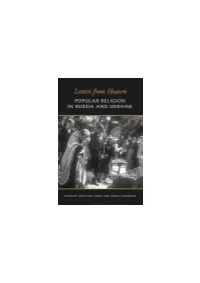
This content downloaded from 132.174.254.159 on Tue, 08 Dec 2015 11:09:27 UTC All use subject to JSTOR Terms and Conditions LETTERS FROM HEAVEN: POPULAR RELIGION IN RUSSIA AND UKRAINE This content downloaded from 132.174.254.159 on Tue, 08 Dec 2015 11:09:27 UTC All use subject to JSTOR Terms and Conditions This page intentionally left blank This content downloaded from 132.174.254.159 on Tue, 08 Dec 2015 11:09:27 UTC All use subject to JSTOR Terms and Conditions Edited by JOHNPAUL HIMKA and ANDRIY ZAYARNYUK Letters from Heaven Popular Religion in Russia and Ukraine UNIVERSITY OF TORONTO PRESS Toronto Buffalo London This content downloaded from 132.174.254.159 on Tue, 08 Dec 2015 11:09:27 UTC All use subject to JSTOR Terms and Conditions www.utppublishing.com © University of Toronto Press Incorporated 2006 Toronto Buffalo London Printed in Canada ISBN13: 9780802091482 ISBN10: 0802091482 Printed on acidfree paper Library and Archives Canada Cataloguing in Publication Letters from heaven : popular religion in Russia and Ukraine / edited by John•Paul Himka and Andriy Zayarnyuk. ISBN13: 9780802091482 ISBN10: 0802091482 1. Russia – Religion – History. 2. Ukraine – Religion – History. 3. Religion and culture – Russia (Federation) – History. 4. Religion and culture – Ukraine – History. 5. Eastern Orthodox Church – Russia (Federation) – History. 6. Eastern Orthodox Church – Ukraine – History. I. Himka, John•Paul, 1949– II. Zayarnyuk, Andriy, 1975– BX485.L48 2006 281.9 947 C20069037116 University of Toronto Press acknowledges the financial assistance to its publishing program of the Canada Council for the Arts and the Ontario Arts Council. -

The Slavic Vampire Myth in Russian Literature
From Upyr’ to Vampir: The Slavic Vampire Myth in Russian Literature Dorian Townsend Thesis submitted for the degree of Doctor of Philosophy School of Languages and Linguistics Faculty of Arts and Social Sciences The University of New South Wales May 2011 PLEASE TYPE THE UNIVERSITY OF NEW SOUTH WALES Thesis/Dissertation Sheet Surname or Family name: Townsend First name: Dorian Other name/s: Aleksandra PhD, Russian Studies Abbreviation for degree as given in the University calendar: School: Languages and Linguistics Faculty: Arts and Social Sciences Title: From Upyr’ to Vampir: The Slavic Vampire Myth in Russian Literature Abstract 350 words maximum: (PLEASE TYPE) The Slavic vampire myth traces back to pre-Orthodox folk belief, serving both as an explanation of death and as the physical embodiment of the tragedies exacted on the community. The symbol’s broad ability to personify tragic events created a versatile system of imagery that transcended its folkloric derivations into the realm of Russian literature, becoming a constant literary device from eighteenth century to post-Soviet fiction. The vampire’s literary usage arose during and after the reign of Catherine the Great and continued into each politically turbulent time that followed. The authors examined in this thesis, Afanasiev, Gogol, Bulgakov, and Lukyanenko, each depicted the issues and internal turmoil experienced in Russia during their respective times. By employing the common mythos of the vampire, the issues suggested within the literature are presented indirectly to the readers giving literary life to pressing societal dilemmas. The purpose of this thesis is to ascertain the vampire’s function within Russian literary societal criticism by first identifying the shifts in imagery in the selected Russian vampiric works, then examining how the shifts relate to the societal changes of the different time periods. -
Dahka Brakha Insert V2.Indd
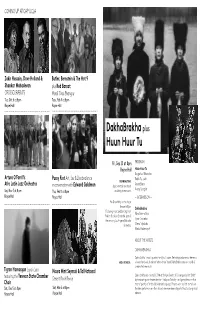
COMING UP AT CAP UCLA Zakir Hussain, Dave Holland & Butler, Bernstein & The Hot 9 Shankar Mahadevan plus Red Baraat CROSSCURRENTS Mardi Gras Bhangra Tue, Oct 6 at 8pm Tues, Feb 9 at 8pm Royce Hall Royce Hall DakhaBrakha plus Huun Huur Tu Fri, Sep 25 at 8pm PROGRAM Royce Hall Huun Huur Tu Kaygal-ool Khavalva Arturo O’Farrill’s Pussy Riot Art, Sex & Disobedience Radik Tyulyush RUNNING TIME: Sayan Bapa Afro Latin Jazz Orchestra in conversation with Edward Goldman Approximately two hours Alexey Saryglar Sat, Nov 7 at 8 pm Thu, Feb 11 at 8pm including intermission. Royce Hall Royce Hall — INTERMISSION — Pre-Show Party on the Royce Terrace 6:30pm DakhaBrakha Featuring music and dancing from Nina Garenetska Firebird Balalaika Ensemble, part of the amazing Los Angeles Balalaika Iryna Kovalenko Orchestra. Olena Tsybulska Marko Halanevych ABOUT THE ARTISTS DAHKHABRAHKA DakhaBrakha is music quartet from Kyiv, Ukraine. Refl ecting fundamental elements MEDIA SPONSOR: of sound and soul, Ukrainian “ethno chaos” band DakhaBrakha creates a world of unexpected new music. Tigran Hamasyan Luys i Luso Noura Mint Seymali & Tal National featuring the Yerevan State Chamber DakhaBrakha was created in 2004 at the Kyiv Center of Contemporary Art “DAKH” Desert Rock Revue by the avant-garde theatre director – Vladyslav Troitskyi – and given the name that Choir means “give/take” in the old Ukrainian language. Theatre work has left its mark on Sat, Dec 5 at 8pm Sat, Mar 5 at 8pm the band performances – their shows have never been staged without a strong visual Royce Hall Royce Hall element. Iryna Kovalenko – vocals, djembe, bass drums, accordion, In 2011, Huun Huur Tu collaborated with prominent Russian MESSAGE FROM THE CENTER: percussion, bugay, zgaleyka, piano composer Vladimir Martynov, who drew on the works by Ira has played Ukrainian ethnic music since her early the visionary early 20th-century avant-garde poet Velimir Tonight’s headlining group DakhaBrakha uses the childhood. -

Slavic Pagan World
Slavic Pagan World 1 Slavic Pagan World Compilation by Garry Green Welcome to Slavic Pagan World: Slavic Pagan Beliefs, Gods, Myths, Recipes, Magic, Spells, Divinations, Remedies, Songs. 2 Table of Content Slavic Pagan Beliefs 5 Slavic neighbors. 5 Dualism & The Origins of Slavic Belief 6 The Elements 6 Totems 7 Creation Myths 8 The World Tree. 10 Origin of Witchcraft - a story 11 Slavic pagan calendar and festivals 11 A small dictionary of slavic pagan gods & goddesses 15 Slavic Ritual Recipes 20 An Ancient Slavic Herbal 23 Slavic Magick & Folk Medicine 29 Divinations 34 Remedies 39 Slavic Pagan Holidays 45 Slavic Gods & Goddesses 58 Slavic Pagan Songs 82 Organised pagan cult in Kievan Rus' 89 Introduction 89 Selected deities and concepts in slavic religion 92 Personification and anthropomorphisation 108 "Core" concepts and gods in slavonic cosmology 110 3 Evolution of the eastern slavic beliefs 111 Foreign influence on slavic religion 112 Conclusion 119 Pagan ages in Poland 120 Polish Supernatural Spirits 120 Polish Folk Magic 125 Polish Pagan Pantheon 131 4 Slavic Pagan Beliefs The Slavic peoples are not a "race". Like the Romance and Germanic peoples, they are related by area and culture, not so much by blood. Today there are thirteen different Slavic groups divided into three blocs, Eastern, Southern and Western. These include the Russians, Poles, Czechs, Ukrainians, Byelorussians, Serbians,Croatians, Macedonians, Slovenians, Bulgarians, Kashubians, Albanians and Slovakians. Although the Lithuanians, Estonians and Latvians are of Baltic tribes, we are including some of their customs as they are similar to those of their Slavic neighbors. Slavic Runes were called "Runitsa", "Cherty y Rezy" ("Strokes and Cuts") and later, "Vlesovitsa". -

A Survey of Ukrainian Folk Tales
Research Report No. 56 A Survey of Ukrainian Folk Tales by Petro Lintur Translated and with an introduction by Bohdan Medwidsky Canadian Institute of Ukrainian Studies Press University of Alberta Edmonton 1994 Canadian Institute of Ukrainian Studies Press Occasional Research Reports The Institute publishes research reports periodically. Copies may be ordered from the Canadian Institute of Ukrainian Studies Press, 352 Athabasca Hall, University of Alberta, Edmonton, Alberta, Canada T6G 2E8. The name of the publication series and the substantive material in each issue (unless otherwise noted) are copyrighted by the Canadian Institute of Ukrainian Studies Press. PRINTED IN CANADA Occasional Research Reports A Survey of Ukrainian Folk Tales by Petro Lintur Translated and with an introduction by Bohdan Medwidsky Research Report No. 56 Canadian Institute of Ukrainian Studies Press University of Alberta Edmonton 1994 Table of Contents Preface 1 A Survey of Ukrainian Folk Tales 5 Bibliography 32 PREFACE This survey of Ukrainian folk tales originally appeared in German as an appendix to the collection of Ukrainian folk tales published as part of an international folk-tale series by the Zentralinstitut fur Geschichte, Wissenschaftsbereich Kulturgeschichte/Volkskunde of the Deutsche Akademie der Wissenschaften zu Berlin under the title Ukrainische Volksmar- chen , edited by P.V. Lintur, Berlin, 1972. Petro Vasyliovych Lintur was bom on 4 May 1909 into a family of peasants in the village of Horonda in the Mukachiv district of Transcarpathia. In 1937 he completed his studies of historical philology at Charles University in Prague. During the years of the Hungarian Horthy government’s rule over Transcarpathia, Lintur was a high school teacher in Khust. -

HISTORY of UKRAINE and UKRAINIAN CULTURE Scientific and Methodical Complex for Foreign Students
Ministry of Education and Science of Ukraine Flight Academy of National Aviation University IRYNA ROMANKO HISTORY OF UKRAINE AND UKRAINIAN CULTURE Scientific and Methodical Complex for foreign students Part 3 GUIDELINES FOR SELF-STUDY Kropyvnytskyi 2019 ɍȾɄ 94(477):811.111 R e v i e w e r s: Chornyi Olexandr Vasylovych – the Head of the Department of History of Ukraine of Volodymyr Vynnychenko Central Ukrainian State Pedagogical University, Candidate of Historical Sciences, Associate professor. Herasymenko Liudmyla Serhiivna – associate professor of the Department of Foreign Languages of Flight Academy of National Aviation University, Candidate of Pedagogical Sciences, Associate professor. ɇɚɜɱɚɥɶɧɨɦɟɬɨɞɢɱɧɢɣɤɨɦɩɥɟɤɫɩɿɞɝɨɬɨɜɥɟɧɨɡɝɿɞɧɨɪɨɛɨɱɨʀɩɪɨɝɪɚɦɢɧɚɜɱɚɥɶɧɨʀɞɢɫɰɢɩɥɿɧɢ "ȱɫɬɨɪɿɹ ɍɤɪɚʀɧɢ ɬɚ ɭɤɪɚʀɧɫɶɤɨʀ ɤɭɥɶɬɭɪɢ" ɞɥɹ ɿɧɨɡɟɦɧɢɯ ɫɬɭɞɟɧɬɿɜ, ɡɚɬɜɟɪɞɠɟɧɨʀ ɧɚ ɡɚɫɿɞɚɧɧɿ ɤɚɮɟɞɪɢ ɩɪɨɮɟɫɿɣɧɨʀ ɩɟɞɚɝɨɝɿɤɢɬɚɫɨɰɿɚɥɶɧɨɝɭɦɚɧɿɬɚɪɧɢɯɧɚɭɤ (ɩɪɨɬɨɤɨɥʋ1 ɜɿɞ 31 ɫɟɪɩɧɹ 2018 ɪɨɤɭ) ɬɚɫɯɜɚɥɟɧɨʀɆɟɬɨɞɢɱɧɢɦɢ ɪɚɞɚɦɢɮɚɤɭɥɶɬɟɬɿɜɦɟɧɟɞɠɦɟɧɬɭ, ɥɶɨɬɧɨʀɟɤɫɩɥɭɚɬɚɰɿʀɬɚɨɛɫɥɭɝɨɜɭɜɚɧɧɹɩɨɜɿɬɪɹɧɨɝɨɪɭɯɭ. ɇɚɜɱɚɥɶɧɢɣ ɩɨɫɿɛɧɢɤ ɡɧɚɣɨɦɢɬɶ ɿɧɨɡɟɦɧɢɯ ɫɬɭɞɟɧɬɿɜ ɡ ɿɫɬɨɪɿɽɸ ɍɤɪɚʀɧɢ, ʀʀ ɛɚɝɚɬɨɸ ɤɭɥɶɬɭɪɨɸ, ɨɯɨɩɥɸɽ ɧɚɣɜɚɠɥɢɜɿɲɿɚɫɩɟɤɬɢ ɭɤɪɚʀɧɫɶɤɨʀɞɟɪɠɚɜɧɨɫɬɿ. ɋɜɿɬɭɤɪɚʀɧɫɶɤɢɯɧɚɰɿɨɧɚɥɶɧɢɯɬɪɚɞɢɰɿɣ ɭɧɿɤɚɥɶɧɢɣ. ɋɬɨɥɿɬɬɹɦɢ ɪɨɡɜɢɜɚɥɚɫɹ ɫɢɫɬɟɦɚ ɪɢɬɭɚɥɿɜ ɿ ɜɿɪɭɜɚɧɶ, ɹɤɿ ɧɚ ɫɭɱɚɫɧɨɦɭ ɟɬɚɩɿ ɧɚɛɭɜɚɸɬɶ ɧɨɜɨʀ ɩɨɩɭɥɹɪɧɨɫɬɿ. Ʉɧɢɝɚ ɪɨɡɩɨɜɿɞɚɽ ɩɪɨ ɤɚɥɟɧɞɚɪɧɿ ɫɜɹɬɚ ɜ ɍɤɪɚʀɧɿ: ɞɟɪɠɚɜɧɿ, ɪɟɥɿɝɿɣɧɿ, ɩɪɨɮɟɫɿɣɧɿ, ɧɚɪɨɞɧɿ, ɚ ɬɚɤɨɠ ɪɿɡɧɿ ɩɚɦ ɹɬɧɿ ɞɚɬɢ. ɍ ɩɨɫɿɛɧɢɤɭ ɩɪɟɞɫɬɚɜɥɟɧɿ ɪɿɡɧɨɦɚɧɿɬɧɿ ɞɚɧɿ ɩɪɨ ɮɥɨɪɭ ɿ ɮɚɭɧɭ ɤɥɿɦɚɬɢɱɧɢɯ -

163 REPORTS FOLKLORICA 2011, Vol. XVI Ukrainian Folklore In
163 REPORTS Ukrainian folklore in Kazakhstan Natalie Kononenko Modern Languages and Cultural Studies University of Alberta Edmonton, AB, Canada Pavlodar is on the other side of the earth – quite literally. There is a 12 hour time difference between Edmonton, Alberta, Canada, where I live and Pavlodar, Kazakhstan, where I spent a month of my summer. Thus when it is 6AM in Edmonton, it is 6PM in Pavlodar. Getting to Pavlodar takes a full day. I left on the evening of June 15 and, had I made all my connections, I would have arrived on the morning of June 17. Coming home, my travel time, with plane changes, was 23 hours and 45 minutes. So why go to Pavlodar? Part of it is the adventure of it all. Why go to Penticton when you can go to Pavlodar? Anyone can go to Penticton; Pavlodar is more of a challenge. But it is not just the risk-taking side of my nature that took me to Pavlodar. There were many other reasons. The personal ones revolve around a desire to see Central Asia, to compare the Kazakh steppe to the Ukrainian one and to the Canadian prairies, to learn more about the Turkic world. Like many Ukrainians born outside of their home country, I had an imagined Ukraine, a constructed and romanticized picture of my homeland that I had formed in my mind and that begged to be compared to the real thing. I have been able to satisfy my desire to see the real Ukraine, having done extensive fieldwork there since a few years after Ukrainian Independence and having travelled to many regions of the country. -
A Comparative Study of the Literary Output of Nikolai Gogol
The Aesthetics of Effacement: A Comparative Study of the Literary Output of Nikolai Gogol and Oscar Wilde PhD Thesis 2019 Brigit Katharine McCone Student no. 09129731 1 I declare that this thesis has not been submitted as an exercise for a degree at this or any other university and it is entirely my own work. I agree to deposit this thesis in the University’s open access institutional repository or allow the Library to do so on my behalf, subject to Irish Copyright Legislation and Trinity College Library conditions of use and acknowledgement. Signed ___________________________________________________ 2 SUMMARY This thesis marks the first comprehensive comparative study of the literary output of Nikolai Gogol and Oscar Wilde, from an intersectional perspective blending genre theory, queer theory, postcolonial theory and Jungian psychoanalysis, to examine the authors as sexually and ethnically closeted while estimating the impact of this closeting on their fiction. The thesis concludes that Nikolai Gogol and Oscar Wilde have significant parallels in their conception of the artistic process, explicable by a shared exposure anxiety, significant stylistic parallels, explicable by a shared imperative to generate interpretative suspense and facilitate plausibly deniable self-expression, and significant thematic parallels in their treatment of sexuality, ethnicity and identity, explicable by a shared experience of sexual and ethnic closeting. By establishing that all major sexual themes in the fiction of Nikolai Gogol have direct parallels in the fiction of Oscar Wilde, this thesis contributes to the contextualization of Gogol as a closeted writer, while proposing new aesthetic frameworks for the evaluation of Oscar Wilde. 3 ACKNOWLEDGEMENT I am grateful for the advice and encouragement of my supervisor, Dr Sarah Smyth, of the Department of Russian and Slavonic Studies of Trinity College Dublin, and my co-supervisor, Dr Paul Delaney of the School of English, and my two examiners Jarlath Killeen and Claire Whitehead. -

Russia and Ukraine Literature and the Discourse of Empire from Napoleonic to Postcolonial Times
Russia and Ukraine Literature and the Discourse of Empire from Napoleonic to Postcolonial Times Drawing on colonial discourse and postcolonial theory to reinterpret key writers of the nineteenth and twentieth centuries, Myroslav Shkandrij shows how the need to legitimize expansion gave rise to ideas of Russian political and cultural hegemony and influenced Russian attitudes towards Ukraine. These notions were then challenged and subverted in a counterdiscourse that shaped Ukrainian literature. Concepts of civilizational superiority and redemptive assimilation, widely held among nineteenth-century Russian intellectuals, helped to form stereotypes of Ukraine and Ukrainians in travel writings, text- books, and historical fiction – stereotypes that have been reactivated in ensuing decades. Both Russian and Ukrainian writers have explored the politics of identity in the post-Soviet period, but while the canon of Russian imperial thought is well known, the tradition of resistance – which in the Ukrainian case can be traced as far back as the meeting of the Russian and Ukrainian polities and cultures in the seventeenth century – is much less familiar. Shkandrij demonstrates that Ukrainian literature has been marginalized in the interests of converting readers to imperial and assimilatory designs by emphasizing narratives of reunion and brotherhood and denying alterity. myroslav shkandrij is a professor in the Department of German and Slavic Studies at the University of Manitoba. This content downloaded from 128.184.220.23 on Mon, 19 Oct 2015 22:33:12 -

“History of Ukrainian Culture”. Part One
МІНІСТЕРСТВО ОХОРОНИ ЗДОРОВ’Я УКРАЇНИ Харківський національний медичний університет N. M. Martynenko, H.L. Demochko Н. М. Мартиненко, Г.Л. Демочко History of Ukrainian Culture Історія української культури Workbook for English-speaking students Робочий зошит для англомовних студентів Kharkiv 2015 УДК 316.722(091)477(076.6)=111 ББК 63.3 М 29 Затверджено вченою радою ХНМУ. Протокол № 3 від 19 березня 2015 р. Martynenko N. M., Demochko H.L. History of Ukrainian Culture : Workbook for English- speaking students / N. M. Martynenko, G.L. Demochko. – Kharkiv : KNMU, 2015. - 97 p. Мартиненко Н.М., Демочко Г.Л. Історія української культури: Робочий зошит для англомов. студентів / Н.М. Мартиненко, Г.Л. Демочко – Харків : ХНМУ, 2015.- 97 с. © Харківський національний медичний університет, 2015 © Мартиненко Н.М., Демочко Г.Л., 2015 C O N T E N T Unit 1 Part Introduction to “History of Ukrainian culture” 4 one Part Archaic cultures at the territory of Ukraine. 11 two Sources of Ukrainian culture Unit 2 Part Culture of Kyivan Rus‟ (9-12th centuries) 25 one Part Culture of Galiсia-Volhynia Principality 31 two Unit 3 Part Ukrainian Culture of Lithuanian Period (14th-16th c.) 38 one Part Ukrainian Culture of Polish Period 41 two (16th-the first half of 17th centuries) Part Ukraine and West-European cultural influences 45 three (late 17th - 18th centuries). Enlightenment Unit 4 Part Ukrainian cultural revival (late 18th –early 20th c.). 51 one First period Part Ukrainian cultural revival (late 18th –early 20th c.). 59 two Second period Part Ukrainian cultural revival (late 18th –early 20th c.). 69 three Third period Unit 5 Part Ukrainian cultural development of the newest period 75 one (20th –early 21st centuries) Part Social and political processes after disintegration 88 two of the USSR and their influence on the development of culture in Ukraine References 96 Unit 1.Introduction to “History of Ukrainian culture”.