Wild Pansy (Flowering Aerial Parts) 2015
Total Page:16
File Type:pdf, Size:1020Kb
Load more
Recommended publications
-

Cyclotides Evolve
Digital Comprehensive Summaries of Uppsala Dissertations from the Faculty of Pharmacy 218 Cyclotides evolve Studies on their natural distribution, structural diversity, and activity SUNGKYU PARK ACTA UNIVERSITATIS UPSALIENSIS ISSN 1651-6192 ISBN 978-91-554-9604-3 UPPSALA urn:nbn:se:uu:diva-292668 2016 Dissertation presented at Uppsala University to be publicly examined in B/C4:301, BMC, Husargatan 3, Uppsala, Friday, 10 June 2016 at 09:00 for the degree of Doctor of Philosophy (Faculty of Pharmacy). The examination will be conducted in English. Faculty examiner: Professor Mohamed Marahiel (Philipps-Universität Marburg). Abstract Park, S. 2016. Cyclotides evolve. Studies on their natural distribution, structural diversity, and activity. Digital Comprehensive Summaries of Uppsala Dissertations from the Faculty of Pharmacy 218. 71 pp. Uppsala: Acta Universitatis Upsaliensis. ISBN 978-91-554-9604-3. The cyclotides are a family of naturally occurring peptides characterized by cyclic cystine knot (CCK) structural motif, which comprises a cyclic head-to-tail backbone featuring six conserved cysteine residues that form three disulfide bonds. This unique structural motif makes cyclotides exceptionally resistant to chemical, thermal and enzymatic degradation. They also exhibit a wide range of biological activities including insecticidal, cytotoxic, anti-HIV and antimicrobial effects. The cyclotides found in plants exhibit considerable sequence and structural diversity, which can be linked to their evolutionary history and that of their host plants. To clarify the evolutionary link between sequence diversity and the distribution of individual cyclotides across the genus Viola, selected known cyclotides were classified using signature sequences within their precursor proteins. By mapping the classified sequences onto the phylogenetic system of Viola, we traced the flow of cyclotide genes over evolutionary history and were able to estimate the prevalence of cyclotides in this genus. -
How to Identify New Brunswick Violets
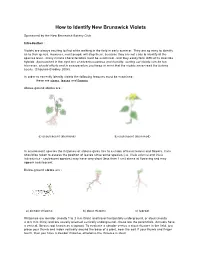
How to Identify New Brunswick Violets Sponsored by the New Brunswick Botany Club Introduction : Violets are always exciting to find while walking in the field in early summer. They are so easy to identify as to their genus. However, most people will stop there, because they are not easy to identify at the species level - many minute characteristics must be examined...and they easily form difficult to describe hybrids. Approached in the right mix of adventurousness and humility, sorting out violets can be fun. However, should efforts end in exasperation, just keep in mind that the violets never read the botany books. (Choukas-Bradley 2004). In order to correctly identify violets the following features must be examined : these are stems, leaves and flowers. Above-ground stems are : a) acaulescent (stemless) b) caulescent (stemmed) In acaulescent species the rhizomes or stolons gives rise to a crown of basal leaves and flowers. Care should be taken to assess the position of leaves since some species (i.e. Viola adunca and Viola labradorica - caulescent species) may have very short (less than 1 cm) stems at flowering and may appear acaulescent. Below-ground stems are : a) slender rhizome b) stout rhizome c) taproot Rhizomes are slender (mostly 1 to 3 mm thick) and travel horizontally underground, or stout (mostly 4 to 6 mm thick) and are usually oriented vertically underground - these are the perennials. Annuals have a vertical, fibrous root known as a taproot. To evaluate a slender versus a stout rhizome in the field, just place your thumb and index vertically around the base of a plant, near the soil. -

3.2.2.12. Familia Violaceae 3.2.2.12.A
102 3.2.2.12. Familia Violaceae 3.2.2.12.a. Características ¾ Porte: hierbas y arbustos perennes. ¾ Hojas: alternas, rara vez opuesta y enteras o dentadas; simples o divididas, con estípulas. ¾ Flores: solitarias o en racimos, perfectas, actinomorfas o fuertemente zigomorfas, hipóginas. ¾ Perianto: cáliz, 5 sépalos libres; a menudo con apéndices gibosos en su base; corola, 5 pétalos, imbricados o contortos de los cuales el inferior suele prolongarse en un espolón. ¾ Estambres: 5, libres, filamentos muy cortos. ¾ Gineceo: ovario súpero; carpelos, 3 soldados, raro 5; óvulos, 1- ∞, por lóculo, parietales. ¾ Fruto: cápsula loculicida o baya. ¾ Semillas: ariladas o aladas, abundante endosperma oleaginoso, embrión recto. Corte longitudinal de la flor mostrando a la derecha un par Corte longitudinal de la flor de Viola sp. con el de estambres con su prolongación nectarífera. El ovario en espolón abierto al que penetran los apéndices nectaríferos ligados a los dos pares de corte longitudinal mostrando una de sus placentas con sus estambres óvulos y a la izquierda el estambre libre 3.2.2.12.b. Biología floral y/o Fenología Generalmente presentan flores vistosas con guías de néctar que atraen insectos. Además puede presentar flores casmógamas durante la primavera, las cuales son sucedidas en el verano por flores cleistógamas. Presentan nectarios estaminales. En Viola tricolor (pensamiento) hay un espolón formado por el pétalo mediano. El néctar es producido por apéndices del conectivo, dos anteras tienen apéndices y cuatro anteras no tienen apéndices (Vogel, com. pers.). 3.2.2.12.c. Distribución y hábitat Familia cosmopolita, distribuida especialmente en regiones templadas. Diversidad Vegetal Facultad de Ciencias Exactas y Naturales y Agrimensura (UNNE) EUDICOTILEDONEAS ESCENCIALES-Clado Rosides-Eurosides I-Malpighiales: Violaceae 103 (Stevens, 2001) 3.2.2.12.d. -

NJ Native Plants - USDA
NJ Native Plants - USDA Scientific Name Common Name N/I Family Category National Wetland Indicator Status Thermopsis villosa Aaron's rod N Fabaceae Dicot Rubus depavitus Aberdeen dewberry N Rosaceae Dicot Artemisia absinthium absinthium I Asteraceae Dicot Aplectrum hyemale Adam and Eve N Orchidaceae Monocot FAC-, FACW Yucca filamentosa Adam's needle N Agavaceae Monocot Gentianella quinquefolia agueweed N Gentianaceae Dicot FAC, FACW- Rhamnus alnifolia alderleaf buckthorn N Rhamnaceae Dicot FACU, OBL Medicago sativa alfalfa I Fabaceae Dicot Ranunculus cymbalaria alkali buttercup N Ranunculaceae Dicot OBL Rubus allegheniensis Allegheny blackberry N Rosaceae Dicot UPL, FACW Hieracium paniculatum Allegheny hawkweed N Asteraceae Dicot Mimulus ringens Allegheny monkeyflower N Scrophulariaceae Dicot OBL Ranunculus allegheniensis Allegheny Mountain buttercup N Ranunculaceae Dicot FACU, FAC Prunus alleghaniensis Allegheny plum N Rosaceae Dicot UPL, NI Amelanchier laevis Allegheny serviceberry N Rosaceae Dicot Hylotelephium telephioides Allegheny stonecrop N Crassulaceae Dicot Adlumia fungosa allegheny vine N Fumariaceae Dicot Centaurea transalpina alpine knapweed N Asteraceae Dicot Potamogeton alpinus alpine pondweed N Potamogetonaceae Monocot OBL Viola labradorica alpine violet N Violaceae Dicot FAC Trifolium hybridum alsike clover I Fabaceae Dicot FACU-, FAC Cornus alternifolia alternateleaf dogwood N Cornaceae Dicot Strophostyles helvola amberique-bean N Fabaceae Dicot Puccinellia americana American alkaligrass N Poaceae Monocot Heuchera americana -
Floristic Quality Assessment Report
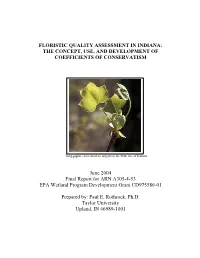
FLORISTIC QUALITY ASSESSMENT IN INDIANA: THE CONCEPT, USE, AND DEVELOPMENT OF COEFFICIENTS OF CONSERVATISM Tulip poplar (Liriodendron tulipifera) the State tree of Indiana June 2004 Final Report for ARN A305-4-53 EPA Wetland Program Development Grant CD975586-01 Prepared by: Paul E. Rothrock, Ph.D. Taylor University Upland, IN 46989-1001 Introduction Since the early nineteenth century the Indiana landscape has undergone a massive transformation (Jackson 1997). In the pre-settlement period, Indiana was an almost unbroken blanket of forests, prairies, and wetlands. Much of the land was cleared, plowed, or drained for lumber, the raising of crops, and a range of urban and industrial activities. Indiana’s native biota is now restricted to relatively small and often isolated tracts across the State. This fragmentation and reduction of the State’s biological diversity has challenged Hoosiers to look carefully at how to monitor further changes within our remnant natural communities and how to effectively conserve and even restore many of these valuable places within our State. To meet this monitoring, conservation, and restoration challenge, one needs to develop a variety of appropriate analytical tools. Ideally these techniques should be simple to learn and apply, give consistent results between different observers, and be repeatable. Floristic Assessment, which includes metrics such as the Floristic Quality Index (FQI) and Mean C values, has gained wide acceptance among environmental scientists and decision-makers, land stewards, and restoration ecologists in Indiana’s neighboring states and regions: Illinois (Taft et al. 1997), Michigan (Herman et al. 1996), Missouri (Ladd 1996), and Wisconsin (Bernthal 2003) as well as northern Ohio (Andreas 1993) and southern Ontario (Oldham et al. -

Pharmacognostical and Phytochemical Studies on Viola Tianschanica Maxim –An Uyghur Ethnomedicinal Plant
© 2016 Journal of Pharmacy & Pharmacognosy Research, 4 (3), 95-106 ISSN 0719-4250 http://jppres.com/jppres Original Article | Artículo Original Pharmacognostical and phytochemical studies of Viola tianschanica Maxim. – An Uyghur ethnomedicinal plant [Estudios farmacognóstico y fitoquímico de Viola tianschanica Maxim. – Una planta de la etnomedicina Uyghur] Yun Zhu, Lulu Zhao, Xiangfei Wang, Peng Li* School of Pharmacy, Shihezi University. Key Laboratory of Phytomedicine Resources & Modernization of TCM, Shihezi Xinjiang 832002, PR China. *E-mail: whitecloud2002001@163.com Abstract Resumen Context: Viola tianschanica Maxim. (Violaceae) is a perennial herb widely Contexto: Viola tianschanica Maxim. (Violaceae) es una hierba perenne distributed in Central Asia, especially in the Xinjiang of China. The whole ampliamente distribuida en Asia Central, especialmente en Xinjiang, herb has been used in traditional Uygur medicines as an antifebrile- China. Esta hierba se ha utilizado en la medicina tradicional Uygur como detoxicate drugs. antifebrífugo-desintoxicante. Aims: To characterize macroscopical and microscopical features of the Objetivos: Caracterizar las peculiaridades macroscópicas y microscópicas root, leave and rhizome of the V. tianschanica Maxim. Explore and de la raíz, hojas y rizoma de V. tianschanica Maxim. Analizar y establecer establish the micro-morphology and quality control methods for this los métodos de micro-morfología y control de calidad de esta planta. plant. Métodos: Las investigaciones farmacognósticas y fitoquímicas -

Isolation of Bioactive Secondary Metabolites and Pharmacological Studies of Viola Serpens Wall
ISOLATION OF BIOACTIVE SECONDARY METABOLITES AND PHARMACOLOGICAL STUDIES OF VIOLA SERPENS WALL By RUKHSANA Ph.D DEPARTMENT OF PHARMACY UNIVERSITY OF PESHAWAR 2017 ISOLATION OF BIOACTIVE SECONDARY METABOLITES AND PHARMACOLOGICAL STUDIES OF VIOLA SERPENS WALL Thesis submitted to the Department of Pharmacy, University of Peshawar, Peshawar, Pakistan in partial fulfillment for the Degree of DOCTOR OF PHILOSOPHY IN PHARMACEUTICAL SCIENCES FEBRUARY, 2017 DEPARTMENT OF PHARMACY UNIVERSITY OF PESHAWAR APPROVAL SHEET A Thesis presented by Rukhsana entitled “Isolation of Bioactive Secondary Metabolites and Pharmacological Studies of Viola Serpens Wall” to the Department of Pharmacy, University of Peshawar in partial fulfillment for the award of the Degree of Ph.D in Pharmaceutical Sciences. We, the undersigned have examined this thesis and do hereby approve it for the award of Ph.D Degree. External Examiner: _________________________________ Supervisor: ______________________________ PROF. DR. MUHAMMAD SAEED Chairman, Department of Pharmacy, University of Peshawar. Co-supervisor: ______________________________ DR. MANZOOR AHMAD Associate Professor, Department of Chemistry, University of Malakand. I Dedicated my this humble effort to my beloved Parents & Family ACKNOWLEDGEMENT In the name of Almighty Allah, the most merciful and beneficent, Who gave me the courage and ability for the better understanding and completion of my PhD project. I bow my head before Allah for His greatness, Who provided me strength and courage to accomplish a useful and beneficial work for the benefit of mankind. With great honor and extreme happy feelings I pay my homage and debt to my research supervisor, Prof. Dr. Muhammad Saeed, Chairman, Department of Pharmacy, University of Peshawar. His broad vision, advice, encouragement and co- operation helped and guided me for the completion of my Ph.D programme and dissertation. -
Effects of Viola Tricolor Flower Hydroethanolic Extract on Lung Inflammation in a Mouse Model of Chronic Asthma
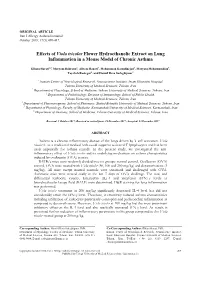
ORIGINAL ARTICLE Iran J Allergy Asthma Immunol October 2018; 17(5):409-417. Effects of Viola tricolor Flower Hydroethanolic Extract on Lung Inflammation in a Mouse Model of Chronic Asthma Elham Harati1,2, Maryam Bahrami2, Alireza Razavi3, Mohammad Kamalinejad4, Maryam Mohammadian5, Tayebeh Rastegar6, and Hamid Reza Sadeghipour2 1 Iranian Center of Neurological Research, Neuroscience Institute, Imam Khomeini Hospital, Tehran University of Medical Sciences, Tehran, Iran 2 Department of Physiology, School of Medicine, Tehran University of Medical Sciences, Tehran, Iran 3 Department of Pathobiology, Division of Immunology, School of Public Health, Tehran University of Medical Sciences, Tehran, Iran 4 Department of Pharmacognosy, School of Pharmacy, Shahid Beheshti University of Medical Sciences, Tehran, Iran 5 Department of Physiology, Faculty of Medicine, Kermanshah University of Medical Sciences, Kermanshah, Iran 6 Department of Anatomy, School of Medicine, Tehran University of Medical Sciences, Tehran, Iran Received: 5 October 2017; Received in revised form: 19 December 2017; Accepted: 23 December 2017 ABSTRACT Asthma is a chronic inflammatory disease of the lungs driven by T cell activation. Viola tricolor L. as a traditional medical herb could suppress activated T lymphocytes and has been used empirically for asthma remedy. In the present study, we investigated the anti- inflammatory effect of Viola tricolor and its underlying mechanism on asthma characteristics induced by ovalbumin (OVA) in mice. BALB/c mice were randomly divided into six groups: normal control, Ovalbumin (OVA) control, OVA mice treated with Viola tricolor (50, 100 and 200 mg/kg) and dexamethasone (3 mg/kg). All mice except normal controls were sensitized and challenged with OVA. Asthmatic mice were treated orally in the last 7 days of OVA challenge. -

Natural Resource Condition Assessment for Cowpens National Battlefield Natural Resource Report NPS/ COWP/NRR—2012/521
National Park Service U.S. Department of the Interior Natural Resource Stewardship and Science Natural Resource Condition Assessment for Cowpens National Battlefield Natural Resource Report NPS/ COWP/NRR—2012/521 ON THE COVER Main Entrance Photograph courtesy of Cowpens National Battlefield Natural Resource Condition Assessment for Cowpens National Battlefield Natural Resource Report NPS/ COWP/NRR—2012/521 Luke Worsham, Gary Sundin, Nathan P. Nibbelink, Michael T. Mengak, Gary Grossman Warnell School of Forestry and Natural Resources University of Georgia 180 E. Green St. Athens, GA 30602 April 2012 U.S. Department of the Interior National Park Service Natural Resource Stewardship and Science Fort Collins, Colorado The National Park Service, Natural Resource Stewardship and Science office in Fort Collins, Colorado publishes a range of reports that address natural resource topics of interest and applicability to a broad audience in the National Park Service and others in natural resource management, including scientists, conservation and environmental constituencies, and the public. The Natural Resource Report Series is used to disseminate high-priority, current natural resource management information with managerial application. The series targets a general, diverse audience, and may contain NPS policy considerations or address sensitive issues of management applicability. All manuscripts in the series receive the appropriate level of peer review to ensure that the information is scientifically credible, technically accurate, appropriately written for the intended audience, and designed and published in a professional manner. This report received informal peer review by subject-matter experts who were not directly involved in the collection, analysis, or reporting of the data. Views, statements, findings, conclusions, recommendations, and data in this report do not necessarily reflect views and policies of the National Park Service, U.S. -
INTRODUCTION This Check List of the Plants of New Jersey Has Been
INTRODUCTION This Check List of the Plants of New Jersey has been compiled by updating and integrating the catalogs prepared by such authors as Nathaniel Lord Britton (1881 and 1889), Witmer Stone (1911), and Norman Taylor (1915) with such other sources as recently-published local lists, field trip reports of the Torrey Botanical Society and the Philadelphia Botanical Club, the New Jersey Natural Heritage Program’s list of threatened and endangered plants, personal observations in the field and the herbarium, and observations by other competent field botanists. The Check List includes 2,758 species, a botanical diversity that is rather unexpected in a small state like New Jersey. Of these, 1,944 are plants that are (or were) native to the state - still a large number, and one that reflects New Jersey's habitat diversity. The balance are plants that have been introduced from other countries or from other parts of North America. The list could be lengthened by hundreds of species by including non-persistent garden escapes and obscure waifs and ballast plants, many of which have not been seen in New Jersey since the nineteenth century, but it would be misleading to do so. The Check List should include all the plants that are truly native to New Jersey, plus all the introduced species that are naturalized here or for which there are relatively recent records, as well as many introduced plants of very limited occurrence. But no claims are made for the absolute perfection of the list. Plant nomenclature is constantly being revised. Single old species may be split into several new species, or multiple old species may be combined into one. -
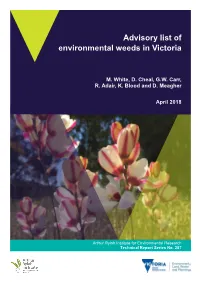
Technical Report Series No. 287 Advisory List of Environmental Weeds in Victoria
Advisory list of environmental weeds in Victoria M. White, D. Cheal, G.W. Carr, R. Adair, K. Blood and D. Meagher April 2018 Arthur Rylah Institute for Environmental Research Technical Report Series No. 287 Arthur Rylah Institute for Environmental Research Department of Environment, Land, Water and Planning PO Box 137 Heidelberg, Victoria 3084 Phone (03) 9450 8600 Website: www.ari.vic.gov.au Citation: White, M., Cheal, D., Carr, G. W., Adair, R., Blood, K. and Meagher, D. (2018). Advisory list of environmental weeds in Victoria. Arthur Rylah Institute for Environmental Research Technical Report Series No. 287. Department of Environment, Land, Water and Planning, Heidelberg, Victoria. Front cover photo: Ixia species such as I. maculata (Yellow Ixia) have escaped from gardens and are spreading in natural areas. (Photo: Kate Blood) © The State of Victoria Department of Environment, Land, Water and Planning 2018 This work is licensed under a Creative Commons Attribution 3.0 Australia licence. You are free to re-use the work under that licence, on the condition that you credit the State of Victoria as author. The licence does not apply to any images, photographs or branding, including the Victorian Coat of Arms, the Victorian Government logo, the Department of Environment, Land, Water and Planning logo and the Arthur Rylah Institute logo. To view a copy of this licence, visit http://creativecommons.org/licenses/by/3.0/au/deed.en Printed by Melbourne Polytechnic, Preston Victoria ISSN 1835-3827 (print) ISSN 1835-3835 (pdf)) ISBN 978-1-76077-000-6 (print) ISBN 978-1-76077-001-3 (pdf/online) Disclaimer This publication may be of assistance to you but the State of Victoria and its employees do not guarantee that the publication is without flaw of any kind or is wholly appropriate for your particular purposes and therefore disclaims all liability for any error, loss or other consequence which may arise from you relying on any information in this publication. -
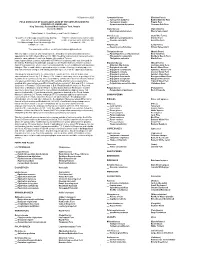
Field Checklist
14 September 2020 Cystopteridaceae (Bladder Ferns) __ Cystopteris bulbifera Bulblet Bladder Fern FIELD CHECKLIST OF VASCULAR PLANTS OF THE KOFFLER SCIENTIFIC __ Cystopteris fragilis Fragile Fern RESERVE AT JOKERS HILL __ Gymnocarpium dryopteris CoMMon Oak Fern King Township, Regional Municipality of York, Ontario (second edition) Aspleniaceae (Spleenworts) __ Asplenium platyneuron Ebony Spleenwort Tubba Babar, C. Sean Blaney, and Peter M. Kotanen* Onocleaceae (SensitiVe Ferns) 1Department of Ecology & Evolutionary Biology 2Atlantic Canada Conservation Data __ Matteuccia struthiopteris Ostrich Fern University of Toronto Mississauga Centre, P.O. Box 6416, Sackville NB, __ Onoclea sensibilis SensitiVe Fern 3359 Mississauga Road, Mississauga, ON Canada E4L 1G6 Canada L5L 1C6 Athyriaceae (Lady Ferns) __ Deparia acrostichoides SilVery Spleenwort *Correspondence author. e-mail: peter.kotanen@utoronto.ca Thelypteridaceae (Marsh Ferns) The first edition of this list Was compiled by C. Sean Blaney and Was published as an __ Parathelypteris noveboracensis New York Fern appendix to his M.Sc. thesis (Blaney C.S. 1999. Seed bank dynamics of native and exotic __ Phegopteris connectilis Northern Beech Fern plants in open uplands of southern Ontario. University of Toronto. __ Thelypteris palustris Marsh Fern https://tspace.library.utoronto.ca/handle/1807/14382/). It subsequently Was formatted for the web by P.M. Kotanen and made available on the Koffler Scientific Reserve Website Dryopteridaceae (Wood Ferns) (http://ksr.utoronto.ca/), Where it Was revised periodically to reflect additions and taxonomic __ Athyrium filix-femina CoMMon Lady Fern changes. This second edition represents a major revision reflecting recent phylogenetic __ Dryopteris ×boottii Boott's Wood Fern and nomenclatural changes and adding additional species; it will be updated periodically.