MUSIC N114T – Indian Classical Music (Instrumental)
Total Page:16
File Type:pdf, Size:1020Kb
Load more
Recommended publications
-
Fusion Without Confusion Raga Basics Indian
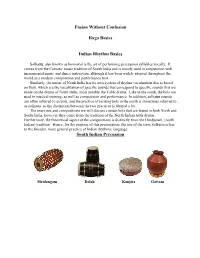
Fusion Without Confusion Raga Basics Indian Rhythm Basics Solkattu, also known as konnakol is the art of performing percussion syllables vocally. It comes from the Carnatic music tradition of South India and is mostly used in conjunction with instrumental music and dance instruction, although it has been widely adopted throughout the world as a modern composition and performance tool. Similarly, the music of North India has its own system of rhythm vocalization that is based on Bols, which are the vocalization of specific sounds that correspond to specific sounds that are made on the drums of North India, most notably the Tabla drums. Like in the south, the bols are used in musical training, as well as composition and performance. In addition, solkattu sounds are often referred to as bols, and the practice of reciting bols in the north is sometimes referred to as solkattu, so the distinction between the two practices is blurred a bit. The exercises and compositions we will discuss contain bols that are found in both North and South India, however they come from the tradition of the North Indian tabla drums. Furthermore, the theoretical aspect of the compositions is distinctly from the Hindustani, (north Indian) tradition. Hence, for the purpose of this presentation, the use of the term Solkattu refers to the broader, more general practice of Indian rhythmic language. South Indian Percussion Mridangam Dolak Kanjira Gattam North Indian Percussion Tabla Baya (a.k.a. Tabla) Pakhawaj Indian Rhythm Terms Tal (also tala, taal, or taala) – The Indian system of rhythm. Tal literally means "clap". -
Intonation Analysis of Rāgas in Carnatic Music1
Intonation analysis of rāgas in Carnatic music1 Gopala Krishna Koduria, Vignesh Ishwarb, Joan Serràc, Xavier Serraa, Hema Murthyb aMusic Technology Group, Universitat Pompeu Fabra, Barcelona, Spain. bDepartment of Computer Science and Engineering, Indian Institute of Technology - Madras, India cInstituto de Investigación en Inteligencia Artificial, Consejo Superior de Investigaciones Científicas, Bellaterra, Spain. Abstract Intonation is a fundamental music concept that has a special relevance in Indian art music. It is charac- teristic of a rāga and key to the musical expression of the artist. Describing intonation is of importance to several music information retrieval tasks such as developing similarity measures based on rāgas and artists. In this paper, we first assess rāga intonation qualitatively by analyzing varṇaṁs, a particular form of Carnatic music compositions. We then approach the task of automatically obtaining a compact rep- resentation of the intonation of a recording from its pitch track. We propose two approaches based on the parametrization of pitch-value distributions: performance pitch histograms, and context-based svara distributions obtained by categorizing pitch contours based on the melodic context. We evaluate both approaches on a large Carnatic music collection and discuss their merits and limitations. We finally go through different kinds of contextual information that can be obtained to further improve the two ap- proaches. Keywords: Music Information Research, Carnatic Music, Histogram parametrization, Pitch analysis 1. Introduction 1.1. Carnatic music and basic melodic concepts e Indian subcontinent has two prominent art music traditions: Carnatic music in south India, and Hindustani music in north India, Pakistan and Bangladesh. Rāga is the melodic framework on which both art music traditions thrive (Narmada, 2001). -

108 Melodies
SRI SRI HARINAM SANKIRTAN - l08 MELODIES - INDEX CONTENTS PAGE CONTENTS PAGE Preface 1-2 Samant Sarang 37 Indian Classical Music Theory 3-13 Kurubh 38 Harinam Phylosphy & Development 14-15 Devagiri 39 FIRST PRAHAR RAGAS (6 A.M. to 9 A.M.) THIRD PRAHAR RAGAS (12 P.M. to 3 P.M.) Vairav 16 Gor Sarang 40 Bengal Valrav 17 Bhimpalasi 4 1 Ramkal~ 18 Piloo 42 B~bhas 19 Multani 43 Jog~a 20 Dhani 44 Tori 21 Triveni 45 Jaidev 22 Palasi 46 Morning Keertan 23 Hanskinkini 47 Prabhat Bhairav 24 FOURTH PKAHAR RAGAS (3 P.M. to 6 P.M.) Gunkali 25 Kalmgara 26 Traditional Keertan of Bengal 48-49 Dhanasari 50 SECOND PRAHAR RAGAS (9 A.M. to 12 P.M.) Manohar 5 1 Deva Gandhar 27 Ragasri 52 Bha~ravi 28 Puravi 53 M~shraBhairav~ 29 Malsri 54 Asavar~ 30 Malvi 55 JonPurl 3 1 Sr~tank 56 Durga (Bilawal That) 32 Hans Narayani 57 Gandhari 33 FIFTH PRAHAR RAGAS (6 P.M. to 9 P.M.) Mwa Bilawal 34 Bilawal 35 Yaman 58 Brindawani Sarang 36 Yaman Kalyan 59 Hem Kalyan 60 Purw Kalyan 61 Hindol Bahar 94 Bhupah 62 Arana Bahar 95 Pur~a 63 Kedar 64 SEVENTH PRAHAR RAGAS (12 A.M. to 3 A.M.) Jaldhar Kedar 65 Malgunj~ 96 Marwa 66 Darbar~Kanra 97 Chhaya 67 Basant Bahar 98 Khamaj 68 Deepak 99 Narayani 69 Basant 100 Durga (Khamaj Thhat) 70 Gaur~ 101 T~lakKarnod 71 Ch~traGaur~ 102 H~ndol 72 Shivaranjini 103 M~sraKhamaj 73 Ja~tsr~ 104 Nata 74 Dhawalsr~ 105 Ham~r 75 Paraj 106 Mall Gaura 107 SIXTH PRAHAR RAGAS (9Y.M. -
Mpa Music Syllabus (Unrevised)
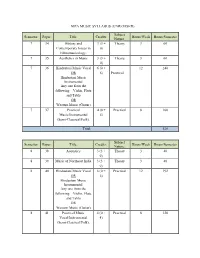
MPA MUSIC SYLLABUS (UNREVISED) Subject Semester: Paper: Title: Credits: Hours/Week Hours/Semester Nature: 7 34 History and 3 (3 + Theory 3 60 Contemporary Issues in 0) Ethnomusicology. 7 35 Aesthetics in Music 3 (3 + Theory 3 60 0) 7 36 Hindustani Music Vocal 6 (0 + 12 240 OR 6) Practical Hindustani Music Instrumental Any one from the following – Violin, Flute and Tabla OR Western Music (Guitar) 7 37 Practical 4 (0 + Practical 8 160 Music/Instrumental 4) (Semi-Classical/Folk). Total: 520 Subject Semester: Paper: Title: Credits: Hours/Week Hours/Semester Nature: 8 38 Acoustics 3 (3 + Theory 3 48 0) 8 39 Music of Northeast India 3 (3 + Theory 3 48 0) 8 40 Hindustani Music Vocal 6 (0 + Practical 12 192 OR 6) Hindustani Music Instrumental Any one from the following – Violin, Flute and Tabla OR Western Music (Guitar) 8 41 Practical Music 4 (0 + Practical 8 128 Vocal/Instrumental 4) (Semi-Classical/Folk). Total 416 Subject Semester: Paper: Title: Credits: Hours/Week Hours/Semester Nature: 9 42 Music and Media 3 (3 + 0) Theory 3 60 9 43 Music in Dance and 3 (3 + 0) Theory 3 60 Theatre 9 44 Hindustani Music Vocal 6 (0 + 6) Practical 12 240 OR Hindustani Music Instrumental Any one from the following – Violin, Flute and Tabla OR Western Music (Guitar) 9 45 Practical Music 4 (0 + 4) Practical 8 160 Vocal/Instrumental (Semi-Classical/Folk) Total: 520 Subject Semester: Paper: Title: Credits: Hours/Week Hours/Semester Nature: 10 46 Music of Sikkim 3 (3 + 0) Theory 3 48 10 47 Fieldwork, Lab. -

Track Name Singers VOCALS 1 RAMKALI Pt. Bhimsen Joshi 2 ASAWARI TODI Pt
Track name Singers VOCALS 1 RAMKALI Pt. Bhimsen Joshi 2 ASAWARI TODI Pt. Bhimsen Joshi 3 HINDOLIKA Pt. Bhimsen Joshi 4 Thumri-Bhairavi Pt. Bhimsen Joshi 5 SHANKARA MANIK VERMA 6 NAT MALHAR MANIK VERMA 7 POORIYA MANIK VERMA 8 PILOO MANIK VERMA 9 BIHAGADA PANDIT JASRAJ 10 MULTANI PANDIT JASRAJ 11 NAYAKI KANADA PANDIT JASRAJ 12 DIN KI PURIYA PANDIT JASRAJ 13 BHOOPALI MALINI RAJURKAR 14 SHANKARA MALINI RAJURKAR 15 SOHONI MALINI RAJURKAR 16 CHHAYANAT MALINI RAJURKAR 17 HAMEER MALINI RAJURKAR 18 ADANA MALINI RAJURKAR 19 YAMAN MALINI RAJURKAR 20 DURGA MALINI RAJURKAR 21 KHAMAJ MALINI RAJURKAR 22 TILAK-KAMOD MALINI RAJURKAR 23 BHAIRAVI MALINI RAJURKAR 24 ANAND BHAIRAV PANDIT JITENDRA ABHISHEKI 25 RAAG MALA PANDIT JITENDRA ABHISHEKI 26 KABIR BHAJAN PANDIT JITENDRA ABHISHEKI 27 SHIVMAT BHAIRAV PANDIT JITENDRA ABHISHEKI 28 LALIT BEGUM PARVEEN SULTANA 29 JOG BEGUM PARVEEN SULTANA 30 GUJRI JODI BEGUM PARVEEN SULTANA 31 KOMAL BHAIRAV BEGUM PARVEEN SULTANA 32 MARUBIHAG PANDIT VASANTRAO DESHPANDE 33 THUMRI MISHRA KHAMAJ PANDIT VASANTRAO DESHPANDE 34 JEEVANPURI PANDIT KUMAR GANDHARVA 35 BAHAR PANDIT KUMAR GANDHARVA 36 DHANBASANTI PANDIT KUMAR GANDHARVA 37 DESHKAR PANDIT KUMAR GANDHARVA 38 GUNAKALI PANDIT KUMAR GANDHARVA 39 BILASKHANI-TODI PANDIT KUMAR GANDHARVA 40 KAMOD PANDIT KUMAR GANDHARVA 41 MIYA KI TODI USTAD RASHID KHAN 42 BHATIYAR USTAD RASHID KHAN 43 MIYA KI TODI USTAD RASHID KHAN 44 BHATIYAR USTAD RASHID KHAN 45 BIHAG ASHWINI BHIDE-DESHPANDE 46 BHINNA SHADAJ ASHWINI BHIDE-DESHPANDE 47 JHINJHOTI ASHWINI BHIDE-DESHPANDE 48 NAYAKI KANADA ASHWINI -

The Thaat-Ragas of North Indian Classical Music: the Basic Atempt to Perform Dr
The Thaat-Ragas of North Indian Classical Music: The Basic Atempt to Perform Dr. Sujata Roy Manna ABSTRACT Indian classical music is divided into two streams, Hindustani music and Carnatic music. Though the rules and regulations of the Indian Shastras provide both bindings and liberties for the musicians, one can use one’s innovations while performing. As the Indian music requires to be learnt under the guidance of Master or Guru, scriptural guidelines are never sufficient for a learner. Keywords: Raga, Thaat, Music, Performing, Alapa. There are two streams of Classical music of India – the Ragas are to be performed with the basic help the North Indian i.e., Hindustani music and the of their Thaats. Hence, we may compare the Thaats South Indian i.e., Carnatic music. The vast area of with the skeleton of creature, whereas the body Indian Classical music consists upon the foremost can be compared with the Raga. The names of the criterion – the origin of the Ragas, named the 10 (ten) Thaats of North Indian Classical Music Thaats. In the Carnatic system, there are 10 system i.e., Hindustani music are as follows: Thaats. Let us look upon the origin of the 10 Thaats Sl. Thaats Ragas as well as their Thaat-ragas (i.e., the Ragas named 01. Vilabal Vilabal, Alhaiya–Vilaval, Bihag, according to their origin). The Indian Shastras Durga, Deshkar, Shankara etc. 02. Kalyan Yaman, Bhupali, Hameer, Kedar, throw light on the rules and regulations, the nature Kamod etc. of Ragas, process of performing these, and the 03. Khamaj Khamaj, Desh, Tilakkamod, Tilang, liberty and bindings of the Ragas while Jayjayanti / Jayjayvanti etc. -
Mukherji-Handout-0056.Pdf
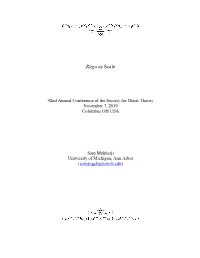
Rāga as Scale 42nd Annual Conference of the Society for Music Theory November 7, 2019 Columbus OH USA Sam Mukherji University of Michigan, Ann Arbor (somangsh@umich.edu) 2 Example 1. Two theorists of North Indian classical music Vishnu Narayan Bhatkhande (1860–1936) Omkarnath Thakur (1897–1967) 3 phrases (1 and 3 performed by Amjad Ali Khan, 2 and 4 performed by Buddhadev Das Gupta) Ali2 and by Khan, (1 and Amjad 4 performed 3 performed phrases rāga Example 2. Four Example 2. Four 4 Example 3. Bhatkhande’s list of ten tḥāṭs, from his Hindustānī Sangīta Paddhatī (1909-32) Tḥāṭ Scale structure (centered on C) Western equivalent Pūrvī C Db Eb F# G Ab Bb C Mārvā C Db Eb F# G Ab Bb C Kalyān Lydian C Db Eb F# G Ab Bb C Bilāval Major, or Ionian C Db Eb F# G Ab Bb C Khamāj Mixolydian C Db Eb F# G Ab Bb C Kāfi Dorian C Db Eb F# G Ab Bb C Āsāvari Natural minor, or Aeolian C Db Eb F# G Ab Bb C Bhairavī Phrygian C Db Eb F# G Ab Bb C Bhairav C Db Eb F# G Ab Bb C Tōdī C Db Eb F# G Ab Bb C Example 4. Thakur’s list of six pedagogical rāgas, from his Sangītānjalī (1938-62) Name Rāga scale (centered on C) Forbidden scale degrees Bhoop C D E F G A B C 4 and 7 Hamsadhvanī C D E F G A B C 4 and 6 Durgā C D E F G A B C 3 and 7 Sārang C D E F G A B C 3 and 6 Tilang C D E F G A B C 2 and 6 Bhinna-shadạj C D E F G A B C 2 and 5 5 Example 5. -

The Journal Ie Music Academy
THE JOURNAL OF IE MUSIC ACADEMY MADRAS A QUARTERLY OTED TO THE ADVANCEMENT OF THE SCIENCE AND ART OF MUSIC XIII 1962 Parts I-£V _ j 5tt i TOTftr 1 ®r?r <nr firerftr ii dwell not in Vaikuntha, nor in the hearts of Yogins, - the Sun; where my Bhaktas sing, there be I, ! ” EDITED BY V. RAGHAVAN, M.A., PH.D. 1 9 6 2 PUBLISHED BY HE MUSIC ACADEMY, MADRAS 115-E, M OW BRAY’S RO AD, M ADRAS-14. "iption—Inland Rs, 4. Foreign 8 sh. Post paid. i ADVERTISEMENT CHARGES I S COVER PAGES: if Back (outside) $ if Front (inside) i Back (D o.) if 0 if INSIDE PAGES: if 1st page (after cover) if if Ot^er pages (each) 1 £M E N i if k reference will be given to advertisers of if instruments and books and other artistic wares. if I Special position and special rate on application. Xif Xtx XK XK X&< i - XK... >&< >*< >*<. tG O^ & O +O +f >*< >•< >*« X NOTICE All correspondence should be addressed to Dr. V. R Editor, Journal of the Music Academy, Madras-14. Articles on subjects of music and dance are accep publication on the understanding that they are contribute) to the Journal of tlie Music Academy. All manuscripts should be legibly written or preferab written (double spaced—on one side of the paper only) and be signed by the writer (giving his address in full). The Editor of the Journal is not responsible for t1 expressed by individual contributors. All books, advertisement, moneys and cheque ♦ended for the Journal should be sent to D CONTENTS 'le X X X V th Madras Music Conference, 1961 : Official Report Alapa and Rasa-Bhava id wan C. -

Raga (Melodic Mode) Raga This Article Is About Melodic Modes in Indian Music
FREE SAMPLES FREE VST RESOURCES EFFECTS BLOG VIRTUAL INSTRUMENTS Raga (Melodic Mode) Raga This article is about melodic modes in Indian music. For subgenre of reggae music, see Ragga. For similar terms, see Ragini (actress), Raga (disambiguation), and Ragam (disambiguation). A Raga performance at Collège des Bernardins, France Indian classical music Carnatic music · Hindustani music · Concepts Shruti · Svara · Alankara · Raga · Rasa · Tala · A Raga (IAST: rāga), Raag or Ragam, literally means "coloring, tingeing, dyeing".[1][2] The term also refers to a concept close to melodic mode in Indian classical music.[3] Raga is a remarkable and central feature of classical Indian music tradition, but has no direct translation to concepts in the classical European music tradition.[4][5] Each raga is an array of melodic structures with musical motifs, considered in the Indian tradition to have the ability to "color the mind" and affect the emotions of the audience.[1][2][5] A raga consists of at least five notes, and each raga provides the musician with a musical framework.[3][6][7] The specific notes within a raga can be reordered and improvised by the musician, but a specific raga is either ascending or descending. Each raga has an emotional significance and symbolic associations such as with season, time and mood.[3] The raga is considered a means in Indian musical tradition to evoke certain feelings in an audience. Hundreds of raga are recognized in the classical Indian tradition, of which about 30 are common.[3][7] Each raga, state Dorothea -
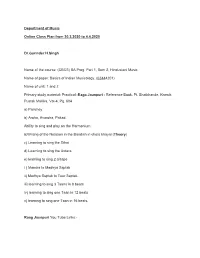
Online Class Plan from 30.3.2020 to 4.4.2020 Click to Download
Department of Music Online Class Plan from 30.3.2020 to 4.4.2020 Dr.Gurinder H.Singh Name of the course: (CBCS) BA Prog. Part 1, Sem 2, Hindustani Music Name of paper: Basics of Indian Musicology. (62444201) Name of unit: 1 and 2 Primary study material: Practical -Raga Jaunpuri - Reference Book, Pt. Bhatkhande, Kramik Pustak Mallika, Vol-4, Pg. 604 a) Parichey b) Aroha, Avaroha, Pakad. Ability to sing and play on the Harmonium. b)Writing of the Notation in the Bandish in chota khayal (Theory) c) Learning to sing the Sthai d) Learning to sing the Antara. e) learning to sing 2 alaaps i ) Mandra to Madhya Saptak ii) Madhya Saptak to Taar Saptak. iii) learning to sing 3 Taans in 8 beats iv) learning to sing one Taan in 12 beats v) learning to sing one Taan in 16 beats. Raag Jaunpuri You Tube Links:- https://youtu.be/9FNv8CZAuA4 https://youtu.be/Ruqu6DPL6PI https://youtu.be/RPPMHvXciNA Dr.Prerna Arora Name of the course: (CBCS) BA Prog. Part 1, Sem 2, Hindustani Music Name of paper: Basics of Indian Musicology. (62444201) Name of unit: 1 and 2 Primary study material: Practical Raga Yaman Pt. Tejpal Singh, Vidhivat Sangeet Sikshan Pg. 111 a) Parichey b) Aroha, Avaroha, Pakad. Ability to sing and play on the Harmonium. b)Writing of the Notation in the Bandish in chota khayal (Theory) c) Learning to sing the Sthai d) Learning to sing the Antara. e) learning to sing 2 alaaps i ) Mandra to Madhya Saptak ii) Madhya Saptak to Taar Saptak. -

MKG-Xxviliitechmt/1 T/01 Tl W-N ~ ~ ---~---~~
1111111111111I1111111111111111111111111111111111111I111111111111111111111111111111111111111I1111111111111 MKG-XXVIlIITECHMT/1 T/01 POST CODE i~ ern; : Write here Roll Number and Answer Sheet No. ~~~~~~~ Roll No. I 3ijsfAi€fi Answer Sheet No./~~~ Time Allowed: 2 hours Maximum Marks: 200 Bmft1 ~ : 2 t:R .~~ : 200 1. If the Roll No. is a 8 digit No., the candidate needs to circle as 1. ~~8~~tm~~~~2 "00" as the first 2 digits in the first 2 columns of the Roll No. ~ ~ 1:!@ 2 3icf; ~~ if "oo..~ ~it I 2. OMR Answer Sheet is enclosed in this Booklet. You must 2. ~ T\R ~ if 3ir.~.:mc T\R ~ ~ tl w-n ~ ~ complete the details of Roll Number, Question Booklet No., qjffiq if~ ~ il ~ :mq ~ ~ if 3ltR1 itR~, etc., on the Answer Sheet and Answer Sheet No. on the space ~~mr,~(lm~~~ii~~~ ~~~~cj;'r~~1 ~~T\R~Cf?r provided above in this Question Booklet, before you actually ~~~:Jftt~~~~1 r--------- start answering the questions, failing which your Answer Sheet 3. 3ir.~.3m:. ~ ~ will not be evaluated and you will b~ awarded 'ZERO' mark. if trft m <f?: I 3. A machine will read the coded information in the OMR Answer ~~~~~~~~~ I • I I I ~ Sheet. In case non/wrong bubbling of Roll Number etc., the ~~~. 3iI.ltlf.3m:. "3ffi~<it I machine shall reject such OMR answer sheet and hence ~~~ 3fIi~ 3U.~.3ffi."3ffi I such OMR answer sheet shall not be evaluated. ~q;y~~~1 I 4. ~ ~~"@ft ms;:UCliT'~ ~ 4. Please check all the pages of the Booklet carefully. In case of '" ....Po~..;..,.~c:::"~-=.'.,...,~ 'I any defect, please ask the Invigilator for replacement of the ~ I "<''< 'I">'!/ '<'''I ~, (I] ''''.IGl'l"> <fit .j~ ~ Booklet. -
Machine Learning Approaches for Mood Identification in Raga: Survey
International Journal of Innovations in Engineering and Technology (IJIET) Machine Learning Approaches for Mood Identification in Raga: Survey Priyanka Lokhande Department of Computer Engineering Maharashtra Institute of Technology, Pune, Maharashtra, India Bhavana S. Tiple Department of Computer Engineering Maharashtra Institute of Technology, Pune, Maharashtra, India Abstract- Music is a “language of emotion”, which defines the emotion or feeling through music. Music directly connects to the soul and induces emotion in mind and brains. In Hindustani Classical Music raga plays very important role. It defines characteristics that differentiate ragas uniquely. Hindustani Classical Music also has nine different swaras that specifically define the emotion. In this paper we surveyed different techniques for raga identification and differentiate them according to their work and accuracy. We give the rasa - bhava relationship and raga-rasa mapping that defines the emotion related to raga. Keywords – Indian Classical Music, Emotion, Raga- Rasa relation, Classifiers. I. INTRODUCTION Indian classical music: One of an ancient tradition is Indian classical music that is an art form that is continuously growing. It has its roots in Sam Veda. Indian classical music is divided into two branches: Carnatic (South Indian Classical Music) and Hindustani (North Indian Classical Music). Carnatic music is sharp and involves many rhythmic and tonal complexities. Hindustani is mellifluous and meant to be entertainment and pleasure oriented music. Indian classical music and Western music vary from each other with respect to their notes, timings and different characteristics associated with raga. Swaras of Indian classical music are similar to the note of western classical music. There are many characteristics of Hindustani classical music.