The Campbell Sisters Dancing a Waltz by Lorenzo Bartolini
Total Page:16
File Type:pdf, Size:1020Kb
Load more
Recommended publications
-

Elenco Manoscritti
Elenco Manoscritti Bibl. Nazionale 1 FRONTINI.= De Re Militari in cambio del 259 2 Ricordanze di Neri di Bicci dipintore, da Biblioteca 1453-1475 Strozzi 3 ADRIANO Marcello Juniore = De Categoria 4 S.S. PATRUM = Opuscolo D. Augusti et Bibl. Nazionale Hyaronimi. Come sopra 5 VACCA FLAMINIO = Antichità di Roma da Biblioteca Strozzi 6 Epitaffio et elogia (Cod. Cartaceo del sec. XVI) 7 Inscriptiones Romanae (2 voll.) da Biblioteca Strozzi 8 Trattato sopra i nomi dalle Tribù da Biblioteca Strozzi 9 BOCCHI = Sulle opere di Andrea del Sarto da Biblioteca Strozzi (Borghini invenzione della cupola) 10 VASARI = Alcuni disegni di macchine, da Biblioteca Statuti della Accademia del Strozzi Disegno...(1584) 11 Ragionamento con Francesco de' Medici da Biblioteca Strozzi sopra le pitture di Palazzo Vecchio.... (Del Vasari) 12 STROZZI = Iscrizioni antiche da Biblioteca Strozzi ? 13 NORIS = Epistolae e studi diversi (Cod. del XVII sec.) 14 Medaglie d'oro della serie Imperiale. 15 Tavole di pittura e sculture egregio. 16 PANETALIO, P. = Trattato della pittura del Lomazzo. da Biblioteca Strozzi 17 MIRABELLA = Medaglie consolari. da Biblioteca 18 Erudizione orientale di numismatica. Strozzi 19 BACINI lasciati per legato alla Casa Medici.... 20 BIANCHI = Descrizione dalla R. Galleria 21 BIANCHI = Catalogo della Imperial Galleria di Firenze. 22 COCCHI = Studi diversi di antiquaria. 23 " = Notizie sopra alcune medaglie 24 " = Indice di Medaglie per classi (5 filze) 25 PELLI BENCIVENNI = Notizie della R. Galleria 26 Studi degli antiquari Bassetti, Querci e Pelli. 27 LANZI = Miscellanea (4 volumi) 28 LANZI = Repertorivm earum ..Inscriptiones pert.. 29 LANZI = Repertorio di Medaglie consolari... 30 LANZI = Repertorium de caracteribus 31 LANZI = Repertorio di antichità figurate. -
Indipendenza
ItinerariItinerari PIAZZE FFIRENZEIRENZE e 17th may 2009 nell’nell’800 MUSICA Piazza dell’Indipendenza The 19th Century Florence itineraries: Squares and Music ThTTheh brass band of the Scuola Marescialli e Brigadieri deddeie Carabinieri is one of the fi ve Carabinieri bands whwwhoseh origin lies in the buglers of the various Legions TheTh 19th19th CenturyC t FlorenceFl ititinerariesi i – 17th1717 h may 2009200009 of the Carabinieri, from which the fi rst bands were designed signifi cantly to coincide with Piazza later formed with brass and percussion instruments. the150th anniversary of the unifi cation of dell’Indipendenza, Today the Brass Band – based in Florence at the Tuscany to the newly born unifi ed state (1859 11.00 am-12.30 am School with the same name – is a small band with – 2009) – will take citizens and tourists on the a varied repertoire (symphonies, operas, fi lm sound discovery of the traces of a Century that left a Fanfara (Brass tracks as well as blues and jazz), especially trained for profound impression on the face of Florence. band) of the its main activity: the performance of ceremonies with The idea is to restore the role of 19th Century Scuola Marescialli assemblies and marches typical of military music. The band wears the so-called Grande Uniforme Speciale, a Florence within the collective imagination, e Brigadieri alongside the Florence of Medieval and very special uniform with its typical hat known as the Renaissance times. This is why one of the dell’Arma dei “lucerna” (cocked hat) and the red and white plume Carabinieri that sets it apart from the musicians of other units of Century’s typical customs will be renewed: the Carabinieri (red-blue plume). -

ITALIAN ART SOCIETY NEWSLETTER XXX, 1, Winter 2019
ITALIAN ART SOCIETY NEWSLETTER XXX, 1, Winter 2019 An Affiliated Society of: College Art Association International Congress on Medieval Studies Renaissance Society of America Sixteenth Century Society & Conference American Association of Italian Studies President’s Message from Sean Roberts benefactors. These chiefly support our dissertation, research and publication grants, our travel grants for modern topics, February 15, 2019 programs like Emerging Scholars workshops, and the cost of networking and social events including receptions. The costs Dear Members of the Italian Art Society: of events, especially, have risen dramatically in recent years, especially as these have largely been organized at CAA and I have generally used these messages to RSA, usually in expensive cities and often at even more promote upcoming programing and events, to call expensive conference hotels. The cost of even one reception attention to recent awards, and to summarize all the in New York, for example, can quickly balloon to activities we regularly support. There are certainly no overshadow our financial support of scholarship. It will be a shortage of such announcements in the near future and significant task for my successor and our entire executive I’m certain that my successor Mark Rosen will have committee to strategize for how we might respond to rising quite a bit to report soon, including our speaker for the costs and how we can best use our limited resources to best 2019 IAS/Kress lecture in Milan. With the final of my fulfill our mission to promote the study of Italian art and messages as president, however, I wanted to address a architecture. -

A Palace and the City
A PALACE AND THE CITY 150 years since Florence was named An exhibition created and curated by the Capital of Italy Stefania Ricci and Riccardo Spinelli Palazzo Spini Feroni opens its doors Design to the city in a fascinating exhibition Maurizio Balò on its centuries of history in collaboration with Davide Amadei Museo Salvatore Ferragamo Exhibition organised by Florence, Palazzo Spini Feroni Museo Salvatore Ferragamo 8 May 2015- 3 April 2016 in collaboration with inauguration 7 May Soprintendenza Speciale per il Patrimonio Storico, Artistico ed Etnoantropologico e per il Polo Museale della Città di Firenze Fondazione Ferragamo With the sponsorship of Ministero dei Beni e delle Attività Culturali e del Turismo Regione Toscana Comune di Firenze 1 A PALACE AND THE CITY “Long before I ever moved into the Palazzo Spini Feroni it was one of the buildings of Florence that I most admired and loved.” Salvatore Ferragamo From 8 May 2015 to 3 April 2016, at Palazzo Spini Feroni, via Tornabuoni, Florence, Museo Salvatore Ferragamo will hold an exhibition on the building’s centuries of history, commemorating the 150 years since Florence was named capital of the Kingdom of Italy (1865-1870), and Palazzo Spini Feroni became the city hall in 1865. Curated by Stefania Ricci and Riccardo Spinelli, the exhibition will include prestigious works of art and documents from museums and private collections and will tell the intricate stories behind the palace and its residents, in captivating displays created by stage designer Maurizio Balò, thus sharing one of the most important buildings in the city’s urban landscape with Florence, Florentines and travellers. -

Lorenzo Bartolini Vernio, 1777 - Florence, 1850
Lorenzo Bartolini Vernio, 1777 - Florence, 1850 Elisa Bonaparte Baciocchi Levoy, Princesse Française, Princess of Piombino and Lucca, Grand Duchess of Tuscany, Countess of Compignano, Sister of Napoleon (1777 –1820) and Felix Pasquale Baciocchi Levoy, Prince of Piombino and Lucca (1762 –1841) Circa 1809 White marble, Elisa presented on a later turned marble socle; Felix inscribed along the chest ‘FELIX’, an old repair to the tip of Felix’s nose Elisa: 57 cm. high, 75 cm. high, overall Felix: 51.5 cm. high Provenance: By family tradition, Elisa Bonaparte, at her country house, the Villa Ciardi a Villa Vicentina, where also photographed between 1913 and 1919.1 On her death, Joseph Bonaparte (1768–1844), brother of Elisa, who, as the first-born son of their parents, had inherited much of the personal property in Villa Ciardi belonging to his sister Elisa, the fifth- born child, when she died in 1820. On his death, his daughter Zenaide Letizia Bonaparte (1801–54), who married her cousin Charles Lucien Bonaparte (1803–57), the son of Lucien Bonaparte (1775–1840), Napoleon's third-born brother. On her death, Julia Charlotte Bonaparte (1830–1900), daughter of Charles Lucien Bonaparte and Zenaide Letizia Bonaparte, who married Alessandro del Gallo, Marchese di Roccagiovine, Cantalupo e Bardella (1826–92) in 1847. On her death Marchese Alberto del Gallo di Roccagiovine (1854–1947) where documented in the State Archives as being in Villa Ciardi in 1913-1919 and erroneously attributed to Antonio Canova. On his death Marchesa Matilde del Gallo di Roccagiovine (1888-1977), who married Francesco Bucci Casari, Conte degli Atti di Sassoferrato. -

TWELVE ITINERARIES to VISIT FLORENCE with the Art Historian and Painter ELISA MARIANINI
TWELVE ITINERARIES TO VISIT FLORENCE with the art historian and painter ELISA MARIANINI Half day (about 3 hours, maximum 4 hours) Itinerary 1 On the trail of the Medici’s family We can visit the Medici’s quarter starting from Palazzo Medici Riccardi, the first residence of the Medici family. There, we can admire the palace, the Cappella dei Magi by Benozzo Gozzoli and the Galleria degli specchi with the extraordinary Baroque frescoes by Luca Giordano. Then we can visit the Basilica of San Lorenzo, where Brunelleschi and Michelangelo worked, which includes important masterpieces by Donatello, Verrocchio, Bronzino, Rosso Fiorentino. It can also be found the burial place of the Medici's ancestor in the stupendous Old Sagrestia, Brunelleschi's Renaissance masterpiece. Itinerary 2 Discovering the religious heart of Florence We can visit the inside of the Florentine Cathedral of Santa Maria del Fiore and the ancient Crypt of Santa Reparata, where Brunelleschi is buried. We can also climb up the Dome, the highest point of the city, and visit the Baptistery of San Giovanni. The itinerary continues in the Museum of the Opera del Duomo which has been recently restored and renovated. Here you can admire the original famous bronze doors of the Baptistery and the sculptures of Arnolfo di Cambio, as well as many other important artists who adorned the original façade, before that it was destroyed to build the current one by Emilio De Fabris in the mid-nineteenth century in neo-gothic style. Within the Museum there are works such as the Maddalena of Donatello, the Pietà by Michelangelo, and the Donatello and Luca della Robbia’s Cantories. -
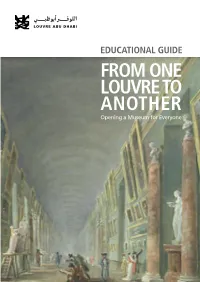
Educational Guide
EDUCATIONAL GUIDE Educational Guide - Exhibition: From One Louvre to Another 1 Introduction 1. THE EXHIBITION “From One Louvre to Another: Opening a Museum for Everyone” is the first “FROM ONE LOUVRE temporary exhibition to be held at the Louvre Abu Dhabi. By retracing the history TO ANOTHER: of the musée du Louvre, the exhibition will question the notion of a museum: OPENING A MUSEUM how have the collections been built up, what projects led up to the creation FOR EVERYONE” of the musée du Louvre, and what is the mission of a museum like the Louvre? These questions will be answered in the three sections of the museum presentation. Visitors will initially discover the royal collections through the figure of Louis XIV, king of France from 1643 to 1715, who exhibited them at the Palace of Versailles. The second part of the exhibition focuses on the Louvre Palace where artists were given accommodation and workshops there. The Royal Academy of Painting and Sculpture and the Salon exhibitions were also hosted there. The last section of the exhibition highlights the museum projects that occurred before the opening of the musée du Louvre, such as the exhibitions held in the Luxembourg Gallery. Lastly, the presentation will end on the subject of the universal nature of the museum. The exhibition will show a variety of objects, including paintings, sculptures, objets d’art and drawings. Most of these outstanding works are drawn from the collections of the Louvre, the Palace of Versailles and other French institutions. They will explain the different stages in the process that led to the creation of a museum in the Louvre Palace. -

LORENZO BARTOLINI LORD BYRON Dried Raw Clay
LORENZO BARTOLINI 1777–1850 LORD BYRON Dried raw clay (terracruda) 19 ⅝ inches; 500 mm, excluding modern socle 1822 Collections: Milan, private collection; With Galleria Carlo Virgilio & Co to 2019 Literature: Thomas Medwin, Journal of the Conversations of Lord Byron. Noted During a Residence with his Lordship at Pisa, in the years 1821 and 1822, London, 1824, pp.5-7; Ed., Leslie Marchand, Byron’s Letters and Journals, Cambridge, 1979, vol.9, p.122; Ed. Richard Garnett, The Journal of Edward Elleker Williams, London, 1902. p.32; Ed. E. A. Stürzl, Teresa Guiccioli, La Vie de Lord Byron en Italie, Salzburg, vol.6, pp.978-979. By the end of March 1822 Lord Byron, the greatest living poet in Europe, had finished sitting to Lorenzo Bartolini for his bust, the result was this previously unpublished terracruda model. Preserved in spectacular condition, this forceful ad vivum study records Byron two years before his death at Missolonghi in 1824. The circumstances of this study are unusually well documented. Bartolini wrote to Byron in October 1821 asking him to sit for his portrait and permission to present Byron with the finished marble, sittings began on 3rd January 1822.1 Byron himself reported to his publisher John Murray the circumstances of the work: ‘Bartolini, the celebrated Sculptor, wrote to me to desire to make my bust: I consented on condition that he also took that of the Countess Guiccioli. He has taken both, I think it will be allowed that Her’s is beautiful...Of my own I can hardly speak, except that it is thought very like what I now am, which is different from what I was, of course, since you saw me. -

Tuscany Travels Through Art
TUSCANY TRAVELS THROUGH ART Searching for beauty in the footsteps of great artists tuscany TRAVELS THROUGH ART Searching for beauty in the footsteps of great artists For the first time, a guide presents itineraries that let you discover the lives and works of the great artists who have made Tuscany unique. Architects, sculptors, painters, draughtsmen, inventors and unrivalled genius– es have claimed Tuscany as their native land, working at the service of famous patrons of the arts and leaving a heritage of unrivalled beauty throughout the territory. This guide is essential not only for readers approaching these famous names, ranging from Cimabue to Modigliani, for the first time, but also for those intent on enriching their knowledge of art through new discoveries. An innovative approach, a different way of exploring the art of Tuscany through places of inspiration and itineraries that offer a new look at the illustrious mas– ters who have left their mark on our history. IN THE ITINERARIES, SOME IMPORTANT PLACES IS PRESENTED ** DON’T MISS * INTERESTING EACH ARTIST’S MAIN FIELD OF ACTIVITY IS DISCUSSED ARCHITECT CERAMIST ENGINEER MATHEMATICIAN PAINTER SCIENTIST WRITER SCULPTOR Buon Voyage on your reading trip! Index of artists 4 Leona Battista Alberti 56 Caravaggio 116 Leonardo da Vinci 168 The Pollaiolo Brothers 6 Bartolomeo Ammannati 58 Galileo Chini 118 Filippo Lippi 170 Pontormo 8 Andrea del Castagno 62 Cimabue 120 Filippino Lippi 172 Raffaello Sanzio 10 Andrea del Sarto 64 Matteo Civitali 124 Ambrogio Lorenzetti 174 Antonio Rossellino -

Download Book
1 INTRODUCTION The history of these magnificent marble busts featuring France’s first Emperor Napoleon Bonaparte (1769–1821) and his second wife the Empress Marie-Louise (1791–1847) is as fascinating as the characters portrayed. Dating from circa 1810, the two busts remained together for the following seven decades, having been passed down to Napoleon Bonaparte’s nephew Napoleon III (1808–73), who housed them at his residence, the Palais de Compiègne. Almost certainly, it was in 1881 that they were then separated, when Napoleon III’s widow the Empress Eugénie (1826–1920) gave the bust of Napoleon to her husband’s devoted former equerry Firmin Rainbeaux (1834–1916). Meanwhile, the bust of Marie-Louise remained with Eugénie who, when exiled in England, displayed it at her home at Farnborough Hill in Hampshire. After her death, it was sold to the Paris art dealer Élie Fabius (1864–1942) in 1927. Nine years later Fabius was able to buy the bust of Napoleon and thus after a separation lasting fifty–five years, this important pair of marbles were once more united. Certain parallels can be made between Napoleon and Marie-Lou- ise’s unusual marriage and the history of the two busts for although the Austrian archduchess was initially opposed to marrying her country’s greatest enemy, their matrimony resulted in love and deep mutual respect. Thus, like the busts themselves, theirs was a story of estrangement followed by union. Napoleon was not only a powerful military leader and astute politician but a man of intellect with great appreciation for the arts. -

Lorenzo BARTOLINI (Savignano Di Prato, 1777 – Florence, 1850)
Lorenzo BARTOLINI (Savignano di Prato, 1777 – Florence, 1850) Herm, Portrait of Joseph Bonaparte, 1808 Carrara marble, height 57 cm Inscribed on the base: JOSEPH Provenance: Elisa Bonaparte (1777–1820) Principessa di Lucca e Piombino, Contessa di Compignano, Duchessa di Massa and Principessa di Carrara, Granduchessa di Toscana (from 1809 to 1814); Joseph Bonaparte (1768–1844) Re di Napoli (1806-1808) and then Re di Spagna (1808 - 1813); Zenaide Letizia Bonaparte (1801–54) Principessa di Canino e Musignano; Giulia Bonaparte (1830–1900), Marchesa di Roccagiovine; Marchese Alberto del Gallo di Raccagiovine (1854 - 1947); Marchesa Matilde del Gallo di Roccagiovine (1888-1977); Oliviero Bucci Casari, Conte degli Atti di Sassoferrato; Antonacci Lapiccirella Fine Art | Via Margutta 54 - 00187 Roma Tel +39.06 45433036 | Fax +39.06 45433054 info@alfineart.com | www.alfineart.com Nobildonna Bucci Casari, Contessa degli Atti di Sassoferrato. Detailed provenance: Elisa Bonaparte (1777–1820), the wife of Felice Baciocchi. On Elisa's death, her brother Joseph Bonaparte (1768–1844) portrayed here, the eldest of the Bonaparte brothers, King of Naples (1806–8) and King of Spain (1808–13), inherited most of Elisa's property in Villa Ciardi and Villa Vicentina. On Joseph's death, his property was inherited by his daughter Zenaide Letizia Bonaparte (1801–54), the wife of his cousin Charles-Lucien Bonaparte (1803–57), the son of Lucien Bonaparte (1775–1840), another brother of Napoleon I. On Zenaide Letizia's death, her property was inherited by her daughter Julie Bonaparte (1830–1900), who married Alessandro del Gallo, Marchese di Roccagiovine (1826–92) in 1847. On Julie's death, her property was inherited by her son Alberto del Gallo di Roccagiovine (1854–1947). -

VINCENZO ROMANELLI Animal Sculpture the ROMANELLI FAMILY
VINCENZO ROMANELLI Animal Sculpture THE ROMANELLI FAMILY For over nearly two centuries, the Romanelli family has made its mark on Florence’s art scene and heritage. It is Florence’s oldest surviving family of artists, with six sculptors spanning six ge- nerations down the male line. Collectively their artworks stand in many piazzas, churches, museums and private households, not only in Italy but also throughout Europe and beyond. VINCENZO ROMANELLI: THE SIXTH GENERATION Vincenzo Romanelli represents the sixth generation to pass through the doors of the family’s historical Florentine atelier and gallery and embark on a career as a sculptor. By doing so, he is con- tinuing a family tradition that spans nearly two centuries. Whilst the atelier and gallery has provided him with the tools to carve a career path in the art world, it has been with time, dedication and talent that sculpting has flourished into a way of life. This year marks the ten year anniversary of sculpting for Vincenzo, who feels a close affinity to his relatives and has been greatly inspired by working amongst their pieces, using techniques and original tools passed down from generation to generation. Florence too, of course, has been a constant source of inspiration. Vincen- zo describes it as a museo a cielo aperto: an open air museum. MASTERING THE TECHNIQUES As is rarely the case with other contemporary artists, Vin- In 2006, Vincenzo Romanelli decided to turn his hands cenzo is well versed in all phases of his chosen artistic path, seriously to pursuing a career in sculpture and enrolled in and is personally involved at every stage of every piece he classes at Charles H.