SEMIARIDA Vol 27-2
Total Page:16
File Type:pdf, Size:1020Kb
Load more
Recommended publications
-

Insect Survey of Four Longleaf Pine Preserves
A SURVEY OF THE MOTHS, BUTTERFLIES, AND GRASSHOPPERS OF FOUR NATURE CONSERVANCY PRESERVES IN SOUTHEASTERN NORTH CAROLINA Stephen P. Hall and Dale F. Schweitzer November 15, 1993 ABSTRACT Moths, butterflies, and grasshoppers were surveyed within four longleaf pine preserves owned by the North Carolina Nature Conservancy during the growing season of 1991 and 1992. Over 7,000 specimens (either collected or seen in the field) were identified, representing 512 different species and 28 families. Forty-one of these we consider to be distinctive of the two fire- maintained communities principally under investigation, the longleaf pine savannas and flatwoods. An additional 14 species we consider distinctive of the pocosins that occur in close association with the savannas and flatwoods. Twenty nine species appear to be rare enough to be included on the list of elements monitored by the North Carolina Natural Heritage Program (eight others in this category have been reported from one of these sites, the Green Swamp, but were not observed in this study). Two of the moths collected, Spartiniphaga carterae and Agrotis buchholzi, are currently candidates for federal listing as Threatened or Endangered species. Another species, Hemipachnobia s. subporphyrea, appears to be endemic to North Carolina and should also be considered for federal candidate status. With few exceptions, even the species that seem to be most closely associated with savannas and flatwoods show few direct defenses against fire, the primary force responsible for maintaining these communities. Instead, the majority of these insects probably survive within this region due to their ability to rapidly re-colonize recently burned areas from small, well-dispersed refugia. -

Lepidoptera Recorded for Imperial County California Compiled by Jeffrey Caldwell J.A.Caldwell71@Gmail.Com 1-925-949-8696 Note
Lepidoptera Recorded for Imperial County California Compiled by Jeffrey Caldwell j.a.caldwell71@gmail.com 1-925-949-8696 Note: BMNA = Butterflies and Moths of North America web site MPG = Moth Photographers Group web site Most are from the Essig Museum’s California Moth Specimens Database web site Arctiidae. Tiger and Lichen Moths. Apantesis proxima (Notarctia proxima). Mexican Tiger Moth. 8181 [BMNA] Ectypia clio (clio). Clio Tiger Moth. 8249 Estigmene acrea (acrea). Salt Marsh Moth. 8131 Euchaetes zella. 8232 Autostichidae (Deoclonidae). Oegoconia novimundi. Four-spotted Yellowneck Moth. 1134 (Oegoconia quadripuncta mis-applied) Bucculatricidae. Ribbed Cocoon-maker Moths. Bucculatrix enceliae. Brittlebrush Moth. 0546 Cossidae. Goat Moths, Carpenterworm Moths, and Leopard Moths. Comadia henrici. 2679 Givira mucida. 2660 Hypopta palmata. 2656 Prionoxystus robiniae (mixtus). Carpenterworm or Locust Borer. 2693 Depressariidae. Pseudethmia protuberans. 1008 [MPG] Ethmiidae. Now assigned to Depressariidae. Ethmiinae. Ethmia timberlakei. 0984 Pseudethmia protuberans. 1008 Gelechiidae. Twirler Moths. Aristotelia adceanotha. 1726 [Sighting 1019513 BMNA] Chionodes abdominella. 2054 Chionodes dentella. 2071 Chionodes fructuaria. 2078 Chionodes kincaidella. 2086 (reared from Atriplex acanthocarpa in Texas) Chionodes oecus. 2086.2 Chionodes sistrella. 2116 Chionodes xanthophilella. 2125 Faculta inaequalis. Palo Verde Webworm. 2206 Friseria cockerelli. Mesquite Webworm. 1916 Gelechia desiliens. 1938 Isophrictis sabulella. 1701 Keiferia lycopersicella. Tomato Pinworm. 2047 Pectinophora gossypiella. Pink Bollworm. 2261 Prolita puertella. 1895 Prolita veledae. 1903 Geometridae. Inchworm Moths, Loopers, Geometers, or Measuring Worms. Archirhoe neomexicana. 7295 Chesiadodes coniferaria. 6535 Chlorochlamys appellaria. 7073 Cyclophora nanaria. Dwarf Tawny Wave. W 7140 Dichorda illustraria. 7055 Dichordophora phoenix. Phoenix Emerald. 7057 Digrammia colorata. Creosote Moth. 6381 Digrammia irrorata (rubricata). 6395 Digrammia pictipennata. 6372 Digrammia puertata. -
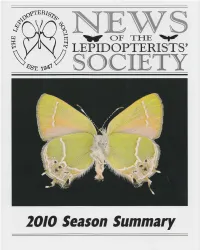
2010 Season Summary Index NEW WOFTHE~ Zone 1: Yukon Territory
2010 Season Summary Index NEW WOFTHE~ Zone 1: Yukon Territory ........................................................................................... 3 Alaska ... ........................................ ............................................................... 3 LEPIDOPTERISTS Zone 2: British Columbia .................................................... ........................ ............ 6 Idaho .. ... ....................................... ................................................................ 6 Oregon ........ ... .... ........................ .. .. ............................................................ 10 SOCIETY Volume 53 Supplement Sl Washington ................................................................................................ 14 Zone 3: Arizona ............................................................ .................................... ...... 19 The Lepidopterists' Society is a non-profo California ............... ................................................. .............. .. ................... 2 2 educational and scientific organization. The Nevada ..................................................................... ................................ 28 object of the Society, which was formed in Zone 4: Colorado ................................ ... ............... ... ...... ......................................... 2 9 May 1947 and formally constituted in De Montana .................................................................................................... 51 cember -

Entomología Agrícola
ENTOMOLOGÍA AGRÍCOLA EFECTIVIDAD BIOLÓGICA DE INSECTICIDAS CONTRA NINFAS DE Diaphorina citri KUWAYAMA (HEMIPTERA: PSYLLIDAE) EN EL VALLE DEL YAQUI, SON. Juan José Pacheco-Covarrubias. Instituto Nacional de Investigaciones Forestales, Agrícolas y Pecuarias (INIFAP), Campo Experimental Norman E. Borlaug. Calle Dr. Norman E. Borlaug Km. 12, CP 85000, Cd. Obregón, Son. pacheco.juanjose@inifap.gob.mx. RESUMEN. El Psilido Asiático de los Cítricos actualmente es la principal plaga de la citricultura en el mundo por ser vector de la bacteria Candidatus liberobacter que ocasiona el Huanglongbing. Tanto adultos como ninfas de cuarto y quinto instar pueden ser vectores de esta enfermedad por lo que su control es básico para minimizar este problema. Se realizó esta investigación para conocer el comportamiento de los estados inmaduros de la plaga a varias alternativas químicas de control. El análisis de los datos de mortalidad muestra que las poblaciones de Diaphorina tratadas con: clorpirifós, dimetoato, clotianidin, dinotefurán, thiametoxan, endosulfán, imidacloprid, lambdacialotrina, zetacipermetrina, y lambdacialotrina registraron mortalidades superiores al 85%. Por otra parte, las poblaciones tratadas con: pymetrozine (pyridine azomethines) y spirotetramat (regulador de crecimiento de la síntesis de lípidos) a las dosis evaluadas no presentaron efecto tóxico por contacto o efecto fumigante sobre la población antes mencionada. Palabras Clave: psílido, Diaphorina citri, ninfas, insecticidas. ABSTRACT. The Asian Citrus Psyllid, vector of Candidatus Liberobacter, bacteria that causes Huanglongbing disease, is currently the major pest of citrus in the world. Both, adults and nymphs of fourth and fifth instar can be vectors this pathogen, and therefore their control is essential to prevent increase and spread of disease. This research was carried out to evaluate the biological response of the immature stages of the pest to several chemical alternatives. -

1 Modern Threats to the Lepidoptera Fauna in The
MODERN THREATS TO THE LEPIDOPTERA FAUNA IN THE FLORIDA ECOSYSTEM By THOMSON PARIS A THESIS PRESENTED TO THE GRADUATE SCHOOL OF THE UNIVERSITY OF FLORIDA IN PARTIAL FULFILLMENT OF THE REQUIREMENTS FOR THE DEGREE OF MASTER OF SCIENCE UNIVERSITY OF FLORIDA 2011 1 2011 Thomson Paris 2 To my mother and father who helped foster my love for butterflies 3 ACKNOWLEDGMENTS First, I thank my family who have provided advice, support, and encouragement throughout this project. I especially thank my sister and brother for helping to feed and label larvae throughout the summer. Second, I thank Hillary Burgess and Fairchild Tropical Gardens, Dr. Jonathan Crane and the University of Florida Tropical Research and Education center Homestead, FL, Elizabeth Golden and Bill Baggs Cape Florida State Park, Leroy Rogers and South Florida Water Management, Marshall and Keith at Mack’s Fish Camp, Susan Casey and Casey’s Corner Nursery, and Michael and EWM Realtors Inc. for giving me access to collect larvae on their land and for their advice and assistance. Third, I thank Ryan Fessendon and Lary Reeves for helping to locate sites to collect larvae and for assisting me to collect larvae. I thank Dr. Marc Minno, Dr. Roxanne Connely, Dr. Charles Covell, Dr. Jaret Daniels for sharing their knowledge, advice, and ideas concerning this project. Fourth, I thank my committee, which included Drs. Thomas Emmel and James Nation, who provided guidance and encouragement throughout my project. Finally, I am grateful to the Chair of my committee and my major advisor, Dr. Andrei Sourakov, for his invaluable counsel, and for serving as a model of excellence of what it means to be a scientist. -

Argentina - 2007 Eel^^T
Rev. Fac. Agronomía - UNLPam Vol 18 1/2 6300 Santa Rosa - Argentina - 2007 EEl^^t. Qrugas cortadoras que dañan cultivos de cosecha gruesa y pasturas de alfalfa en la regióri oriental de la provincia de La Pampa. Revisión bibliográfica Cutwornn that damage summer crops and pastures of alfalfa in the oriental region of the province of La Pampa. Bibliographical review. Recibido: 21/03/2007 Aceptado: 03/10/2007 Baudino, E. '* & D. VillarreaP RESUMEN El complejo de orugas cortadoras en la región semiárida oriental de la provincia de La Pampa está integrado por: Agrotis malefída, A. gypaetina, Pehdroma saucia y Pseudoleucania bilitura (Lepidoptera: Noctuidae). La presente contribución es una síntesis de la información disponible sobre estas cuatro especies que provocan daños en los cultivos. Se describe el grupo de los noctuidos y se sintetiza la biología con especial referencia a las especies citadas anteriormente. Además, para cada una de las especies se proporciona la distribución geográfica y un listado de plantas huéspedes. El complejo incluye tres especies neotropicales {A. malefída, A. gypaetina y Pseudoíeucania bilitura), la distribución de la primera se extiende hasta el Sur de la Neártida y una especies cosmopolitas (Peridroma saucia). Se enfatiza la información producida sobre el grupo en Argentina. Palabras clave: orugas cortadoras, Noctuidae, distribución geográfica, plantas huéspedes, Argentina, revisión. facultad de Agronomía de la UNLPam. Ruta 35, Km 334 (6300). Santa Rosa. La Pampa. * E-mail: baudino@agro.unlpam.edu.ar ^Facultad de Ciencias Exactas y Naturales de la UNLPam. Uruguay 151 (6300). Santa Rosa, La Pampa. 11 SUMMARY The cutworms complex in the semiarid oriental region of La Pampa province is integrated for: Agrotis malefida, A. -

Biology and Illustrated Key for the Identification of Twenty Species of Economically Important Noctuid Pests a D
Louisiana State University LSU Digital Commons LSU Agricultural Experiment Station Reports LSU AgCenter 1981 Biology and illustrated key for the identification of twenty species of economically important noctuid pests A D. Oliver Follow this and additional works at: http://digitalcommons.lsu.edu/agexp Recommended Citation Oliver, A D., "Biology and illustrated key for the identification of twenty species of economically important noctuid pests" (1981). LSU Agricultural Experiment Station Reports. 260. http://digitalcommons.lsu.edu/agexp/260 This Article is brought to you for free and open access by the LSU AgCenter at LSU Digital Commons. It has been accepted for inclusion in LSU Agricultural Experiment Station Reports by an authorized administrator of LSU Digital Commons. For more information, please contact gcoste1@lsu.edu. Biology and Illustrated Key for the Identification of Twenty Species of bconomically Impor tant Noctuid Pests A.D. C liver and J. B Chapin LOUISIANA STATE UNIVERSITY AND AGRICULTURAL AND MECHANICAL COLLEGE Center for Agricultural Sciences And Rural Dei lopment ALVIN C HARPER CHANCE. LOP AGRICULTURAL EXPERIMENT Sia;ION DO^E C-1 AMBERS, DIRECT "P Table of Contents Page Introduction 3 4 Identifying Noccuid Larvae The Larval Key 6 Dichotomous Ke\ to the Larvae of 20 Species of Important Noctuid Pests Identifying Noctuid Adults 9 Summary Descriptions, Distributions, Hosts, and Seasonal Histories 9 Varieeated Cutworm, Peridroma saucia (Hiibner) 9 Granulate Cutworm, Feltia subterranea (F.) 10 () Dingy Cutworm, Feltia ducens Walker ' Black Cutworm. Agrotis ipsilon (Hufnagel) 10 Claybacked Cutworm, Agrotis gladiaria Morrison 11 Palesided Cutworm, Agrotis malefida Guene'e 11 Tobacco Budworm, Heliothis virescens (F.) 1- Cotton Boll worm, Heliothis zea (Boddie) '2 Cotton Leafworm, Alabama argillacea (Hiibner) ... -
The Granulate Cutworm (Lepidoptera: Noctuidae): Biological Parameters Under Controlled Conditions, Host Plants, and Distribution in the Americas
Journal of Insect Science, (2020) 20(6): 22; 1–18 doi: 10.1093/jisesa/ieaa115 Research The Granulate Cutworm (Lepidoptera: Noctuidae): Biological Parameters Under Controlled Conditions, Host Plants, and Distribution in the Americas 1,11, 2,3, 4, Alexandre Specht, Fernando M. S. Dias, Germán San Blas, Downloaded from https://academic.oup.com/jinsectscience/article/20/6/22/5960127 by guest on 08 November 2020 Vânia F. Roque-Specht,5, Mirna M. Casagrande,3, Olaf H. H. Mielke,3, Débora G. Montezano,6, Izailda Barbosa Santos,7 Silvana V. Paula-Moraes,7, Thomas E. Hunt,8 Juaci V. Malaquias,1, Felipe A. D. Bonfin,1,9 and Paulo V. M. Vieira1,10 1Embrapa Cerrados, BR 020 Km 18, Caixa Postal 08223, 73310-970, Planaltina, DF, Brazil, 2Departamento de Biologia Animal e Vegetal, Universidade Estadual de Londrina, PO Box 10.011, 86.057-970, Londrina, Paraná, Brazil, 3Laboratório de Estudos de Lepidoptera Neotropical, Departamento de Zoologia, Universidade Federal do Paraná, P.O. Box 19.020, 81.531-980, Curitiba, Paraná, Brazil, 4INCITAP-CONICET - Facultad de Ciencias Exactas y Naturales, Universidad Nacional de La Pampa, RN35 km 335, P.O.Box 6300, Santa Rosa, Argentina, 5Universidade de Brasília, Faculdade UnB Planaltina, Área Universitária 1, Vila Nossa Senhora de Fátima, 73345-010, Planaltina, DF, Brazil, 6Corteva Agrisciense, 52302 Marion IA, 7Entomology & Nematology Department, West Florida Research and Education Center, University of Florida, 4253 Experiment Road, Jay, FL, 8Haskell Agricultural Laboratory, Department of Entomology, University -

A Preliminary Investigation of the Arthropod Fauna of Quitobaquito Springs Area, Organ Pipe Cactus National Monument, Arizona
COOPERATIVE NATIONAL PARK RESOURCES STUDIES UNIT UNIVERSITY OF ARIZONA 125 Biological Sciences (East) Bldg. 43 Tucson, Arizona 85721 R. Roy Johnson, Unit Leader National Park Senior Research Scientist TECHNICAL REPORT NO. 23 A PRELIMINARY INVESTIGATION OF THE ARTHROPOD FAUNA OF QUITOBAQUITO SPRINGS AREA, ORGAN PIPE CACTUS NATIONAL MONUMENT, ARIZONA KENNETH J. KINGSLEY, RICHARD A. BAILOWITZ, and ROBERT L. SMITH July 1987 NATIONAL PARK SERVICE/UNIVERSITY OF ARIZONA National Park Service Project Funds CONTRIBUTION NUMBER CPSU/UA 057/01 TABLE OF CONTENTS Introduction......................................................................................................................................1 Methods............................................................................................................................................1 Results ............................................................................................................................................2 Discussion......................................................................................................................................20 Literature Cited ..............................................................................................................................22 Acknowledgements........................................................................................................................23 LIST OF TABLES Table 1. Insects Collected at Quitobaquito Springs ...................................................................3 -

INTA Bases Para El Cultivo De Maíz
El crecimiento que ha experimentado el cultivo de maíz en nuestro país en los últimos años está sustentado por la generación, transferencia y adopción de tecnologías adecuadas a la diversidad de BasesBases parapara elel nuestros sistemas productivos. Los aumentos de rendimientos por hectárea son el resultado de la aplicación de tecnologías enmarcadas en un esquema de sustentabilidad de los recursos naturales y del sistema productivo. La contribución a la mejora de los rendimientos del avance de la siembra directa, de ManejoManejo deldel CultivoCultivo dede MaízMaíz la creación y difusión de cultivares mejor adaptados a las condiciones de suelo, clima y adversidades biológicas, y del ajuste de las prácticas de manejo del cultivo, cosecha y post-cosecha de cada región productiva difícilmente pueda estimarse de manera separada, por cuanto el éxito alcanzado se debe a la conjunción de esfuerzos desde diferentes ámbitos y disciplinas. Y poco de ello hubiese sido posible de lograr tan rápidamente sin la insustituible asistencia de asesores profesionales y la decisión de nuestros productores. El maíz es hoy mucho más que un cultivo. Es uno de los tres cereales de los que depende Compilador y editor: la humanidad para proveerse de alimentos y derivados industriales. Para la economía nacional Ing. Agr MSc PhD Guillermo H. Eyhérabide constituye uno de los rubros productivos más importantes, y su trama productiva e industrial asociada genera valor agregado, empleo y riqueza nacional. INTA PERGAMINO Han transcurrido casi treinta años desde la edición del libro del INTA El Cultivo de Maíz. Desde entonces se han generado desde diferentes ámbitos institucionales y privados un buen número de publicaciones orientadas a determinados aspectos del cultivo, o bien a difundir y actualizar las prácticas de manejo del cultivo en cada región. -

Lepidoptera: Noctuidae): a History of Misidentifications Revista Mexicana De Biodiversidad, Vol
Revista Mexicana de Biodiversidad ISSN: 1870-3453 falvarez@ib.unam.mx Universidad Nacional Autónoma de México México San Blas, Germán; Barrionuevo, María José Status and redescription of the South American pest species Agrotis robusta (Lepidoptera: Noctuidae): a history of misidentifications Revista Mexicana de Biodiversidad, vol. 84, núm. 4, 2013, pp. 1153-1158 Universidad Nacional Autónoma de México Distrito Federal, México Available in: http://www.redalyc.org/articulo.oa?id=42529675035 How to cite Complete issue Scientific Information System More information about this article Network of Scientific Journals from Latin America, the Caribbean, Spain and Portugal Journal's homepage in redalyc.org Non-profit academic project, developed under the open access initiative Revista Mexicana de Biodiversidad 84: 1153-1158, 2013 Revista Mexicana de Biodiversidad 84: 1153-1158, 2013 DOI: 10.7550/rmb.36317 DOI: 10.7550/rmb.363171153 Status and redescription of the South American pest species Agrotis robusta (Lepidoptera: Noctuidae): a history of misidentifications Estado y redescripción de Agrotis robusta (Lepidoptera: Noctuidae), especie plaga en América del Sur: una historia de errores de identificación Germán San Blas1 and María José Barrionuevo2 1Laboratorio de Entomología, Instituto Argentino de Investigaciones de las Zonas Áridas, Centro Científico Tecnológico-Consejo Nacional de Investigaciones Científicas y Técnicas, Mendoza, CC 507, 5500 Mendoza, Argentina. 2Instituto Superior de Entomología, Instituto y Fundación Miguel Lillo, 4000 San Miguel de Tucumán, Tucumán, Argentina. gsanblas@mendoza-conicet.gov.ar Abstract. Agrotis robusta (Blanchard, 1852) (Lepidoptera: Noctuidae) is a species of economic importance in South America. This species is considered a pest on seedlings of several crops. Agrotis robusta is commonly confused with and treated as A. -

Tesis Doctoral Estela Baudino
Universidad de Buenos Aires Facultad de Ciencias Exactas y Naturales COMPLEJO DE ORUGAS CORTADORAS (LEPIDOPTERA: NOCTUIDAE) DEL ÁREA FISIOGRÁFICA ORIENTAL DE LA PROVINCIA DE LA PAMPA, Y SUS PARASITOIDES Tesis presentada para optar al título de Doctor de la Universidad de Buenos Aires en el área de Ciencias Biológicas Estela Maris Baudino Director de tesis: Dr. Axel Bachmann Consejero de estudios: Dra. Graciela Esnal Lugar de trabajo: Fac. de Agronomía. Universidad Nacional de La Pampa. Lab. de Entomología, Fac. de Cs. Ex. y Naturales. UBA. Buenos Aires 2006 COMPLEJO DE ORUGAS CORTADORAS (LEPIDOPTERA: NOCTUIDAE) DEL ÁREA FISIOGRÁFICA ORIENTAL DE LA PROVINCIA DE LA PAMPA, Y SUS PARASITOIDES Resumen El presente estudio se llevó a cabo con los objetivos de revisar la información existente sobre el grupo de orugas cortadoras, con particular énfasis sobre la Argentina, y en dos subregiones del área fisiográfica Oriental de La Pampa, Argentina; establecer la composición del complejo de orugas cortadoras y los períodos de actividad de las especies que lo integran; identificar sus parasitoides, pertenecientes a las familias Ichneumonidae y Braconidae, y evaluar sus efectos sobre las poblaciones de orugas cortadoras a través de la determinación de la tasa de parasitismo. Los muestreos se realizaron quincenalmente durante los años 1999 a 2002 en campos de los departamentos Capital y Maracó, y en 2001 y 2002 en campos del departamento Trenel. En cada área de muestreo se revisaron dos lotes de alfalfa por año. En cada lote se demarcaron 5 sitios y se seleccionaron entre 20 y 40 plantas, de las que se revisó la corona, la broza adyacente y los primeros 5 cm de profundidad del suelo.