Turkologiya-2011-4.Pdf
Total Page:16
File Type:pdf, Size:1020Kb
Load more
Recommended publications
-

4 Vol. 2 2020
ISSN 2664-5157 (print) ISSN 2708-7360 (online) №4 Turkic Studies Vol. 2 Journal 2020 Nur-Sultan ISSN (print)2664-5157 ISSN (online)2708-7360 Turkic Studies Journal 2020, Volume 2, Number 4 2019 жылдан бастап шығады Founded in 2019 Издается с 2019 года Жылына 4 рет шығады Published 4 times a year Выходит 4 раза в год Нұр-Сұлтан, 2020 Nur-Sultan, 2020 Нур-Султан, 2020 ISSN 2664-5157. Turkic Studies Journal, 2020, Volume 2, Number 4 1 Бас редакторы: Ерлан Сыдықов, т.ғ.д., проф., ҚР ҰҒА академигі, Л.Н. Гумилев атындағы Еуразия ұлттық университеті (Нұр-Сұлтан, Қазақстан) Бас редактордың орынбасары Шакимашрип Ибраев, ф.ғ.д., проф., Л.Н. Гумилев атындағы Еуразия ұлттық университеті (Нұр-Сұлтан, Қазақстан) Бас редактордың орынбасары Ирина Невская, доктор, проф., Гете университеті (Франкфурт, Германия) Редакция алқасы Ғайбулла Бабаяров т.ғ.д., Өзбекстан ғылым академиясы Ұлттық археология орталығы (Ташкент, Өзбекстан) Ұлданай Бахтикиреева ф.ғ.д., проф., Ресей халықтар достастығы университеті (Мәскеу, Ресей Федерациясы) Дмитрий Васильев т.ғ.д., проф., Ресей ғылым академиясының Шығыстану институты (Мәскеу, Ресей Федерациясы) Гюрер Гульсевин доктор, проф., Эгей университеті (Измир, Түркия) Анна Дыбо ф.ғ.д., проф., Ресей ғылым академиясының Тіл білімі институты (Мәскеу, Ресей Федерациясы) Мырзатай Жолдасбеков ф.ғ.д., проф., Л.Н. Гумилев атындағы Еуразия ұлттық университеті (Нұр-Сұлтан, Қазақстан) Дания Загидуллина ф.ғ.д., проф., Татарстан Республикасы ғылым академиясы (Қазан, Ресей Федерациясы) Зимони Иштван доктор, проф., Сегед университеті (Сегед, Венгрия). Болат Көмеков т.ғ.д., проф., Л.Н. Гумилев атындағы Еуразия ұлттық университеті (Нұр-Сұлтан, Қазақстан) Игорь Кызласов т.ғ.д., проф., Ресей ғылым академиясы Археология институты (Мәскеу, Ресей Федерациясы) Дихан Қамзабекұлы ф.ғ.д., проф., Л.Н. -
LCSH Section K
K., Rupert (Fictitious character) Motion of K stars in line of sight Ka-đai language USE Rupert (Fictitious character : Laporte) Radial velocity of K stars USE Kadai languages K-4 PRR 1361 (Steam locomotive) — Orbits Ka’do Herdé language USE 1361 K4 (Steam locomotive) UF Galactic orbits of K stars USE Herdé language K-9 (Fictitious character) (Not Subd Geog) K stars—Galactic orbits Ka’do Pévé language UF K-Nine (Fictitious character) BT Orbits USE Pévé language K9 (Fictitious character) — Radial velocity Ka Dwo (Asian people) K 37 (Military aircraft) USE K stars—Motion in line of sight USE Kadu (Asian people) USE Junkers K 37 (Military aircraft) — Spectra Ka-Ga-Nga script (May Subd Geog) K 98 k (Rifle) K Street (Sacramento, Calif.) UF Script, Ka-Ga-Nga USE Mauser K98k rifle This heading is not valid for use as a geographic BT Inscriptions, Malayan K.A.L. Flight 007 Incident, 1983 subdivision. Ka-houk (Wash.) USE Korean Air Lines Incident, 1983 BT Streets—California USE Ozette Lake (Wash.) K.A. Lind Honorary Award K-T boundary Ka Iwi National Scenic Shoreline (Hawaii) USE Moderna museets vänners skulpturpris USE Cretaceous-Paleogene boundary UF Ka Iwi Scenic Shoreline Park (Hawaii) K.A. Linds hederspris K-T Extinction Ka Iwi Shoreline (Hawaii) USE Moderna museets vänners skulpturpris USE Cretaceous-Paleogene Extinction BT National parks and reserves—Hawaii K-ABC (Intelligence test) K-T Mass Extinction Ka Iwi Scenic Shoreline Park (Hawaii) USE Kaufman Assessment Battery for Children USE Cretaceous-Paleogene Extinction USE Ka Iwi National Scenic Shoreline (Hawaii) K-B Bridge (Palau) K-TEA (Achievement test) Ka Iwi Shoreline (Hawaii) USE Koro-Babeldaod Bridge (Palau) USE Kaufman Test of Educational Achievement USE Ka Iwi National Scenic Shoreline (Hawaii) K-BIT (Intelligence test) K-theory Ka-ju-ken-bo USE Kaufman Brief Intelligence Test [QA612.33] USE Kajukenbo K. -
Declension System of the Turkic Languages: Historical Development of Case Endings Gulgaysha S
Bulletin of the KIH of the RAS, 2016, Vol. 23, Is. 1 Copyright © 2016 by the Kalmyk Institute for Humanities of the Russian Academy of Sciences Published in the Russian Federation Bulletin of the Kalmyk Institute for Humanities of the Russian Academy of Sciences Has been issued since 2008 ISSN: 2075-7794; E-ISSN: 2410-7670 Vol. 23, Is. 1, pp. 166–173, 2016 DOI 10.22162/2075-7794-2016-23-1-166-173 Journal homepage: http://kigiran.com/pubs/vestnik UDC 811.512.1 Declension System of the Turkic Languages: Historical Development of Case Endings Gulgaysha S. Sagidolda1 1 Ph. D. of Philology, Professor of the Kazakh Linguistics Department at L. N. Gumilyev Eurasian National University (Astana, the Republic of Kazakhstan). E-mail: asem963@mail.ru Abstract Declension system of the Turkic languages is characterized by a large number of cases and a variety of forms of cases. The research works indicate the number of cases in the Turkic languages in different ways, in some languages they are considered to be 6, and in the others 7 or 8. There are different opinions about the number of cases in the language of the ancient Turkic written monuments, known as the source of the Turkic languages. Some scholars defi ne 11 cases and some say that the number of main cases is 7. In the language of the Orkhon, Yenisei and Talas monuments there are hidden or null form of cases, as well as the meaning of cases can be given by individual words. Also, some endings correspond with the formants of other cases according to the form or comply with other formants of cases according to the meaning. -

Studies in Honour of Éva Kincses-Nagy
ALTAIC AND CHAGATAY LECTURES Studies in Honour of Éva Kincses-Nagy Altaic and Chagatay Lectures Studies in Honour of Éva Kincses-Nagy Edited by István Zimonyi Szeged – 2021 This publication was supported by the ELTE-SZTE Silk Road Research Group, ELKH Cover illustration: Everyone acts according to his own disposition (Q 17,84, written in nasta’liq) Calligraphy of Mustafa Khudair Letters and Words. Exhibtion of Arabic Calligraphy. Cairo 2011, 35. © University of Szeged, Department of Altaic Studies, Printed in 2021 All rights reserved. No part of this book may be reproduced, stored in a retrieval system, or transmitted in any form or by other means, electronic, mechanical, photocopying, recording or otherwise, without the prior permission in writing of the author or the publisher. Printed by: Innovariant Ltd., H-6750 Algyő, Ipartelep 4. ISBN: 978 963 306 793 2 (printed) ISBN: 978 963 306 794 9 (pdf) Contents Preface ................................................................................................................. 11 ŞÜKRÜ HALÛK AKALIN On the Etymology and Word Formation of Arıbeyi ‘Queen Bee’: How did the Female Bee Become Bey ‘Male Ruler’ in Turkish? ....................... 15 KUTSE ALTIN The Reconstruction of the Motives and Activities of the Last Campaign of Kanuni Sultan Süleyman ........................................................ 21 TATIANA A. ANIKEEVA The Tale of the Epic Cycle of “Kitab-i Dedem Korkut” in Turkish Folklore of the 20th Century ................................................................... 43 İBRAHIM AHMET AYDEMIR Zur Typologie von „Small Clauses” in modernen Türksprachen ........................ 51 LÁSZLÓ BALOGH Notes on the Ethnic and Political Conditions of the Carpathian Basin in the Early 9th Century ........................................................... 61 JÚLIA BARTHA Turkish Heritage of Hungarian Dietary Culture .................................................. 71 BÜLENT BAYRAM An Epic about Attila in Chuvash Literature: Attilpa Krimkilte ......................... -
[.35 **Natural Language Processing Class Here Computational Linguistics See Manual at 006.35 Vs
006 006 006 DeweyiDecimaliClassification006 006 [.35 **Natural language processing Class here computational linguistics See Manual at 006.35 vs. 410.285 *Use notation 019 from Table 1 as modified at 004.019 400 DeweyiDecimaliClassification 400 400 DeweyiDecimali400Classification Language 400 [400 [400 *‡Language Class here interdisciplinary works on language and literature For literature, see 800; for rhetoric, see 808. For the language of a specific discipline or subject, see the discipline or subject, plus notation 014 from Table 1, e.g., language of science 501.4 (Option A: To give local emphasis or a shorter number to a specific language, class in 410, where full instructions appear (Option B: To give local emphasis or a shorter number to a specific language, place before 420 through use of a letter or other symbol. Full instructions appear under 420–490) 400 DeweyiDecimali400Classification Language 400 SUMMARY [401–409 Standard subdivisions and bilingualism [410 Linguistics [420 English and Old English (Anglo-Saxon) [430 German and related languages [440 French and related Romance languages [450 Italian, Dalmatian, Romanian, Rhaetian, Sardinian, Corsican [460 Spanish, Portuguese, Galician [470 Latin and related Italic languages [480 Classical Greek and related Hellenic languages [490 Other languages 401 DeweyiDecimali401Classification Language 401 [401 *‡Philosophy and theory See Manual at 401 vs. 121.68, 149.94, 410.1 401 DeweyiDecimali401Classification Language 401 [.3 *‡International languages Class here universal languages; general -

Turkic Toponyms of Eurasia BUDAG BUDAGOV
BUDAG BUDAGOV Turkic Toponyms of Eurasia BUDAG BUDAGOV Turkic Toponyms of Eurasia © “Elm” Publishing House, 1997 Sponsored by VELIYEV RUSTAM SALEH oglu T ranslated by ZAHID MAHAMMAD oglu AHMADOV Edited by FARHAD MAHAMMAD oglu MUSTAFAYEV Budagov B.A. Turkic Toponyms of Eurasia. - Baku “Elm”, 1997, -1 7 4 p. ISBN 5-8066-0757-7 The geographical toponyms preserved in the immense territories of Turkic nations are considered in this work. The author speaks about the parallels, twins of Azerbaijani toponyms distributed in Uzbekistan, Kazakhstan, Turkmenistan, Altay, the Ural, Western Si beria, Armenia, Iran, Turkey, the Crimea, Chinese Turkistan, etc. Be sides, the geographical names concerned to other Turkic language nations are elucidated in this book. 4602000000-533 В ------------------------- 655(07)-97 © “Elm” Publishing House, 1997 A NOTED SCIENTIST Budag Abdulali oglu Budagov was bom in 1928 at the village o f Chobankere, Zangibasar district (now Masis), Armenia. He graduated from the Yerevan Pedagogical School in 1947, the Azerbaijan State Pedagogical Institute (Baku) in 1951. In 1955 he was awarded his candidate and in 1967 doctor’s degree. In 1976 he was elected the corresponding-member and in 1989 full-member o f the Azerbaijan Academy o f Sciences. Budag Abdulali oglu is the author o f more than 500 scientific articles and 30 books. Researches on a number o f problems o f the geographical science such as geomorphology, toponymies, history o f geography, school geography, conservation o f nature, ecology have been carried out by academician B.A.Budagov. He makes a valuable contribution for popularization o f science. -
Mutual Intelligibility Among the Turkic Languages
Mutual Intelligibility Among the Turkic Languages By Robert Lindsay Abstract: The Turkic family of languages with all important related dialects was analyzed on the basis of mutual intelligibility: (1) To determine the extent to which various Turkic lects can understand each other. (2) To ascertain whether various Turkic lects are better characterized as full languages in the own in need of ISO codes from SIL or rather as dialects of another language. (3) To analyze the history of various Turkic lects in an attempt to write a proper history of the important lects. (4) To attempt to categorize the Turkic languages in terms of subfamilies, sub-sub families, etc. The results were: (1) Rough intelligibility figures for various Turkic lects, related lects and Turkish itself were determined. Surprisingly, it was not difficult to arrive at these rough estimates. (2) The Turkic family was expanded from Ethnologue's 41 languages to 53 languages. Splitting: a number of new languages were created from existing dialects, as these dialects were better characterized as full languages than as dialects of another tongue. Lumping: a few existing languages were eliminated and re-analyzed as dialects of another or newly created language. (3) Full and detailed histories for many Turkic lects were written up in a coherent, easy to understand way, a task sorely needed in Turkic as histories of Turkic lects are often confused, inaccurate, controversial, and incomplete. (4) A new attempt was made at categorizing the Turkic family that rejects and rewrites some of the better-known characterizations. Acknowledgments: This paper could not be written without the generous support and kind, wise heart of Professor Suer Eker of Bashkent University in Ankara, who is in charge of the book project where this article is published. -

Cultural Changes in the Turkic World
Cultural Changes in the Turkic World © 2016 Orient-Institut Istanbul ISTANBULER TEXTE UND STUDIEN HERAUSGEGEBEN VOM ORIENT-INSTITUT ISTANBUL BAND 7 © 2016 Orient-Institut Istanbul Cultural Changes in the Turkic World edited by Filiz Kıral, Barbara Pusch, Claus Schönig, Arus Yumul WÜRZBURG 2016 ERGON VERLAG WÜRZBURG IN KOMMISSION © 2016 Orient-Institut Istanbul Umschlaggestaltung: Taline Yozgatian Titelfoto: Barbara Pusch Bibliografische Information der Deutschen Nationalbibliothek Die Deutsche Nationalbibliothek verzeichnet diese Publikation in der Deutschen Nationalbibliografie; detaillierte bibliografische Daten sind im Internet über http://dnb.d-nb.de abrufbar. Bibliographic information published by the Deutsche Nationalbibliothek The Deutsche Nationalbibliothek lists this publication in the Deutsche Nationalbibliografie; detailed bibliographic data are available in the Internet at http://dnb.d-nb.de. ISBN 978-3-95650-181-4 ISSN 1863-9461 © 2016 Orient-Institut Istanbul (Max Weber Stiftung) Das Werk einschließlich aller seiner Teile ist urheberrechtlich geschützt. Jede Verwertung des Werkes außerhalb des Urheberrechtsgesetzes bedarf der Zustimmung des Orient-Instituts Istanbul. Dies gilt insbesondere für Vervielfältigungen jeder Art, Übersetzungen, Mikro- verfilmung sowie für die Einspeicherung in elektronische Systeme. Gedruckt mit Unter- stützung des Orient-Instituts Istanbul, gegründet von der Deutschen Morgenländischen Gesellschaft, aus Mitteln des Bundesministeriums für Bildung und Forschung. Ergon-Verlag GmbH Keesburgstr. 11, -

Filologiya Məsələləri, № 9, 2020
Filologiya məsələləri, № 9, 2020 AZƏRBAYCAN MİLLİ ELMLƏR AKADEMİYASI M. FÜZULİ adına ƏLYAZMALAR İNSTİTUTU FİLOLOGİYA MƏSƏLƏLƏRİ № 9 Toplu Azərbaycan Respublikası Prezidenti yanında Ali Attestasiya Komissiyası tərəfindən rəsmi qeydiy- yata alınmışdır (Filologiya elmləri bölməsi, №13). Azərbaycan Respublikası Ədliyyə Nazirliyi Mətbu nəşrlərin reyestrinə daxil edilmişdir. Reyestr №3222. «Елм вя тящсил» Бакы – 2020 – 1 – Filologiya məsələləri, № 9, 2020 РЕДАКСИЙА ЩЕЙЯТИ: академик Иса Щябиббяйли, академик Теймур Кяримли, akademik Мющсцн Наьысойлу, akademik Низами Ъяфяров, академик Rafael Hüseynov, АМЕА-нын мцхbир цзвц, фilologiya elmləri doktoru, проф. Ябцлфяз Гулийев, фilologiya elmləri doktoru, проф. Fəxrəddin Veysəlli, фilologiya elmləri doktoru, проф. Гязянфяр Казымов, фilologiya elmləri doktoru, проф. Рцфят Рцстямов фilologiya elmləri doktoru, проф. Əsgər Rəsulov, фilologiya elmləri doktoru, проф. Надир Мяммядли, фilologiya elmləri doktoru, проф. Мясуд Мащ- мудов, фilologiya elmləri doktoru, проф. Ябцлфяз Ряъябли, фilologiya elmləri doktoru, проф. Ъялил Наьыйев, фilologiya elmləri doktoru, проф. İsmayıl Məmmədli, фilologiya elmləri doktoru, проф. Nizami Xudiyev, фilologiya elmləri doktoru, проф. Həbib Zərbəliyev, фilologiya elmləri doktoru, проф. İlham Tahirov, фilologiya elmləri doktoru, проф. Tofiq Hacıyev, фilologiya elmləri doktoru, проф. Sevil Meh- diyeva, фilologiya elmləri doktoru, проф. Buludxan Xəlilov, фilologiya elmləri doktoru, проф. Мцбариз Йусифов, фilologiya elmləri doktoru, проф. Гязянфяр Пашайев, фilologiya elmləri doktoru, -

Halaççanın Yitim Ve Değişim Sürecine Tasarlama Kipleri Açısından Bir Bakış*
Halaççanın Yitim ve Değişim Sürecine Tasarlama Kipleri Açısından Bir Bakış* Sonel Bosnalı** Özet: On Halaç köyünde yürütülen saha araştırmasında elde edilen verilerden hareket edilerek, tasarlama kiplerinin değişik türleri, biçimbi- rim, işlev ve sözdizimi özellikleri açısından değerlendirildiğinde, var olan değişik biçimbirimleri yerine birçok işlevin odaklandığı tek bir bi- çimbirim kullanımı eğilimi ortaya çıkmaktadır. İstek, şart, gereklilik, ola- sılık, zamanda öncelik, amaç bildirme gibi değişik işlevlerde kullanılan /-GA/ istek kipi biçimbirimi, hatta bazen buyurma bildiren cümlelerde de kullanılabilmektedir. Bu bağlamda, tasarlama kiplerinin, Farsçanın yapısal ve işlevsel özelliklerine uygun bir şekilde, yapısal bakımdan da- raldığı, buna karşın işlevsel kapsamının genişlediği bir değişim sürecin- den bahsetmek mümkündür. Konu morfolojik ve sözdizimi düzeyinde değerlendirildiğinde, yine Farsçaya uygun olarak, sentetik yapıdan analitik yapıya, ortaçlı cümleden bağımlı bileşik cümle yapısına doğru bir dönüşüm gözlemlenmektedir. Sonuç olarak, Farsçadan kopyalanan unsurlar Halaççanın yapısal değişimine yol açmakla birlikte bu dilin yi- timini değil, bilakis onun işlevselliğini sağlamaktadır. Anahtar Kelimeler: Halaçça, dil yitimi, dil değişimi, tasarlama kipleri. Giriş: Bir dilin işlevlerinin ve kullanımının daralması (işlevsizleşme), aktarımı- nın durması dolayısıyla konuşur sayısının giderek azalması (azınlıklaşma), bu dilin yitim sürecinin belli başlı göstergelerindendir. Bununla birlikte, dilin yapı- sında da bu süreçle ilgili -
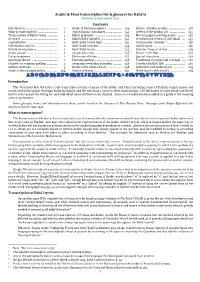
A B C Chd Dhe FG Ghhi J Kkh L M N P Q RS Sht Thu V WY Z Zh
Arabic & Fársí transcription list & glossary for Bahá’ís Revised September Contents Introduction.. ................................................. Arabic & Persian numbers.. ....................... Islamic calendar months.. ......................... What is transcription?.. .............................. ‘Ayn & hamza consonants.. ......................... Letters of the Living ().. ........................ Transcription of Bahá ’ı́ terms.. ................ Bahá ’ı́ principles.. .......................................... Meccan pilgrim meeting points.. ............ Accuracy.. ........................................................ Bahá ’u’llá h’s Apostles................................... Occultation & return of th Imám.. ..... Capitalization.. ............................................... Badı́‘-Bahá ’ı́ week days.. .............................. Persian solar calendar.. ............................. Information sources.. .................................. Badı́‘-Bahá ’ı́ months.. .................................... Qur’á n suras................................................... Hybrid words/names.. ................................ Badı́‘-Bahá ’ı́ years.. ........................................ Qur’anic “names” of God............................ Arabic plurals.. ............................................... Caliphs (first ).. .......................................... Shrine of the Bá b.. ........................................ List arrangement.. ........................................ Elative word -

LCSH Section K
K., Rupert (Fictitious character) Homology theory Ka nanʻʺ (Burmese people) (May Subd Geog) USE Rupert (Fictitious character : Laporte) NT Whitehead groups [DS528.2.K2] K-4 PRR 1361 (Steam locomotive) K. Tzetnik Award in Holocaust Literature UF Ka tūʺ (Burmese people) USE 1361 K4 (Steam locomotive) UF Ka-Tzetnik Award BT Ethnology—Burma K-9 (Fictitious character) (Not Subd Geog) Peras Ḳ. Tseṭniḳ ʾKa nao dialect (May Subd Geog) UF K-Nine (Fictitious character) Peras Ḳatseṭniḳ BT China—Languages K9 (Fictitious character) BT Literary prizes—Israel Hmong language K 37 (Military aircraft) K2 (Pakistan : Mountain) Ka nō (Burmese people) USE Junkers K 37 (Military aircraft) UF Dapsang (Pakistan) USE Tha noʹ (Burmese people) K 98 k (Rifle) Godwin Austen, Mount (Pakistan) Ka Rang (Southeast Asian people) USE Mauser K98k rifle Gogir Feng (Pakistan) USE Sedang (Southeast Asian people) K.A.L. Flight 007 Incident, 1983 Mount Godwin Austen (Pakistan) Ka-taw USE Korean Air Lines Incident, 1983 BT Mountains—Pakistan USE Takraw K.A. Lind Honorary Award Karakoram Range Ka Tawng Luang (Southeast Asian people) USE Moderna museets vänners skulpturpris K2 (Drug) USE Phi Tong Luang (Southeast Asian people) K.A. Linds hederspris USE Synthetic marijuana Kā Tiritiri o te Moana (N.Z.) USE Moderna museets vänners skulpturpris K3 (Pakistan and China : Mountain) USE Southern Alps/Kā Tiritiri o te Moana (N.Z.) K-ABC (Intelligence test) USE Broad Peak (Pakistan and China) Ka-Tu USE Kaufman Assessment Battery for Children K4 (Pakistan and China : Mountain) USE Kha Tahoi K-B Bridge (Palau) USE Gasherbrum II (Pakistan and China) Ka tūʺ (Burmese people) USE Koro-Babeldaod Bridge (Palau) K4 Locomotive #1361 (Steam locomotive) USE Ka nanʻʺ (Burmese people) K-BIT (Intelligence test) USE 1361 K4 (Steam locomotive) Ka-Tzetnik Award USE Kaufman Brief Intelligence Test K5 (Pakistan and China : Mountain) USE K.