Kiss Me in New York
Total Page:16
File Type:pdf, Size:1020Kb
Load more
Recommended publications
-
Café Society
Presents CAFÉ SOCIETY A film by Woody Allen (96 min., USA, 2016) Language: English Distribution Publicity Bonne Smith Star PR 1352 Dundas St. West Tel: 416-488-4436 Toronto, Ontario, Canada, M6J 1Y2 Fax: 416-488-8438 Tel: 416-516-9775 Fax: 416-516-0651 E-mail: starpr@sympatico.ca E-mail: info@mongrelmedia.com www.mongrelmedia.com @MongrelMedia MongrelMedia CAFÉ SOCIETY Starring (in alphabetical order) Rose JEANNIE BERLIN Phil STEVE CARELL Bobby JESSE EISENBERG Veronica BLAKE LIVELY Rad PARKER POSEY Vonnie KRISTEN STEWART Ben COREY STOLL Marty KEN STOTT Co-starring (in alphabetical order) Candy ANNA CAMP Leonard STEPHEN KUNKEN Evelyn SARI LENNICK Steve PAUL SCHNEIDER Filmmakers Writer/Director WOODY ALLEN Producers LETTY ARONSON, p.g.a. STEPHEN TENENBAUM, p.g.a. EDWARD WALSON, p.g.a. Co-Producer HELEN ROBIN Executive Producers ADAM B. STERN MARC I. STERN Executive Producer RONALD L. CHEZ Cinematographer VITTORIO STORARO AIC, ASC Production Designer SANTO LOQUASTO Editor ALISA LEPSELTER ACE Costume Design SUZY BENZINGER Casting JULIET TAYLOR PATRICIA DiCERTO 2 CAFÉ SOCIETY Synopsis Set in the 1930s, Woody Allen’s bittersweet romance CAFÉ SOCIETY follows Bronx-born Bobby Dorfman (Jesse Eisenberg) to Hollywood, where he falls in love, and back to New York, where he is swept up in the vibrant world of high society nightclub life. Centering on events in the lives of Bobby’s colorful Bronx family, the film is a glittering valentine to the movie stars, socialites, playboys, debutantes, politicians, and gangsters who epitomized the excitement and glamour of the age. Bobby’s family features his relentlessly bickering parents Rose (Jeannie Berlin) and Marty (Ken Stott), his casually amoral gangster brother Ben (Corey Stoll); his good-hearted teacher sister Evelyn (Sari Lennick), and her egghead husband Leonard (Stephen Kunken). -
Scorses by Ebert
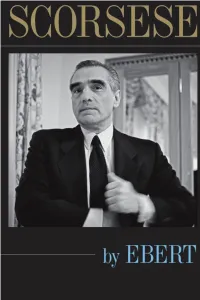
Scorsese by Ebert other books by An Illini Century roger ebert A Kiss Is Still a Kiss Two Weeks in the Midday Sun: A Cannes Notebook Behind the Phantom’s Mask Roger Ebert’s Little Movie Glossary Roger Ebert’s Movie Home Companion annually 1986–1993 Roger Ebert’s Video Companion annually 1994–1998 Roger Ebert’s Movie Yearbook annually 1999– Questions for the Movie Answer Man Roger Ebert’s Book of Film: An Anthology Ebert’s Bigger Little Movie Glossary I Hated, Hated, Hated This Movie The Great Movies The Great Movies II Awake in the Dark: The Best of Roger Ebert Your Movie Sucks Roger Ebert’s Four-Star Reviews 1967–2007 With Daniel Curley The Perfect London Walk With Gene Siskel The Future of the Movies: Interviews with Martin Scorsese, Steven Spielberg, and George Lucas DVD Commentary Tracks Beyond the Valley of the Dolls Casablanca Citizen Kane Crumb Dark City Floating Weeds Roger Ebert Scorsese by Ebert foreword by Martin Scorsese the university of chicago press Chicago and London Roger Ebert is the Pulitzer The University of Chicago Press, Chicago 60637 Prize–winning film critic of the Chicago The University of Chicago Press, Ltd., London Sun-Times. Starting in 1975, he cohosted © 2008 by The Ebert Company, Ltd. a long-running weekly movie-review Foreword © 2008 by The University of Chicago Press program on television, first with Gene All rights reserved. Published 2008 Siskel and then with Richard Roeper. He Printed in the United States of America is the author of numerous books on film, including The Great Movies, The Great 17 16 15 14 13 12 11 10 09 08 1 2 3 4 5 Movies II, and Awake in the Dark: The Best of Roger Ebert, the last published by the ISBN-13: 978-0-226-18202-5 (cloth) University of Chicago Press. -

ROBERT GREENHUT Producer
ROBERT GREENHUT Producer TRUST - Millennium - David Schwimmer, director PICASSO & BRAQUE GO TO THE MOVIES - Independent - Arne Glimcher, director BROOKLYN’S FINEST - Warner Bros. - Antoine Fuqua, director AUGUST RUSH - Warner Bros. - Kirsten Sheridan, director FIND ME GUILTY - Yari Film Group - Sidney Lumet, director STATESIDE - First Look Films - Reverge Anselmo, director THE BLACK KNIGHT - 20th Century Fox - Gil Junger, director WHITE RIVER KID - Independent - Arne Glimcher, director WITH FRIENDS LIKE THESE - Independent - Phillip Frank Messina, director THE PREACHER’S WIFE - Buena Vista - Penny Marshall, director EVERYONE SAYS I LOVE YOU - Miramax - Woody Allen, director MIGHTY APHRODITE - Miramax - Woody Allen, director BULLETS OVER BROADWAY - Miramax - Woody Allen, director RENAISSANCE MAN - Buena Vista - Penny Marshall, director WOLF (Executive) - Columbia - Mike Nichols, director MANHATTAN MURDER MYSTERY - TriStar - Woody Allen, director HUSBANDS AND WIVES - TriStar - Woody Allen, director SHADOWS AND FOG - Orion - Woody Allen, director A LEAGUE OF THEIR OWN - Columbia - Penny Marshall, director REGARDING HENRY (Executive) - Paramount - Mike Nichols, director ALICE - Orion - Woody Allen, director QUICK CHANGE - Warner Bros. - Howard Franklin, Bill Murray, directors POSTCARDS FROM THE EDGE (Executive) - Columbia - Mike Nichols, director CRIMES AND MISDEMEANORS - Orion - Woody Allen, director NEW YORK STORIES - Touchstone - Woody Allen, director WORKING GIRL - 20th Century Fox - Mike Nichols, director BIG - 20th Century Fox - Penny -

New York Stories De Martin Scorsese, Francis Ford Coppola Et Woody Allen Michel Beauchamp
Document generated on 09/27/2021 5:31 p.m. 24 images New York vu par… New York Stories de Martin Scorsese, Francis Ford Coppola et Woody Allen Michel Beauchamp Cinéma d’animation Number 43, Summer 1989 URI: https://id.erudit.org/iderudit/22936ac See table of contents Publisher(s) 24/30 I/S ISSN 0707-9389 (print) 1923-5097 (digital) Explore this journal Cite this review Beauchamp, M. (1989). Review of [New York vu par… / New York Stories de Martin Scorsese, Francis Ford Coppola et Woody Allen]. 24 images, (43), 76–77. Tous droits réservés © 24 images inc., 1989 This document is protected by copyright law. Use of the services of Érudit (including reproduction) is subject to its terms and conditions, which can be viewed online. https://apropos.erudit.org/en/users/policy-on-use/ This article is disseminated and preserved by Érudit. Érudit is a non-profit inter-university consortium of the Université de Montréal, Université Laval, and the Université du Québec à Montréal. Its mission is to promote and disseminate research. https://www.erudit.org/en/ NEW YORK STORIES DE MARTIN SCORSESE, FRANCIS FORD COPPOLA ET WOODY ALLEN Le peintre Lionel Dobie (Nick Nolte) en compagnie de son assistante /amante Paulette (Rosanna Arquette). NEW YORK VII PAR.. par Michel Beauchamp ew York, Scorsese, Coppola et tème et en renverser les valeurs. Il pousse d'un orchestre qui accompagne le célé- Allen. C'est l'affiche la plus presti à son terme la logique du désir qui lui est brissime flûtiste. Seule échappée dans le N gieuse que pouvait offrir le cinéma chère et se rend aux confins du rêve, là où réel, un clochard enfoui sous un amas de américain pour donner toutes ses chances disparaît le désir. -

Celebrity and Authorial Integrity in the Films of Woody Men %Y
CELEBRITY AND AUTHORIAL INTEGRITY IN THE FILMS OF WOODY ALLEN BY FAYE MCINTYRE A Thesis Submitted to the Facul@ of Graduate Studies in Partial Fulfillment of the Requirements for the Degree of DOCTOR OF PHILOSOPHY Department of English University of Manitoba Winnipeg, Manitoba (c) January, 200 1 National Library BibIiothèque nationale du Canada Acquisitions and Acquisitions et Bibliographic Services services bibliographiques 395 Wellington Street 395. rue Wellington Ottawa ON Ki A ON4 Ottawa ON KI A ON4 Canada Canada rour rïk vom rbw~ Our fi& Notre rtifBrence The author has granted a non- L'auteur a accordé une licence non exclusive licence allowing the exclusive permettant à la National Lïbrary of Canada to Bibliothèque nationale du Canada de reproduce, loan, distribute or seU reproduire, prêter, distribuer ou copies of this thesis in microform, vendre des copies de cette thèse sous paper or electronic formats. la forme de microfiche/film, de reproduction sur papier ou sur format électronique. The author retains ownership of the L'auteur conserve la propriété du copyright in this thesis. Neither the droit d'auteur qui protège cette thèse. thesis nor substantid extracts fÏom it Ni la thèse ni des extraits substantiels may be printed or othemise de celle-ci ne doivent être imprimés reproduced without the author's ou autrement reproduits sans son permission. autorisation. THE UNIVERSITY OF MANITOBA FACULTY OF GRADUATE STUDIES *f *f * COPYRIGHT PERMISSION PAGE Celebrity and Authorial Integrity in the Films of Woody Men %Y Faye McIntyre A Thesis/Practicum submitted to the Faculty of Graduate Studies of The University of Manitoba in partial fulNlment of the requirements of the degree of Doctor of Philosophy FAYE MCINTYRE O 2001 Permission has been granted to the Library of The University of Manitoba to Iend or seU copies of this thesis/practicum, to the National Library of Canada to microfilm this thesis/practicum and to lend or sell copies of the film, and to Dissertations Abstracts International to publish an abstract of this thesis/practicum. -
Introduction."
O’Brien, Catherine. "Introduction." : . London: Bloomsbury Academic, 2018. 1–12. Bloomsbury Collections. Web. 1 Oct. 2021. <http://dx.doi.org/10.5040/9781350003309.0005>. Downloaded from Bloomsbury Collections, www.bloomsburycollections.com, 1 October 2021, 12:51 UTC. Copyright © O’Brien 2018. You may share this work for non-commercial purposes only, provided you give attribution to the copyright holder and the publisher, and provide a link to the Creative Commons licence. Introduction A statue of a Madonna and Child in a New York kitchen appears in the opening shot of Martin Scorsese’s Who’s That Knocking at My Door (1967–9); and the final image ofSilence (2016) is of a handmade crucifix glowing in the flames of a crematory fire in seventeenth-century Japan. It is inarguable that there is a Catholic dimension to Scorsese’s filmography that can be traced from the Marian icon in his first full-length feature right through to his movie about Jesuit priests that was released around fifty years later. With due respect paid to the scale of the task, the following chapters engage with that particular cinematic trajectory and take seriously the oft-quoted words of the director himself: ‘My whole life has been movies and religion. That’s it. Nothing else.’ Scorsese was born in 1942, educated by the Sisters of Charity and received his religious instruction before the mood of aggiornamento that was heralded by Pope John XXIII’s instigation of Vatican II (the Second Vatican Council of 1962– 5), which was an effort to modernize the Catholic Church. Indeed, religion(s) played a role in the young boy’s life, even down to the fact that his father Charles earned pragmatic money by lighting the stoves for his Jewish neighbours on the Sabbath. -
1 Evolving Authorship, Developing Contexts: 'Life Lessons'
Notes 1 Evolving Authorship, Developing Contexts: ‘Life Lessons’ 1. This trajectory finds its seminal outlining in Caughie (1981a), being variously replicated in, for example, Lapsley and Westlake (1988: 105–28), Stoddart (1995), Crofts (1998), Gerstner (2003), Staiger (2003) and Wexman (2003). 2. Compare the oft-quoted words of Sarris: ‘The art of the cinema … is not so much what as how …. Auteur criticism is a reaction against sociological criticism that enthroned the what against the how …. The whole point of a meaningful style is that it unifies the what and the how into a personal state- ment’ (1968: 36). 3. For a fuller discussion of the conception of film authorship here described, see Grist (2000: 1–9). 4. While for this book New Hollywood Cinema properly refers only to this phase of filmmaking, the term has been used by some to designate ‘either something diametrically opposed to’ such filmmaking, ‘or some- thing inclusive of but much larger than it’ (Smith, M. 1998: 11). For the most influential alternative position regarding what he calls ‘the New Hollywood’, see Schatz (1993). For further discussion of the debates sur- rounding New Hollywood Cinema, see Kramer (1998), King (2002), Neale (2006) and King (2007). 5. ‘Star image’ is a concept coined by Richard Dyer in relation to film stars, but it can be extended to other filmmaking personnel. To wit: ‘A star image is made out of media texts that can be grouped together as promotion, publicity, films and commentaries/criticism’ (1979: 68). 6. See, for example, Grant (2000), or the conception of ‘post-auteurism’ out- lined and critically demonstrated in Verhoeven (2009). -
Whatever Works
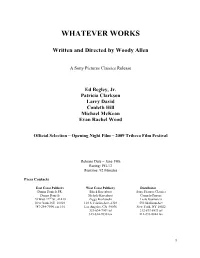
WHATEVER WORKS Written and Directed by Woody Allen A Sony Pictures Classics Release Ed Begley, Jr. Patricia Clarkson Larry David Conleth Hill Michael McKean Evan Rachel Wood Official Selection – Opening Night Film – 2009 Tribeca Film Festival Release Date – June 19th Rating: PG-13 Runtime: 92 Minutes Press Contacts East Coast Publicity West Coast Publicity Distributor Donna Daniels PR. Block Korenbrot Sony Pictures Classics Donna Daniels Melody Korenbrot Carmelo Pirrone 20 West 22nd St., #1410 Ziggy Kozlowski Leila Guenancia New York, NY 10010 110 S. Fairfax Ave, #310 550 Madison Ave 347-254-7054, ext 101 Los Angeles, CA 90036 New York, NY 10022 323-634-7001 tel 212-833-8833 tel 323-634-7030 fax 212-833-8844 fax 1 WHATEVER WORKS Starring (in alphabetical order) John ED BEGLEY, JR. Marietta PATRICIA CLARKSON Boris LARRY DAVID Leo Brockman CONLETH HILL Joe MICHAEL McKEAN Melody EVAN RACHEL WOOD Co-Starring (in alphabetical order) Randy James HENRY CAVILL Perry JOHN GALLAGHER, JR. Helena JESSICA HECHT Jessica CAROLYN McCORMICK Howard CHRISTOPHER EVAN WELCH Filmmakers Writer/Director WOODY ALLEN Producers LETTY ARONSON STEPHEN TENENBAUM Co-Producer HELEN ROBIN Executive Producers VINCENT MARAVAL BRAHIM CHIOUA Co-Executive Producers JACK ROLLINS CHARLES H. JOFFE Director of Photography HARRIS SAVIDES, A.S.C. Production Designer SANTO LOQUASTO Editor ALISA LEPSELTER Costume Designer SUZY BENZINGER Casting JULIET TAYLOR LAURA ROSENTHAL ALI FARRELL 2 WHATEVER WORKS Synopsis Woody Allen returns to New York with an offbeat comedy about a crotchety misanthrope (Larry David) and a naïve, impressionable young runaway from the south (Evan Rachel Wood). When her uptight parents, (Patricia Clarkson and Ed Begley, Jr.) arrive to rescue her, they are quickly drawn into wildly unexpected romantic entanglements. -
New York Revisited (1992) Shaun O’Connell University of Massachusetts Boston, Shaun.Oconnell@Umb.Edu
New England Journal of Public Policy Volume 28 Issue 1 Assembled Pieces: Selected Writings by Shaun Article 8 O'Connell 11-18-2015 New York Revisited (1992) Shaun O’Connell University of Massachusetts Boston, shaun.oconnell@umb.edu Follow this and additional works at: http://scholarworks.umb.edu/nejpp Part of the Creative Writing Commons, Public Policy Commons, and the United States History Commons Recommended Citation O’Connell, Shaun (2015) "New York Revisited (1992)," New England Journal of Public Policy: Vol. 28: Iss. 1, Article 8. Available at: http://scholarworks.umb.edu/nejpp/vol28/iss1/8 This Article is brought to you for free and open access by ScholarWorks at UMass Boston. It has been accepted for inclusion in New England Journal of Public Policy by an authorized administrator of ScholarWorks at UMass Boston. For more information, please contact library.uasc@umb.edu. New York Revisited What is a city? Well we might ask, for today the city as we have known it— particularly New York City, which has long reflected the state of the nation at its best and its worst—is a disintegrating entity, a depleted idea, a diminished thing. The decline of the city, as emblem and actuality, is eroding the nation’s stated commitment to life, liberty, and the pursuit of happiness. For it is the gritty city, particularly New York City, rather than the fabled New England village that has stood as the last hope for American democracy. the place where “aliens”—the huddled masses from across the Atlantic and the internal emigrés from the heart of the country—have arrived with great expectations, and it is the city that has transformed them into committed members of the body politic. -

Five Harlem Short Stories by Zora Neale Hurston
Five Harlem Short Stories by Zora Neale Hurston The Harvard community has made this article openly available. Please share how this access benefits you. Your story matters Citation Carpio, Glenda Rossanna and Werner Sollors. Five Stories by Zora Neale Hurston (includes Introduction). 2010. Amerikastudien/ American Studies 55(4): 553-581. Citable link http://nrs.harvard.edu/urn-3:HUL.InstRepos:34603462 Terms of Use This article was downloaded from Harvard University’s DASH repository, and is made available under the terms and conditions applicable to Open Access Policy Articles, as set forth at http:// nrs.harvard.edu/urn-3:HUL.InstRepos:dash.current.terms-of- use#OAP Five Harlem Short Stories by Zora Neale Hurston Glenda R. Carpio and Werner Sollors “West 139th street at ten p.m. Rich fur wraps tripping up the steps of the well furnished home in the two hundred block. Sedans, coaches, coupes, roadsters. Inside fine gowns and tuxedos, marcel waves and glitter. People who seemed to belong to every race on earth—Harlem’s upper class had gathered there her beauty and chivalry.” Does this sound like Zora Neale Hurston? If you know Hurston only as the Southern folk writer and author of Their Eyes Were Watching God (1937), probably not. Hurston, after all, put on the American literary map her beloved Eatonville, the small Florida town she claimed as her native home, although she was Alabama-born. Her story of her black Eatonville folk heroine Janie Crawford finding her own voice gave Hurston mythical status as an anti-establishment novelist who defied constricting gender roles. -

Oedipus Wrecks" Barbara J
Maurice A. Deane School of Law at Hofstra University Scholarly Commons at Hofstra Law Hofstra Law Faculty Scholarship 1992 Psycho-Feminism and Divorce Law: "Oedipus Wrecks" Barbara J. Stark Maurice A. Deane School of Law at Hofstra University Follow this and additional works at: https://scholarlycommons.law.hofstra.edu/faculty_scholarship Recommended Citation Barbara J. Stark, Psycho-Feminism and Divorce Law: "Oedipus Wrecks", 4 51 (1992) Available at: https://scholarlycommons.law.hofstra.edu/faculty_scholarship/1204 This Book Chapter is brought to you for free and open access by Scholarly Commons at Hofstra Law. It has been accepted for inclusion in Hofstra Law Faculty Scholarship by an authorized administrator of Scholarly Commons at Hofstra Law. For more information, please contact lawcls@hofstra.edu. PSYCHO-FEMINISM AND DIVORCE LAW: "OEDIPUS WRECKS" Barbara Stark In “Oedipus Wrecks,” one of the short films in the anthology “New York Stories,” Woody Allen plays a middle-aged neurotic who takes his nagging mother to a magic show. The magician makes her vanish on stage during the performance and is unable to make her reappear at the end of the act. The hero, relieved but feeling guilty, has reconciled himself to this strange development when to his horror his mother materializes, in monstrously gigantic form, over the New York skyline. She is inescapable^—discussing his girlfriend, his job, his diet in front of the whole world. Allen has shown us how an individual may be dominated by obvious but unresolved Oedipal conflicts. This paper will show how divorce functions in a social context similarly dominated by unresolved— and equally obvious, although generally ignored—Oedipal wreckage. -

Readily Admits) That Was Provoked by a Growing Interest in the Female Sex
Martin Scorsese’s Divine Comedy Also available from Bloomsbury: The Bloomsbury Companion to Religion and Film, edited by William L. Blizek Dante’s Sacred Poem, Sheila J. Nayar The Sacred and the Cinema, Sheila J. Nayar Martin Scorsese’s Divine Comedy Movies and Religion Catherine O’Brien BLOOMSBURY ACADEMIC Bloomsbury Publishing Plc 50 Bedford Square, London, WC1B 3DP, UK 1385 Broadway, New York, NY 10018, USA BLOOMSBURY and the Diana logo are trademarks of Bloomsbury Publishing Plc First published in Great Britain 2018 Copyright © Catherine O'Brien, 2018 Catherine O'Brien has asserted her right under the Copyright, Designs and Patents Act, 1988, to be identified as Author of this work. For legal purposes the Acknowledgements on p. vi constitute an extension of this copyright page. Cover design by Catherine Wood Cover image © Appian Way / Paramount / Rex Shutterstock All rights reserved. No part of this publication may be reproduced or transmitted in any form or by any means, electronic or mechanical, including photocopying, recording, or any information storage or retrieval system, without prior permission in writing from the publishers. A catalogue record for this book is available from the British Library. Library of Congress Cataloging-in-Publication Data Names: O’Brien, Catherine, 1962- author. Title: Martin Scorsese’s divine comedy: movies and religion / Catherine O’Brien. Description: London; New York, NY : Bloomsbury Academic, 2018. | Includes bibliographical references and index. | Includes filmography. Identifiers: LCCN 2017051481|