TAXON:Bromus Catharticus SCORE:19.0 RATING:High Risk
Total Page:16
File Type:pdf, Size:1020Kb
Load more
Recommended publications
-
Some Observations on Salsola L. (Chenopodiaceae) in Australia R.J
© 2010 Board of the Botanic Gardens & State Herbarium, Government of South Australia J. Adelaide Bot. Gard. 24 (2010) 75–79 © 2010 Department of Environment and Natural Resources, Government of South Australia NOTE Some observations on Salsola L. (Chenopodiaceae) in Australia R.J. Chinnock State Herbarium of South Australia, P.O. Box 2732, Kent Town, South Australia 5071 E-mail: bob.chinnock@sa.gov.au Abstract In recent years there has been much confusion as to the correct name application for the Australian species of Salsola L. Prior to the late 1990’s S. kali L. was universally applied throughout Australia but Rilke (1999) adopted the name S. tragus L. and more recently some authors have taken up the name S. australis R.Br. Molecular studies by Hrusa & Gaskin (2008), Borger et al. (2008) and Ayers et.al. (2008) confirm that Salsola australis is distinct from both S. tragus and S. kali so this name has been adopted for the forthcoming 5th edition of the Flora of South Australia. Observation of Salsola populations in Western Australia and South Australia suggest that Salsola australis is a complex of at least six forms which require an Australian-wide molecular/ systematic study to determine their status. Keywords: Chenopodiaceae, Salsola, S. australis, S. austroafricanus, S. tragus, S. kali, molecular studies, observations of populations in Western Australia and South Australia Introduction haplotypes mostly exclusive to the tetraploid S. tragus When preparing the genera of Chenopodiaceae for and the diploid Salsola ‘type B’. Salsola ‘type C’ was the fifth edition of the Flora of South Australia (in prep.) determined to be a fertile allohexaploid resulting from a problem arose over the application of the species name hybridisation between S. -

Wild Plants of Big Break Regional Shoreline Common Name Version
Wild Plants of Big Break Regional Shoreline Common Name Version A Photographic Guide Sorted by Form, Color and Family with Habitat Descriptions and Identification Notes Photographs and text by Wilde Legard District Botanist, East Bay Regional Park District New Revised and Expanded Edition - Includes the latest scientific names, habitat descriptions and identification notes Decimal Inches .1 .2 .3 .4 .5 .6 .7 .8 .9 1 .5 2 .5 3 .5 4 .5 5 .5 6 .5 7 .5 8 .5 9 1/8 1/4 1/2 3/4 1 1/2 2 1/2 3 1/2 4 1/2 5 1/2 6 1/2 7 1/2 8 1/2 9 English Inches Notes: A Photographic Guide to the Wild Plants of Big Break Regional Shoreline More than 2,000 species of native and naturalized plants grow wild in the San Francisco Bay Area. Most are very difficult to identify without the help of good illustrations. This is designed to be a simple, color photo guide to help you identify some of these plants. This guide is published electronically in Adobe Acrobat® format so that it can easily be updated as additional photographs become available. You have permission to freely download, distribute and print this guide for individual use. Photographs are © 2014 Wilde Legard, all rights reserved. In this guide, the included plants are sorted first by form (Ferns & Fern-like, Grasses & Grass-like, Herbaceous, Woody), then by most common flower color, and finally by similar looking flowers (grouped by genus within each family). Each photograph has the following information, separated by '-': COMMON NAME According to The Jepson Manual: Vascular Plants of California, Second Edition (JM2) and other references (not standardized). -

Biological Control
Salsola tragus Biological Control: Hasan et al . (2001) report that, "The rust fungus Uromyces salsolae Reichardt (Isolate MW338; IMI No. 372660) was found on S. tragus in western Turkey. The attacked plants were covered with a powdery brown mass of unicellular, globular to oval-shaped urediniospores produced in round to elongated sori on the leaves and stems, and showed much reduced growth. Later in the season, the plants produced unicellular, thick-walled, dark teliospores borne in round to elongated telia. Similarly, the S. tragus plants from the USA, when inoculated in the greenhouse with a water suspension of the urediniospores of U. salsolae , developed brown uredinia and then telia as the disease advanced. The rust has been reported on several species of Salsola in the former-USSR, Israel, Iran, Romania, Australia, France, Pakistan, and Portugal (CAB International Report, unpublished). IMI records also show that the rust has been recorded on other genera of Chenopodiaceae from former USSR, Cyprus, and Romania. During our host specicity studies, the strain of U. salsolae collected by S. Hasan in Turkey was restricted to S. tragus and did not infect any of the other 16 plant species or varieties belonging to six different families that were tested. The fungus severely infected S. tragus plants not only from the USA but also those from Montpellier (France) and Turkey, showing that the rust may not be restricted only to certain biotypes of the weed. The rust fungus, which is highly damaging and effective in killing or severely reducing the growth of the weed under greenhouse conditions, has recently been imported into the USA for further host specificity testing under quarantine conditions. -
State Noxious-Weed Seed Requirements Recognized in the Administration of the Federal Seed Act
State Noxious-Weed Seed Requirements Recognized in the Administration of the Livestock, Poultry, and Seed Program Seed Regulatory Federal Seed Act and Testing Division TABLE OF CONTENTS CHANGES FOR 2017 ........................ II MISSOURI ........................................... 44 INTRODUCTION ................................. III MONTANA .......................................... 46 FSA REGULATIONS §201.16(B) NEBRASKA ......................................... 48 NOXIOUS-WEED SEEDS NEVADA .............................................. 50 UNDER THE FSA ............................... IV NEW HAMPSHIRE ............................. 52 ALABAMA ............................................ 1 NEW JERSEY ..................................... 53 ALASKA ............................................... 3 NEW MEXICO ..................................... 55 ARIZONA ............................................. 4 NEW YORK ......................................... 56 ARKANSAS ......................................... 6 NORTH CAROLINA ............................ 57 CALIFORNIA ....................................... 8 NORTH DAKOTA ............................... 59 COLORADO ........................................ 10 OHIO .................................................... 60 CONNECTICUT .................................. 12 OKLAHOMA ........................................ 62 DELAWARE ........................................ 13 OREGON............................................. 64 DISTRICT OF COLUMBIA ................. 15 PENNSYLVANIA................................ -

Tragus Berteronianus Schultes (Poaceae), a Newly Naturalized Grass in Taiwan
Taiwan J For Sci 31(4): 331-5, 2016 331 Research note Tragus berteronianus Schultes (Poaceae), a Newly Naturalized Grass in Taiwan Ming-Jer Jung,1,3) Chien-Hsun Cheng2) 【Summary】 The newly naturalized genus, Tragus Haller (Poaceae), and its species newly recorded in the flora of Taiwan, T. berteronianus Schultes, which is broadly distributed in Africa, the Americas, and Eurasia, are described and illustrated herein. This grass species was stably found in a coastal region of the Penghu Archipelago, and its habitat and diagnosable characters are also described herein. Key words: Tragus, new record. Jung MJ, Cheng CH. 2016. Tragus berteronianus Schultes (Poaceae), a newly naturalized grass in Taiwan. Taiwan J For Sci 31(4):331-5. 1) Independent researcher, 3rd Fl., No. 27, Lane 13, Jinghua St., Wenshan District, Taipei 11683, Taiwan. 自由研究者,11683台北市文山區景華街13巷27號3樓。 2) No. 1, Zhonghe Village, Cimei Township, Penghu County, 88341, Taiwan. 88341澎湖縣七美鄉中和 村4鄰1號。 3) Corresponding author, e-mail:l5692401@gmail.com 通訊作者。 Received January 2016, Accepted April 2016. 2016年1月送審 2016年4月通過。 332 Jung and Cheng─Tragus in Taiwan 研究簡報 蝨子草(Tragus berteronianus Schultes, Poaceae), 台灣新歸化禾草 鍾明哲1,3) 鄭謙遜2) 摘要 本文描述台灣禾本科新歸化屬:鋒芒草屬(Tragus Haller)及本屬中廣布於美洲、非洲與歐亞大 陸,及其新紀錄於澎湖群島海濱的禾草:蝨子草(T. berteronianus Schultes),並描述其生育地與鑑定特 徵。 關鍵詞:鋒芒草屬、新紀錄。 鍾明哲,鄭謙遜。2016。蝨子草(Tragus berteronianus Schultes, Poaceae),台灣新歸化禾草。台灣林業 科學31(4):331-5。 The Poaceae is one of the main contribu- .........................................................鋒芒草屬 tors to the flora of Taiwan, and more than 80 Annual or perennial herb. Leaf ligule a alien species have been newly recorded and row of hairs. Panicle constricted, linear and naturalized in Taiwan (Hsu 2000, Boufford et cylindrical in outline, spikelike; branches al. -
Klamath Network Invasive Species Early Detection: 2015 Annual Report
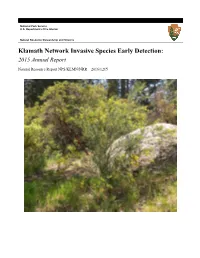
National Park Service U.S. Department of the Interior Natural Resource Stewardship and Science Klamath Network Invasive Species Early Detection: 2015 Annual Report Natural Resource Report NPS/KLMN/NRR—2016/1215 ON THE COVER Scotch broom (Cytisus scoparius) growing in ponderosa pine woodland in the Klamath Region. Photograph by: Dennis Odion (Klamath Network) Klamath Network Invasive Species Early Detection: 2015 Annual Report Natural Resource Report NPS/KLMN/NRR—2016/1215 Sean B. Smith, Alice Chung-MacCoubrey, and Ian Whited Klamath Inventory and Monitoring Network 1250 Siskiyou Blvd. Ashland, OR 97520 May 2016 U.S. Department of the Interior National Park Service Natural Resource Stewardship and Science Fort Collins, Colorado The National Park Service, Natural Resource Stewardship and Science office in Fort Collins, Colorado, publishes a range of reports that address natural resource topics. These reports are of interest and applicability to a broad audience in the National Park Service and others in natural resource management, including scientists, conservation and environmental constituencies, and the public. The Natural Resource Report Series is used to disseminate comprehensive information and analysis about natural resources and related topics concerning lands managed by the National Park Service. The series supports the advancement of science, informed decision-making, and the achievement of the National Park Service mission. The series also provides a forum for presenting more lengthy results that may not be accepted by publications with page limitations. All manuscripts in the series receive the appropriate level of peer review to ensure that the information is scientifically credible, technically accurate, appropriately written for the intended audience, and designed and published in a professional manner. -

Bromus Catharticus Vahl (Poaceae): a New Plant Record for Kashmir Himalaya, India
12 2 1875 the journal of biodiversity data 27 April 2016 Check List NOTES ON GEOGRAPHIC DISTRIBUTION Check List 12(2): 1875, 27 April 2016 doi: http://dx.doi.org/10.15560/12.2.1875 ISSN 1809-127X © 2016 Check List and Authors Bromus catharticus Vahl (Poaceae): a new plant record for Kashmir Himalaya, India Insha Muzafar1, Anzar A. Khuroo1*, Gousia Mehraj1, Maroof Hamid1 and Irfan Rashid2 1 University of Kashmir, Centre for Biodiversity and Taxonomy, Srinagar 190 006, Jammu and Kashmir, India 2 University of Kashmir, Department of Botany, Srinagar 190 006, Jammu and Kashmir, India * Corresponding author. E-mail: anzarak@gmail.com Abstract: Bromus catharticus Vahl, a grass species 2014 to September 2014, while working on the flora of native to South America, is newly reported here to the Srinagar city in the Kashmir Himalaya, we collected spec- flora of Kashmir Himalaya, India. A detailed description imens of an unknown Bromus species. The species was and photographs of diagnostic features are provided growing commonly around dry road verges, wastelands, to distinguish B. catharticus from allied species and grassy embankments and pavement edges and formed authenticate this new record from this region. abundant populations in the wild. On close examination of the specimens and using relevant taxonomic litera- Keywords: plant diversity; Bromus catharticus; ture (Bor 1960), online e-flora illustrations and expert Kashmir Himalaya; new distribution record scrutiny, these were identified as Bromus catharticus Vahl, which has hitherto been unreported from this Himalayan region. Thus, this paper adds B. catharticus to The genus Bromus L. (Poaceae: Bromeae) comprises of the flora of Kashmir Himalaya. -

Pollen Morphology of Poaceae (Poales) in the Azores, Portugal
See discussions, stats, and author profiles for this publication at: http://www.researchgate.net/publication/283696832 Pollen morphology of Poaceae (Poales) in the Azores, Portugal ARTICLE in GRANA · OCTOBER 2015 Impact Factor: 1.06 · DOI: 10.1080/00173134.2015.1096301 READS 33 4 AUTHORS, INCLUDING: Vania Gonçalves-Esteves Maria A. Ventura Federal University of Rio de Janeiro University of the Azores 86 PUBLICATIONS 141 CITATIONS 43 PUBLICATIONS 44 CITATIONS SEE PROFILE SEE PROFILE All in-text references underlined in blue are linked to publications on ResearchGate, Available from: Maria A. Ventura letting you access and read them immediately. Retrieved on: 10 December 2015 Grana ISSN: 0017-3134 (Print) 1651-2049 (Online) Journal homepage: http://www.tandfonline.com/loi/sgra20 Pollen morphology of Poaceae (Poales) in the Azores, Portugal Leila Nunes Morgado, Vania Gonçalves-Esteves, Roberto Resendes & Maria Anunciação Mateus Ventura To cite this article: Leila Nunes Morgado, Vania Gonçalves-Esteves, Roberto Resendes & Maria Anunciação Mateus Ventura (2015) Pollen morphology of Poaceae (Poales) in the Azores, Portugal, Grana, 54:4, 282-293, DOI: 10.1080/00173134.2015.1096301 To link to this article: http://dx.doi.org/10.1080/00173134.2015.1096301 Published online: 04 Nov 2015. Submit your article to this journal Article views: 13 View related articles View Crossmark data Full Terms & Conditions of access and use can be found at http://www.tandfonline.com/action/journalInformation?journalCode=sgra20 Download by: [b-on: Biblioteca do conhecimento -

Cristina Salmeri Plant Morphology
Article Fl. Medit. 29: 163-180 https://doi.org/10.7320/FlMedit29.163 Version of Record published online on 23 September 2019 Cristina Salmeri Plant morphology: outdated or advanced discipline in modern plant sciences?* Abstract Salmeri, C.: Plant morphology: outdated or advanced discipline in modern plant sciences? — Fl. Medit. 29: 163-180. 2019. — ISSN: 1120-4052 printed, 2240-4538 online. In the last decades, with the increase of molecular studies, the study of plant forms has gone through a steady decline in interest, and researches on this topic are often neglected and under- estimated. Notwithstanding, comparative morphology as integrative discipline still assumes a pivotal role in modern sciences, remaining fundamentally relevant to nearly all fields of plant biology, such as systematics, evolutionary biology, ecology, physiology, genetics, molecular biology, not to mention also agriculture, bioengineering, and forensic botany. Contrary to com- mon belief, plant morphology is not a conservative finished science, but, like other sciences, it is open to constant innovations involving both concepts and methods. This contribution aims to promote a reflective discourse on the role of plant morphology in modern sciences and provides some examples of significant supports from plant morphology to different botanical issues. Key words: Systematics, plant micromorphology, seed coat sculpturing, leaf anatomy, ecomor- phology, climate adaptation. Introduction Despite the increasing societal awareness and sensitivity about the knowledge of bio- logical diversity and ecosystem functioning as pivotal matters for nature conservation on which human health and well-being fundamentally depend, studies in morphology-based classical taxonomy have increasingly become marginalized and considered less significant than other scientific methods in plant biology. -

97. BROMUS Linnaeus, Sp. Pl. 1: 76. 1753. 雀麦属 Que Mai Shu
Flora of China 22: 371–386. 2006. 97. BROMUS Linnaeus, Sp. Pl. 1: 76. 1753. 雀麦属 que mai shu Liu Liang (刘亮), Zhu Guanghua (朱光华); Klaus H. Ammann Bromopsis (Dumortier) Fourreau; Ceratochloa P. Beauvois; Nevskiella Kreczetowicz & Vvedensky. Annuals or perennials. Culms erect, tufted or with rhizomes. Leaf sheaths closed; leaf blades linear, usually flat; ligules mem- branous. Panicles spreading or contracted, branches scabrid or pubescent, elongated or arched. Spikelets large, with 3 to many flo- rets, upper florets often sterile; rachilla disarticulating above glumes and between florets, scabrid or shortly hairy; glumes unequal or subequal, shorter than spikelet, lanceolate or nearly ovate, (1–)5–7-veined, apex acute or long acuminate or aristiform; floret callus glabrous or both sides thinly hairy; lemmas rounded on back or compressed to keel, 5–9(–11)-veined, herbaceous or nearly leathery, margins often membranous, apex entire or 2-toothed; awn terminal or arising from lemma between teeth slightly under apex, rarely awnless or 3-awned; palea narrow, usually shorter than lemma, keels ciliate or scabrid. Lodicules 2. Stamens 3. Ovary apex with ap- pendage; styles 2, arising from lower front of appendage. Caryopsis oblong, apex hairy, adaxial surface sulcate. Chromosomes large, x = 7, 2n = 14, 28, 42, 56, 70. About 150 species: temperate regions, mainly in the N hemisphere, also on mountains in the tropics; 55 species (eight endemic, at least three introduced) in China. In addition to the species treated below, Bromus pubescens Muhlenberg ex Willdenow (Enum. Pl. 120. 1809) was recorded by Jung et al. (Taiwania 51: 2. 2005) from a roadside at 2400 m in Taiwan (Nantou). -

California Grasslands and Range Forage Grasses
CALIFORNIA GRASSLANDS AND RANGE FORAGE GRASSES ARTHUR W. SAMPSON AGNES CHASE DONALD W. HEDRICK BULLETIN 724 MAY, 1951 CALIFORNIA AGRICULTURAL EXPERIMENT STATION i THE COLLEGE OF AGRICULTURE UNIVERSITY OF CALIFORNIA . CALIFORNIA GRASSLANDS AND RANGE FORAGE GRASSES provides useful and technical information on the uncultivated or wild grass- lands, and the native and naturalized range forage grasses of California. This bulletin will be helpful to you if you are among these readers: 1 Stockmen who have had some botanical training and who will want to use the illustrated keys and descriptions to determine the identity and the relative usefulness of the grasses growing on their range; 2. Range technicians and range appraisers who are chiefly concerned with management, evaluations, and economic considerations of the state's range lands; and 3. Students of range management and related fields whose knowl- edge of ecology, forage value, and taxonomy of the range grasses is an essential part of their training or official work. THE AUTHORS: Arthur W. Sampson is Professor of Forestry and Plant Ecologist in the Experiment Station, Berkeley. Agnes Chase is Research Associate, U. S. National Herbarium, Smithsonian Institu- tion; formerly Senior Agrostologist, U. S. Department of Agriculture. Donald W. Hedrick is Research Assistant in the Department of Forestry; on leave from the Soil Conservation Service, U. S. Department of Agriculture. Manuscript submitted for publication August 22, 1949. CONTENTS PAGE Introduction . 5 Where Grasses Grow 7 Topography, climate, grassland soils, life zones, grasslands in relation to other plant associations Plant Succession and the Climax Cover 17 The Nutrition of Range Grasses 18 Annual vs. -

Wildlife Habitat and Invasive Plant Species Prioritization (Pdf)
Wildlife Habitat and Invasive Plant Species Prioritization Diné Native Plants Program Jesse Mike1, Nora Talkington2 October 2020 1 Forester, Diné Native Plants Program, Navajo Natural Heritage Program, Navajo Nation Department of Fish & Wildlife 2 Botanist, Navajo Natural Heritage Program, Navajo Nation Department of Fish and Wildlife. PO Box 1480, Window Rock, Arizona 86515, correspondence to: Jesse Mike (jmike@nndfw.org) CONTENTS Introduction ............................................................................................................................................................................... 1 Data Sources ............................................................................................................................................................................... 1 BIA Invasive Plant Species Data ............................................................................................................................................. 2 Invasive Species Distribution (Mapping) ............................................................................................................................ 2 Target Invasive Species ....................................................................................................................................................... 2 Navajo Nation Wildlife Resources .......................................................................................................................................... 4 Topography .............................................................................................................................................................................