The Odonata of Finzel Swamp
Total Page:16
File Type:pdf, Size:1020Kb
Load more
Recommended publications
-

Working List of Prairie Restricted (Specialist) Insects in Wisconsin (11/26/2015)
Working List of Prairie Restricted (Specialist) Insects in Wisconsin (11/26/2015) By Richard Henderson Research Ecologist, WI DNR Bureau of Science Services Summary This is a preliminary list of insects that are either well known, or likely, to be closely associated with Wisconsin’s original native prairie. These species are mostly dependent upon remnants of original prairie, or plantings/restorations of prairie where their hosts have been re-established (see discussion below), and thus are rarely found outside of these settings. The list also includes some species tied to native ecosystems that grade into prairie, such as savannas, sand barrens, fens, sedge meadow, and shallow marsh. The list is annotated with known host(s) of each insect, and the likelihood of its presence in the state (see key at end of list for specifics). This working list is a byproduct of a prairie invertebrate study I coordinated from1995-2005 that covered 6 Midwestern states and included 14 cooperators. The project surveyed insects on prairie remnants and investigated the effects of fire on those insects. It was funded in part by a series of grants from the US Fish and Wildlife Service. So far, the list has 475 species. However, this is a partial list at best, representing approximately only ¼ of the prairie-specialist insects likely present in the region (see discussion below). Significant input to this list is needed, as there are major taxa groups missing or greatly under represented. Such absence is not necessarily due to few or no prairie-specialists in those groups, but due more to lack of knowledge about life histories (at least published knowledge), unsettled taxonomy, and lack of taxonomic specialists currently working in those groups. -

Chrysomela 43.10-8-04
CHRYSOMELA newsletter Dedicated to information about the Chrysomelidae Report No. 43.2 July 2004 INSIDE THIS ISSUE Fabreries in Fabreland 2- Editor’s Page St. Leon, France 2- In Memoriam—RP 3- In Memoriam—JAW 5- Remembering John Wilcox Statue of 6- Defensive Strategies of two J. H. Fabre Cassidine Larvae. in the garden 7- New Zealand Chrysomelidae of the Fabre 9- Collecting in Sholas Forests Museum, St. 10- Fun With Flea Beetle Feces Leons, France 11- Whither South African Cassidinae Research? 12- Indian Cassidinae Revisited 14- Neochlamisus—Cryptic Speciation? 16- In Memoriam—JGE 16- 17- Fabreries in Fabreland 18- The Duckett Update 18- Chrysomelidists at ESA: 2003 & 2004 Meetings 19- Recent Chrysomelid Literature 21- Email Address List 23- ICE—Phytophaga Symposium 23- Chrysomela Questionnaire See Story page 17 Research Activities and Interests Johan Stenberg (Umeå Univer- Duane McKenna (Harvard Univer- Eduard Petitpierre (Palma de sity, Sweden) Currently working on sity, USA) Currently studying phyloge- Mallorca, Spain) Interested in the cy- coevolutionary interactions between ny, ecological specialization, population togenetics, cytotaxonomy and chromo- the monophagous leaf beetles, Altica structure, and speciation in the genus somal evolution of Palearctic leaf beetles engstroemi and Galerucella tenella, and Cephaloleia. Needs Arescini and especially of chrysomelines. Would like their common host plant Filipendula Cephaloleini in ethanol, especially from to borrow or exchange specimens from ulmaria (meadow sweet) in a Swedish N. Central America and S. America. Western Palearctic areas. Archipelago. Amanda Evans (Harvard University, Maria Lourdes Chamorro-Lacayo Stefano Zoia (Milan, Italy) Inter- USA) Currently working on a phylogeny (University of Minnesota, USA) Cur- ested in Old World Eumolpinae and of Leptinotarsa to study host use evolu- rently a graduate student working on Mediterranean Chrysomelidae (except tion. -
Utilizing Novel Grasslands for the Conservation and Restoration Of
Iowa State University Capstones, Theses and Graduate Theses and Dissertations Dissertations 2014 Utilizing novel grasslands for the conservation and restoration of butterflies nda other pollinators in agricultural ecosystems John Thomas Delaney Iowa State University Follow this and additional works at: https://lib.dr.iastate.edu/etd Part of the Biodiversity Commons, Ecology and Evolutionary Biology Commons, Natural Resources and Conservation Commons, and the Natural Resources Management and Policy Commons Recommended Citation Delaney, John Thomas, "Utilizing novel grasslands for the conservation and restoration of butterflies and other pollinators in agricultural ecosystems" (2014). Graduate Theses and Dissertations. 14097. https://lib.dr.iastate.edu/etd/14097 This Dissertation is brought to you for free and open access by the Iowa State University Capstones, Theses and Dissertations at Iowa State University Digital Repository. It has been accepted for inclusion in Graduate Theses and Dissertations by an authorized administrator of Iowa State University Digital Repository. For more information, please contact digirep@iastate.edu. Utilizing novel grasslands for the conservation and restoration of butterflies and other pollinators in agricultural ecosystems by John Thomas Delaney A dissertation submitted to the graduate faculty in partial fulfillment of the requirements for the degree of DOCTOR OF PHILOSOPHY Major: Ecology and Evolutionary Biology Program of Study Committee: Diane M. Debinski, Major Professor David M. Engle Mary A. Harris Amy L. Toth Brian J. Wilsey Iowa State University Ames, Iowa 2014 Copyright © John Thomas Delaney, 2014. All rights reserved. ii Dedication I dedicate this dissertation to all of my family, friends, and mentors who have helped me along in this journey. -

Chrysomelidae, Coleoptera)
THE DONACIINAE, CRIOCERINAE, CLYTRINAE, - ~ CHLAMISINAE, EUMOLPINAE, AND CHRYSOMELINAE OF OKLAHOMA (CHRYSOMELIDAE, COLEOPTERA) by JAMES HENRY SHADDY \\ Bachelor of Science Oklahoma State University Stillwater, Oklahoma Submitted to the faculty of the Graduate School of the Oklahoma State University in partial fulfillment of the requirements for the degree of MASTER OF SCIENCE August, 1964 I OKLAHOMA lfAT&: UNNE.RSITf . LIBRARY JAN 8 lSGS THE DONACIINAE, CRIOCERINAE, CLYTRINAE, CHLAMISINAE, EUMOLPINAE, AND CHRYSOMELINAE OF OKLAHOMA (CHRYSOMELIDAE, COLEOPTERA) Thesis Approved: 570350 ii TABLE OF CONTENTS Page INTRODUCTION ..... 1 REVIEW OF THE LITERATURE 3 SYSTEMATICS ... 4 LITERATURE CITED 45 ILLUSTRATIONS 47 INDEX • • • . 49 iii INTRODUCTION The leaf beetles form a conspicuous segment of the coleopterous fauna of Oklahoma. Because no taxonomic paper on the Chrysomelidae existed for the state, the present work with the subfamilies Donaciinae, Criocerinae, Clytrinae, Chlamisinae, Eumolpinae, and Chrysomelinae of the eleven subfamilies found in Oklahoma was inaugurated. The chrysomelids are a large family of small or medium-sized beetles. They are generally host specific and sometimes cause extensive damage to field crops and horticultural plants. However, the Donaciinae, Clytrinae, and Chlamisinae are of little economic interest. The economically important species belong to the Criocerinae, Eumolpinae, and·Chrysomelinae. The larvae and adults of these feed on the foliage of plants, except the larvae of Eumolpinae which are primarily rootfeeders. Included in this work are 29 genera contain- ing 59 species of which 54 species are known to occur in the state and five. species are likely to occur here. I wish to thank my major advisor, Dr. William A. Drew, for his encouragement, guidance and assistance, and the other committee members, Drs. -
An Annotated Checklist of the Coleoptera of the Smithsonian Environmental Research Center, Maryland
B A N I S T E R I A A JOURNAL DEVOTED TO THE NATURAL HISTORY OF VIRGINIA ISSN 1066-0712 Published by the Virginia Natural History Society The Virginia Natural History Society (VNHS) is a nonprofit organization dedicated to the dissemination of scientific information on all aspects of natural history in the Commonwealth of Virginia, including botany, zoology, ecology, archaeology, anthropology, paleontology, geology, geography, and climatology. The society’s periodical Banisteria is a peer-reviewed, open access, online-only journal. Submitted manuscripts are published individually immediately after acceptance. A single volume is compiled at the end of each year and published online. The Editor will consider manuscripts on any aspect of natural history in Virginia or neighboring states if the information concerns a species native to Virginia or if the topic is directly related to regional natural history (as defined above). Biographies and historical accounts of relevance to natural history in Virginia also are suitable for publication in Banisteria. Membership dues and inquiries about back issues should be directed to the Co-Treasurers, and correspondence regarding Banisteria to the Editor. For additional information regarding the VNHS, including other membership categories, annual meetings, field events, pdf copies of papers from past issues of Banisteria, and instructions for prospective authors visit http://virginianaturalhistorysociety.com/ Editorial Staff: Banisteria Editor Todd Fredericksen, Ferrum College 215 Ferrum Mountain Road Ferrum, Virginia 24088 Associate Editors Philip Coulling, Nature Camp Incorporated Clyde Kessler, Virginia Tech Nancy Moncrief, Virginia Museum of Natural History Karen Powers, Radford University Stephen Powers, Roanoke College C. L. Staines, Smithsonian Environmental Research Center Copy Editor Kal Ivanov, Virginia Museum of Natural History Copyright held by the author(s). -

A Preliminary Annotated Checklist and Evaluation of the Diversity of the Chrysomelidae (Coleoptera) of the Baja California Peninsula, Mexico
INSECTA MUNDI, Vol. 19, No. 1-2, March-June, 2005 89 A preliminary annotated checklist and evaluation of the diversity of the Chrysomelidae (Coleoptera) of the Baja California peninsula, Mexico Fred G. Andrews California Department of Food and Agriculture Plant Health & Pest Prevention, Analysis & Identification 3294 Meadowview Road Sacramento, California 95832 Arthur J. Gilbert California Department of Food and Agriculture Plant Health & Pest Prevention, Pest Detection/Emergency Projects 2889 N. Larkin #106 Fresno, California 93727 Abstract. A preliminary annotated checklist of the Chrysomelidae of the Baja California peninsula, Mexico is presented based on literature records and the examination of approximately 16,000 chrysomelid specimens. Seven subfamilies and 218 described species have been identified. Ninty-one species are recognized from the Baja California peninsula for the first time. Twenty-nine species are listed as endemic. An additional 128 morphospecies have been identified as undescribed or not yet associated with described species of mainland Mexico or the United States. Adult host plant associations have been identified for approximately 120 species or 35% of the leaf beetle fauna of the region. Each of the 218 described species is associated with the eight plant communities as outlined by Wiggins (1980). Two dominant subfamilies comprise 76% of the leaf beetle fauna: Galerucinae, 87 species (40%) and Cryptocephalinae, 78 species (36%). The following new combinations are proposed: Neolema californica (Heinze, 1927), transferred from Lema Fabricius, 1798; Pseudoluperus histrio (Horn, 1895), transferred from Keitheatus Wilcox, 1965, and Diachus peninsularis (Schaeffer, 1906), transferred from Triachus J. L. LeConte, 1880. Lema peninsulae Crotch, 1873, is removed from synonymy with L. -

Butterflies of North America
Insects of Western North America 7. Survey of Selected Arthropod Taxa of Fort Sill, Comanche County, Oklahoma. 4. Hexapoda: Selected Coleoptera and Diptera with cumulative list of Arthropoda and additional taxa Contributions of the C.P. Gillette Museum of Arthropod Diversity Colorado State University, Fort Collins, CO 80523-1177 2 Insects of Western North America. 7. Survey of Selected Arthropod Taxa of Fort Sill, Comanche County, Oklahoma. 4. Hexapoda: Selected Coleoptera and Diptera with cumulative list of Arthropoda and additional taxa by Boris C. Kondratieff, Luke Myers, and Whitney S. Cranshaw C.P. Gillette Museum of Arthropod Diversity Department of Bioagricultural Sciences and Pest Management Colorado State University, Fort Collins, Colorado 80523 August 22, 2011 Contributions of the C.P. Gillette Museum of Arthropod Diversity. Department of Bioagricultural Sciences and Pest Management Colorado State University, Fort Collins, CO 80523-1177 3 Cover Photo Credits: Whitney S. Cranshaw. Females of the blow fly Cochliomyia macellaria (Fab.) laying eggs on an animal carcass on Fort Sill, Oklahoma. ISBN 1084-8819 This publication and others in the series may be ordered from the C.P. Gillette Museum of Arthropod Diversity, Department of Bioagricultural Sciences and Pest Management, Colorado State University, Fort Collins, Colorado, 80523-1177. Copyrighted 2011 4 Contents EXECUTIVE SUMMARY .............................................................................................................7 SUMMARY AND MANAGEMENT CONSIDERATIONS -

Strawberry Rootworm Biology and Control
SNA RESEARCH CONFERENCE - VOL. 48 - 2003 SNA RESEARCH CONFERENCE - VOL. 48 - 2003 Strawberry Rootworm Biology and Control Charles P. Hesselein and David W. Boyd, Jr.1 Alabama Cooperative Extension System, P.O. Box 8276, Mobile, AL 36689-0276 1USDA, ARS, P.O. Box 287, 306 S. High St., Poplarville, MS 39470 Index words: Strawberry Rootworm, Paria fragarie, Azalea, Pests Nature of Work: The strawberry rootworm (SRW), Paria fragariae Wilcox (Coleoptera: Chrysomelidae), is proving to be a threat to profitable azalea production. Stephenson (1983) reported an outbreak of the strawberry rootworm in container-produced azaleas in 1982. However, only in the past several years have reports of damage by this pest become widespread in azalea production within the Southeast. This nocturnal beetle damages plants by feeding on the foliage. Symptoms of an infestation are small circular to elongated feeding holes in the foliage generally not more than 1/16 inch in diameter or width. The beetles are a little over 1/8 inch long, oval, and shiny dark brown with four black markings on their wings. During the day, beetles hide within foliage or in plant debris at the base of the plant. They can be found by vigorously shaking infested plants over a clean ground cover or by striking infested plants with a blunt instrument over a net, such as a sweep net, and collecting plant debris and beetles. Initially, dislodged beetles will stop moving (i.e., play dead), but within a minute the dislodged beetles will scurry or fly for cover. The majority of information about the life history of this insect has been collected in strawberry production (Smith and Kido 1949, Bennett and Fulton 1953). -
Survey Report on the Leaf Beetles (Insecta: Coleoptera: Chrysomelidae) of Cove Point LNG Property and Vicinity, Calvert County, Maryland
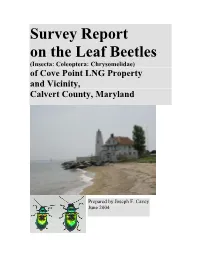
Survey Report on the Leaf Beetles (Insecta: Coleoptera: Chrysomelidae) of Cove Point LNG Property and Vicinity, Calvert County, Maryland Prepared by Joseph F. Cavey June 2004 Survey Report on the Leaf Beetles (Insecta: Coleoptera: Chrysomelidae) of Cove Point LNG Property and Vicinity, Calvert County, Maryland Joseph F. Cavey 6207 Guthrie Court Eldersburg, Maryland 21784 Submitted June 2004 Abstract A survey was funded by the Cove Point Natural Heritage Trust to document the leaf beetles (Insecta: Coleoptera: Chrysomelidae) of the Cove Point Liquefied Natural Gas (LNG) Limited Partnership Site in Calvert County, Maryland. The survey was conducted during periods of seasonal beetle activity from March 2002 to October 2003. The survey detected 92 leaf beetle species, including two species not formerly recorded for the State of Maryland and 55 additional species new to Calvert County. The detection of the rare flea beetle, Glyptina maritima Fall, represents only the third recorded collection of this species and the only recorded collection in the past 32 years. Dichanthelium (Panicum) dichromatum (L.) Gould is reported as the larval host plant of the leaf-mining hispine beetle Glyphuroplata pluto (Newman), representing the first such association for this beetle. Introduction This manuscript summarizes work completed in a two year survey effort begun in March 2002 to document the leaf beetles (Insecta: Coleoptera: Chrysomelidae) of the Cove Point Liquefied Natural Gas (LNG) Limited Partnership Site in Calvert County, Maryland, USA. Fieldwork for this study was conducted under contract with the Cove Point Natural Heritage Trust, dated February 28, 2002. One of the largest insect families, the Chrysomelidae, or leaf beetles, contains more than 37,000 species worldwide, including some 1,700 North American species (Jolivet 1988, Riley et al. -

Chrysomela 36
CHRYSOMELA newsletter Dedicated to information about the Chrysomelidae Report No. 36 October 1998 Hanoi, VIETNAM: INSIDE THIS ISSUE 2-In Memoriam Institute of Ecology 2-Notes Up Front 3-Again, Bruchid Classification 4-Proposed Upper Classification Course 4-Green Algae & Chrysomelid Evolu- tion 5-Colombia Field Trip & Museum Tours 6-Fifth International Symposium on the Chrysomelids 6-ICE XXI Updates 7-The 1998 Mid-Atlantic States Field Trip 8-Far Eastern Entomology 10-The ICIPE WWW site 11-Literature on the Chrysomelidae 13-Book Notices 14-Literature (Available or Needed) Pierre and Siraj are hosted by our Vietnam collegues in Hanoi on his November ‘97 trip 14-Specimens(Available or Needed) to the Far East. from left: Siraj HASSAN (Phytopathologist), VU Quang Con (Director, 15-Member Directory, October ‘98 Inst. of Ecology), PHAM Van Lam (Entomologist), DANG Thi Dap (Deputy Director, Inst. of Ecology, Entomologist), and Pierre JOLIVET. (story, page 8) Research Activities and Interests Laurnet Amsellem (Bangkok, Pleurosticha; planning to revise subgen- outbreak of western corn rootworm, and Thailand) PhD student working in era Arctolina (Siberian and Arctic is interested in trying to develop an Thailand on the interactions between species), Ovosoma, Lithopteroides and identification guide or “key” that Rubus alceifolius and its associated Taeniosticha. Also finishing doctoral incorporates new world Diabrotica with pathogens: a rust and a chrysomelid... thesis, Biology of Palaearctic Donacii- the old world fauna. Anyone interested, The plant is actually a real weed in La nae (Chrysomelidae). please contact him (send an email note). Reunion Island, and in order to do Lech Borowiec (Wroclaw, Poland) Shawn M. -

Coleoptera: Insecta) of Saskatchewan
1 CHECKLIST OF BEETLES (COLEOPTERA: INSECTA) OF SASKATCHEWAN R. R. Hooper1 and D. J. Larson2 1 – Royal Saskatchewan Museum, Regina, SK. Deceased. 2 – Box 56, Maple Creek, SK. S0N 1N0 Introduction A checklist of the beetles of Canada (Bousquet 1991) was published 20 years ago in order to provide a list of the species known from Canada and Alaska along with their correct names and a indication of their distribution by major political units (provinces, territories and state). A total of 7447 species and subspecies were recognized in this work. British Columbia and Ontario had the most diverse faunas, 3628 and 3843 taxa respectively, whereas Saskatchewan had a relatively poor fauna (1673 taxa) which was about two thirds that its neighbouring provinces (Alberta – 2464; Manitoba – 2351). This raises the question of whether the Canadian beetle fauna is distributed like a doughnut with a hole in the middle, or is there some other explanation. After assembling available literature records as well as the collection records available to us, we present a list of 2312 species (generally only single subspecies of a species are recognized in the province) suggesting that the Canadian distribution pattern of species is more like that of a Bismark, the dough may be a little thinner in the center but there is also a core of good things. This list was largely R. Hopper’s project. He collected Saskatchewan insects since at least the 1960’s and over the last decade before his death he had compiled a list of the species he had collected along with other records from the literature or given him by other collectors (Hooper 2001). -

An Inventory of Endemic Leaf Litter Arthropods of Arkansas with Emphasis on Certain Insect Groups and Diplopoda Derek Alan Hennen University of Arkansas, Fayetteville
University of Arkansas, Fayetteville ScholarWorks@UARK Theses and Dissertations 12-2015 An Inventory of Endemic Leaf Litter Arthropods of Arkansas with Emphasis on Certain Insect Groups and Diplopoda Derek Alan Hennen University of Arkansas, Fayetteville Follow this and additional works at: http://scholarworks.uark.edu/etd Part of the Biology Commons, Entomology Commons, and the Terrestrial and Aquatic Ecology Commons Recommended Citation Hennen, Derek Alan, "An Inventory of Endemic Leaf Litter Arthropods of Arkansas with Emphasis on Certain Insect Groups and Diplopoda" (2015). Theses and Dissertations. 1423. http://scholarworks.uark.edu/etd/1423 This Thesis is brought to you for free and open access by ScholarWorks@UARK. It has been accepted for inclusion in Theses and Dissertations by an authorized administrator of ScholarWorks@UARK. For more information, please contact scholar@uark.edu, ccmiddle@uark.edu. An Inventory of Endemic Leaf Litter Arthropods of Arkansas with Emphasis on Certain Insect Groups and Diplopoda A thesis submitted in partial fulfillment of the requirements for the degree of Master of Science in Entomology by Derek Hennen Marietta College Bachelor of Science in Biology, 2012 December 2015 University of Arkansas This thesis is approved for recommendation to the Graduate Council. ___________________________________ Dr. Ashley P.G. Dowling Thesis Director ___________________________________ Dr. Frederick M. Stephen Committee Member ___________________________________ Dr. John David Willson Committee Member Abstract Endemic arthropods of Arkansas were sampled and their nomenclature and distributions were updated. The Arkansas endemic species list is updated to 121 species, including 16 species of millipedes. A study of the millipedes of Arkansas was undertaken, and resulted in the first checklist and key to all millipede species in the state.