Strawberry Rootworm Biology and Control
Total Page:16
File Type:pdf, Size:1020Kb
Load more
Recommended publications
-

Chrysomela 43.10-8-04
CHRYSOMELA newsletter Dedicated to information about the Chrysomelidae Report No. 43.2 July 2004 INSIDE THIS ISSUE Fabreries in Fabreland 2- Editor’s Page St. Leon, France 2- In Memoriam—RP 3- In Memoriam—JAW 5- Remembering John Wilcox Statue of 6- Defensive Strategies of two J. H. Fabre Cassidine Larvae. in the garden 7- New Zealand Chrysomelidae of the Fabre 9- Collecting in Sholas Forests Museum, St. 10- Fun With Flea Beetle Feces Leons, France 11- Whither South African Cassidinae Research? 12- Indian Cassidinae Revisited 14- Neochlamisus—Cryptic Speciation? 16- In Memoriam—JGE 16- 17- Fabreries in Fabreland 18- The Duckett Update 18- Chrysomelidists at ESA: 2003 & 2004 Meetings 19- Recent Chrysomelid Literature 21- Email Address List 23- ICE—Phytophaga Symposium 23- Chrysomela Questionnaire See Story page 17 Research Activities and Interests Johan Stenberg (Umeå Univer- Duane McKenna (Harvard Univer- Eduard Petitpierre (Palma de sity, Sweden) Currently working on sity, USA) Currently studying phyloge- Mallorca, Spain) Interested in the cy- coevolutionary interactions between ny, ecological specialization, population togenetics, cytotaxonomy and chromo- the monophagous leaf beetles, Altica structure, and speciation in the genus somal evolution of Palearctic leaf beetles engstroemi and Galerucella tenella, and Cephaloleia. Needs Arescini and especially of chrysomelines. Would like their common host plant Filipendula Cephaloleini in ethanol, especially from to borrow or exchange specimens from ulmaria (meadow sweet) in a Swedish N. Central America and S. America. Western Palearctic areas. Archipelago. Amanda Evans (Harvard University, Maria Lourdes Chamorro-Lacayo Stefano Zoia (Milan, Italy) Inter- USA) Currently working on a phylogeny (University of Minnesota, USA) Cur- ested in Old World Eumolpinae and of Leptinotarsa to study host use evolu- rently a graduate student working on Mediterranean Chrysomelidae (except tion. -

Chrysomelidae, Coleoptera)
THE DONACIINAE, CRIOCERINAE, CLYTRINAE, - ~ CHLAMISINAE, EUMOLPINAE, AND CHRYSOMELINAE OF OKLAHOMA (CHRYSOMELIDAE, COLEOPTERA) by JAMES HENRY SHADDY \\ Bachelor of Science Oklahoma State University Stillwater, Oklahoma Submitted to the faculty of the Graduate School of the Oklahoma State University in partial fulfillment of the requirements for the degree of MASTER OF SCIENCE August, 1964 I OKLAHOMA lfAT&: UNNE.RSITf . LIBRARY JAN 8 lSGS THE DONACIINAE, CRIOCERINAE, CLYTRINAE, CHLAMISINAE, EUMOLPINAE, AND CHRYSOMELINAE OF OKLAHOMA (CHRYSOMELIDAE, COLEOPTERA) Thesis Approved: 570350 ii TABLE OF CONTENTS Page INTRODUCTION ..... 1 REVIEW OF THE LITERATURE 3 SYSTEMATICS ... 4 LITERATURE CITED 45 ILLUSTRATIONS 47 INDEX • • • . 49 iii INTRODUCTION The leaf beetles form a conspicuous segment of the coleopterous fauna of Oklahoma. Because no taxonomic paper on the Chrysomelidae existed for the state, the present work with the subfamilies Donaciinae, Criocerinae, Clytrinae, Chlamisinae, Eumolpinae, and Chrysomelinae of the eleven subfamilies found in Oklahoma was inaugurated. The chrysomelids are a large family of small or medium-sized beetles. They are generally host specific and sometimes cause extensive damage to field crops and horticultural plants. However, the Donaciinae, Clytrinae, and Chlamisinae are of little economic interest. The economically important species belong to the Criocerinae, Eumolpinae, and·Chrysomelinae. The larvae and adults of these feed on the foliage of plants, except the larvae of Eumolpinae which are primarily rootfeeders. Included in this work are 29 genera contain- ing 59 species of which 54 species are known to occur in the state and five. species are likely to occur here. I wish to thank my major advisor, Dr. William A. Drew, for his encouragement, guidance and assistance, and the other committee members, Drs. -

Butterflies of North America
Insects of Western North America 7. Survey of Selected Arthropod Taxa of Fort Sill, Comanche County, Oklahoma. 4. Hexapoda: Selected Coleoptera and Diptera with cumulative list of Arthropoda and additional taxa Contributions of the C.P. Gillette Museum of Arthropod Diversity Colorado State University, Fort Collins, CO 80523-1177 2 Insects of Western North America. 7. Survey of Selected Arthropod Taxa of Fort Sill, Comanche County, Oklahoma. 4. Hexapoda: Selected Coleoptera and Diptera with cumulative list of Arthropoda and additional taxa by Boris C. Kondratieff, Luke Myers, and Whitney S. Cranshaw C.P. Gillette Museum of Arthropod Diversity Department of Bioagricultural Sciences and Pest Management Colorado State University, Fort Collins, Colorado 80523 August 22, 2011 Contributions of the C.P. Gillette Museum of Arthropod Diversity. Department of Bioagricultural Sciences and Pest Management Colorado State University, Fort Collins, CO 80523-1177 3 Cover Photo Credits: Whitney S. Cranshaw. Females of the blow fly Cochliomyia macellaria (Fab.) laying eggs on an animal carcass on Fort Sill, Oklahoma. ISBN 1084-8819 This publication and others in the series may be ordered from the C.P. Gillette Museum of Arthropod Diversity, Department of Bioagricultural Sciences and Pest Management, Colorado State University, Fort Collins, Colorado, 80523-1177. Copyrighted 2011 4 Contents EXECUTIVE SUMMARY .............................................................................................................7 SUMMARY AND MANAGEMENT CONSIDERATIONS -
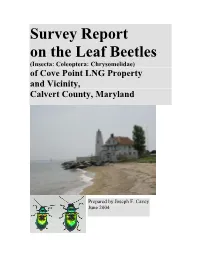
Survey Report on the Leaf Beetles (Insecta: Coleoptera: Chrysomelidae) of Cove Point LNG Property and Vicinity, Calvert County, Maryland
Survey Report on the Leaf Beetles (Insecta: Coleoptera: Chrysomelidae) of Cove Point LNG Property and Vicinity, Calvert County, Maryland Prepared by Joseph F. Cavey June 2004 Survey Report on the Leaf Beetles (Insecta: Coleoptera: Chrysomelidae) of Cove Point LNG Property and Vicinity, Calvert County, Maryland Joseph F. Cavey 6207 Guthrie Court Eldersburg, Maryland 21784 Submitted June 2004 Abstract A survey was funded by the Cove Point Natural Heritage Trust to document the leaf beetles (Insecta: Coleoptera: Chrysomelidae) of the Cove Point Liquefied Natural Gas (LNG) Limited Partnership Site in Calvert County, Maryland. The survey was conducted during periods of seasonal beetle activity from March 2002 to October 2003. The survey detected 92 leaf beetle species, including two species not formerly recorded for the State of Maryland and 55 additional species new to Calvert County. The detection of the rare flea beetle, Glyptina maritima Fall, represents only the third recorded collection of this species and the only recorded collection in the past 32 years. Dichanthelium (Panicum) dichromatum (L.) Gould is reported as the larval host plant of the leaf-mining hispine beetle Glyphuroplata pluto (Newman), representing the first such association for this beetle. Introduction This manuscript summarizes work completed in a two year survey effort begun in March 2002 to document the leaf beetles (Insecta: Coleoptera: Chrysomelidae) of the Cove Point Liquefied Natural Gas (LNG) Limited Partnership Site in Calvert County, Maryland, USA. Fieldwork for this study was conducted under contract with the Cove Point Natural Heritage Trust, dated February 28, 2002. One of the largest insect families, the Chrysomelidae, or leaf beetles, contains more than 37,000 species worldwide, including some 1,700 North American species (Jolivet 1988, Riley et al. -
1 the RESTRUCTURING of ARTHROPOD TROPHIC RELATIONSHIPS in RESPONSE to PLANT INVASION by Adam B. Mitchell a Dissertation Submitt
THE RESTRUCTURING OF ARTHROPOD TROPHIC RELATIONSHIPS IN RESPONSE TO PLANT INVASION by Adam B. Mitchell 1 A dissertation submitted to the Faculty of the University of Delaware in partial fulfillment of the requirements for the degree of Doctor of Philosophy in Entomology and Wildlife Ecology Winter 2019 © Adam B. Mitchell All Rights Reserved THE RESTRUCTURING OF ARTHROPOD TROPHIC RELATIONSHIPS IN RESPONSE TO PLANT INVASION by Adam B. Mitchell Approved: ______________________________________________________ Jacob L. Bowman, Ph.D. Chair of the Department of Entomology and Wildlife Ecology Approved: ______________________________________________________ Mark W. Rieger, Ph.D. Dean of the College of Agriculture and Natural Resources Approved: ______________________________________________________ Douglas J. Doren, Ph.D. Interim Vice Provost for Graduate and Professional Education I certify that I have read this dissertation and that in my opinion it meets the academic and professional standard required by the University as a dissertation for the degree of Doctor of Philosophy. Signed: ______________________________________________________ Douglas W. Tallamy, Ph.D. Professor in charge of dissertation I certify that I have read this dissertation and that in my opinion it meets the academic and professional standard required by the University as a dissertation for the degree of Doctor of Philosophy. Signed: ______________________________________________________ Charles R. Bartlett, Ph.D. Member of dissertation committee I certify that I have read this dissertation and that in my opinion it meets the academic and professional standard required by the University as a dissertation for the degree of Doctor of Philosophy. Signed: ______________________________________________________ Jeffery J. Buler, Ph.D. Member of dissertation committee I certify that I have read this dissertation and that in my opinion it meets the academic and professional standard required by the University as a dissertation for the degree of Doctor of Philosophy. -

The Odonata of Finzel Swamp
The Odonata of Finzel Swamp Richard L. Orr 5215 Durham Rd - East, Columbia, Maryland 21044 (410) 730-7290, E-mail: rorr@aphis.usda.gov October 18, 1996 This report covers the field work completed in 1995 and 1996 for partial fulfillment of the Maryland Department of Natural Resources (DNR), Heritage and Biodiversity Conservation Programs (HBCP) contract. The purpose for the contract was to identify and survey for dragonflies and damselflies (Insecta: Odonata) at Finzel Swamp, Negro Mountain Bog, and the Glades of Cherry Creek. Finzel Swamp is a cold water swamp located at the edge of Garrett and Allegany counties east of Route 546. The 333 protected acres of the swamp and the surrounding environs has been under protection since 1969. The cool microclimate of the area acts as a refuge for cold tolerant organisms which inhabited Western Maryland 15,000 years ago during the most recent ice age. Finzel Swamp has been studied by biologists for years and many aspects of its unique fauna and flora are well documented. For that reason neither a biological review or a map is included in this report. However, two appendices are include on butterflies and leaf beetles because new species of interest were found during the 1995-1996 field season. The survey focused on three very different aquatic environments: the swamp proper, an abandoned farm pond, and the marshy pools located in the open fields edging the swamp and pond. Both dragonfly and damselfly adults and larval cast skins were used to gather information during the survey. No direct larval sampling was done. -

Arthropod Species Diversity, Composition and Trophic Structure
Loyola University Chicago Loyola eCommons Master's Theses Theses and Dissertations 1986 Arthropod Species Diversity, Composition and Trophic Structure at the Soil Level Biotope of Three Northeastern Illinois Prairie Remnants, with Botanical Characterization for Each Site Dean George Stathakis Loyola University Chicago Follow this and additional works at: https://ecommons.luc.edu/luc_theses Part of the Biology Commons Recommended Citation Stathakis, Dean George, "Arthropod Species Diversity, Composition and Trophic Structure at the Soil Level Biotope of Three Northeastern Illinois Prairie Remnants, with Botanical Characterization for Each Site" (1986). Master's Theses. 3435. https://ecommons.luc.edu/luc_theses/3435 This Thesis is brought to you for free and open access by the Theses and Dissertations at Loyola eCommons. It has been accepted for inclusion in Master's Theses by an authorized administrator of Loyola eCommons. For more information, please contact ecommons@luc.edu. This work is licensed under a Creative Commons Attribution-Noncommercial-No Derivative Works 3.0 License. Copyright © 1986 Dean George Stathakis ARTHROPOD SPECIES DIVERSITY, COMPOSITION AND TROPHIC STRUCTURE AT THE SOIL LEVEL BIOTOPE OF THREE NORTHEASTERN ILLINOIS PRAIRIE REMNANTS, WITH BOTANICAL CHARACTERIZATION FOR EACH SITE by Dean George Stathakis A Thesis Submitted to the Faculty of the Graduate School of Loyola University of Chicago in Partial Fulfillment of the Requirements for the Degree of Master of Science April 1986 ACKNOWLEDGMENTS I would like to thank Drs. John Smarrelli and Walter J. Tabachnick for their valuable comments, criticisms and suggestions regarding this manuscript. Thanks also to Dr. John J. Janssen for his advice in developing the computer programs used in the data analysis; Don McFall, Illinois Department of Conservation for the information on Illinois prairies; Alberts. -

Evaluation of Insecticides to Control the Asian Ambrosia Beetle, Xylosandrus Crassiusculus
SNA RESEARCH CONFERENCE - VOL. 49 - 2004 Entomology Jason Oliver Section Editor and Moderator 151 SNA RESEARCH CONFERENCE - VOL. 49 - 2004 Evaluation of Insecticides to Control the Asian Ambrosia Beetle, Xylosandrus crassiusculus Russell F. Mizell, III and T. Charles Riddle NFREC-Quincy, University of Florida, 155 Research Rd, Quincy, FL 32351 rfmizell@mail.ifas.ufl.edu Index Words: Insecticides, Asian Ambrosia Beetle, Xylosandrus crassiusculus, Recommendations Significance to Industry: Based on experiences with Asian ambrosia beetle (AAB) in Florida and the results from using a new attack-inducing technique, the following steps for AAB management are recommended. Build and use the Kovach trap (Kovach 1986, Mizell et al. 1998) or buy the Lindgren funnel trap to determine the emergence time of the adult beetles. The traps must be baited with ethyl alcohol to attract the beetles. The emergence of AAB varies dramatically from location to location and from year to year. Emergence usually occurs around mid February to early March in north Florida and south Georgia, but peak emergence may occur one to five weeks earlier or later depending upon location and year. In 2004, an unusual emergence peak and attacks occurred in early January in north Florida (different from all other years of data). Once beetles appear in the traps, scout the nursery for newly attacked Drake elm, Bradford pear, Kwanzan cherry, golden raintree, weeping willow, dogwood and any other species that is stressed or has not broken bud. Species shipped in from a more northern location may have increased susceptibility, as observed with dogwood in Florida. It is important to treat attacked trees before the beetles close the galleries with frass. -

Coleoptera, Chrysomelidae)
Molecular Phylogenetics and Evolution 34 (2005) 584–600 www.elsevier.com/locate/ympev Molecular systematics of Eumolpinae and the relationships with Spilopyrinae (Coleoptera, Chrysomelidae) Jesús Gómez-Zuritaa,b,¤,1, Pierre Jolivetc, Alfried P. Voglera,b a Department of Entomology, The Natural History Museum, London, UK b Department of Biological Sciences, Imperial College London, Silwood Park Campus, Ascot, Berkshire, UK c 67 Boulevard Soult, Paris, France Received 5 April 2004; revised 8 November 2004 Available online 8 January 2005 Abstract The 3400 species of Eumolpinae constitute one of the largest subfamilies of leaf beetles (Chrysomelidae). Their systematics is still largely based on late 19th century monographs and remains highly unsatisfactory. Only recently, some plesiomorphic lineages have been split out as separate subfamilies, including the southern hemisphere Spilopyrinae and the ambiguously placed Synetinae. Here we provide insight into the internal systematics of the Eumolpinae based on molecular phylogenetic analyses of three ribosomal genes, including partial mitochondrial 16S and nuclear 28S and complete nuclear 18S rRNA gene sequences. Sixteen morphological characters considered important in the higher-level systematics of Eumolpinae were also included in a combined analysis with the molecular characters. All phylogenetic analyses were performed using parsimony by optimizing length variation directly on the tree, as implemented in the POY software. The data support the monophyly of the Spilopyrinae outside the clade including all sampled Eumolpinae, corroborating their treatment as a separate subfamily within the Chrysomelidae. The systematic placement of the Synetinae remains ambiguous but consistent with considering it a diVerent subfamily as well, since the phylogenetic analyses using all the available evidence show the representative sequence of the subfamily also unrelated to the Eumolpinae. -
INSECTA MUNDI a Journal of World Insect Systematics
INSECTA MUNDI A Journal of World Insect Systematics 0144 The beetles of the island of St. Vincent, Lesser Antilles (Insecta: Coleoptera); diversity and distributions Stewart B. Peck Department Biology, Carleton University, 1125 Colonel By Drive Ottawa, Ontario K1S 5B6, CANADA Date of Issue: October 15, 2010 CENTER FOR SYSTEMATIC ENTOMOLOGY, INC., Gainesville, FL Stewart B. Peck The beetles of the island of St. Vincent, Lesser Antilles (Insecta: Coleoptera); diversity and distributions Insecta Mundi 0144: 1-77 Published in 2010 by Center for Systematic Entomology, Inc. P. O. Box 141874 Gainesville, FL 32614-1874 U. S. A. http://www.centerforsystematicentomology.org/ Insecta Mundi is a journal primarily devoted to insect systematics, but articles can be published on any non-marine arthropod taxon. Manuscripts considered for publication include, but are not limited to, systematic or taxonomic studies, revisions, nomenclatural changes, faunal studies, phylogenetic analy- ses, biological or behavioral studies, etc. Insecta Mundi is widely distributed, and referenced or ab- stracted by several sources including the Zoological Record, CAB Abstracts, etc. As of 2007, Insecta Mundi is published irregularly throughout the year, not as quarterly issues. As manuscripts are completed they are published and given an individual number. Manuscripts must be peer reviewed prior to submission, after which they are again reviewed by the editorial board to insure quality. One author of each submitted manuscript must be a current member of the Center for System- atic Entomology. Managing editor: Paul E. Skelley, e-mail: insectamundi@gmail.com Production editor: Michael C. Thomas, e-mail: insectamundi@gmail.com Editorial board: J. H. Frank, M. -
Revista Chilena De Entomología
Rev. Chilena Ent. 1990, 18: 29-37 A TAXONOMIC REVISIÓN OF THE G^NVS JANSONIUS BALY 1878: TAXONOMIC CONFUSIÓN AND TRIBAL RECLASSIFICATION (COLEÓPTERA: CHRYSOMELIDAE: EUMOLPINAE) Ingolf S. Askevold' & Laurent LeSage^ ABSTRACT The species Haltica aenea Blanchard, 1851, described from Chile, is found to be a eumolpine; it has been misidentified by authors variously as a species oí Chaetocnema (Alticinae), and as two monobasic genera of Eumolpinae. The genera Paraulacia Bréthes, 1928 (Eumolpinae), and Halticops Bréthes, 1928 (here removed from synonymy of Chaetocnema Stephens), are here placed as júnior objective synoyms oí Jansoniíis Baly, 1878. Eumolpus valdivianus Philippi and Philippi, 1864, Chaetocnema blanchardi Baly, 1877, and Jansonius alternatus Baly, 1878, are placed as júnior subjective synonyms oí Haltica aenea Blanchard, 1851;//. aenea is transferred loJansonius as the sénior and valid ñame, emended toy. aeneus. Jansonius is removed from the Section Myochroites, in Adoxini, and transferred to Metachromites in Nodinini. RESUMEN Se concluye que Haltica aenea Blanchard, 1851, especie propia de Chile, es un Eumolpinae, la cual ha sido erróneamente identificada por distintos autores como perteneciente a Chaetocnema (Alticinae) y a dos géneros monobásicos de Eumolpinae. Paraulacia Bréthes, 1928 (Eumolpinae) y Halticops Bréthes, 1928 (removido aquí de la sinonimia de Chaetocnema Stephens) se consideran Jansonius 1 sinónimos áe Baly, 877. Eumolpus valdivianus Philippi y Philippi, 1864, Chaetocnema blanchardi Baly, 1877 y Jansonius alternatus Baly, 1877, son considerados sinónimos de Haltica aenea Blanchard, 1851; esta última es ubicada en el género Jansonius, debiendo quedar como/, aeneus. Jansonius es transferido desde Adoxini (Sección Myochromites) a Nodinini (Sección Metachromites). INTRODUCTION or described taxa from few specimens, so it comes as no surprise that considerable confu- The Chrysomelidae of Chile are a largely un- sión exists at all taxonomic levéis. -
Proceedings of the Arkansas Academy of Science - Volume 26 1972 Academy Editors
Journal of the Arkansas Academy of Science Volume 26 Article 1 1972 Proceedings of the Arkansas Academy of Science - Volume 26 1972 Academy Editors Follow this and additional works at: https://scholarworks.uark.edu/jaas Recommended Citation Editors, Academy (1972) "Proceedings of the Arkansas Academy of Science - Volume 26 1972," Journal of the Arkansas Academy of Science: Vol. 26 , Article 1. Available at: https://scholarworks.uark.edu/jaas/vol26/iss1/1 This article is available for use under the Creative Commons license: Attribution-NoDerivatives 4.0 International (CC BY-ND 4.0). Users are able to read, download, copy, print, distribute, search, link to the full texts of these articles, or use them for any other lawful purpose, without asking prior permission from the publisher or the author. This Entire Issue is brought to you for free and open access by ScholarWorks@UARK. It has been accepted for inclusion in Journal of the Arkansas Academy of Science by an authorized editor of ScholarWorks@UARK. For more information, please contact scholar@uark.edu, ccmiddle@uark.edu. <- Journal of the Arkansas Academy of Science, Vol. 26 [1972], Art. 1 AKASO p.3- ARKANSAS ACADEMYOF SCIENCE VOLUME XXVI 1972 Flagella and basal body of Trypanosoma ARKANSAS ACADEMYOF SCIENCE BOX 1709 UNIVERSITY OF ARKANSAS FAYETTEVILLE,ARKANSAS 72701 Published by Arkansas Academy of Science, 1972 1 EDITOR J. L. WICKLIFF Department of Botany and Bacteriology JournalUniversity of the Arkansasof Arkansas, AcademyFayettevi of Science,lie. Vol.Arkansas 26 [1972],72701 Art. 1 EDITORIALBOARD John K. Beadles Lester C.Howick Jack W. Sears James L.Dale Joe F.