Marvin M. Grieve. 4375
Total Page:16
File Type:pdf, Size:1020Kb
Load more
Recommended publications
-

The Future of The
The Future of Public Service Broadcasting Some thoughts Stephen Fry Before I can even think to presume to dare to begin to expatiate on what sort of an organism I think the British Broadcasting Corporation should be, where I think the BBC should be going, how I think it and other British networks should be funded, what sort of programmes it should make, develop and screen and what range of pastries should be made available in its cafés and how much to the last penny it should pay its talent, before any of that, I ought I think in justice to run around the games field a couple of times puffing out a kind of “The BBC and Me” mini‐biography, for like many of my age, weight and shoe size, the BBC is deeply stitched into my being and it is important for me as well as for you, to understand just how much. Only then can we judge the sense, value or otherwise of my thoughts. It all began with sitting under my mother’s chair aged two as she (teaching history at the time) marked essays. It was then that the Archers theme tune first penetrated my brain, never to leave. The voices of Franklin Engelman going Down Your Way, the women of the Petticoat Line, the panellists of Twenty Questions, Many A Slip, My Word and My Music, all these solid middle class Radio 4 (or rather Home Service at first) personalities populated my world. As I visited other people’s houses and, aged seven by now, took my own solid state transistor radio off to boarding school with me, I was made aware of The Light Programme, now Radio 2, and Sparky’s Magic Piano, Puff the Magic Dragon and Nelly the Elephant, I also began a lifelong devotion to radio comedy as Round The Horne, The Clitheroe Kid, I’m Sorry I’ll Read That Again, Just A Minute, The Men from The Ministry and Week Ending all made themselves known to me. -
Transatlantic Spaces: Production, Location and Style in 1960S-1970S Action- Adventure TV Series
Transatlantic spaces: production, location and style in 1960s-1970s action- adventure TV series Article Accepted Version Bignell, J. (2010) Transatlantic spaces: production, location and style in 1960s-1970s action-adventure TV series. Media History, 16 (1). pp. 53-65. ISSN 1469-9729 doi: https://doi.org/10.1080/13688800903395460 Available at http://centaur.reading.ac.uk/17666/ It is advisable to refer to the publisher’s version if you intend to cite from the work. See Guidance on citing . To link to this article DOI: http://dx.doi.org/10.1080/13688800903395460 Publisher: Taylor & Francis All outputs in CentAUR are protected by Intellectual Property Rights law, including copyright law. Copyright and IPR is retained by the creators or other copyright holders. Terms and conditions for use of this material are defined in the End User Agreement . www.reading.ac.uk/centaur CentAUR Central Archive at the University of Reading Reading’s research outputs online Transatlantic spaces: Production, location and style in 1960s-70s Action-Adventure TV Series Jonathan Bignell Abstract This article argues that transatlantic hybridity connects space, visual style and ideological point of view in British television action-adventure fiction of the 1960s-70s. It analyses the relationship between the physical location of TV series production at Elstree Studios, UK, the representation of place in programmes, and the international trade in television fiction between the UK and USA. The TV series made at Elstree by the ITC and ABC companies and their affiliates linked Britishness with an international modernity associated with the USA, while also promoting national specificity. To do this, they drew on film production techniques that were already common for TV series production in Hollywood. -

Cert No Name Doing Business As Address City Zip 1 Cust No
Cust No Cert No Name Doing Business As Address City Zip Alabama 17732 64-A-0118 Barking Acres Kennel 250 Naftel Ramer Road Ramer 36069 6181 64-A-0136 Brown Family Enterprises Llc Grandbabies Place 125 Aspen Lane Odenville 35120 22373 64-A-0146 Hayes, Freddy Kanine Konnection 6160 C R 19 Piedmont 36272 6394 64-A-0138 Huff, Shelia Blackjack Farm 630 Cr 1754 Holly Pond 35083 22343 64-A-0128 Kennedy, Terry Creeks Bend Farm 29874 Mckee Rd Toney 35773 21527 64-A-0127 Mcdonald, Johnny J M Farm 166 County Road 1073 Vinemont 35179 42800 64-A-0145 Miller, Shirley Valley Pets 2338 Cr 164 Moulton 35650 20878 64-A-0121 Mossy Oak Llc P O Box 310 Bessemer 35021 34248 64-A-0137 Moye, Anita Sunshine Kennels 1515 Crabtree Rd Brewton 36426 37802 64-A-0140 Portz, Stan Pineridge Kennels 445 County Rd 72 Ariton 36311 22398 64-A-0125 Rawls, Harvey 600 Hollingsworth Dr Gadsden 35905 31826 64-A-0134 Verstuyft, Inge Sweet As Sugar Gliders 4580 Copeland Island Road Mobile 36695 Arizona 3826 86-A-0076 Al-Saihati, Terrill 15672 South Avenue 1 E Yuma 85365 36807 86-A-0082 Johnson, Peggi Cactus Creek Design 5065 N. Main Drive Apache Junction 85220 23591 86-A-0080 Morley, Arden 860 Quail Crest Road Kingman 86401 Arkansas 20074 71-A-0870 & Ellen Davis, Stephanie Reynolds Wharton Creek Kennel 512 Madison 3373 Huntsville 72740 43224 71-A-1229 Aaron, Cheryl 118 Windspeak Ln. Yellville 72687 19128 71-A-1187 Adams, Jim 13034 Laure Rd Mountainburg 72946 14282 71-A-0871 Alexander, Marilyn & James B & M's Kennel 245 Mt. -

Celluloid Television Culture the Specificity of Film on Television: The
ORBIT-OnlineRepository ofBirkbeckInstitutionalTheses Enabling Open Access to Birkbeck’s Research Degree output Celluloid Television Culture The Specificity of Film on Television: the Action-adventure Text as an Example of a Production and Textual Strategy, 1955 – 1978. https://eprints.bbk.ac.uk/id/eprint/40025/ Version: Full Version Citation: Sexton, Max (2013) Celluloid Television Culture The Speci- ficity of Film on Television: the Action-adventure Text as an Example of a Production and Textual Strategy, 1955 – 1978. [Thesis] (Unpublished) c 2020 The Author(s) All material available through ORBIT is protected by intellectual property law, including copy- right law. Any use made of the contents should comply with the relevant law. Deposit Guide Contact: email Celluloid Television Culture The Specificity of Film on Television: the Action-adventure Text as an Example of a Production and Textual Strategy, 1955 – 1978. Max Sexton A thesis submitted for the Degree of Doctor of Philosophy, Birkbeck, University of London, 2012. Declaration I hereby declare that the thesis presented by me for examination of the PhD degree is solely my own work, other than where I have clearly indicated. Birkbeck, University of London Abstract of Thesis (5ST) Notes for Candidate: 1. Type your abstract on the other side of this sheet. 2. Use single-spacing typing. Limit your abstract to one side of the sheet. 3. Please submit this copy of your abstract to the Research Student Unit, Birkbeck, University of London, Registry, Malet Street, London, WC1E 7HX, at the same time as you submit copies of your thesis. 4. This abstract will be forwarded to the University Library, which will send this sheet to the British Library and to ASLIB (Association of Special Libraries and Information Bureaux) for publication to Index to Theses . -
2013 Syndicate Directory
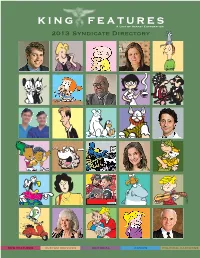
2013 Syndicate Directory NEW FEATURES CUSTOM SERVICES EDITORIAL COMICS POLITICAL CARTOONS What’s New in 2013 by Norman Feuti Meet Gil. He’s a bit of an underdog. He’s a little on the chubby side. He doesn’t have the newest toys or live in a fancy house. His parents are split up – his single mother supports them with her factory job income and his father isn’t around as often as a father ought to be. Gil is a realistic and funny look at life through the eyes of a young boy growing up under circumstances that are familiar to millions of American families. And cartoonist Norm Feuti expertly crafts Gil’s world in a way that gives us all a good chuckle. D&S From the masterminds behind Mobilewalla, the search, discovery and analytics engine for mobile apps, comes a syndicated weekly column offering readers both ratings and descriptions of highly ranked, similarly themed apps. Each week, news subscribers receive a column titled “Fastest Moving Apps of the Week,” which is the weekly hot list of the apps experiencing the most dramatic increases in popularity. Two additional “Weekly Category” features, pegged to relevant news, events, holidays and calendars, are also available. 3TW Drs. Oz and Roizen give readers quick access to practical advice on how to prevent and combat conditions that affect overall wellness and quality of life. Their robust editorial pack- age, which includes Daily Tips, a Weekly Feature and a Q & A column, covers a wide variety of topics, such as diet, exercise, weight loss, sleep and much more. -

Download (15Mb)
University of Warwick institutional repository: http://go.warwick.ac.uk/wrap A Thesis Submitted for the Degree of PhD at the University of Warwick http://go.warwick.ac.uk/wrap/1294 This thesis is made available online and is protected by original copyright. Please scroll down to view the document itself. Please refer to the repository record for this item for information to help you to cite it. Our policy information is available from the repository home page. Histories of Telefantasy: the Representation of the Fantastic and the Aesthetics of Television Volume 1 of 2 by Catherine Johnson A thesis submitted in partial fulfilment of the requirements for the degree of Doctor of Philosophy in Film and Television Studies University of Warwick Department of Film and Television Studies April 2002 Contents Volume 1: Illustrations 4 Acknowledgements 10 Declaration 11 Abstract 12 Introduction: 13 Approaching Telefantasy: History, Industry, Aesthetics Chapter 1: 32 Literature Review: Exploring the Discourses of 'Fantasy' and 'Cult' Chapter 2: 56 Spectacle and Intimacy: The Quatermass Serials (BBC, 1953-59) and the Aesthetics of Early British Television Chapter 3: 104 'Serious Entertainment': The Prisoner (ITV, 1967) and Discourses of Quality in 1960s British Television 2 Chpter4: 164 'Regulated Innovation': Star Trek (NBC, 1967-69) and the Commercial Strategies of 1960s US Television Volume 2: Illustrations 223 Chapter 5: 227 Quality Cult Television: The X-Files (Fox, 1993-), Buffy the Vampire Slayer (WB, 1997-) and the Economics and Aesthetics of -

Celebrating 50Years of the Prisoner
THE MAGAZINE BEYOND YOUR IMAGINATION www.infinitymagazine.co.uk THE MAGAZINE BEYOND YOUR IMAGINATION 6 DOUBLE-SIDED POSTER INSIDE! “I AM NOT A NUMBER!” CELEBRATING 50 YEARS PLUS: OF THE PRISONER • CHRISTY MARIE - COSPLAY QUEEN • SPACECRAFT KITS • IAIN M. BANKS • THE VALLEY OF GWANGI • NEWS • SATURDAY MORNING SUPERHEROES • CHILDREN’S FILM FOUNDATION AND MUCH, MUCH MORE… FUTURE SHOCK! THE HISTORY OF 2000 AD AN ARRESTING CONCEPT - TAKE A TRIP IN ROBOCOP THE TIME TUNNEL WRITER INFINITY ISSUE 6 - £3.99 06 THE MAGAZINE BEYOND YOUR IMAGINATION www.infinitymagazine.co.uk 6 THE MAGAZINE BEYOND YOUR IMAGINATION DOUBLE-SIDED POSTER INSIDE! 8 14 “I AM NOT A 38 NUMBER!”50 YEARS CELEBRATING OF THE PRISONER • SPACECRAFT KITS PLUS: • NEWS • CHRISTY MARIE• THE - COSPLAY VALLEY QUEEN OF GWANGI• CHILDREN’S • IAIN M. BANKS • SATURDAY MORNING SUPERHEROES FILM FOUNDATION AND MUCH, MUCH MORE… FUTURE SHOCK! AN ARRESTING THE HISTORY OF CONCEPT - 2000 AD ROBOCOP WRITER TAKE A TRIP IN THE TIME TUNNEL INFINITY ISSUE 6 - £3.99 Prisoner cover art by Mark Maddox (www.maddoxplanet.com) 19 44 08: CONFESSIONS OF A CONVENTION QUEEN Pat Jankiewicz discovers how Star Wars FanGirl Christy Marie became a media phenomenon! 14: SATURDAY MORNING SUPER-HEROES Jon Abbott looks at Hanna-Barbera’s Super TV Heroes line of animated adventurers. 19: UNLOCKING THE PRISONER Don’t miss this amazing 11-page special feature on Patrick McGoohan’s cult favourite from the 1960s. 38: MODEL BEHAVIOUR Sci-fi & Fantasy Modeller’s Andy Pearson indulges his weakness for spacecraft kits… 40 40: FUTURE SHOCK! John Martin talks to Paul Goodwin, director of an acclaimed documentary on the history of 2000 AD. -

(Iowa City, Iowa), 1957-11-14
:Ieanlng Iners Rain and Drizzle Iowa City's Top Marks in the 50s Murder Cases " Cloudy Weekend owon See page 6 3 and the People of Iowa City Ington Established in 1868 - Five Cents a Copy Member oC Associated Press - AP Leased Wire 8lJd Photo Service Iowa City, Iowa. Thursday. No\'ember 14, lw.i7 Burma's Win'Hailed By Pres. Hancher U Win, Burmese Ambassador to His visit here is sponsored by the the United States, was welcomed SUI Asian Foundation. He will give I' 10 the SUI campus Wednesday af· lectures before students in ome oC lemoon by President Virgil M. their regular classes in geography, Hancher. political science, oriental art, reo The Burmese politician and dip. !igion and journalism. loma! will stay here through Nov. The ambassador will address the 23 and give a number of lectures . Iowa City Rotary Club this noon in different SUI colleges and and speak to the Kiwanis Club schools. Nov. 19. U Win's plane from Washington The SUI School oC Journalism, was grounded because of fog in in cooperation with 0 r i e n t a I Moline, 111 ., and the ambassador Studies, will sponsor a lecture by had to take an air line limousine U Win on "Burma's Foreign Pol· to Iowa City. icy ," Nov. 21. e Yqu Missile Progress Seen; 'Will Meet Challenge,' Demands Austerity President Tells Nation OKLAHOMA CITY (.fI - Presi· dent Eisenhower, cau tioning that "there I danger ahead {or rree men everywherr," told the nation Wednesday ni ~ ht America m'lst spe nd sub tantially more money on weapons o( the future to meet Russia's challenge. -

One Fine Sunday in the Funny Pages” Exhibit
John Read is the creator and curator of the “One Fine Sunday in the Funny Pages” exhibit. A freelance cartoonist, John also teaches cartooning to children and is the publisher and editor of Stay Tooned! Magazine, considered the trade journal of the craft. The Comic Mode The comic strip provides a colorful and humorous respite from the serious and often tragic news that precedes it. There are many reasons for reading the “funny pages”; from the basic need to be entertained, to the desire to escape for a moment into what seems a playful combination of a joke and a sequence of images that illustrate the nonsense and play that generates it. Yet, what really constitutes the “comic” in a comic strip? Are they simply funny, as in Blondie, Garfield or Hagar the Horrible? Or do we sense underlying tones of irony, satire, political and social commentary as evidenced in Doonesbury, Non Sequitur, and Between Friends? How are we to understand the double entendre, the sting of wit or the twist of the absurd that infuses so many contemporary comic strips? It would seem that as in dreams, there are many levels to the comic mode. On the first take, the superficial or manifest appeal generates a smile or laughter. But as with many dreams and good jokes, there is the second take, a latent need to establish or defy meaning as embedded within the structure of the images themselves. The paradox or playfulness of the comic strip partially lies in discovering the truth in the nonsensical aspects of day-to-day living. -

Typical Girls: the Rhetoric of Womanhood in Comic Strips Susan E
Typical girls The Rhetoric of Womanhood in Comic Strips Susan E. Kirtley TYPICAL GIRLS STUDIES IN COMICS AND CARTOONS Jared Gardner and Charles Hatfield, Series Editors TYPICAL GIRLS The Rhetoric of Womanhood in Comic Strips SUSAN E. KIRTLEY THE OHIO STATE UNIVERSITY PRESS COLUMBUS COPYRIGHT © 2021 BY THE OHIO STATE UNIVERSITY. THIS EDITION LICENSED UNDER A CREATIVE COMMONS ATTRIBUTION- NONCOMMERCIAL-NODERIVS LICENSE. THE VARIOUS CHARACTERS, LOGOS, AND OTHER TRADEMARKS APPEARING IN THIS BOOK ARE THE PROPERTY OF THEIR RESPECTIVE OWNERS AND ARE PRESENTED HERE STRICTLY FOR SCHOLARLY ANALYSIS. NO INFRINGEMENT IS INTENDED OR SHOULD BE IMPLIED. Library of Congress Cataloging-in-Publication Data Names: Kirtley, Susan E., 1972– author. Title: Typical girls : the rhetoric of womanhood in comic strips / Susan E. Kirtley. Other titles: Studies in comics and cartoons. Description: Columbus : The Ohio State University Press, [2021] | Series: Studies in comics and cartoons | Includes bibliographical references and index. | Summary: “Drawing from the work of Lynn Johnston (For Better or For Worse), Cathy Guisewite (Cathy), Nicole Hollander (Sylvia), Lynda Barry (Ernie Pook’s Comeek), Barbara Brandon-Croft (Where I’m Coming From), Alison Bechdel (Dykes to Watch Out For), and Jan Eliot (Stone Soup), Typical Girls examines the development of womanhood and women’s rights in popular comic strips”—Provided by publisher. Identifiers: LCCN 2020052823 | ISBN 9780814214572 (cloth) | ISBN 0814214576 (cloth) | ISBN 9780814281222 (ebook) | ISBN 0814281222 (ebook) Subjects: LCSH: Comic strip characters—Women. | Women in literature. | Women’s rights in literature. | Comic books, strips, etc.—History and criticism. Classification: LCC PN6714 .K47 2021 | DDC 741.5/3522—dc23 LC record available at https://lccn.loc.gov/2020052823 COVER DESIGN BY ANGELA MOODY TEXT DESIGN BY JULIET WILLIAMS TYPE SET IN PALATINO For my favorite superhero team—Evelyn, Leone, and Tamasone Castigat ridendo mores. -

Happy 140Th, ASPCA! Celebrating 140 Years of Enlightening America for Animals
Action Spring 2006 Happy 140th, ASPCA! Celebrating 140 Years of Enlightening America for Animals Spring 2006 1 >> PRESIDENT’S NOTE 140 Years of Compassion Board of Directors As a member of the ASPCA, you are part of a unique group of Officers of the Board individuals who have chosen to act Hoyle C. Jones, Chairman, Linda Lloyd Lambert, Vice Chairman, William Secord, Secretary, on their convictions—to help James W. Gerard, Treasurer defenseless animals find peace, comfort, and healing. I am truly Members of the Board grateful for your activism and compassion—highly Penelope Ayers, Alexandra G. Bishop, J. Elizabeth commendable qualities that are truly inspiring. Bradham, Reenie Brown, Wendy H. Carhart, Patricia Qualities not unlike those of Henry Bergh, the ASPCA J. Crawford, Jonathan D. Farkas, Franklin Maisano, William Morrison Matthews, Sean McCarthy, Founder. Gurdon H. Metz, Michael F.X. Murdoch, James L. As we make our way into 2006, I look back with Nederlander, Marsha Reines Perelman, George great pride on our 140-year history as America’s first Stuart Perry, Helen S.C. Pilkington, Gail Sanger, animal welfare organization. 2005 alone was a year Richard Silverman, Sally Spooner, Richard C. filled with planned and unplanned challenges on our Thompson, Cathy Wallach time and resources. Yet, through the unrelenting Directors Emeriti commitment and support of ASPCA staff, volunteers, Steven M. Elkman, George Gowen, Alastair B. and members we were able to make great strides this Martin, Thomas N. McCarter 3rd, Marvin Schiller, past year in improving the lives of animals across the James F. Stebbins, Esq. country. We have created and are implementing some very ambitious initiatives in conjunction with local The ASPCA 424 East 92nd Street animal shelters and rescue groups all across America. -

The Jewish Comic Book Industry, 1933-1954
“THE WHOLE FURSHLUGGINER OPERATION”: THE JEWISH COMIC BOOK INDUSTRY, 1933-1954 By Sebastian T. Mercier A DISSERTATION Submitted to Michigan State University in partial fulfillment of the requirements for the degree of History – Doctor of Philosophy 2018 ABSTRACT “THE WHOLE FURSHLUGGINER OPERATION”: THE JEWISH COMIC BOOK INDUSTRY, 1933-1954 By Sebastian T. Mercier Over the course of the twentieth century, the comic book industry evolved from an amateur operation into a major institution of American popular culture. Comic books, once considered mere cultural ephemera or quite simply “junk,” became a major commodity business. The comic book industry emerged out of the pulp magazine industry. According to industry circulation data, new comic book releases increased from 22 in 1939 to 1125 titles by the end of 1945. Comic book scholars have yet to adequately explain the roots of this historical phenomenon, particularly its distinctly Jewish composition. Between the years of 1933 and 1954, the comic book industry operated as a successful distinct Jewish industry. The comic book industry emerged from the pulp magazine trade. Economic necessity, more than any other factor, attracted Jewish writers and artists to the nascent industry. Jewish publishers adopted many of the same business practices they inherited from the pulps. As second-generation Jews, these young men shared similar experiences growing up in New York City. Other creative industries actively practiced anti-Semitic hiring procedures. Many Jewish artists came to comic book work with very little professional experience in cartooning and scripting. The comic book industry allowed one to learn on the job. The cultural world comic books emerged out of was crucially important to the industry’s development.