Political Parties Important Questions and Answers
Total Page:16
File Type:pdf, Size:1020Kb
Load more
Recommended publications
-

Growing Cleavages in India? Evidence from the Changing Structure of Electorates, 1962-2014
WID.world WORKING PAPER N° 2019/05 Growing Cleavages in India? Evidence from the Changing Structure of Electorates, 1962-2014 Abhijit Banerjee Amory Gethin Thomas Piketty March 2019 Growing Cleavages in India? Evidence from the Changing Structure of Electorates, 1962-2014 Abhijit Banerjee, Amory Gethin, Thomas Piketty* January 16, 2019 Abstract This paper combines surveys, election results and social spending data to document the long-run evolution of political cleavages in India. From a dominant- party system featuring the Indian National Congress as the main actor of the mediation of political conflicts, Indian politics have gradually come to include a number of smaller regionalist parties and, more recently, the Bharatiya Janata Party (BJP). These changes coincide with the rise of religious divisions and the persistence of strong caste-based cleavages, while education, income and occupation play little role (controlling for caste) in determining voters’ choices. We find no evidence that India’s new party system has been associated with changes in social policy. While BJP-led states are generally characterized by a smaller social sector, switching to a party representing upper castes or upper classes has no significant effect on social spending. We interpret this as evidence that voters seem to be less driven by straightforward economic interests than by sectarian interests and cultural priorities. In India, as in many Western democracies, political conflicts have become increasingly focused on identity and religious-ethnic conflicts -
![List of Political Parties in India ]]National Political Parties](https://docslib.b-cdn.net/cover/1574/list-of-political-parties-in-india-national-political-parties-2051574.webp)
List of Political Parties in India ]]National Political Parties
List of political parties in India ]]National political parties Party Abbreviation General Secretary / President Nationalist Congress Party NCP Sharad Pawar Indian National Congress INC Sonia Gandhi Bharatiya Janata Party BJP Nitin Gadkari Communist Party of India CPI Suravaram Sudhakar Reddy Communist Party of India (Marxist) CPI(M) Prakash Karat Source: Election Commission of India[2] [[edit]]State political parties (State wise list) Political State Party name Election symbol Abbr. Alliance Lok Satta Party Whistle LSP Majlis-e-Ittehadul Muslimeen Kite AIMIM Andhra Pradesh Telangana Rashtra Samithi Car TRS NDA Telugu Desam Party Bicycle TDP Third Front Arun Khitoliya National Party cealing Fan YSRCP All India United Democratic Front Lock & Key Assam Asom Gana Parishad Elephant NDA Bodoland People's Front Nangol UPA Janata Dal (United) Arrow JD(U) NDA Bihar raman party Bungalow LJP Rashtriya Janata Dal Hurricane Lamp RJD Fourth Front ZGE Goa Map Goa Save Goa Front Aeroplane Haryana Janhit Congress (BL) Tractor HJC NDA Haryana Indian National Lok Dal Eyeglasses INLD Jammu & Kashmir National Plough UPA Conference Jammu & Jammu & Kashmir National Bicycle Kashmir Panthers Party Jammu and Kashmir Peoples Ink Pot & Pen Democratic Party Jharkhand AJSU Party Banana Jharkhand Mukti Morcha Bow & Arrow JMM NDA Jharkhand Vikas Morcha Comb NDA (Prajatantrik) Rashtriya Janata Dal Hurricane Lamp RJD Fourth Front A Lady Farmer carrying Paddy Janata Dal (Secular) JD(S) on her head Karnataka Janata Party KJP Karnataka BSR Congress Kannada Chalavali Vatal -
Why Regional Parties?: Clientelism, Elites, and the Indian Party System Adam Ziegfeld Index More Information
Cambridge University Press 978-1-107-11868-3 - Why Regional Parties?: Clientelism, Elites, and the Indian Party System Adam Ziegfeld Index More information Index 2014 election (India) Argentina Bharatiya Janata Party and, electoral success clientelism in, 120 of, 189–90 Peronist Party in, 68 coalition era after, durability of, 188–9 regional parties in, 11, 33 regional parties after, 189–90 Asom Gana Parishad (AGP), 38, 40 SPM government following, 187–90 as opportunistic faction, 230 regional support for, 94 Aam Aadmi Party (AAP), 31, 48–9 Assam (state) programmatic politics and, 89–90 opportunistic factions in, 223–4 African party systems, 19 regional parties in, 98, 180, 214 agrarian national parties. See Janata Dal Australia, regional parties in, 33 Akali Dal. See Shiromani Akali Dal autonomist parties. See regionalist parties All India Anna Dravida Munnetra Kazhagam (AIADMK), 38–9, 182 backward caste. See Other Backward Classes Tamil Maanila Congress (Moopanar) and, Bahujan Samaj Party (BSP), 20, 31, 48, 161 107 clientelistic strategies of, 63 All India Communist Party, 161–2 electoral success of, 180 All India Forward Bloc (AIFB), 44–5, 163 programmatic politics and, 88–9 All India Indira Congress (Tiwari), Scheduled Caste voters and, 87 43, 177 Bandhopadhyay, Debabrata, 110 All India Majlis-e-Ittehadul Muslimeen Banerjee, Mamata, 186–7 (AIMIM), 25, 47 Bangla Congress (BAC), 43, 162, 186–7 All India N. R. Congress (AINRC), 49 Berhampore, 110–11 All India Trinamool Congress (AITC), 43, 199, bhadralok castes, 247–8, 250 233 Bhajan -
CNNIBN-CSDS Tracker Poll Round I-Survey Findings
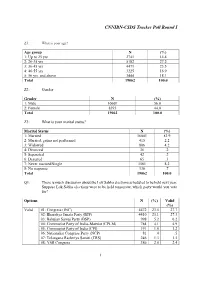
CNNIBN-CSDS Tracker Poll Round I Z1: What is your age? _____ Age group N (%) 1: Up to 25 yrs 2741 14.4 2: 26-35 yrs 5182 27.2 3: 36-45 yrs 4471 23.5 4: 46-55 yrs 3225 16.9 5: 56 yrs. and above 3444 18.1 Total 19062 100.0 Z2: Gender Gender N (%) 1: Male 10669 56.0 2: Female 8393 44.0 Total 19062 100.0 Z3: What is your marital status? Marital Status N (%) 1: Married 16001 83.9 2: Married, gauna not performed 415 2.2 3: Widowed 806 4.2 4: Divorced 36 .2 5: Separated 42 .2 6: Deserted 65 .3 7: Never married/Single 1561 8.2 8: No response 136 .7 Total 19062 100.0 Q1: There is much discussion about the Lok Sabha elections scheduled to be held next year. Suppose Lok Sabha elections were to be held tomorrow, which party would you vote for? Options N (%) Valid (%) Valid 01: Congress (INC) 4472 23.5 27.7 02: Bharatiya Janata Party (BJP) 4410 23.1 27.3 03: Bahujan Samaj Party (BSP) 998 5.2 6.2 04: Communist Party of India–Marxist (CPI-M) 784 4.1 4.9 05: Communist Party of India (CPI) 191 1.0 1.2 06: Nationalist Congress Party (NCP) 81 .4 .5 07: Telangana Rashtriya Samiti (TRS) 246 1.3 1.5 08: YSR Congress 386 2.0 2.4 1 CNNIBN-CSDS Tracker Poll Round I Options N (%) Valid (%) 09: Majlis-E-Ittehadul Muslimeen (MIM) 33 .2 .2 10 Telugu Desam Party (TDP) 251 1.3 1.6 11: Loksatta Party 9 .0 .1 13: Asom Gana Parishad (AGP) 41 .2 .3 14: All India United Democratic Front (AIUDF) 45 .2 .3 15: Autonomous State Demand Committee(ASDC) 33 .2 .2 16: Bodoland People’s Front (BPF) 112 .6 .7 17: Janata Dal United (JD-U) 482 2.5 3.0 18: Lok Janshakti Party (LJP) 75 -

Election Commission of India
ELECTION COMMISSION OF INDIA POLITICAL PARTIES AND ELECTION SYMBOLS NIRVACHAN SADAN ASHOKA ROAD NEW DELHI – 110001 Political Parties and Election Symbols CONTENTS SUBJECT PAGE NO. 1. The Election Symbols (Reservation and Allotment) order , 1968 1 23 2. Notification dated 3rd April, 2001 24 2a. Table - I, National Parties 25 2b. Table - II, State Parties 26 32 2c. Table - III, Registered Unrecognised Parties 33 68 2d. Table - IV, List of free symbols 69 70 3 Symbols 71 3a. Part-I Symbols Reserved For National Parties 71 3b. Part-II State Parties And Their Symbols 72 82 3c. Part-III Unrecognised Political Parties covered under Paragraph 10A of the Symbols Order, and the symbols allotted to them when they were 83 84 Recognised Parties 3d. Part-IV Free Symbols 85 90 THE ELECTION SYMBOLS (RESERVATION AND ALLOTMENT) ORDER, 1968 AN ORDER to provide for specification, reservation, choice and allotment of symbols at elections in Parliamentary and Assembly Constituencies, for the recognition of political parties in relation thereto and for matters connected therewith. S.O. 2959, dated the 31st August, 1968 – WHEREAS, the superintendence, direction and control of all elections to Parliament and to the Legislature of every State are vested by the Constitution of India in the Election Commission of India; AND WHEREAS, it is necessary and expedient to provide, in the interest of purity of elections to the House of the People and the Legislative Assembly of every State and in the interest of the conduct of such elections in a fair and efficient manner, for the specification, reservation, choice and allotment of symbols, for the recognition of political parties in relation thereto and for matters connected therewith; 1 NOW THEREFORE, in exercise of the powers conferred by Article 324 of the Constitution 1[read with section 29A of the Representation of the People Act, 1951 (43 of 1951) ] and rules 5 and 10 of the Conduct of Elections Rules, 1961 and all other powers enabling it in this behalf, the Election Commission of India hereby makes the following Order :- 1. -

Election Commission of India
TO BE PUBLISHED IN THE GAZETTE OF INDIA EXTRAORDINARY, PART II, SECTION 3, SUB-SECTION (iii) IMMEDIATELY ELECTION COMMISSION OF INDIA Nirvachan Sadan, Ashoka Road, New Delhi – 110001 No.56/2008/PPS Dated : 17th October, 2008. 25, Asvina, 1930 (Saka). NOTIFICATION WHEREAS, the Election Commission of India has decided to update its Notification No. 56/2007/J.S.III, dated 6th January, 2007, specifying the names of recognised National and State Parties, registered-unrecognised parties and the list of free symbols, issued in pursuance of paragraph 17 of the Election Symbols (Reservation and Allotment) Order, 1968, as amended from time to time; NOW, THEREFORE, in pursuance of paragraph 17 of the Election Symbols (Reservation and Allotment) Order, 1968, and in supersession of its aforesaid principal notification No. 56/2007/J.S.III, dated 6th January, 2007, published in the Gazette of India, Extra- Ordinary, Part-II, Section-3, Sub-Section (iii), the Election Commission of India hereby specifies: - (a) In Table I, the National Parties and the Symbols respectively reserved for them and postal address of their Headquarters; (b) In Table II, the State Parties, the State or States in which they are State Parties and the Symbols respectively reserved for them in such State or States and postal address of their Headquarters; (c) In Table III, the registered-unrecognized political parties and postal address of their Headquarters; and (d) In Table IV, the free symbols. TABLE – I NATIONAL PARTIES Sl. National Parties Symbol reserved Address No. 1. 2. 3. 4. 1.Bahujan Samaj Party Elephant 16, Gurudwara Rakabganj [ In all States/U.T.s except Road, New Delhi – 110001. -

The Politics of State Formation in India: the Case of Uttarakhand
The politics of state formation in India: the case of Uttarakhand by Sangeeta Mishra B.A., The University of Arizona, 1991 M.A., The University of Colorado at Boulder, 1996 A THESIS IN PARTIAL FULFILLMENT OF THE REQUIREMENTS FOR THE DEGREE OF MASTER OF ARTS in THE FACULTY OF GRADUATE STUDIES Department of Political Science We accept this thesis as conforming to the required standard THE UNIVERSITY OF BRITISH COLUMBIA September 2000 © Sangeeta Mishra, 2000 In presenting this thesis in partial fulfilment of the requirements for an advanced degree at the University of British Columbia, I agree that the Library shall make it freely available for reference and study. I further agree that permission for extensive copying of this thesis for scholarly purposes may be granted by the head of my department or by his or her representatives. It is understood that copying or publication of this thesis for financial gain shall not be allowed without my written permission. Department of VrX\i ca\ S^We* The University of British Columbia Vancouver, Canada Date Se.pl. ^O^a^ DE-6 (2/88) 11 Abstract The recently ratified new states in India have profound implications for understanding the capability of federations globally to accommodate the increasing number of autonomy demands. Granting state status to regions seeking autonomy seems to be one solution to achieving greater stability and unity in a state. However, before fully embracing this as a solution to possible fragmenting tendencies and ultimate cases of dis-unification, it becomes necessary to examine in what context regions are given state status. -

Political Party & Election Symbol
© Election Commission of India, 2007 Published by Media Coordination & Publication Division, Election Commission of India, Nirvachan Sadan, Ashoka Road, New Delhi-110001 and produced by Ashok Creatives, India Tourism Development Corporation and printed at M/s. I.G. Printers, New Delhi. Tel : 91-11-23717391 Fax : 91-11-23713412 Website : www.eci.gov.in THE ELECTION SYMBOLS (RESERVATION AND ALLOTMENT) ORDER, 1968 AN ORDER to provide for specification, reservation, choice and allotment of symbols at elections in Parliamentary and Assembly Constituencies, for the recognition of political parties in relation thereto and for matters connected therewith. S.O. 2959, dated the 31st August, 1968 – WHEREAS, the superintendence, direction and control of all elections to Parliament and to the Legislature of every State are vested by the Constitution of India in the Election Commission of India; AND WHEREAS, it is necessary and expedient to provide, in the interest of purity of elections to the House of the People and the Legislative Assembly of every State and in the interest of the conduct of such elections in a fair and efficient manner, for the specification, reservation, choice and allotment of symbols, for the recognition of political parties in relation thereto and for matters connected therewith; NOW THEREFORE, in exercise of the powers conferred by Article 324 of the Constitution 1 [read with section 29A of the Representation of the People Act, 1951 (43 of 1951)] and rules 5 and 10 of the Conduct of Elections Rules, 1961 and all other powers enabling it in this behalf, the Election Commission of India hereby makes the following Order :- 1. -
Name of Assembly Constituency: 01-Purola (SC)
Name of Assembly Constituency: 01-Purola (SC) General Electors Service Electors Total Male Female Total Male Female Total Male Female Total Total 28334 27871 56205 142 56 198 28476 27927 56403 Electors Electors 21373 20169 41542 56 21373 20169 41598 who cast their votes Percentage 75.43 72.37 73.91 0.00 0.00 28.28 75.06 72.22 73.75 Name of Candidates Party Affiliation Votes % 1 Shri Rajesh Urf Indian National 15467 37.18 Winner Rajesh Juwantha Congress 2 Shri Malchand Independent 14942 35.92 3 Shri Amrit Singh Bharatiya Janata Party 7027 16.89 4 Shri Gulbiya Singh Uttarakhand Kranti Dal 1179 2.83 5 Shri Ram Lal Nationalist Congress 1119 2.69 Party 6 Shri Surya Bahujan Samaj Party 1016 2.44 Prakesh 7 Shri Madan Independent 848 2.04 Mohan Arya Name of Assembly Constituency : 02-Gangotri General Electors Service Electors Total Male Female Total Male Female Total Male Female Total Total 35931 35670 71601 683 178 861 36614 35848 72462 Electors Electors 24429 26366 50795 116 24429 26366 50911 who cast their votes Percentage 67.99 73.92 70.94 0.00 0.00 13.47 67.99 73.55 70.26 Name of Party Affiliation Votes % Candidates 1 Shri Gopal Bharatiya Janata 24250 47.63 Winner Singh Rawat Party 2 Shri Vijaypal Indian National 18704 36.74 Singh Congress 3 Shri Chait Ram Bahujan Samaj 2348 4.61 Party 4 Shri Kamala Communist Party of 2272 4.46 Ram India 5 Shri Partap Independent 832 1.63 Singh 6 Shri Jagdesh Bharatiya Jan 611 1.20 Singh Pokhriyal Shakti Party 7 Dr. -

ELECTION COMMISSION of INDIA Nirvachan Sadan, Ashoka Road, New Delhi-110001
ELECTION COMMISSION OF INDIA Nirvachan Sadan, Ashoka Road, New Delhi-110001 No. ECI/PN/19/2009/M&TS Dated 19th March, 2009 PRESS NOTE Subject: General Election to the Lok Sabha, 2009 and certain State Legislative Assemblies - Allotment of Broadcast/Telecast time to Political Parties - regarding. A copy of the Order No.437/TVs/2009/M&TS dated 19th March 2009 issued by the Commission regarding allotment of Broadcast/Telecast time to political parties in the General Election Lok Sabha and certain State Legislative Assemblies, 2009 is enclosed for the information of the general public. (B.M. SHARMA ) UNDER SECRETARY D:\GE\press\pn190309.doc ELECTION COMMISSION OF INDIA Nirvachan Sadan, Ashoka Road, New Delhi-110001 No. 437/TVs/2009/M&TS Dated : 19th March , 2009 Subject:- General Election to Lok Sabha and certain State Legislative Assemblies, 2009- Telecast/Broadcast facility to political parties during elections ORDER At the time of General Elections to the Lok Sabha, in February, 1998 the Election Commission of India had taken up a new initiative for state funding of recognized political parties, through free use of state owned Television and Radio under directions of the Commission (vide Order No. ECI/GE98/437/MCS/98 dated 16th January, 1998). 2. The scheme was discussed in detail with representative of all national and state recognized political parties on the eve of the Lok Sabha Elections in 1998. All the Parties welcomed the proposal of the Election Commission. The Commission in comprehensive consultation with the Prasar Bharati Corporation, Doordarshan and All India Radio gave the operational parameters of the scheme. -
![4H4 TR]] ` 22A Ezvd E`Urj](https://docslib.b-cdn.net/cover/9122/4h4-tr-22a-ezvd-e-urj-6619122.webp)
4H4 TR]] ` 22A Ezvd E`Urj
% & ='; #&> &> > SIDISrtVUU@IB!&!!"&#S@B9IV69P99I !%! %! ' "+ ,"-.(/ ' ,-,'-. '#()*+ '#*/ *2""</"+<, .,<'2 $2"'02+'<2' / <"4.4@%22%4"< ' ! " # ""#$!#% %#%#% ,2,<? ;24;;4 $'2O"*<.<+40 <+,04,0,4"'2" #&#%%# A* )*(: ""& BC A4 " 2 4 $0 '10'234 (' /2;2*0 some of the comments and people from different sections Siddharamaiah, Oomen barbs by party’s senior leaders of society and held several Chandy, Tarun Gogoi and he Congress Working gave opportunities to ruling rounds of consultations with Harish Rawat will attend the TCommittee (CWC) on parties to embarrass the them across the country, to meeting. Priyanka Gandhi Monday is likely to take the Congress. The Congress leaders include their views in the man- Vadra and Jyotiraditya Scindia, final call on AAP-Congress will discuss pros and cons of ifesto. It has also launched an who took charge last month as alliance in the national Capital aligning with the AAP. While online portal to seek views and AICC general secretary UP and also strategise on how to the opinion within the Congress expectations of people from the east and UP west respectively, run the party’s campaigns in is divided on this issue, NCP grand old party ahead of the will also be present. Opposition-ruled States like Chief Sharad Pawar is active- Lok Sabha polls. The top party The party also released its West Bengal, Andhra Pradesh ly involved in getting the two leaders have promised to make ninth list of 10 candidates for without annoying its prospec- parties together. the manifesto a comprehensive the Lok Sabha elections, field- tive post-poll allies. The issue has divided document that will include ing former Finance Minister P Sources said the Congress Delhi Congress unit between views of all sections. -

Recent State Assembly Elections in India: How Big a Setback for the Congress?
ISAS Brief No. 6 – Date: 8 March 2007 (All rights reserved) Institute of South Asian Studies 469A Tower Block Bukit Timah Road #07-01 (259770) Tel : 65164239 Fax: 67767505 Email : isasijie@nus.edu.sg Website: www.isas.nus.edu.sg Recent State Assembly Elections in India: How Big a Setback for the Congress? Dr Maathai Mathiyazhagan1 In February 2007, the Indian states of Punjab, Uttarakhand (formerly Uttaranchal) and Manipur held their state assembly elections. Manipur and Punjab witnessed a high voter turnout. The Punjab elections registered 74.3 per cent turnout which was about 10 per cent higher than that in the last assembly election in 2002. Similarly, Manipur had a turnout of 75 per cent in the first phase and 80 per cent in the final phase of the election. However, the percentage of votes polled in the Uttarakhand reduced by nearly 10 per cent when compared to the 2002 elections. India’s governing Congress Party suffered losses in Punjab and Uttarakhand. The only solace for it, perhaps, was retaining the tiny state of Manipur. Even though the elected new governments have taken over power in their respective states, many questions have arisen about the results. Is the Congress Party losing its popular vote base in these states? Is its loss a boost for the Bharatiya Janata Party (BJP) opposition, providing it the impetus to push further? Are the results reflective of anti-incumbency? Do they indicate a referendum for the United Progressive Alliance’s (UPA) coalition government at the Centre? Do they pave the way for regional equations, with the possibility of another political front (or third front) in India? Punjab The BJP and its ally, the Sikh Akali Dal (SAD) Party, won 68 of the total 116 seats in Punjab while the Congress Party managed to win 44 seats.