Literaturverzeichnis in Auswahl1
Total Page:16
File Type:pdf, Size:1020Kb
Load more
Recommended publications
-
Intimations Surnames
Intimations Extracted from the Watt Library index of family history notices as published in Inverclyde newspapers between 1800 and 1918. Surnames H-K This index is provided to researchers as a reference resource to aid the searching of these historic publications which can be consulted on microfiche, preferably by prior appointment, at the Watt Library, 9 Union Street, Greenock. Records are indexed by type: birth, death and marriage, then by surname, year in chronological order. Marriage records are listed by the surnames (in alphabetical order), of the spouses and the year. The copyright in this index is owned by Inverclyde Libraries, Museums and Archives to whom application should be made if you wish to use the index for any commercial purpose. It is made available for non- commercial use under the Creative Commons Attribution-Noncommercial-ShareAlike International License (CC BY-NC-SA 4.0 License). This document is also available in Open Document Format. Surnames H-K Record Surname When First Name Entry Type Marriage HAASE / LEGRING 1858 Frederick Auguste Haase, chief steward SS Bremen, to Ottile Wilhelmina Louise Amelia Legring, daughter of Reverend Charles Legring, Bremen, at Greenock on 24th May 1858 by Reverend J. Nelson. (Greenock Advertiser 25.5.1858) Marriage HAASE / OHLMS 1894 William Ohlms, hairdresser, 7 West Blackhall Street, to Emma, 4th daughter of August Haase, Herrnhut, Saxony, at Glengarden, Greenock on 6th June 1894 .(Greenock Telegraph 7.6.1894) Death HACKETT 1904 Arthur Arthur Hackett, shipyard worker, husband of Mary Jane, died at Greenock Infirmary in June 1904. (Greenock Telegraph 13.6.1904) Death HACKING 1878 Samuel Samuel Craig, son of John Hacking, died at 9 Mill Street, Greenock on 9th January 1878. -

Milton's Inward Liberty
Università degli Studi di Milano Scuola di Dottorato Humanae Litterae Dipartimento di Scienze del Linguaggio e Letterature Straniere Comparate Dottorato di Ricerca in Lingue, Letterature e Culture Straniere Sezione di Anglistica XXIV ciclo Milton’s Inward Liberty A Study of Christian Liberty from the Prose to Paradise Lost L-Lin/10 Tutor: Prof. Marialuisa Bignami Giuliana Iannaccaro Edward Jones Coordinatore del Dottorato: Tesi di Dottorato di: Prof. Alessandro Costazza Filippo Falcone Anno Accademico 2010-2011 Milton’s Inward Liberty For Sandra, Miriam and Benjamin, My associate souls 2 Milton’s Inward Liberty Contents Introduction 5-13 1. Christian Liberty Towards Paradise Lost I. Pauline Christian Liberty 14-16 II. Freedom from the Slavery of Sin and Thus from the Rule of the Law 16-24 III. Adult Sonship 24-32 IV. Freedom from the Slavery of Sin and Thus from the Rule of Men 32-56 2. Christian Liberty and Paradise Lost 57-72 3. Inner Light and Christian Liberty 73-93 4. The Prison of Satan 94-108 5. Eschatology Realized I. Prelapsarian Liberty 109-115 II. Adam and Eve’s Perfectibility 115-122 III. The Separation Scene 122-134 IV. The Fall 134-140 V. The Slavery of Sin 140-148 VI. A Transmuted Lump of Futurity 148-167 Conclusion 168-170 Bibliography 171-208 Index 209-213 3 Milton’s Inward Liberty Abbreviations CM Frank A. Patterson et al (eds.), The Works of John Milton CPW Don M. Wolfe et al (eds.), The Complete Prose Works of John Milton De Doctrina De Doctrina Christiana ELH English Literary History ELR English Literary Renaissance -
0074098C.Pdf (6.211Mb)
£ARLY ENGLISH PURITANISM A3 EXEMPLIFIED IN THE LIFE AMD OF HENRY SMITH A Thesis in partial fulfilment of the requirements for the degree of Ph.D., Edinburgh University DOUGLAS EVOiM NELSON, B.A. , Th.B. November, 1939 TABLE OF Chapter Preface i . ENGLISH PURITANISM: QRI^I^ AND EARLY DEVELOPMENT . i Part One- The beginning of the vestiarian controversy under Edward VI. Part Two- The Reformation in exile. The Troubles uf Frankfort. The English Church at G-eneva; its contributions to later Puritanism II. PUhiTANIdu UNDER ELIZABETH (1558-1568).......... 25 The hopeful return or the exiles. Elizabeth and Parker hostile to the Genevan spirit. Principle of via media adopted in ecclesiasti cal policy. Act Qf Supremacy and Act of Uniformity give Elizabeth full scope ror her Tudor absolutism. Convocation of 156J5 closes door nnaily on Puritan hopes of concessions. Parker determined to enforce conformity in spite of reluctance or his bishops. III. PURITANISM (1568-1583) ....................... 49 Attack on Church shifts from vestments and rites to polity. Puritan party begins to organize around Presbyterianism of Cartwright. Admonitions to Parliament. .Yandsworth Presby. Book of Discipline arranged by Travers. Grindai and the "Prophesylngs". IV. PURITANISM (1583-16031......................... 82 Archbishop whitgift and his arbitrary policy. Court or High Commission ana its powers. Presbyterian activities on Continent and in Parliament. Cartwright and Browne. Synods and classes. Presbyterian movement subsides alter dereat 01 Armada. Marpreiate Tracts. Hooker's Ecclesiastical Polity deiines new basis for Churcn claims, flhitgirt and the Lambetn Articles. Doctrinal divergences begin to appear. TABLE OF (cont'd. ) Chapter V BRIEF HISTORY OF HEJNRI 5aITH(l^60-lb90) . -

The Puritan Use of Imagination
A Quarterly Journal for Church Leadership Volume 10 • Number 1 • Winter 2001 THE PURITAN USE OF IMAGINATION 7Piety is the root of charity. JOHN CALVIN Wouldest thou see a Truth within a Fable? I I heir ministers, whom Wesley consulted about their con Then read my fancies, they will stick like Burs victions, were trained at Halle, which was the centre of the ... come hither, Lutheran movement that most affected Evangelical origins: And lay my Book thy head, and Heart together. Pietism. Philip Spener had written in 1675 the manifesto of the movement, Pia Desideria, urging the need for repen Co wrote John Bunyan in his "Apology" to The Pilgrim's tance, the new birth, putting faith into practice and close o Progress at its first appearance in 1678.1 Time has proven fellowship among true believers. His disciple August him right. Few books, even of the powerful Puritan era, Francke created at Halle a range of institutions for embody make as lasting an impression on head and heart as his. ing and propagating Spener's vision. Chief among them God's truth is conveyed effectively by Bunyan's fiction.2 was the orphan house, then the biggest building in Europe, with a medical dispensary attached. It was to inspire both TRUTH ALONGSIDE FICTION Wesley and Whitefield to erect their own orphan houses Bunyan was certainly aware of the seeming inconsisten and Howel Harris to establish a community as centre of cy between "truth" and "fable." He had even sought the Christian influence at Trevecca. advice of his contemporaries about such an enterprise: DAVID W. -

The Lord's Supper
The Doctrine of Communion Trinity Baptist Church Discipleship Training (June, 2004) Introduction: The Lord’s Supper is one of the two ordinances of the Christian Church. Like baptism, it is also a doctrine that is surrounded by disagreement and controversy among believers. We should never consider the Lord’s Supper a minor issue of doctrine. The purpose of this study is to examine the Biblical doctrine of the Lord’s Supper. Bibliography: Calvin, John, Institutes of the Christian Religion, translated by Henry Beveridge. Grand Rapids, Wm. B. Eerdmans Publishing Co., 1983 Dagg, John L. Manual of Theology, Second Part: A Treatise on Church Order. Harrisonburg: Gano Books, 1990 Elwell, Walter A. Evangelical Dictionary of Theology, Grand Rapids: Baker Book House, 1985 Gray, Andrew. The Works of Andrew Gray, Ligonier: Soli Deo Gloria Publications, 1992 Hodge, Charles. Systematic Theology, Grand Rapids: Eerdmans, 1986 House, H. Wayne. Charts of Christian Theology and Doctrine. Grand Rapids: Zondervan Publishing House, 1992. Kauffman, Donald T. The Dictionary of Religious Terms. Westwood: Fleming H. Revell Co., 1967 Phillips, Richard D, What is the Lord’s Supper?, Phillipsburgburgh: Presbyterian and Reformed Publishing, 2005) Watson, Thomas, The Lord’s Supper, Edinburgh: The Banner of Truth Trust, 2004 Part I -- Main Views Held in Christianity Transubstantiation, Consubstantiation, Reformed, Memorial I. Transubstantiation A. View Described - The elements of communion are consecrated by the priest and literally change to the body and blood of Christ. Christ is truly and substantially present in the elements of the supper. B. This view was adopted as the doctrine of the Catholic Church in 1059 although the term was not used until the Fourth Lateran Council of 1215 under Pope Innocent III. -
The Five Solas of the Reformation
The Five Solas of the Reformation Contents Background ...................................................................................................................................... 3 Sola Gratia ........................................................................................................................................ 6 Indulgences .................................................................................................................................. 6 Definition of Grace ...................................................................................................................... 7 Grace Alone ................................................................................................................................. 9 Grace is Part of the Character of God ...................................................................................... 9 Grace is Clearly Displayed by the Cross of Jesus .................................................................. 11 Grace is Expressed in Different Ways ................................................................................... 12 Grace is Pure .......................................................................................................................... 14 Grace is Sovereign ................................................................................................................. 14 Grace in Relation to the Law ................................................................................................. 16 Grace is Given -

Title Page R.J. Pederson
Cover Page The handle http://hdl.handle.net/1887/22159 holds various files of this Leiden University dissertation Author: Pederson, Randall James Title: Unity in diversity : English puritans and the puritan reformation, 1603-1689 Issue Date: 2013-11-07 Chapter 3 John Downame (1571-1652) 3.1 Introduction John Downame (or Downham) was one of the greatest exponents of the precisianist strain within Puritanism during the pre-revolutionary years of the seventeenth century, a prominent member of London Puritanism, and renowned casuist.1 His fame rests chiefly in his nineteen published works, most of which were works of practical divinity, such as his four-part magnum opus, The Christian Warfare (1604-18), and his A Guide to Godlynesse (1622), a shorter, though still copious, manual for Christian living. Downame was also known for his role in publishing two of the most popular theological manuals: Sir Henry Finch’s The Summe of Sacred Divinitie (1620), which consisted of a much more expanded version of Finch’s earlier Sacred Doctrine (1613), and Archbishop James Ussher’s A Body of Divinitie (1645), which was published from rough manuscripts and without Ussher’s consent, having been intended for private use.2 Downame also had a role in codifying the Westminster annotations on the Bible, being one of a few city ministers to work on the project, though he never sat at the Westminster Assembly.3 Downame’s older brother, 1 Various historians from the seventeenth century to the present have spelled Downame’s name differently (either Downame or Downham). The majority of seventeenth century printed works, however, use “Downame.” I here follow that practice. -
Nadere Reformatie Lecture 1
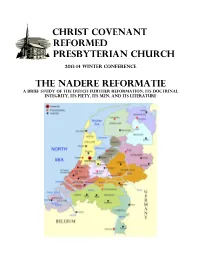
CHRIST COVENANT Reformed PRESBYTERIAN CHURCH 2013-14 WINTER CONFERENCE THE NADERE REFORMATIE A Brief Study of the Dutch Further Reformation, its doctrinal integrity, its piety, its men, and its Literature Nadere Reformatie Lectures-Pastor Ruddell’s Notes 1) The Name: Nadere Reformatie a) The name itself is a difficult term. It has been translated as: i) Second Reformation: As a name, the second reformation has something to be said for it, but it may give the impression that it is something separate from the first reformation, it denies the continuity that would have been confessed by its adherents. ii) Further Reformation: This is the term that is popular with Dutch historians who specialize in this movement. This term is preferred because it does set forth a continuity with the past, and with the Protestant Reformation as it came to the Netherlands. Its weakness is that it may seem to imply that the original Reformation did not go far enough—that there ought to be some noted deficiency. iii) The movement under study has also been called “Dutch Precisianism” as in, a more precise and exacting practice of godliness or piety. The difficulty here is that there are times when that term “precisionist” has been used pejoratively, and historians are unwilling to place a pejorative name upon a movement so popular with godly Dutch Christians. iv) There are times when the movement has been referred to as “Dutch Puritanism”. And, while there is much to commend this name as well, Puritanism also carries with it a particular stigma, which might be perceived as unpopular. -
Home Study Mark 5:21-43 SCRIPTURE
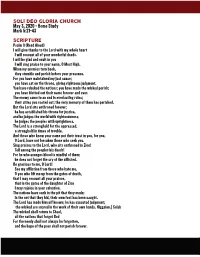
SOLI DEO GLORIA CHURCH May 3, 2020 - Home Study Mark 5:21-43 SCRIPTURE Psalm 9 (Read Aloud) I will give thanks to the Lord with my whole heart I will recount all of your wonderful deeds. I will be glad and exult in you I will sing praise to your name, O Most High. When my enemies turn back, they stumble and perish before your presence. For you have maintained my just cause; you have sat on the throne, giving righteous judgment. You have rebuked the nations; you have made the wicked perish; you have blotted out their name forever and ever. The enemy came to an end in everlasting ruins; their cities you rooted out; the very memory of them has perished. But the Lord sits enthroned forever; he has established his throne for justice, and he judges the world with righteousness; he judges the peoples with uprightness. The Lord is a stronghold for the oppressed, a stronghold in times of trouble. And those who know your name put their trust in you, for you, O Lord, have not forsaken those who seek you. Sing praises to the Lord, who sits enthroned in Zion! Tell among the peoples his deeds! For he who avenges blood is mindful of them; he does not forget the cry of the aicted. Be gracious to me, O Lord! See my aiction from those who hate me, O you who lift me up from the gates of death, that I may recount all your praises, that in the gates of the daughter of Zion I may rejoice in your salvation. -

Title Page R.J. Pederson
Cover Page The handle http://hdl.handle.net/1887/22159 holds various files of this Leiden University dissertation Author: Pederson, Randall James Title: Unity in diversity : English puritans and the puritan reformation, 1603-1689 Issue Date: 2013-11-07 Chapter 7 Defining Puritans and Puritanism: Narrative and Metanarrative 7.1 Introduction While a sufficient definition of English Puritanism continues to elude historians, this has not stayed the use of the terms Puritan and Puritanism.1 In the first chapter we saw, briefly, how various historians have attempted to define Puritanism.2 We also saw that some leading historians, given the sheer difficulty of identifying a definition that is encompassing enough, are now referring to Puritanisms.3 This shift is not too different 1 Most English historians continue to employ “Puritan” and “Puritanism” with confidence. See, for instance, Patrick Collinson, Richard Bancroft and Elizabethan Anti-Puritanism (Cambridge: Cambridge University Press, 2013), 1-12; Bernard Capp, England’s Culture Wars: Puritan Reformation and Its Enemies in the Interregnum, 1649-1660 (New York: Oxford University Press, 2012), 1-12; Andrew Cambers, Godly Reading: Print, Manuscript and Puritanism in England, 1580-1720 (Cambridge: Cambridge University Press, 2011), 10-15; Michael P. Winship, Godly Republicanism: Puritans, Pilgrims, and a City on a Hill (Cambridge: Harvard University Press, 2012); Arnold Hunt, The Art of Hearing: English Preachers and Their Audiences, 1590-1640 (Cambridge: Cambridge University Press, 2010), 30-31; Catherine Gimelli Martin, Milton Among the Puritans: The Case for Historical Revisionism (Aldershot: Ashgate Publishing, 2010), 31-64; John Coffey and Paul C. H. Lim, “Introduction,” in The Cambridge Companion to Puritanism (Cambridge: Cambridge University Press, 2008), 1-18; Tom Webster, Godly Clergy in Early Stuart England: The Caroline Puritan Movement, c.1620-1643 (Cambridge: Cambridge University Press, 2003), 1-8; N. -
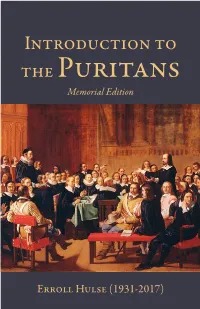
Introduction to the Puritans: Memorial Edition
Introduction to the Puritans Memorial Edition Erroll Hulse (1931-2017) INTRODUCTION TO THE PURITANS Erroll Hulse (1931-2017) Memorial Edition A Tribute to the Life and Ministry of Erroll Hulse Dedicated to the memory of Erroll Hulse with great joy and gratitude for his life and ministry. Many around the world will continue to benefit for many years to come from his untiring service. Those who knew him, and those who read this volume, will be blessed by his Christ- honoring life, a life well-lived to the glory of God. The following Scripture verses, psalm, and hymns were among his favorites. ISAIAH 11:9 They shall not hurt nor destroy in all my holy mountain: for the earth shall be full of the knowledge of the LORD, as the waters cover the sea. HABAKKUK 2:14 For the earth shall be filled with the knowledge of the glory of the LORD, as the waters cover the sea. PSALM 72 1Give the king thy judgments, O God, and thy righteousness unto the king’s son. 2He shall judge thy people with righteousness, and thy poor with judgment. 3The mountains shall bring peace to the people, and the little hills, by righteousness. 4He shall judge the poor of the people, he shall save the children of the needy, and shall break in pieces the oppressor. 5They shall fear thee as long as the sun and moon endure, throughout all generations. 6He shall come down like rain upon the mown grass: as showers that water the earth. 7In his days shall the righteous flourish; and abundance of peace so long as the moon endureth. -
Puritanism Notes
Puritanism Who were the Puritans? They are a group of Protestants in England who sought to purify (hence the name, “puritan”) the Church of England (Anglicanism) by removing the elements of Anglican Christianity that they considered to be too “Roman Catholic.” They are the type of Christianity that dominated the colonies in North America. What did the Puritans oppose in the Church of England? Answer: Anything they considered to be too “Roman Catholic” -Using crosses in churches -Certain priestly garments -Celebrating communion at an altar -Religious images -Wealth and luxury -Bishops (though some Puritans allowed for an episcopacy) -Celebrating Christmas or saint’s days -Having godparents -Kneeling during communion -Having an organ in church -Etc. Where did the Puritans come from? They primarily arose during the reign of Elizabeth in England (a Protestant) who hoped the Church of England would be a middle way (via media) between Roman Catholicism and Protestantism. Whereas Anglicanism (and episcopacy) united the country, the Puritans wanted presbyterian or congregational leadership which threatened the unity of England. In 1593 an act was passed that allowed Puritans to be arrested if they didn’t attend Anglican church services. After Elizabeth died she was succeeded by James I. James needed the bishops of the Church of England to unify his country, so religious groups that did not belong to that (Anabaptists, Independents, etc.) received less toleration. In 1605, due to English oppression of Catholics, a group of Catholics rented a space below where the British Parliament met. There they put large wine barrels filled with gunpowder in an attempt to blow up the king and several Puritans who sat in Parliament.