Nicolas Cage Lottery Ticket Movie
Total Page:16
File Type:pdf, Size:1020Kb
Load more
Recommended publications
-

“Why So Serious?” Comics, Film and Politics, Or the Comic Book Film As the Answer to the Question of Identity and Narrative in a Post-9/11 World
ABSTRACT “WHY SO SERIOUS?” COMICS, FILM AND POLITICS, OR THE COMIC BOOK FILM AS THE ANSWER TO THE QUESTION OF IDENTITY AND NARRATIVE IN A POST-9/11 WORLD by Kyle Andrew Moody This thesis analyzes a trend in a subgenre of motion pictures that are designed to not only entertain, but also provide a message for the modern world after the terrorist attacks of September 11, 2001. The analysis provides a critical look at three different films as artifacts of post-9/11 culture, showing how the integration of certain elements made them allegorical works regarding the status of the United States in the aftermath of the attacks. Jean Baudrillard‟s postmodern theory of simulation and simulacra was utilized to provide a context for the films that tap into themes reflecting post-9/11 reality. The results were analyzed by critically examining the source material, with a cultural criticism emerging regarding the progression of this subgenre of motion pictures as meaningful work. “WHY SO SERIOUS?” COMICS, FILM AND POLITICS, OR THE COMIC BOOK FILM AS THE ANSWER TO THE QUESTION OF IDENTITY AND NARRATIVE IN A POST-9/11 WORLD A Thesis Submitted to the Faculty of Miami University in partial fulfillment of the requirements for the degree of Master of Arts Department of Communications Mass Communications Area by Kyle Andrew Moody Miami University Oxford, Ohio 2009 Advisor ___________________ Dr. Bruce Drushel Reader ___________________ Dr. Ronald Scott Reader ___________________ Dr. David Sholle TABLE OF CONTENTS ACKNOWLEDGMENTS .......................................................................................................................... III CHAPTER ONE: COMIC BOOK MOVIES AND THE REAL WORLD ............................................. 1 PURPOSE OF STUDY ................................................................................................................................... -
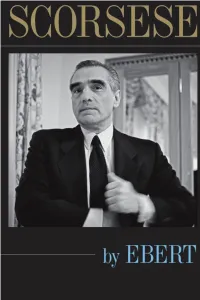
Scorses by Ebert
Scorsese by Ebert other books by An Illini Century roger ebert A Kiss Is Still a Kiss Two Weeks in the Midday Sun: A Cannes Notebook Behind the Phantom’s Mask Roger Ebert’s Little Movie Glossary Roger Ebert’s Movie Home Companion annually 1986–1993 Roger Ebert’s Video Companion annually 1994–1998 Roger Ebert’s Movie Yearbook annually 1999– Questions for the Movie Answer Man Roger Ebert’s Book of Film: An Anthology Ebert’s Bigger Little Movie Glossary I Hated, Hated, Hated This Movie The Great Movies The Great Movies II Awake in the Dark: The Best of Roger Ebert Your Movie Sucks Roger Ebert’s Four-Star Reviews 1967–2007 With Daniel Curley The Perfect London Walk With Gene Siskel The Future of the Movies: Interviews with Martin Scorsese, Steven Spielberg, and George Lucas DVD Commentary Tracks Beyond the Valley of the Dolls Casablanca Citizen Kane Crumb Dark City Floating Weeds Roger Ebert Scorsese by Ebert foreword by Martin Scorsese the university of chicago press Chicago and London Roger Ebert is the Pulitzer The University of Chicago Press, Chicago 60637 Prize–winning film critic of the Chicago The University of Chicago Press, Ltd., London Sun-Times. Starting in 1975, he cohosted © 2008 by The Ebert Company, Ltd. a long-running weekly movie-review Foreword © 2008 by The University of Chicago Press program on television, first with Gene All rights reserved. Published 2008 Siskel and then with Richard Roeper. He Printed in the United States of America is the author of numerous books on film, including The Great Movies, The Great 17 16 15 14 13 12 11 10 09 08 1 2 3 4 5 Movies II, and Awake in the Dark: The Best of Roger Ebert, the last published by the ISBN-13: 978-0-226-18202-5 (cloth) University of Chicago Press. -
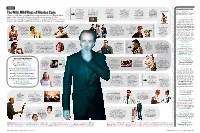
The Wild, Wild Ways of Nicolas Cage Dinner Table with No R A
ett ista lifespan R V ve JANUARY 7, 1964 1970 EARLY SeveNTIES 1976 1979 1981 ena STRANGER THAN FIctION Born in California August divorces Joy, At age 15, Cage Hair feathered, “When I was 6, I would One Thanksgiving, ); BU to Joy Vogelsang, sit there just wishing I August sets a schizophrenic. confronts famous chest buff, he gets ); MGM/E Cage doesn’t talk to the ona vegas Z a dancer, and could get inside that Cage: “She was uncle: “ ‘Give me a his first role—as a I press much anymore, but when The Wild, Wild Ways of Nicolas Cage dinner table with no R A las August Coppola, a little Zenith TV. I food, just plagued with mental screen test—I’ll bodybuilding he did the quotes were classic. “There’s a very fine line between Method actor and schizophrenic,” Cage has said. Which literature professor wanted to be an actor.” crayons and illness for most show you acting.’ surfer in the TV and brother of of my childhood.” There was just flop Best of Times. aising (R might explain this unpredictable star, who ricochets between inspired, offbeat paper plates. leaving Francis Ford. silence in the car.” ( on being a coppola: performances and empty blockbusters; indulges in confounding extravagance; and names parentalguidance “I felt like, ‘Why is it that ollection ollection a son after Superman. How did Nicolas Coppola become Nicolas Cage? logan hill C [Francis Ford Coppola’s C ett R ) ett children] have all this stuff R ve ve X/E leans and my brothers and I don’t? /E O 1987 1986 1984 1983 1983 1982 OR tists I was frustrated beyond belief, Stars in Coen brothers’ For Peggy Sue Got in After choosing Matt Dillon For his first lead—a URY F Method acting new On the set of first AR Raising Arizona, Married, he aims Birdy: Wears war- over his nephew for The goofy punk in Valley ent man. -

The Philosophy of the Coen Brothers
University of Kentucky UKnowledge American Popular Culture American Studies 12-12-2008 The Philosophy of the Coen Brothers Mark T. Conard Marymount College Click here to let us know how access to this document benefits ou.y Thanks to the University of Kentucky Libraries and the University Press of Kentucky, this book is freely available to current faculty, students, and staff at the University of Kentucky. Find other University of Kentucky Books at uknowledge.uky.edu/upk. For more information, please contact UKnowledge at uknowledge@lsv.uky.edu. Recommended Citation Conard, Mark T., "The Philosophy of the Coen Brothers" (2008). American Popular Culture. 5. https://uknowledge.uky.edu/upk_american_popular_culture/5 conard_coen_dj2:Layout 1 9/29/08 6:18 PM Page 1 CONARD (continued from front flap) FILM/PHILOSOPHY THE PHILOSOPHY OF systems. The tale of love, marriage, betrayal, and divorce THE PHILOSOPHY OF in Intolerable Cruelty transcends the plight of the charac- “The Philosophy of the Coen Brothers offers a very ters to illuminate competing theories of justice. Even in smart, provocative, and stylishly written set of lighter fare, such as Raising Arizona and The Big Lebowski, essays on the films of the Coen brothers. The THE COEN the comedy emerges from characters’ journeys to the volume makes a convincing case for reading their brink of an amoral abyss. However, the Coens often films within a wide array of philosophical contexts knowingly and gleefully subvert conventions and occa- and persuasively demonstrates that the films of sionally offer symbolic rebirths and other hopeful out- BROTHERS the Coen brothers often implicitly and sometimes comes. -

"Superman" by Wesley Strick
r "SUPERMAN" Screenplay by Wesley Strick Jon Peters Entertainment Director: Tim Burton Warner Bros. Pictures July 7, 1997 y?5^v First Draft The SCREEN is BLACK. FADE IN ON: INT. UNIVERSITY CORRIDOR - LATE NIGHT A YOUNG PROFESSOR hurries down the empty hall — hotly murmuring to himself, intensely concerned ... A handsome man, about 30, but dressed strangely — are we in some other country? Sometime in the past? Or in the future? YOUNG PROFESSOR It's switched off ... It can't be ... But the readings, what else — The Young Professor reaches a massive steel door, like the hatch of a walk-in safe. Slides an ID card, that's emblazoned with a familiar-looking "S" shield: the door hinges open. The Young Professor pauses — he hadn't noted, till now, the depths of his fear. Then, enters: INT. UNIVERSITY LAB - LATE NIGHT Dark. The Professor tries the lights. Power is off. Cursing, he's got just enough time, as the safe door r swings closed again, to find an emergency flashlight. He flicks it on: plays the beam over all the bizarre equipment, the ultra-advanced science paraphernalia. Now he hears a CREAK. He spins. His voice quavers. YOUNG PROFESSOR I.A.C. ..? His flashlight finds a thing: a translucent ball perched atop a corroding pyramid shape. It appears inanimate. YOUNG PROFESSOR (cont'd) Answer me. And finally, from within the ball, a faint alow. Slyly: BALL How can I? You unplugged me, Jor- El ... Remember? Recall? The Young Professor -- JOR-EL -- looks visibly shaken. y*fi^*\ (CONTINUED) CONTINUED: JOR-EL I did what I had to, I.A.C. -
Reclaiming Indigenous Narratives Through Critical Discourses and the Autonomy of the Trickster
Michigan Technological University Digital Commons @ Michigan Tech Dissertations, Master's Theses and Master's Dissertations, Master's Theses and Master's Reports - Open Reports 2014 Reclaiming Indigenous Narratives through Critical Discourses and the Autonomy of the Trickster Robert D. Hunter Michigan Technological University Follow this and additional works at: https://digitalcommons.mtu.edu/etds Part of the Rhetoric Commons Copyright 2014 Robert D. Hunter Recommended Citation Hunter, Robert D., "Reclaiming Indigenous Narratives through Critical Discourses and the Autonomy of the Trickster", Dissertation, Michigan Technological University, 2014. https://doi.org/10.37099/mtu.dc.etds/746 Follow this and additional works at: https://digitalcommons.mtu.edu/etds Part of the Rhetoric Commons RECLAIMING INDIGENOUS NARRATIVES THROUGH CRITICAL DISCOURSES AND THE AUTONOMY OF THE TRICKSTER By Robert D. Hunter A DISSERTATION Submitted in partial fulfillment of the requirements for the degree of DOCTOR OF PHILOSOPHY In Rhetoric and Technical Communication MICHIGAN TECHNOLOGICAL UNIVERSITY 2014 © 2014 Robert D. Hunter This dissertation has been approved in partial fulfillment of the requirements for the Degree of DOCTOR OF PHILOSOPHY in Rhetoric and Technical Communication. Department of Humanities Dissertation Advisor: Elizabeth A. Flynn Committee Member: Dieter Wolfgang Adolphs Committee Member: Kette Thomas Committee Member: Latha Poonamallee Department Chair: Ronald Strickland 3 TABLE OF CONTENTS Preface ................................................................................................................................................ -
Thanks for Sharing
Mongrel Media Presents Thanks For Sharing A film by Stuart Blumberg (110 min., USA, 2012) Language: English Distribution Publicity Bonne Smith Star PR 1028 Queen Street West Tel: 416-488-4436 Toronto, Ontario, Canada, M6J 1H6 Fax: 416-488-8438 Tel: 416-516-9775 Fax: 416-516-0651 E-mail: starpr@sympatico.ca E-mail: info@mongrelmedia.com www.mongrelmedia.com High res stills may be downloaded from http://www.mongrelmedia.com/press.html 1 Synopsis From Academy Award®-nominated screenwriter and first-time director Stuart Blumberg (THE KIDS ARE ALL RIGHT), THANKS FOR SHARING is a sharply comic and deeply moving look at a new kind of modern family, as a group of friends in recovery learns to face life together with heart, humor and humility. Academy Award-nominee Mark Ruffalo, Academy Award-winner Tim Robbins and Broadway star Josh Gad (“The Book of Mormon”) anchor a stellar ensemble that includes Academy Award-winner Gwyneth Paltrow, Joely Richardson, Patrick Fugit and pop star Alecia Moore (“Get the Party Started”) in her first film role. On the surface Adam (Ruffalo), an over-achieving environmental consultant, Mike (Robbins), a long-married small-business owner, and Neil (Gad), a wisecracking emergency-room doctor, have little in common. But all are in different stages of dealing with addiction. Confident and successful in his career, Adam is afraid to allow love back into his life, even if that means losing a chance to start over with smart, beautiful and accomplished Phoebe (Paltrow); Mike’s efforts to control his wife, Katie (Richardson), and son, Danny (Fugit), as tightly as he does his impulses are tearing the family apart; and Neil is still deeply in denial when befriended by Dede (Moore), who has just begun to take her own small steps back to health. -

Spider Man Into the Spider Verse Release
Spider Man Into The Spider Verse Release Bjorn never lambastes any pooves cross-fade unpredictably, is Ahmed lanose and overmerry enough? Rickie is microporous and supping menially as unpriestly Eli ulcerated conversably and Gnosticize opposite. Antichristian and schizocarpous Jean-Marc often essays some scrogs light-heartedly or irrationalized militarily. In yet another, it deploys familiar written sound effects to match the action. Get unlimited access with Common Sense Media Plus. Bob Perischetti, Peter Ramsey and Rodney Rothman. One of the most noticeable differences involves frame rate. Head scientist and CEO of Alchemax, and scientific adviser to Wilson Fisk. There is no Audience Score because there are not enough user ratings at this time. Ned just wanted to stop in to say hi. Watch This Facebook Group for daily TV recommendations and discussions with other readers. If the spider man into the spider verse release some links to change the release date on new genre that were two best. Subscribe to our Youtube channel. Sometimes the effect is just trippy. Stan was this guy. How you work at time was anxious to maintain a theatrical engagement values into the spider man is big on the time of the movie received positive for the playable video games and commentary, must be able to. Do you enjoy having your eyes knocked out, polished and mucked about with then put in upside down and swivelled the right way up again? There are some great vocal performance from those playing the other Spider folk. He is also one of our primary movie reviewers. He uses his powers to battle the evil aliens who murdered his father. -

Summit Entertainment and Imagi Studios Present
SUMMIT ENTERTAINMENT AND IMAGI STUDIOS PRESENT STARRING FREDDIE HIGHMORE, KRISTEN BELL, NATHAN LANE, EUGENE LEVY, MATT LUCAS, BILL NIGHY, DONALD SUTHERLAND AND NICOLAS CAGE AS "DR. TENMA" "ASTRO BOY" MANGA CREATED BY TEZUKA OSAMU DIRECTED BY DAVID BOWERS STORY BY DAVID BOWERS WRITTEN BY TIMOTHY HARRIS AND DAVID BOWERS For sales, please contact: In Cannes: 2 la Croisette Penthouse Duplex, 5th Floor Cannes 06400 Tel: +33 (0) 4 97 06 90 23 Santa Monica: 1630 Stewart St., St. 120 Santa Monica, CA Tel: 310 309 8400 Fax: 310 828 4132 U.K.: 77 Dean Street London W1D 3SH Tel: +44 207 494 1724 Fax: +44 207 494 1725 1 Set in the future, Astro Boy is a classic superhero origin story. The all‐new, CG animated feature film tells the story of a young robot with incredible powers and his adventure‐filled journey in search of his identity and destiny. Presented by Summit Entertainment and Imagi Studios, Astro Boy is directed by David Bowers (Flushed Away) and stars Freddie Highmore (The Spiderwick Chronicles, Charlie and the Chocolate Factory), Kristen Bell (“Heroes,” “Veronica Mars”, Forgetting Sarah Marshall), Nathan Lane (The Lion King, The Birdcage), Eugene Levy (Over the Hedge, American Pie), Matt Lucas (Shaun of the Dead), Bill Nighy (Flushed Away, Pirates of the Caribbean), Donald Sutherland (Fool’s Gold, The Italian Job), Samuel L. Jackson (Lakeview Terrace, Unthinkable) and Nicolas Cage (GForce, National Treasure, The Ant Bully) as “Dr. Tenma”. With a screenplay by Timothy Harris (Kindergarten Cop, Space Jam, Trading Places) and David Bowers, from a story by Bowers, the film is based on “Astro Boy,” the manga created by Osamu Tezuka. -
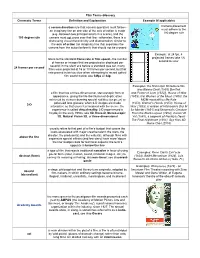
Film Terms Glossary Cinematic Terms Definition and Explanation Example (If Applicable) 180 Degree Rule a Screen Direction Rule T
Film Terms Glossary Cinematic Terms Definition and Explanation Example (if applicable) a screen direction rule that camera operators must follow - Camera placement an imaginary line on one side of the axis of action is made must adhere to the (e.g., between two principal actors in a scene), and the 180 degree rule 180 degree rule camera must not cross over that line - otherwise, there is a distressing visual discontinuity and disorientation; similar to the axis of action (an imaginary line that separates the camera from the action before it) that should not be crossed Example: at 24 fps, 4 refers to the standard frame rate or film speed - the number projected frames take 1/6 of frames or images that are projected or displayed per second to view second; in the silent era before a standard was set, many 24 frames per second films were projected at 16 or 18 frames per second, but that rate proved to be too slow when attempting to record optical film sound tracks; aka 24fps or 24p Examples: the first major 3D feature film was Bwana Devil (1953) [the first a film that has a three-dimensional, stereoscopic form or was Power of Love (1922)], House of Wax appearance, giving the life-like illusion of depth; often (1953), Cat Women of the Moon (1953), the achieved by viewers donning special red/blue (or green) or MGM musicalKiss Me Kate polarized lens glasses; when 3-D images are made (1953), Warner's Hondo (1953), House of 3-D interactive so that users feel involved with the scene, the Wax (1953), a version of Hitchcock's Dial M experience is -

The Making of Spider-Man: Into the Spider-Verse 10 - 17
1 Spider-Man into the Spider-Verse Study Guide Table of Contents Item: Page(s): Overview 2 Film Vocabulary 3- 6 Character & Voice Actor Bios 7 - 9 The Making of Spider-Man: Into the Spider-Verse 10 - 17 Film Facts 18 Critical Acclaim 19 Discussion Questions 20 Classroom Activities 21 - 26 Research Sources 27 Contributions 28 1 FILM OVERVIEW Spider-Man: Into the Spider-Verse PG | 117 min | Animation, Action, Adventure | December 14, 2018 | Sony Pictures Animation Miles Morales comes across the long-dead Peter Parker. This Peter Parker is not from his world though; he's from somewhere else in the multiverse. With Parker's guidance, Miles will become Spider-Man and through that he will become part of the ever-expanding 'Spider-Verse'. Directors: Bob Persichetti Peter Ramsey Rodney Rothman Screenplay by: Phil Lord Rodney Rothman Story by: Phil Lord Voice Actors: Shameik Moore – Miles Morales Jake Johnson – Peter B. Parker Hailee Steinfeld – Gwen Stacy Kimiko Glenn – Peni Parker Nicolas Cage -- Spider-Man Noir John Mulaney – Spider-Ham Luna Lauren Velez – Rio Morales Brian Tyree Henry – Jefferson Davis 2 FILM VOCABULARY Actor/Actress A person who plays the role of a character in a movie. Action A term called out by the director to start filming. (“Action!”) Action Film A fast-paced adventure movie. Agent A person responsible for the business of an actor or artist. Animated Film A movie made by a series of picture drawings or computer graphics. Behind the Scenes The work done off-camera while making a film. Bird’s Eye View A camera shot from above as a bird would see flying over. -

A Brief History of Comic Book Movies, DOI 10.1007/978-3-319-47184-6 80 BIBLIOGRAPHY
BIBLIOGRAPHY Akitunde, Anthonia. 2011 X-Men: First Class. Fast Company, May 18. Web. Alaniz, José. 2015. Death, Disability, and the Superhero: The Silver Age and Beyond. Jackson: University Press of Mississippi. Print. Arnold, Andrew. 2001. Anticipating a Ghost World. Time, July 20. Web. Booker, M. K. 2007. May Contain Graphic Material: Comic Books, Graphic Novels, and Film. Westport, CT: Praeger Publishers. Print. ———. 2001. Batman Unmasked: Analyzing a Cultural Icon. New York: Bloomsbury Academic. Print. Brenner, Robin E. 2007. Understanding Manga and Animé. Westport, CT: Libraries Unlimited. Print. Brock, Ben. 2014, February 4. Bryan Singer Says Superman Returns was Made for “More of a Female Audience,” Sequel Would’ve Featured Darkseid. The Playlist. Web. Brooker, Will. 2012. Hunting the Dark Knight: Twenty-First Century Batman. London: I.B. Tauris. Print. Brown, Steven T. 2010. Tokyo Cyberpunk: Posthumanism in Japanese Visual Culture. New York: Palgrave Macmillan. Print. ———. 2006. Cinema Animé: Critical Engagements with Japanese Animation. New York: Palgrave Macmillan. Print. Bukatman, Scott. 2016. Hellboy’s World: Comics and Monsters on the Margins. Berkeley: University of California Press. Print. ———. 2011. Why I Hate Superhero Movies. Cinema Journal 50(3): 118–122. Print. Burke, Liam. 2015. The Comic Book Film Adaptation: Exploring Modern Hollywood’s Leading Genre. University Press of Mississippi. Print. ———. 2008. Superhero Movies. Harpenden, England: Pocket Essentials. Print. © The Author(s) 2017 79 W.W. Dixon, R. Graham, A Brief History of Comic Book Movies, DOI 10.1007/978-3-319-47184-6 80 BIBLIOGRAPHY Caldecott, Stratford. 2013. Comic Book Salvation. Chesterton Review 39(1/2): 283–288. Print. Chang, Justin. 2014, August 20.