Neglected Canadian Orchestral Music Robin Elliott
Total Page:16
File Type:pdf, Size:1020Kb
Load more
Recommended publications
-
Parsifal and Canada: a Documentary Study
Parsifal and Canada: A Documentary Study The Canadian Opera Company is preparing to stage Parsifal in Toronto for the first time in 115 years; seven performances are planned for the Four Seasons Centre for the Performing Arts from September 25 to October 18, 2020. Restrictions on public gatherings imposed as a result of the Covid-19 pandemic have placed the production in jeopardy. Wagnerians have so far suffered the cancellation of the COC’s Flying Dutchman, Chicago Lyric Opera’s Ring cycle and the entire Bayreuth Festival for 2020. It will be a hard blow if the COC Parsifal follows in the footsteps of a projected performance of Parsifal in Montreal over 100 years ago. Quinlan Opera Company from England, which mounted a series of 20 operas in Montreal in the spring of 1914 (including a complete Ring cycle), announced plans to return in the fall of 1914 for another feast of opera, including Parsifal. But World War One intervened, the Parsifal production was cancelled, and the Quinlan company went out of business. Let us hope that history does not repeat itself.1 While we await news of whether the COC production will be mounted, it is an opportune time to reflect on Parsifal and its various resonances in Canadian music history. This article will consider three aspects of Parsifal and Canada: 1) a performance history, including both excerpts and complete presentations; 2) remarks on some Canadian singers who have sung Parsifal roles; and 3) Canadian scholarship on Parsifal. NB: The indication [DS] refers the reader to sources that are reproduced in the documentation portfolio that accompanies this article. -

Manfred Honeck, Conductor Vilde Frang, Violin Matthias Goerne, Baritone Eric Cutler, Tenor
Pittsburgh Symphony Orchestra 2018-2019 Mellon Grand Classics Season May 10 and 12, 2019 MANFRED HONECK, CONDUCTOR VILDE FRANG, VIOLIN MATTHIAS GOERNE, BARITONE ERIC CUTLER, TENOR LUDWIG VAN BEETHOVEN Concerto in D major for Violin and Orchestra, Opus 61 I. Allegro ma non troppo II. Larghetto — III. Rondo: Allegro Ms. Frang Intermission GUSTAV MAHLER Das Lied von der Erde for Baritone* and Tenor† Soloists and Orchestra I. Das Trinklied vom Jammer der Erde (“The Drinking Song of the Earth’s Misery”)† II. Der Einsame im Herbst (“The Lonely One in Autumn”)* III. Von der Jugend (“of Youth”)† IV. Von der Schönheit (“of Beauty”)* V. Der Trunkene im Frühling (“The Drunkard in Spring”)† VI. Der Abschied (“The Parting”)* Mr. Goerne Mr. Cutler May 10-12, 2019, page 1 PROGRAM NOTES BY DR. RICHARD E. RODDA LUDWIG VAN BEETHOVEN Concerto in D major for Violin and Orchestra, Opus 61 (1806) Ludwig van Beethoven was born in Bonn on December 16, 1770, and died in Vienna on March 26, 1827. He composed his Violin Concerto in 1806, and it was premiered at the Theater-an-der-Wien in Vienna with Beethoven conducting and soloist Franz Clement on December 23, 1806. The Pittsburgh Symphony first performed the concerto at Carnegie Music Hall with conductor Victor Herbert and violinist Luigi von Kunits in November 1898, and most recently performed it with music director Manfred Honeck and violinist Christian Tetzlaff in June 2015. The score calls for flute, pairs of oboes, clarinets, bassoons, horns, and trumpets, timpani and strings. Performance time: approximately 45 minutes. In 1794, two years after he moved to Vienna from Bonn, Beethoven attended a concert by an Austrian violin prodigy named Franz Clement. -
Weinzweig Long
John Weinzweig (1913-2006) Born in 1913 to Polish-Jewish immigrants, John Weinzweig became a noted Canadian composer, educator and advocate. He began music study at the age of 14, learning mandolin at the Workmen’s Circle Peretz School, a Jewish community school in North Toronto. During his high school years at Harbord Collegiate, Weinzweig joined the orchestra playing the violin parts on the mandolin but eventually learned the tuba, tenor saxophone, and bass. Weinzweig’s early musical training led to an interest in composition and he spent between 1934-37 studying at the University of Toronto with Healy Willan, Leo Smith, and Sir Ernest McMillan. During his time at the University of Toronto Weinzweig founded and conducted the University of Toronto Symphony Orchestra. Following the completion of his education in Toronto, Weinzweig moved to Rochester, NY to study with Howard Hanson at the Eastman School of Music. There he was first introduced to serial compositional techniques. Upon his return to Toronto, Weinzweig experimented with serialism in his Piano Suite no. 1 (1939) and in incidental music for docudrama radio programming at the growing CBC. For the remainder of his career, Weinzweig continued to use serialism as the governing structure behind his compositions even when he experimented with other musical ideas. Following a decade long tenure at the CBC (1941-51), Weinzweig’s compositional interests returned to concert music. He began composition of his Divertimenti, with Divertimento no. 1 winning an award for chamber music at the 1948 Olympics. Works such as String Quartet no. 1 and Suite for Piano no. -

Journal September 1984
The Elgar Society JOURNAL ^■m Z 1 % 1 ?■ • 'y. W ■■ ■ '4 September 1984 Contents Page Editorial 3 News Items and Announcements 5 Articles: Further Notes on Severn House 7 Elgar and the Toronto Symphony 9 Elgar and Hardy 13 International Report 16 AGM and Malvern Dinner 18 Eigar in Rutland 20 A Vice-President’s Tribute 21 Concert Diary 22 Book Reviews 24 Record Reviews 29 Branch Reports 30 Letters 33 Subscription Detaiis 36 The editor does not necessarily agree with the views expressed by contributors, nor does the Elgar Society accept responsibility for such views The cover portrait is reproduced by kind permission of National Portrait Gallery This issue of ‘The Elgar Society Journal’ is computer-typeset. The computer programs were written by a committee member, Michael Rostron, and the processing was carried out on Hutton -t- Rostron’s PDPSe computer. The font used is Newton, composed on an APS5 photo-typesetter by Systemset - a division of Microgen Ltd. ELGAR SOCIETY JOURNAL ISSN 0143-121 2 r rhe Elgar Society Journal 01-440 2651 104 CRESCENT ROAD, NEW BARNET. HERTS. EDITORIAL September 1984 .Vol.3.no.6 By the time these words appear the year 1984 will be three parts gone, and most of the musical events which took so long to plan will be pleasant memories. In the Autumn months there are still concerts and lectures to attend, but it must be admitted there is a sense of ‘winding down’. However, the joint meeting with the Delius Society in October is something to be welcomed, and we hope it may be the beginning of an association with other musical societies. -
CALIFORNIA STATE UNIVERSITY, NORTHRIDGE CANADIAN MUSIC SINCE 1940: a QUESTION of NATIONALISM a Thesis Submitted in Partial Satis
CALIFORNIA STATE UNIVERSITY, NORTHRIDGE CANADIAN MUSIC SINCE 1940: A QUESTION OF NATIONALISM A Thesis submitted in partial satisfaction of the requirements for the degree of Master of Arts in Music by Ronald Frederick Erin August, 1983 J:lhe Thesis of Ronald Frederick Erin is approved: California StD. te Universi tJr, Northridge ii PREFACE This thesis represents a survey of Canadian music since 1940 within the conceptual framework of 'nationalism'. By this selec- tive approach, it does not represent a conclusive view of Canadian music nor does this paper wish to ascribe national priorities more importance than is due. However, Canada has a unique relationship to the question of nationalism. All the arts, including music, have shared in the convolutions of national identity. The rela- tionship between music and nationalism takes on great significance in a country that has claimed cultural independence only in the last 40 years. Therefore, witnessed by Canadian critical res- ponse, the question of national identity in music has become an important factor. \ In utilizing a national focus, I have attempted to give a progressive, accumulative direction to the six chapters covered in this discussion. At the same time, I have attempted to make each chapter self-contained, in order to increase the paper's effective- ness as a reference tool. If the reader wishes to refer back to information on the CBC's CRI-SM record label or the Canadian League of Composers, this informati6n will be found in Chapter IV. Simi- larly, work employing Indian texts will be found in Chapter V. Therefore, a certain amount of redundancy is unavoidable when interconnecting various components. -
Gr. 4 to 8 Study Guide
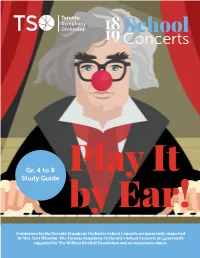
Toronto Symphony TS Orchestra Gr. 4 to 8 Study Guide Conductors for the Toronto Symphony Orchestra School Concerts are generously supported by Mrs. Gert Wharton. The Toronto Symphony Orchestra’s School Concerts are generously supported by The William Birchall Foundation and an anonymous donor. Click on top right of pages to return to the table of contents! Table of Contents Concert Overview Concert Preparation Program Notes 3 4 - 6 7 - 11 Lesson Plans Artist Biographies MusicalGlossary 12 - 38 39 - 42 43 - 44 Instruments in Musicians Teacher & Student the Orchestra of the TSO Evaluation Forms 45 - 56 57 - 58 59 - 60 The Toronto Symphony Orchestra gratefully acknowledges Pierre Rivard & Elizabeth Hanson for preparing the lesson plans included in this guide - 2 - Concert Overview No two performances will be the same Play It by Ear! in this laugh-out-loud interactive February 26-28, 2019 concert about improvisation! Featuring Second City alumni, and hosted by Suitable for grades 4–8 Kevin Frank, this delightfully funny show demonstrates improvisatory techniques Simon Rivard, Resident Conductor and includes performances of orchestral Kevin Frank, host works that were created through Second City Alumni, actors improvisation. Each concert promises to Talisa Blackman, piano be one of a kind! Co-production with the National Arts Centre Orchestra Program to include excerpts from*: • Mozart: Overture to The Marriage of Figaro • Rimsky-Korsakov: Scheherazade, Op. 35, Mvt. 2 (Excerpt) • Copland: Variations on a Shaker Melody • Beethoven: Symphony No. 3, Mvt. 4 (Excerpt) • Holst: St. Pauls Suite, Mvt. 4 *Program subject to change - 3 - Concert Preparation Let's Get Ready! Your class is coming to Roy Thomson Hall to see and hear the Toronto Symphony Orchestra! Here are some suggestions of what to do before, during, and after the performance. -

Luigi Von Kunits Mrs
Cabbagetown Preservation Association CPA: Who Are We? Attention All Volunteers ounded in 1988 to encourage the Fpreservation of the architectural and Would-be Volunteers: integrity and historic character of Cabbagetown, the CPA does that and We are also always looking for more people to join in. more. Here’s what we do: There are several volunteer committees that take responsibility EWSLETTER Heritage Preservation Board Members Preserving the architectural integrity and historic character of our neighbourhood Stephen Yeates, Chair for various interesting CPA projects including: • Review applications to Committee of Helen Coltrinari, Vice-Chair Adjustment and the Ontario Municipal Sandie Scott, Treasurer Board, Heritage Walking Tours, Heritage Research, Sue McMurtry, Secretary • Make submissions to regulatory bodies Alan Waterhouse, Past President Cabbagetown Festival Booth, Forsythia Festival, Christopher Dew Tour of Homes Afternoon Tea, C/RP Museum Reveals A Different Beat Heritage Promotion Mary Gallant • Produce quarterly newsletter Newsletter Delivery, etc. David Pretlove s the Cabbagetown/Regent Park Misdemeanours didn’t significantly escalate • Produce special heritage displays Helen Coltrinari museum gears up for its first public from those of 1860, which included one • Organize “Speaker Series” What Rick Merrill Some committees are responsible for an annual event, some a • Manage “Walking Tour” program A exposure at Police Division 51, we “Andrew Adams having in his possession a Toby Schertzer A few times each year, and some on a more frequent basis. We Sheila Schirmer will be giving you teasers of future displays. is this horse and buggy stolen from Dr. Geikie,” and Awards Programs Carol Moore-Ede have a chair person for each of these committees, and this per- The following account of policing shows “a house at the head of Sayer Street, lately • “Restoration Awards” Peggy Weir son connects with our Volunteer Director who is a member of object? • “Streetscapes in Bloom” us a very different Toronto. -

The Piano Music of Jean Coulthard: an Historical Perspective
INFORMATION TO USERS This manuscript has been reproduced from the microfilm master. UMI films the text directly from the original or copy submitted. Thus, some thesis and dissertation copies are in typewriter face, while others may be from any type o f computer printer. The quality of this reproduction Is dependent upon the quality of the copy submitted. Broken or indistinct print, colored or poor quality illustrations and photographs, print bleedthrough, substandard margins, and improper alignment can adversely affect reproduction. In the unlikely event that the author did not send UMI a complete manuscript and there are missing pages, these will be noted. Also, if unauthorized copyright material had to be removed, a note wiU indicate the deletion. Oversize materials (e.g., maps, drawings, charts) are reproduced by sectioning the original, beginning at the upper left-hand comer and continuing from left to right in equal sections with small overlaps. Each original is also photographed in one exposure and is included in reduced form at the back o f the book. Photographs included in the original manuscript have been reproduced xerographically in this copy. Higher quality 6” x 9” black and white photographic prints are available for any photographs or illustrations appearing in this copy for an additional charge. Contact UMI directly to order. UMI A Bell & Howell Information Company 300 North Zed) Road, Ann Arbor MI 48106-1346 USA 313/761-4700 800/521-0600 The Piano Music of Jean Couithard By Glenn David Colton B.Mus., Memorial University of Newfoundland, 1990 M.A. (Music Criticism), McMaster University, 1992 A dissertation submitted in partial fulfilment of the requirements for the degree of DOCTOR OF PHILOSOPHY (Musicology) in the Department of Music We accept this dissertation as conforming to the required standard fl$r. -

Conservatory of Music Piano Examinations, 1887-2015: Their Impact and Influence
A HISTORY OF THE ROYAL (TORONTO) CONSERVATORY OF MUSIC PIANO EXAMINATIONS, 1887-2015: THEIR IMPACT AND INFLUENCE TATIANA VOITOVITCH-CAMILLERI A DISSERTATION SUBMITTED TO THE FACULTY OF GRADUATE STUDIES IN PARTIAL FULFILLMENT OF THE REQUIREMENTS FOR THE DEGREE OF DOCTOR OF PHILOSOPHY GRADUATE PROGRAM IN MUSIC YORK UNIVERSITY TORONTO, ONTARIO November 2019 © Tatiana Voitovitch-Camilleri, 2019 ii ABSTRACT Since its inception in 1887, the Royal Conservatory of Music has maintained its position as one of the largest and oldest community-based music schools and education centres in North America, with an integrated examination body and a comprehensive graded curriculum, influencing and shaping the Canadian musical landscape. For the past 130 years, the Conservatory has presented a wide-ranging art music repertoire for studying piano and offered a comprehensive system for assessing students’ progress through its Examinations, recently retitled as The Certificate Program. The Conservatory’s internal examinations began in 1887, with the external examinations following in 1898. The latter preserved the format of the former and expanded through increasing the number of the examination centres across Canada for both financial and educational reasons. Despite varying opinions of professionals and amateurs on the efficacy and value of the piano examinations in particular from the beginning, this dissertation, using historical sources and interviews, argues that over the years the structure and content of the piano examinations, while innately conservative on the whole, have kept up with a changing demographic of students across the country, and either countered or taken on the many criticisms that surrounded them over the years despite geographical and financial challenges, and indeed competition from other institutions. -

Louis Riel. Music by Harry Somers, Text by Mavor Moore with the Collaboration of Jacques Languirand
Louis Riel. Music by Harry Somers, text by Mavor Moore with the collaboration of Jacques Languirand. 1 video disc (2:06:26). Roxolana Roslak, Mary Morrison, sopranos; Patricia Rideout, mezzo-soprano; Donald Rutherford, Bernard Turgeon, baritones; Joseph Rouleau, bass; Canadian Opera Company Chorus and Orchestra; Victor Feldbrill, conductor. Toronto: Centrediscs CMCDVD 16711, 2011. Contents: Act 1 (40:40) − Act 2 (35:20) −Act 3 (47:12) − Interview with Mavor Moore and Harry Somers (10:21) − Introductions by Mavor Moore (7:14 and 3:48). $29.98. Louis Riel commands a position of prominence in Canadian opera and must be counted among Canada’s most significant cultural achievements. Written by composer Harry Somers and librettists Mavor Moore and Jacques Languirand, it was first performed in 1967 as part of Canada’s centennial celebrations. The opera embraced the spirit of these celebrations, if perhaps not the tone, with a plot addressing historical events that resonate deeply for Canadians and which played a crucial role in establishing an early sense of nationhood. The librettists found a distinctly Canadian means to convey the tensions and allegiances among Protestant English Ontario, Catholic French Québec, and Riel’s Métis by taking a multilingual approach involving the English, French, Cree, and Latin languages in situations appropriate to each character’s background and circumstance. Somers complemented the linguistic diversity of the libretto by embracing a range of musical styles that placed diatonic melodies, popular song, and lyricism in juxtaposition and superimposition with abstract atonal writing, Sprechstimme, and electronically generated sounds. The opera is a dramatic tour de force that brings the story of Riel vividly to life while acknowledging many of the fundamental challenges faced by Canada throughout its first century. -
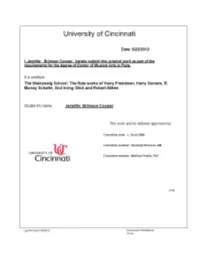
The Weinzweig School: the Flute Works of Harry Freedman, Harry Somers, R
The Weinzweig School: The flute works of Harry Freedman, Harry Somers, R. Murray Schafer, Srul Irving Glick and Robert Aitken A Document Submitted to the Graduate School of the University of Cincinnati in partial fulfillment of the requirements for the degree of DOCTOR OF MUSICAL ARTS in the Performance Studies Division of the College-Conservatory of Music 2012 by Jennifer Brimson Cooper B.M., Wilfrid Laurier University, 2006 M.M., Royal Northern College of Music, 2007 Advisor: Dr. Brett Scott Readers: Dr. Matthew Peattie and Randy Bowman, B.M. ABSTRACT This document studies a generation of students of Canadian pedagogue John Jacob Weinzweig (1913-2006) who have written for the flute. R. Harry Freedman (1922-2005), Harry Somers (1925-1999), R Murray Schafer (b.1933), Srul Irving Glick (1934-2002) and Robert Aitken (b.1939) have all contributed substantial works to the canon of Canadian flute repertory. The purpose of this document is to show the artistic aims and scope of these composer’s works, exploring their respective approaches to writing for the flute. By synthesizing analytic and aesthetic approaches to composition and through the study of available literary history and criticism this document will broaden the perspective on Canadian flute literature. Pieces to be examined in detail include: Harry Freedman, Soliloquy (1971); Harry Somers, Etching from the Vollard Suite (1964); R. Murray Schafer, Sonatina (1958); Srul Irving Glick, Sonata for Flute and Piano (1983) and Robert Aitken, Icicle (1977). BLANK PAGE ACKNOWLEDGEMENTS I would like to acknowledge Dr. Brett Scott for his help with the generation of the document proposal and for his guidance through the writing and editing stages of this document, and the members of my committee, Dr. -

The Canadian Academy of Music Limited : Toronto.
anactiaa r|Eu0itin^ "Toronto 1914-1^ INDEX PAGE Introduction 1-2 The Faculty 4-5 Piano ft-12 Walther Kirschbaum 6-8 Richard Tattersall 8 Maria Bauchop, L.R.A.M 8-10 Laura Newman 10 Mrs. G. E. Grove, Mus. Bac 10 Mary L. Gunther 10 W. F. Pickard 10-12 J. Y. S. Ross 12 G. F. Liddle 12 Grant Gall 12 Dorothy Allen, L.R.A.M., A.R.C.M 12 A. M. Fellman, Dalton McLaughlin, Mary D. Kemp, Mildred F. Pett, Helen Sturrock and Lily McBain 12 Singing 13-18 Otto Morando 13-14 Wm. G. Armstrong 14-16 Stanley Adams 16 Mrs. E. Varty Roberts 16-18 Edith M. Parker 18 A. L. Madeline Carter 18 John Adamson 18 Emily Taylor 18 Violin 19-22 Luigi von Kunits 19-22 Arthur Ely 22 Marie Southall 22 Benedick Clarke 22 Violoncello 22 George A. Bruce 22 Harp 22 Thelma Holm 22 Normal Training for Piano Teachers 23 Children's Department 23-24 Academy Orchestra 24 Preparatory Orchestral Class 24-26 Ensemble Classes 26 Chamber Music Concerts 25 Sight Singing and Part Singing Classes 26 Dancing 26-27 Mrs. J. Melton Adam 26-27 Elocution and Dramatic Art 28 Mrs. May Anderson Trestrail 28 Examination Courses 29-38 Piano 29-30 Vocal Department 30-31 Violin 31 Violoncello 32 Theoretical Course 32-33 Preparatory Examination 32 Junior Examination 32 Intermediate Examination 33 Senior Examination 33 Examination Fees 33 Scholarship 33-34 Partial Scholarships 34 Rules and Regulations 34 Ul INDEX—Continued PAGE Tuition Fees 35-39 Piano 35-36 Assistant Piano Teachers 36 Singing 36 Violin 37 Viola 37 Violoncello 37 Organ 38 Accompanying 38 Harp 38 Harmony, Counterpoint and Composition 38 Sight Singing Classes 38 Dancing , 39 Italian 39 Elocution and Dramatic Art 39 WEST END BRANCH Introduction 42 The Faculty 43 .