Acta Botanica Brasilica - 32(3): 493-502
Total Page:16
File Type:pdf, Size:1020Kb
Load more
Recommended publications
-

Book of Abstracts.Pdf
1 List of presenters A A., Hudson 329 Anil Kumar, Nadesa 189 Panicker A., Kingman 329 Arnautova, Elena 150 Abeli, Thomas 168 Aronson, James 197, 326 Abu Taleb, Tariq 215 ARSLA N, Kadir 363 351Abunnasr, 288 Arvanitis, Pantelis 114 Yaser Agnello, Gaia 268 Aspetakis, Ioannis 114 Aguilar, Rudy 105 Astafieff, Katia 80, 207 Ait Babahmad, 351 Avancini, Ricardo 320 Rachid Al Issaey , 235 Awas, Tesfaye 354, 176 Ghudaina Albrecht , Matthew 326 Ay, Nurhan 78 Allan, Eric 222 Aydınkal, Rasim 31 Murat Allenstein, Pamela 38 Ayenew, Ashenafi 337 Amat De León 233 Azevedo, Carine 204 Arce, Elena An, Miao 286 B B., Von Arx 365 Bétrisey, Sébastien 113 Bang, Miin 160 Birkinshaw, Chris 326 Barblishvili, Tinatin 336 Bizard, Léa 168 Barham, Ellie 179 Bjureke, Kristina 186 Barker, Katharine 220 Blackmore, 325 Stephen Barreiro, Graciela 287 Blanchflower, Paul 94 Barreiro, Graciela 139 Boillat, Cyril 119, 279 Barteau, Benjamin 131 Bonnet, François 67 Bar-Yoseph, Adi 230 Boom, Brian 262, 141 Bauters, Kenneth 118 Boratyński, Adam 113 Bavcon, Jože 111, 110 Bouman, Roderick 15 Beck, Sarah 217 Bouteleau, Serge 287, 139 Beech, Emily 128 Bray, Laurent 350 Beech, Emily 135 Breman, Elinor 168, 170, 280 Bellefroid, Elke 166, 118, 165 Brockington, 342 Samuel Bellet Serrano, 233, 259 Brockington, 341 María Samuel Berg, Christian 168 Burkart, Michael 81 6th Global Botanic Gardens Congress, 26-30 June 2017, Geneva, Switzerland 2 C C., Sousa 329 Chen, Xiaoya 261 Cable, Stuart 312 Cheng, Hyo Cheng 160 Cabral-Oliveira, 204 Cho, YC 49 Joana Callicrate, Taylor 105 Choi, Go Eun 202 Calonje, Michael 105 Christe, Camille 113 Cao, Zhikun 270 Clark, John 105, 251 Carta, Angelino 170 Coddington, 220 Carta Jonathan Caruso, Emily 351 Cole, Chris 24 Casimiro, Pedro 244 Cook, Alexandra 212 Casino, Ana 276, 277, 318 Coombes, Allen 147 Castro, Sílvia 204 Corlett, Richard 86 Catoni, Rosangela 335 Corona Callejas , 274 Norma Edith Cavender, Nicole 84, 139 Correia, Filipe 204 Ceron Carpio , 274 Costa, João 244 Amparo B. -

Tree and Tree-Like Species of Mexico: Asteraceae, Leguminosae, and Rubiaceae
Revista Mexicana de Biodiversidad 84: 439-470, 2013 Revista Mexicana de Biodiversidad 84: 439-470, 2013 DOI: 10.7550/rmb.32013 DOI: 10.7550/rmb.32013439 Tree and tree-like species of Mexico: Asteraceae, Leguminosae, and Rubiaceae Especies arbóreas y arborescentes de México: Asteraceae, Leguminosae y Rubiaceae Martin Ricker , Héctor M. Hernández, Mario Sousa and Helga Ochoterena Herbario Nacional de México, Departamento de Botánica, Instituto de Biología, Universidad Nacional Autónoma de México. Apartado postal 70- 233, 04510 México D. F., Mexico. mricker@ib.unam.mx Abstract. Trees or tree-like plants are defined here broadly as perennial, self-supporting plants with a total height of at least 5 m (without ascending leaves or inflorescences), and with one or several erect stems with a diameter of at least 10 cm. We continue our compilation of an updated list of all native Mexican tree species with the dicotyledonous families Asteraceae (36 species, 39% endemic), Leguminosae with its 3 subfamilies (449 species, 41% endemic), and Rubiaceae (134 species, 24% endemic). The tallest tree species reach 20 m in the Asteraceae, 70 m in the Leguminosae, and also 70 m in the Rubiaceae. The species-richest genus is Lonchocarpus with 67 tree species in Mexico. Three legume genera are endemic to Mexico (Conzattia, Hesperothamnus, and Heteroflorum). The appendix lists all species, including their original publication, references of taxonomic revisions, existence of subspecies or varieties, maximum height in Mexico, and endemism status. Key words: biodiversity, flora, tree definition. Resumen. Las plantas arbóreas o arborescentes se definen aquí en un sentido amplio como plantas perennes que se pueden sostener por sí solas, con una altura total de al menos 5 m (sin considerar hojas o inflorescencias ascendentes) y con uno o varios tallos erectos de un diámetro de al menos 10 cm. -

The Complete Chloroplast Genome of a Key Ancestor of Modern Roses, Rosa Chinensis Var
molecules Article The Complete Chloroplast Genome of a Key Ancestor of Modern Roses, Rosa chinensis var. spontanea, and a Comparison with Congeneric Species Hong-Ying Jian 1,*,† ID , Yong-Hong Zhang 2,†, Hui-Jun Yan 1, Xian-Qin Qiu 1, Qi-Gang Wang 1, Shu-Bin Li 1 and Shu-Dong Zhang 3,* 1 National Engineering Research Center for Ornamental Horticulture/Flower Research Institute, Yunnan Academy of Agricultural Sciences, Kunming 650205, China; hjyan8203@126.com (H.-J.Y.); xianqin711@sina.com (X.-Q.Q.); wqg712@sina.com (Q.-G.W.); sbli315@126.com (S.-B.L.) 2 School of Life Sciences, Yunnan Normal University, Kunming 650500, China; yhzhang@mail.kib.ac.cn 3 School of Biological Sciences and Technology, Liupanshui Normal University, Liupanshui 553004, China * Correspondence: ynwildflower@aliyun.com (H.-Y.J.); sdchang@mail.kib.ac.cn (S.-D.Z.); Tel.: +86-871-6589-2602 (H.-Y.J.) † These authors contributed equally to this work. Received: 19 January 2018; Accepted: 7 February 2018; Published: 12 February 2018 Abstract: Rosa chinensis var. spontanea, an endemic and endangered plant of China, is one of the key ancestors of modern roses and a source for famous traditional Chinese medicines against female diseases, such as irregular menses and dysmenorrhea. In this study, the complete chloroplast (cp) genome of R. chinensis var. spontanea was sequenced, analyzed, and compared to congeneric species. The cp genome of R. chinensis var. spontanea is a typical quadripartite circular molecule of 156,590 bp in length, including one large single copy (LSC) region of 85,910 bp and one small single copy (SSC) region of 18,762 bp, separated by two inverted repeat (IR) regions of 25,959 bp. -

Rbcl and Legume Phylogeny, with Particular Reference to Phaseoleae, Millettieae, and Allies Tadashi Kajita; Hiroyoshi Ohashi; Yoichi Tateishi; C
rbcL and Legume Phylogeny, with Particular Reference to Phaseoleae, Millettieae, and Allies Tadashi Kajita; Hiroyoshi Ohashi; Yoichi Tateishi; C. Donovan Bailey; Jeff J. Doyle Systematic Botany, Vol. 26, No. 3. (Jul. - Sep., 2001), pp. 515-536. Stable URL: http://links.jstor.org/sici?sici=0363-6445%28200107%2F09%2926%3A3%3C515%3ARALPWP%3E2.0.CO%3B2-C Systematic Botany is currently published by American Society of Plant Taxonomists. Your use of the JSTOR archive indicates your acceptance of JSTOR's Terms and Conditions of Use, available at http://www.jstor.org/about/terms.html. JSTOR's Terms and Conditions of Use provides, in part, that unless you have obtained prior permission, you may not download an entire issue of a journal or multiple copies of articles, and you may use content in the JSTOR archive only for your personal, non-commercial use. Please contact the publisher regarding any further use of this work. Publisher contact information may be obtained at http://www.jstor.org/journals/aspt.html. Each copy of any part of a JSTOR transmission must contain the same copyright notice that appears on the screen or printed page of such transmission. The JSTOR Archive is a trusted digital repository providing for long-term preservation and access to leading academic journals and scholarly literature from around the world. The Archive is supported by libraries, scholarly societies, publishers, and foundations. It is an initiative of JSTOR, a not-for-profit organization with a mission to help the scholarly community take advantage of advances in technology. For more information regarding JSTOR, please contact support@jstor.org. -

Research Indicators – Herbarium
State Herbarium of South Australia Research Prospectus 2008–09 The State’s key institution for advancing and disseminating knowledge of plants, algae and fungi Table of Contents Overview..............................................................................................................................3 Background .........................................................................................................................3 Reporting .........................................................................................................................3 History..............................................................................................................................3 Vision & Mission ..................................................................................................................5 Research expertise, strengths and opportunities.................................................................6 Background......................................................................................................................6 Current strengths .............................................................................................................7 Taxonomic expertise ........................................................................................................8 Key groups.......................................................................................................................9 Opportunities .....................................................................................................................10 -

Wood Density Variation in Neotropical Forests Page 1
Wood density variation in Neotropical forests Page 1 1 Regional and phylogenetic variation of wood density across 2,456 neotropical tree 2 species 3 4 Jérôme Chave1,*, Helene C. Muller-Landau2, Timothy R. Baker3, Tomás A. Easdale4,**, Hans 5 ter Steege5, Campbell O. Webb6 6 7 1 Laboratoire Evolution et Diversité Biologique, CNRS UMR5174, Université Paul Sabatier 8 Bâtiment 4R3, 31062 Toulouse, France 9 2 Dept of Ecology, Evolution and Behavior, University of Minnesota, 1987 Upper Buford 10 Circle, St. Paul, MN 55108 USA 11 3 Earth and Biosphere Institute, School of Geography, University of Leeds, Leeds, LS2 9JT, 12 UK 13 4 Laboratorio de Investigaciones Ecológicas de las Yungas, Facultad de Ciencias Naturales, 14 Universidad Nacional de Tucumán, CC 34, CP 4107 Yerba Buena, Argentina 15 5 National Herbarium of the Netherlands NHN, Utrecht University branch, Heidelberglaan 2, 16 3584 CS Utrecht, The Netherlands. 17 6 Arnold Arboretum of Harvard University, 22 Divinity Ave, Cambridge, MA 02138, USA 18 19 * Corresponding author. Email: chave@cict.fr 20 ** Present address: School of Agricultural and Forest Sciences, University of Wales, Bangor, 21 Gwynedd LL57 2UW, Wales, UK 22 23 Abstract length: 294 words. Wood density variation in Neotropical forests Page 2 24 Abstract 25 Wood density is a crucial variable in carbon accounting programs of both secondary and old- 26 growth tropical forests. It also is the best single descriptor of wood: it correlates with 27 numerous morphological, mechanical, physiological, and ecological properties. To explore 28 the extent to which wood density could be estimated for rare or poorly censused taxa, and 29 possible sources of variation in this trait, we analysed regional, taxonomic, and phylogenetic 30 variation in wood density among 2,456 tree species from Central and South America. -
Appendix Ii –Curricula Vitae
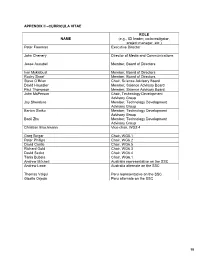
APPENDIX II –CURRICULA VITAE ROL E NAME (e.g., ICI leader, co-investigator, project manager, etc.) Peter Freeman Executive Director John Chenery Director of Media and Communications Jesse Ausubel Member, Board of Directors Ivar Myklebust Member, Board of Directors Rocky Skeef Member, Board of Directors Steve O’Brien Chair, Science Advisory Board David Haussler Member, Science Advisory Board Paul Thompson Member, Science Advisory Board John McPerson Chair, Technology Development Advisory Group Jay Shendure Member, Technology Development Advisory Group Barton Slatko Member, Technology Development Advisory Group Baoli Zhu Member, Technology Development Advisory Group Christian Brochmann Vice-chair, WG2.4 Greg Singer Chair, WG5.1 Peter Phillips Chair, WG6.2 David Castle Chair, WG6.5 Richard Gold Chair, WG6.3 David Secko Chair, WG6.4 Tania Bubela Chair, WG6.1 Andrew Mitchell Australia representative on the SSC Andrew Lowe Australia alternate on the SSC Thomas Valqui Peru representative on the SSC Gisella Orjeda Peru alternate on the SSC 98 PETER FREEMAN BA, PHD, FIBD 120 Stuart Street, Guelph, Ontario, CANADA N1E 4S8 Phone (W): +1 519 824 4120 Cell: +1 519 731 2163 Email: pfreeman@ibol.org PROFILE Experienced science-based (PhD qualified) executive director, with a track record of successfully co- ordinating large multi-institutional research projects, networks and consortia in genomics, proteomics, stem cell research and population health. Strong financial management, strategic planning and project management skills gained in R&D and operations roles in the international malting and brewing industry Superior mentoring, facilitating, technical writing and editing skills used to develop successful interdisciplinary funding proposals. Fully proficient in information /communication technologies and their use in knowledge translation and public outreach activities. -

Rhododendron Viscosum
Phenotypic and Genetic Variation for Rhizosphere Acidification, a Candidate Trait for pH Adaptability, in Deciduous Azalea (Rhododendron sect. Pentanthera) A THESIS SUBMITTED TO THE FACULTY OF UNIVERSITY OF MINNESOTA BY Alexander Q. Susko IN PARTIAL FULFILLMENT OF THE REQUIREMENTS FOR THE DEGREE OF MASTER OF SCIENCE Stan C. Hokanson, Co-advisor James M. Bradeen, Co-advisor July, 2016 © Alexander Q. Susko, 2016 i Acknowledgements I am very thankful for the support and advice of my full committee (Stan Hokanson, Jim Bradeen, and Tim Rinehart) throughout this project. The laboratory of Tim Rinehart at the USDA-ARS in Poplarville, MS was essential to the SSR genotyping and next- generation sequencing presented in this thesis. Credit is due to Jennifer Carroll for her work and guidance in helping me with the genotyping portion of my research. The Minnesota Landscape Arboretum and Horticultural Research Center has been home to much of this research, and I thank Steven McNamara and Tacy Sickeler for maintaining plants and rooted cuttings in the greenhouse. I also thank Elsa Eshenaur and Mitchal Peterson for their assistance with tissue culture, as well as Sydney Schiffner for her work in phenotyping the cultivated and wild deciduous azalea germplasm for rhizosphere acidification, growth rates, and leaf color. This work was supported in part through research grants from the American Rhododendron Society and the Azalea Society of America. Permission to collect wild germplasm used in this research was made possible by collection permits issued from National Forest Service offices in the Ouachita, Angelina, Kisatchie, DeSoto, Apalachicola, and Ocala National Forests. ii Dedication I dedicate this research to readers who have traveled to the ends of the world, physically or mentally, to better understand their passions. -
Research Outputs Publications
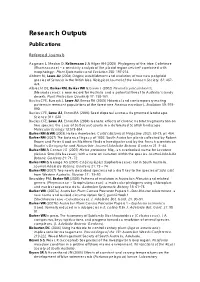
Research Outputs Publications Refereed Journals Aagesen L, Medan D, Kellermann J & Hilger HH (2005) Phylogeny of the tribe Colletieae (Rhamnaceae) – a sensitivity analysis of the plastid region trnL-trnF combined with morphology. Plant Systematics and Evolution 250: 197-214. Abbott RJ, Lowe AJ (2004) Origins, establishment and evolution of two new polyploid species of Senecio in the British Isles. Biological Journal of the Linnean Society. 82: 467- 474. Albrecht DE, Barker RM, Barker WR & Gavin J (2002) Neurada procumbens L. (Neuradaceae): a new record for Australia and a potential threat to Australia’s sandy deserts. Plant Protection Quarterly 17: 158-161. Bacles CFE, Burczyk J, Lowe AJ, Ennos RA (2005) Historical and contemporary mating patterns in remnant populations of the forest tree Fraxinus excelsior L. Evolution 59: 979- 990. Bacles CFE, Lowe AJ, Ennos RA (2006) Seed dispersal across a fragmented landscape. Science 311: 628. Bacles CFE, Lowe AJ, Ennos RA (2004) Genetic effects of chronic habitat fragmentation on tree species: the case of Sorbus aucuparia in a deforested Scottish landscape. Molecular Ecology 13:573-584. Barker RM & WR (2003) Hakea rhombales. Curtis’s Botanical Magazine 20(2): 69-73, pl. 464. Barker RM (2007) The botanical legacy of 1802. South Australian plants collected by Robert Brown and Peter Good on Matthew Flinders Investigator and by the French scientists on Baudin’s Geographe and Naturaliste. Journal Adelaide Botanic Gardens 21: 5- 44. Barker RM & Conran JG (2007) Malva preissiana Miq., an overlooked name for Lavatera plebeia Sims (Malvaceae), with a note on variation within the species. Journal Adelaide Botanic Gardens 21: 71- 72. -

Further Lectotypifications and Nomenclatural Notes on Rhamnaceae from Northern Australia Jürgen Kellermanna,B
Swainsona 35: 1–9 (2021) © 2021 Board of the Botanic Gardens & State Herbarium (Adelaide, South Australia) Further lectotypifications and nomenclatural notes on Rhamnaceae from northern Australia Jürgen Kellermanna,b a State Herbarium of South Australia, Botanic Gardens and State Herbarium, Hackney Road, Adelaide, South Australia 5000 Email: juergen.kellermann@sa.gov.au b The University of Adelaide, School of Biological Sciences, Adelaide, South Australia 5005 Abstract: The nomenclature and typification of seven species names of Rhamnaceae is discussed and lectotypes are chosen for Rhamnus napalensis (Wall.) M.A.Lawson, Schistocarpaea johnsonii F.Muell. and Ventilago pubiflora C.T.White, and the synonym Rhamnus javanica Miq. The lectotype of Colubrina asiatica (L.) Brongn. is corrected. A table is presented of the publication details for types and lectotypes of all taxa of Australian Rhamnaceae, excluding the tribe Pomaderreae, and the status of the genus Dallachya F.Muell. is discussed. The following species are illustrated: Rhamnella vitiensis (Benth.) A.C.Sm. and Rhamnus napalensis, Sageretia hamosa (Wall.) Brongn., Schistocarpaea johnsonii, Ventilago ecorollata F.Muell. and V. pubiflora. Keywords: Nomenclature, typification, Rhamnaceae, Rhamneae, Ventilagineae, northern Australia Introduction Nomenclature With over 250 species, Australia is home to about one Rhamnaceae trib. Rhamneae Horan. quarter of the world’s species of Rhamnaceae. Most of Char. Ess. Fam. 138 (1847). Hook.f. in Benth. & these belong to one tribe, Pomaderreae Reissek ex Endl. Hook.f., Gen. Pl. 1: 373 (1862), emend. J.E.Richard- (Kellermann et al. 2005; Kellermann 2007), but 14 son, Kew Bull. 55: 333 (2000). — Type: Rhamnus L. genera with 28 species are from a variety of other tribes or are currently incertae sedis, according to the most The tribe Rhamneae is distributed throughout most recent family classification (Richardson et al. -
Triumfetta Acahuizotlanensis (Malvaceae), a New Tree Species Endemic of Guerrero, Mexico
Phytotaxa 265 (3): 273–278 ISSN 1179-3155 (print edition) http://www.mapress.com/j/pt/ PHYTOTAXA Copyright © 2016 Magnolia Press Article ISSN 1179-3163 (online edition) http://dx.doi.org/10.11646/phytotaxa.265.3.8 Triumfetta acahuizotlanensis (Malvaceae), a new tree species endemic of Guerrero, Mexico JAIME JIMÉNEZ-RAMÍREZ1, CÉSAR ADRIÁN GONZÁLEZ-MARTÍNEZ1,2 & SANDRA RIOS-CARRASCO3 1Universidad Nacional Autónoma de México, Facultad de Ciencias, Departamento de Biología Comparada, Herbario (FCME), México, Ciudad de México, 04510, México; 2e-mail: cagonzalez_m@hotmail.com 3Universidad Nacional Autónoma de México, Facultad de Ciencias, Departamento de Biología Comparada, Laboratorio de Desarrollo en Plantas, México, D. F. 04510, México. Abstract Triumfetta acahuizotlanensis is herein described and illustrated as a new species from the state of Guerrero, Mexico. The new taxon can be identified by the presence of tetramerous flowers, four glands in the androgynophore and piriform fruit. Resumen Se describe e ilustra a Triumfetta acahuizotlanensis como una especie nueva del estado de Guerrero, México. El nuevo taxón se distingue de las especies conocidas del género por presentar flores tetrámeras, cuatro glándulas en el androginóforo y fruto piriforme. Introduction The genus Triumfetta L. (1753: 444) (Malvaceae: Tilioideae) (Bayer et al. 1999, APG III 2003) has a pantropical distribution with nearly 150 described species (Lay 1950, Meijer 2009). They occur in Mexico in limited areas and only some species extend up to the north of Central America, proposing the latter as a primary dispersal center (Lay 1950). The genus comprises 37 species in Mexico, 32 of wich are endemic, incluiding the ones of recent publication (Thomas & McVaugh 1978, Fryxell 1998, Fryxell & Guadarrama 2001, Gual-Díaz et al. -
Plant Species with Extremely Small Populations (PSESP) in China: a Seed and Spore Biology Perspective
Accepted Manuscript Plant species with extremely small populations (PSESP) in China: a seed and spore biology perspective Ellie Merrett Wade, Jayanthi Nadarajan, Xiangyun Yang, Daniel Ballesteros, Weibang Sun, Hugh W. Pritchard PII: S2468-2659(16)30078-6 DOI: 10.1016/j.pld.2016.09.002 Reference: PLD 30 To appear in: Plant Diversity Received Date: 6 August 2016 Revised Date: 6 September 2016 Accepted Date: 7 September 2016 Please cite this article as: Wade, E.M., Nadarajan, J., Yang, X., Ballesteros, D., Sun, W., Pritchard, H.W., Plant species with extremely small populations (PSESP) in China: a seed and spore biology perspective, Plant Diversity (2016), doi: 10.1016/j.pld.2016.09.002. This is a PDF file of an unedited manuscript that has been accepted for publication. As a service to our customers we are providing this early version of the manuscript. The manuscript will undergo copyediting, typesetting, and review of the resulting proof before it is published in its final form. Please note that during the production process errors may be discovered which could affect the content, and all legal disclaimers that apply to the journal pertain. ACCEPTED MANUSCRIPT Plant species with extremely small populations (PSESP) in China: a seed and spore biology perspective Ellie Merrett Wade 1, Jayanthi Nadarajan 1, Xiangyun Yang 2, Daniel Ballesteros 1, Weibang Sun 3 and Hugh W. Pritchard 1* 1Royal Botanic Gardens, Kew, Wellcome Trust Millennium Building, Wakehurst Place, Ardingly, West Sussex RH17 6TN, UK. 2 The Germplasm Bank of Wild Species, Kunming Institute of Botany, Chinese Academy of Sciences, Kunming 650201, Yunnan, P.R.