Supplementary Information
Total Page:16
File Type:pdf, Size:1020Kb
Load more
Recommended publications
-
Saltmarsh and Samphire
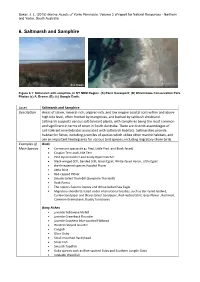
Baker, J. L. (2015) Marine Assets of Yorke Peninsula. Volume 2 of report for Natural Resources - Northern and Yorke, South Australia 6. Saltmarsh and Samphire © A. Brown Figure 6.1: Saltmarsh with samphire, in NY NRM Region. (A) Point Davenport; (B) Winninowie Conservation Park. Photos (c) A. Brown. (B): (c) Google Earth. Asset Saltmarsh and Samphire Description Areas of saline, mineral-rich, organic-rich, and low oxygen coastal soils within and above high tide level, often fronted by mangroves, and backed by saltbush shrubland. Saltmarsh supports various salt-tolerant plants, with samphires being the most common and significant in terms of cover in South Australia. There are distinct assemblages of salt-tolerant invertebrates associated with saltmarsh habitats. Saltmarshes provide habitat for fishes, including juveniles of species which utilise other marine habitats, and are an important feeding area for various bird species, including migratory shore birds. Examples of Birds Main Species Cormorant species (e.g.; Pied, Little Pied, and Black-faced) Caspian Tern and Little Tern Pied Oystercatcher and Sooty Oystercatcher Black-winged Stilt, Banded Stilt, Great Egret, White-faced Heron, Little Egret the threatened species Hooded Plover Little Stint Red-capped Plover Slender-billed Thornbill (Samphire Thornbill) Rock Parrot The raptors Eastern Osprey and White-bellied Sea Eagle Migratory shorebirds listed under international treaties, such as Bar-tailed Godwit, Curlew Sandpiper and Sharp-tailed Sandpiper, Red-necked Stint, Grey Plover , Red Knot, Common Greenshank, Ruddy Turnstones Bony Fishes juvenile Yelloweye Mullet juvenile Greenback Flounder juvenile Southern Blue-spotted Flathead Western Striped Grunter Congolli Glass Goby Small-mouthed Hardyhead Silver Fish Smooth Toadfish Goby species such as Blue-spotted Goby and Southern Longfin Goby Adelaide Weedfish Baker, J. -

Panpulmonata: Amphibolidae) in South-Eastern Australia
Biodiversity Data Journal 8: e54724 doi: 10.3897/BDJ.8.e54724 Research Article Genetic assessment of the variation and distribution of the species of Salinator (Panpulmonata: Amphibolidae) in south-eastern Australia Donald Colgan‡, Hugo Lumsdaine‡ ‡ The Australian Museum, Sydney, Australia Corresponding author: Donald Colgan (don.colgan@austmus.gov.au) Academic editor: Cristian Altaba Received: 26 May 2020 | Accepted: 16 Sep 2020 | Published: 29 Oct 2020 Citation: Colgan D, Lumsdaine H (2020) Genetic assessment of the variation and distribution of the species of Salinator (Panpulmonata: Amphibolidae) in south-eastern Australia. Biodiversity Data Journal 8: e54724. https://doi.org/10.3897/BDJ.8.e54724 Abstract Amphibolidae is one of the most abundant families of gastropods in estuarine environments of south-eastern Australia. However, the range limits of the species of Salinator, one of the family’s two genera in the region, remain unclear partly due to uncertainty of identifications based solely on shell morphology. Insufficient data have been collected to address questions regarding the genetic variability of any of the species of Salinator. Here, DNA sequences from a segment of the cytochrome c oxidase subunit I and 28S ribosomal RNA genes were collected to investigate the distribution and variation of the three Salinator species in the region, these being S. fragilis, S. rhamphidia and S. tecta. The results demonstrate a large range extension in S. rhamphidia and suggest that S. tecta may have limited distribution in Tasmania. In contrast to previously-studied estuarine Mollusca in the south-eastern coasts of the mainland and Tasmania, S. rhamphidia has regional differentiation. There is evidence of genetic disequilibrium within S. -
And Pseudonoba Columen (Melvill), (Gastropoda: Iravadiidae) from India
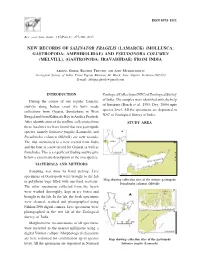
GHOSH et al. : New records of salinator fragilis (Lamarck)....from India 277 ISSN 0375-1511 Rec. zool. Surv. India : 115(Part-3) : 277-280, 2015 NEW RECORDS OF SALINATOR FRAGILIS (LAMARCK) (MOLLUSCA: GASTROPODA: AMPHIBOLIDAE) AND PSEUDONOBA COLUMEN (MELVILL), (GASTROPODA: IRAVADIIDAE) FROM INDIA ABHIJNA GHOSH, BASUDEV TRIPATHY AND AMIT MUKHOPADHYAY Zoological Survey of India, Prani Vigyan Bhawan, M- Block, New Alipore, Kolkata–700 053 E-mail: abhijna.ghosh@gmail.com INTRODUCTION Zoological Collections (NZC) of Zoological Survey During the course of our regular faunistic of India. The samples were identified with the help surveys along Indian coast we have made of literature (Bosch et al., 1995; Dey, 2006) upto collections from Gujarat, Sundarbans in West species level. All the specimens are deposited in Bengal and from Kakinada Bay in Andhra Pradesh. NZC of Zoological Survey of India. After identification of the mollusc collections from STUDY AREA these localities we have found that two gastropods species, namely Salinator fragilis (Lamarck), and Pseudonoba columen (Melvill) are new records. The first mentioned is a new record from India INDIA and the later is a new record for Gujarat as well as from India. This is a significant finding and we give MANDAVI BEACH GUJARAT below a systematic description of the two species. GULF OF KUTCH MATERIALS AND METHODS Sampling was done by hand picking. Live Legend specimens of Gastropods were brought to the lab in polythene bags filled with one-third seawater. Map showing collection sites of the minute gastropods Pseudonoba columen (Melvill) The other specimens collected from the beach were washed thoroughly, kept in ice boxes and SOUTH 24 PARGANAS brought to the lab. -

Jmmv19743506.Pdf
. https://doi.org/10.24199/j.mmv.1974.35.06 18 February 1974 DESCRIPTION OF RETUSA CHRYSOMA BURN SP. NOV. (OPISTHOBRANCHIA) AND ITS FOOD RESOURCES FROM CORNER INLET, VICTORIA By Robert Burn and K. N. Bell Honorary Associates, National Museum of Victoria, Melbourne Abstract Retusa chrysoma Burn sp. nov. is described from Corner Inlet, Victoria, and compared with other species reported from the Victorian coastline. Gizzard contents show selective food preferences for foraminifera and juveniles of the air breathing gastropod Salinator fragilis (Lamarck, 1822). Introduction rounded anteriorly, obliquely truncate pos- teriorly. Colour pale yellow, thin periostracum Little is known anatomically of the shell- golden yellow. Sculpture, faint growth lines at bearing opisthobranch molluscs of Victoria. anterior end develop into raised riblets on Similarly, little is known of their food resources posterior third, riblets passing obliquely over and selective preferences. Foraminifera are shoulder into vertex; encircled by fine, vari- believed to form wholly or part of the food of ably spaced, wavy lines, less noticeable pos- several species of retusid opisthobranchs teriorly where the riblets are strongest. Aper- (Bacescu and Caraion 1956, Marcus and ture anteriorly pyriform, medially narrow and Marcus 1969, Moore 1961, Morton 1958, slightly constricted, posteriorly rising above the Rudman 1971), but the overall part they play last whorl and inclined towards the axis. in the marine food-energy cycle is poorly Columella thickened, with a nearly vertical known (Lipps and Valentine 1970). plait rising at mid-length, with a broad reflex- In order to study Australian species/food ion behind the plait. Spire deeply sunk, resources, we have examined a new species of shoulder of the preceding whorl visible, sculp- Retusa collected by one of us (K.N.B.) at tured by oblique riblets descending to a large, Corner Inlet, Victoria. -

And Pseudonoba Columen (Melvill), (Gastropoda: Iravadiidae) from India
GHOSH et al. : New records of salinator fragilis (Lamarck)....from India 277 ISSN 0375-1511 Rec. zool. Surv. India : 115(Part-3) : 277-280, 2015 NEW RECORDS OF SALINATOR FRAGILIS (LAMARCK) (MOLLUSCA: GASTROPODA: AMPHIBOLIDAE) AND PSEUDONOBA COLUMEN (MELVILL), (GASTROPODA: IRAVADIIDAE) FROM INDIA ABHIJNA GHOSH, BASUDEV TRIPATHY AND AMIT MUKHOPADHYAY Zoological Survey of India, Prani Vigyan Bhawan, M- Block, New Alipore, Kolkata–700 053 E-mail: abhijna.ghosh@gmail.com INTRODUCTION Zoological Collections (NZC) of Zoological Survey During the course of our regular faunistic of India. The samples were identified with the help surveys along Indian coast we have made of literature (Bosch et al., 1995; Dey, 2006) upto collections from Gujarat, Sundarbans in West species level. All the specimens are deposited in Bengal and from Kakinada Bay in Andhra Pradesh. NZC of Zoological Survey of India. After identification of the mollusc collections from STUDY AREA these localities we have found that two gastropods species, namely Salinator fragilis (Lamarck), and Pseudonoba columen (Melvill) are new records. The first mentioned is a new record from India INDIA and the later is a new record for Gujarat as well as from India. This is a significant finding and we give MANDAVI BEACH GUJARAT below a systematic description of the two species. GULF OF KUTCH MATERIALS AND METHODS Sampling was done by hand picking. Live Legend specimens of Gastropods were brought to the lab in polythene bags filled with one-third seawater. Map showing collection sites of the minute gastropods Pseudonoba columen (Melvill) The other specimens collected from the beach were washed thoroughly, kept in ice boxes and SOUTH 24 PARGANAS brought to the lab. -

First Molecular Examination of Vietnamese Mudflat Snails
www.nature.com/scientificreports OPEN First molecular examination of Vietnamese mudfat snails in the genus Naranjia Golding, Ponder & Byrne, 2007 (Gastropoda: Amphibolidae) Takumi Saito 1,2*, Larisa Prozorova3, Ngo Xuan Quang4,5 & Satoshi Chiba6 Maritime ecosystems in Vietnam such as mangroves and mud fats are characterized by high biodiversity. However, elements of its biodiversity remain unclear and highly threatened. In this context, the assessment of rare species is a starting point to develop efective strategies for the conservation of entire ecosystems. In this paper, we report upon cryptic amphibolid gastropods in Vietnamese mangrove forests from the Mekong Delta. The snail fauna in the mangrove forests was previously known from published literature and three museum specimens as three amphibolid species, ‘Amphibola’ burmana, A. quadrasi, Salinator fragilis and ‘S.’ quadrasi. We investigated the identities of such snails using molecular and morphological methods. The amphibolids found in this survey were identifed to belong to the genus Naranjia, new for Vietnam fauna. In addition, our phylogenetic analyses suggested that the Vietnamese amphibolids were the same species as Naranjia sp. reported from Thailand, and the amphibolids have both genetic and morphological polymorphisms within the population. These fndings add to the great biodiversity of Vietnamese mangrove forests and mudfats. Te country of Vietnam straddles some 13 degrees of latitude with a corresponding long coastline with biodiver- sity hotspot which are highly threatened1–6. In particular, mangrove forests which mainly occur in the Mekong Delta along the southern coastline, and also around the Red River Delta in the north, are being destroyed rapidly in spite of their importance to economics, coastal stability, and habitat for organisms 7–9. -

Zootaxa 1476: 1–50 (2007) ISSN 1175-5326 (Print Edition) ZOOTAXA Copyright © 2007 · Magnolia Press ISSN 1175-5334 (Online Edition)
Zootaxa 1476: 1–50 (2007) ISSN 1175-5326 (print edition) www.mapress.com/zootaxa/ ZOOTAXA Copyright © 2007 · Magnolia Press ISSN 1175-5334 (online edition) Taxonomy and anatomy of Amphiboloidea (Gastropoda: Heterobranchia: Archaeopulmonata) ROSEMARY E. GOLDING1, 2, WINSTON F. PONDER2 & MARIA BYRNE1 1Anatomy and Histology, University of Sydney, Sydney, NSW 2006, Australia; rgol8300@anatomy.usyd.edu.au 2Australian Museum, 6 College Street, Sydney, NSW 2010, Australia TABLE OF CONTENTS ABSTRACT . 2 INTRODUCTION . 2 MATERIALS AND METHODS. 3 Morphological examination. 3 Terminology. 4 RESULTS . 5 Systematic descriptions . 5 Amphiboloidea . 5 Family Amphibolidae . 6 Genus Amphibola Schumacher, 1817. 6 Amphibola crenata (Martyn, 1786) . 7 Genus Salinator Hedley, 1900 . 9 Salinator fragilis (Lamarck, 1822) . 10 Salinator tecta sp. nov. 11 Salinator rhamphidia sp. nov. 13 Salinator rosacea sp. nov. 14 Genus Lactiforis gen. nov. 14 Lactiforis tropicalis sp. nov. .15 Lactiforis takii (Kuroda, 1928) . 16 Genus Naranjia gen. nov.. 17 Naranjia cf. swatowensis (Yen, 1939). 17 Family Phallomedusidae fam. nov.. 19 Genus Phallomedusa gen. nov.. 19 Phallomedusa solida (Martens, 1878). 19 Phallomedusa austrina sp. nov.. .21 Family Maningrididae fam. nov.. 22 Genus Maningrida gen. nov. 22 Maningrida arnhemensis sp. nov. 22 Incertae sedis . 24 Amphibola quadrasi Möllendorf, 1894 . 24 Salinator burmana (Blanford, 1867) . 24 Salinator sanchezi (Qadras & Möllendorf, 1894) . .24 Salinator quoyana (Potiez & Michaud, 1838) . 25 Discriminant analysis of shell measurements . 25 Key to species . 25 DISCUSSION . 26 ACKNOWLEDGEMENTS. 28 REFERENCES . 28 PLATES . 31 TABLES . 48 Accepted by B.Ruthensteiner: 20 Mar. 2001; published: 17 May 2007 1 ABSTRACT The taxonomy of the pulmonate superfamily Amphiboloidea is investigated with particular reference to Australasian taxa. -

Studies on the Vertical Distribution Pattern in Mangrove Associated Molluscs Along the Karachi Coast, Pakistan
Indian Journal of Geo Marine Sciences Vol. 47 (01), January 2018, pp. 127-134 Studies on the vertical distribution pattern in mangrove associated molluscs along the Karachi coast, Pakistan Ziaullah1, Itrat Zehra2 & Muhammad Asif Gondal*3 1Department of Tourism and Hospitality, Abdul Wali Khan University, Mardan, Pakistan. 2Centre of Excellence in Marine Biology, University of Karachi, Karachi, Pakistan 3*Department of Biosciences, COMSATS Institute of Information Technology, Park Road, Islamabad, Pakistan [Email: gondalmasif@gmail.com ; zia_swat@yahoo.com] Received 13 October 2015 ; revised 17 November 2016 Present study consists the vertical distribution pattern in mangrove associated molluscs (gastropods and bivalves) in two mangal areas: Sandspit and Korangi along the Karachi coast, Pakistan. The vertical distribution pattern delineated that the number of species decreased from high to low tide zone at two sites, however, marked differences were encountered with reference to the density distribution. At Sandspit, highest annual mean density was observed in the high tide zone followed by low and mid tide zones respectively, while, at Korangi the highest annual mean density was observed in the mid tide zone followed by high and low tide zones respectively. An important correlation was observed between the vertical distribution pattern of species and the sediments. [Key Words: mangroves, molluscs, distribution, Karachi, Pakistan] Introduction tolerance and desiccation rate are the primary Mangrove or Mangal forests cover about factors which limits the upper extent of zonation 617, 470 hectare in the Indus delta1. These of intertidal species within the supralittoral zone, wetlands provide both hatching as well as while the behavioral adoptions like restrictions nursery grounds for large number of to specific food resources or lack of upper shore commercially important fish and shell fish migratory behavior limited the distribution of species. -
A Preliminary Checklist of the Molluscs of Singapore
A PRELIMINARY CHECKLIST OF THE MOLLUSCS OF SINGAPORE Siong Kiat Tan and Henrietta P. M. Woo Raffles Museum of Biodiversity Research National University of Singapore Singapore 2010 A PRELIMINARY CHECKLIST OF THE MOLLUSCS OF SINGAPORE Siong Kiat Tan Henrietta P. M. Woo Raffles Museum of Biodiversity Research, Department of Biological Sciences, National University of Singapore, Block S6, Science Drive 2, #03-01, Singapore 117546, Email: dbstsk@nus.edu.sg (SKT) Raffles Museum of Biodiversity Research National University of Singapore Singapore 2010 A Preliminary Checklist of the Molluscs of Singapore by Siong Kiat Tan and Henrietta P. M. Woo is published by the: Raffles Museum of Biodiversity Research and Department of Biological Sciences Faculty of Science National University of Singapore Blk S6, #03-01, Science Drive 2 Singapore 117546 Republic Of Singapore Website: http://rmbr.nus.edu.sg/ Email: ask.rmbr@gmail.com Editor: Hugh T. W. Tan Typesetter: Chua Keng Soon Cover photograph: A subadult Cyclophorus perdix aquila (Sowerby, 1843) in Fern Valley, Bukit Timah Nature Reserve. (Photograph by: Kelvin Lim). ISBN 978-981-08-5834-6 (online) © 2010 Raffles Museum of Biodiversity Research All rights reserved. No part of this publication may be reproduced, stored in a retrieval system, or transmitted, in any form, or by any means, electronic, mechanical, photocopying, recording or otherwise, without the prior permission of the copyright holder. For information regarding permission(s) please write to: ask.rmbr@gmail.com CONTENTS Introduction ....................................................................................................................................................................... -

Biodiversity Summary: Kangaroo Island, South Australia
Biodiversity Summary for NRM Regions Species List What is the summary for and where does it come from? This list has been produced by the Department of Sustainability, Environment, Water, Population and Communities (SEWPC) for the Natural Resource Management Spatial Information System. The list was produced using the AustralianAustralian Natural Natural Heritage Heritage Assessment Assessment Tool Tool (ANHAT), which analyses data from a range of plant and animal surveys and collections from across Australia to automatically generate a report for each NRM region. Data sources (Appendix 2) include national and state herbaria, museums, state governments, CSIRO, Birds Australia and a range of surveys conducted by or for DEWHA. For each family of plant and animal covered by ANHAT (Appendix 1), this document gives the number of species in the country and how many of them are found in the region. It also identifies species listed as Vulnerable, Critically Endangered, Endangered or Conservation Dependent under the EPBC Act. A biodiversity summary for this region is also available. For more information please see: www.environment.gov.au/heritage/anhat/index.html Limitations • ANHAT currently contains information on the distribution of over 30,000 Australian taxa. This includes all mammals, birds, reptiles, frogs and fish, 137 families of vascular plants (over 15,000 species) and a range of invertebrate groups. Groups notnot yet yet covered covered in inANHAT ANHAT are notnot included included in in the the list. list. • The data used come from authoritative sources, but they are not perfect. All species names have been confirmed as valid species names, but it is not possible to confirm all species locations. -

Ampullariidae
WMSDB - Worldwide Mollusc Species Data Base Family: AMPULLARIIDAE Author: Claudio Galli - claudio@bagniliggia.it (updated 07/set/2015) Class: GASTROPODA --- Clade: CAENOGASTROPODA-ARCHITAENIOGLOSSA-AMPULLARIOIDEA ------ Family: AMPULLARIIDAE Gray, 1824 (Freshwater) - Alphabetic order - when first name is in bold the species has images Taxa=480, Genus=10, Subgenus=7, Species=183, Subspecies=32, Synonyms=247, Images=104 adamsoni , Lanistes varicus adamsoni (W. Kobelt, 1911) adansoni , Lanistes adansoni W. Kobelt, 1911 - syn of: Lanistes varicus O.F. Müller, 1774 adusta, Pila adusta (L.A. Reeve, 1856) affinis , Lanistes affinis E.A. Smith, 1878 - syn of: Lanistes ellipticus E.C. Von Martens, 1866 affinis manyarana , Lanistes affinis manyarana R. Sturany, 1894 - syn of: Lanistes ovum F.H. Troschel, 1845 africana , Pila africana E.C. Von Martens, 1886 aldersoni , Pomacea aldersoni (T. Pain, 1946) alexandri, Lanistes alexandri J.R. Bourguignat, 1889 amazonica , Pomacea amazonica L.A. Reeve, 1856 - syn of: Pomacea maculata haustrum (L.A. Reeve, 1857) ambiguus, Lanistes ambiguus (E.C. Von Martens, 1866) americana, Pomacea americana (H.F.A. von Ihering, 1919) americanista, Asolene americanista H.F.A. von Ihering, 1919 - syn of: Pomacea americana (H.F.A. von Ihering, 1919) ampullacea , Pila ampullacea C. Linnaeus, 1758 angelica , Pila angelica T.N. Annandale, 1920 angulata , Ampullaria angulata G.P. Deshayes, 1850 - syn of: Pomacea scalaris (D'Orbigny, 1835) angulata , Ampullaria angulata J.C. Jay, 1836 - syn of: Pomacea scalaris (D'Orbigny, 1835) aperta, Turbincola aperta (B. Prashad, 1925) archimedes, Pomacea zonata archimedes (J.B. von Spix, 1827) archimedis , Pomacea archimedis J.B. von Spix, 1827 armeniaca, Pomacea armeniaca (L.H. Hupé, 1857) atalanta, Forbesopomus atalanta J.C. -

The Recent Apple Snails of Africa and Asia (Mollusca: Gastropoda: Ampullariidae: Afropomus, Forbesopomus, Lanistes, Pila, Saulea): a Nomenclatural and Type Catalogue
Zootaxa 3940 (1): 001–092 ISSN 1175-5326 (print edition) www.mapress.com/zootaxa/ Monograph ZOOTAXA Copyright © 2015 Magnolia Press ISSN 1175-5334 (online edition) http://dx.doi.org/10.11646/zootaxa.3940.1.1 http://zoobank.org/urn:lsid:zoobank.org:pub:B5D45D1B-4B52-4F0B-8AF6-B587F8857475 ZOOTAXA 3940 The recent apple snails of Africa and Asia (Mollusca: Gastropoda: Ampullariidae: Afropomus, Forbesopomus, Lanistes, Pila, Saulea): a nomenclatural and type catalogue. The apple snails of the Americas: addenda and corrigenda ROBERT H. COWIE Pacific Biosciences Research Center, University of Hawaii, 3050 Maile Way, Gilmore 408, Honolulu, Hawaii 96822, USA. E-mail: cowie@hawaii.edu Magnolia Press Auckland, New Zealand Accepted by M. deMaintenon: 9 Feb. 2015; published: 27 Mar. 2015 ROBERT H. COWIE The Recent apple snails of Africa and Asia (Mollusca: Gastropoda: Ampullariidae: Afropomus, Forbesopo- mus, Lanistes, Pila, Saulea): a nomenclatural and type catalogue. The apple snails of the Americas: addenda and corrigenda (Zootaxa 3940) 92 pp.; 30 cm. 27 Mar. 2015 ISBN 978-1-77557-671-6 (paperback) ISBN 978-1-77557-672-3 (Online edition) FIRST PUBLISHED IN 2015 BY Magnolia Press P.O. Box 41-383 Auckland 1346 New Zealand e-mail: zootaxa@mapress.com http://www.mapress.com/zootaxa/ © 2015 Magnolia Press All rights reserved. No part of this publication may be reproduced, stored, transmitted or disseminated, in any form, or by any means, without prior written permission from the publisher, to whom all requests to reproduce copyright material should be directed in writing. This authorization does not extend to any other kind of copying, by any means, in any form, and for any purpose other than private research use.