Landmarks Preservation Commission June 25, 2013, Designation List 465 LP-2530
Total Page:16
File Type:pdf, Size:1020Kb
Load more
Recommended publications
-
Bits & Pieces of the Big Apple
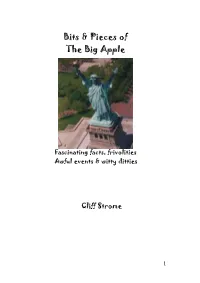
Bits & Pieces of The Big Apple Fascinating facts, frivolities Awful events & witty ditties Cliff Strome 1 Cover Photo The Statue of Liberty’s arms were raised and the tablet was put under lock and key during the soaring rate of crime from the 1970’s through the ‘90’s. It served as a warning that the city should take the crime surge seriously. The tablet is embossed: July IV MDCCLXXVI (July 4th 1776) the date of the signing of The Declaration of Independence. She is the enduring symbol our nation. “Life, liberty and the pursuit of happiness.” Photo by Cliff Strome Photoshop by Evan Kimia Custom & Private New York Tours, Inc. www.customandprivate.com cliff@stomandprivate.com 212-222-1441 “Providing fun, memorable and informative New York City experiences, targeting your interests, preferences and whims!” That’s my mission. 2 Welcome to Bits & Pieces of The Big Apple Bits & Pieces is an assortment of humorous snippets, amusing info, offbeat tales, tragedies, folklore, obscure historic facts and hilarities happenings in New York. Bits and Pieces This tour through “the city” will entertain, educate and amuse you. A table of contents is not provided to encourage you to read every Bit and Piece. What’s the difference between a bit and apiece? I don’t have a clue I just like the name! I’m not a writer however I like to tell stories. Throughout the book I provide my opinions and others may include my participation. Please don’t take everything too seriously, it’s intended to amuse, entertain and in form. -

A Self Guided Tour
Things to See in Midtown Manhattan | A Self Guided Tour Midtown Manhattan Self-Guided Tour Empire State Building Herald Square Macy's Flagship Store New York Times Times Square Bank of America Tower Bryant Park former American Radiator building New York Public Library Grand Central Terminal Chanin Building Chrysler Building United Nations Headquarters MetLife Building Helmsley Building Waldorf Astoria New York Saks Fifth Avenue St. Patrick's Cathedral Rockefeller Center The Museum of Modern Art Carnegie Hall Trump Tower Tiffany & Co. Bloomingdale's Serendipity 3 Roosevelt Island Tram Self-guided Tour of Midtown Manhattan by Free Tours By Foot Free Tours by Foot's Midtown Manhattan Self-Guided Tour If you would like a guided experience, we offer several walking tours of Midtown Manhattan. Our tours have no cost to book and have a pay-what-you-like policy. This tour is also available in an anytime, GPS-enabled audio tour . Starting Point: The tour starts at the Empire State Building l ocated at 5th Avenue between 33rd and 34th Streets. For exact directions from your starting point use this helpful G oogle directions tool . By subway: 34th Street-Herald Square (Subway lines B, D, F, N, Q, R, V, W) or 33rd Street Station by 6 train. By ferry: You can now take a ferry to 34th Street and walk or take the M34 bus to 5th Avenue. Read our post on the East River Ferry If you are taking one of the many hop-on, hop-off bus tours such as Big Bus Tours or Grayline , all have stops at the Empire State Building. -

140 BROADWAY, Originally the Marine Midland Bank Building (Aka 71-89 Cedar Street, 54- 74 Liberty Street, 27-39 Nassau Street), Manhattan
Landmarks Preservation Commission June 25, 2013, Designation List 465 LP-2530 140 BROADWAY, originally the Marine Midland Bank Building (aka 71-89 Cedar Street, 54- 74 Liberty Street, 27-39 Nassau Street), Manhattan. Built 1964-68; Skidmore, Owings & Merrill, architect; Gordon Bunshaft, partner in charge of design; Roger N. Radford, lead designer Landmark Site: Borough of Manhattan Tax Map Block 48, Lot 1 On April 2, 2013, the Landmarks Preservation Commission held a hearing on the proposed designation as a Landmark of 140 Broadway and the proposed designation of the Landmark site (Item No. 1). The hearing was duly advertised according to law. Four people spoke in favor of designation, including representatives of Docomomo US/New York Tri-State, the Historic Districts Council, and the New York Landmarks Conservancy. A second hearing was held on May 13, 2013 (Item No. 1) in which three representatives of the owner spoke in support of designation. Summary A critically-acclaimed example of mid- 20thcentury modernism, the former Marine Midland Bank Building at 140 Broadway was completed in early 1968. Architect Gordon Bunshaft, of Skidmore, Owings & Merrill, was the partner in charge of the minimalist design – a matte black aluminum and bronze-tinted glass skyscraper that The New York Times architecture critic Ada Louise Huxtable later described as “not only one of [the] buildings I admire most in New York, but that I admire most anywhere.” Erwin S. Wolfson assembled the trapezoidal site by 1961, covering an entire block between Nassau Street and Broadway, and following his death, a revised 51-story scheme was commissioned by developers Harry Helmsley and Lawrence A. -

Goldman Sacked by Fraud Allegations
20100419-NEWS--0001-NAT-CCI-CN_-- 4/16/2010 7:39 PM Page 1 INSIDE OPINION TOP STORIES Greg David on Wall St. Crowd-pleasing and NYC musicals make economy Broadway sing ® PAGE 2 PAGE 11 VOL. XXVI, NO. 16 WWW.CRAINSNEWYORK.COM APRIL 19-25, 2010 PRICE: $3.00 Once dust clears, Goldman airlines preparing for merger liftoff sacked PAGE 2 by fraud Prophet of doom seeks his own allegations profit and boom PAGE 3 Charges hit shares, Governors Island: weaken effort to fend What’ll Bloomberg off financial reform do with new jewel? BY AARON ELSTEIN PAGE 3 last week’s move by the Securities and Exchange Commission to charge mighty Goldman Sachs with fraud did more than gut-punch the investment bank’s shares and dent its 24-carat im- age.In the longer term,the lawsuit could have a profound impact on the future shape of the American financial system, coming when the Obama administra- STOCKING UP: tion is struggling to win support for Joe Holtz fills sweeping financial reform legislation. produce bins at Goldman, with its powerful Wash- the Park Slope ington connections and reputation for Food Coop. uncompromising excellence, had been leading the charge to water down some of those reforms. Now it has a battle to fight much closer to home. BUSINESS LIVES Prominently displayed on Goldman Sachs’ Web site are the firm’s 14 guid- GOTHAM GIGS See GOLDMAN on Page 23 Getting down to Earth Day, planting trees P. 25 G ANNE FISHER on trusting employees to larry ford Startlingly create loyal clients P. -

Value Retail’S Downfall? Heknew Downfall? Retail’S Bevalue to Going Italy Or to Company Tohis Weretherelimits His Guest
9-803-008 REV: JULY 7, 2008 ARTHUR I SEGEL Value Retail In March 2002, Scott Malkin, the Chairman and Chief Executive of Value Retail, a developer and operator of European outlet villages serving luxury brands, hosted a dinner during Milan’s Fashion Week with some of his most important existing and potential clients in Italy including Prada, Gucci, Tod’s, Zegna, Versace and Ferragamo. Before dessert, Scott proposed a toast to working together on his company’s new 18,503 m2 open air outlet village to be built 98 kilometers south of Milan on land he was about to acquire for €7.26 million.1 Although the dinner sparkled with a convivial atmosphere, there was a tension in the room. What he was proposing was new and possibly a real threat to the brands represented that evening, in a location close to their home. Scott smiled and put down his champagne glass. Someone shouted out “Buona Fortuna” or “Good Luck” while another shouted out “Bocca Lupo.” Scott bent over to ask his friend joining him that evening, Dario Cecchini, the famed cook and “mad butcher” of Florence, what “Boca Lupo” meant. Dario responded, “Well, the literal translation is ‘in the mouth of the wolf.’ In Lombardy, it also means ‘Good Luck,’ but in Tuscany, it means ‘Go to Hell.’” As with everything else he had seen in Italy, Scott was left perplexed as to what was intended by his guest. Were there limits to his company or to any real estate company going transnational? Was Italy going to be Value Retail’s downfall? He knew he was introducing a real estate product almost entirely new to the market. -

Reprinted from the Spring 2017 Issue of Philanthropy Magazine (Philmag.Org) Istockphoto.Com / OSTILL Istockphoto.Com
Reprinted from the Spring 2017 issue of Philanthropy magazine (PhilMag.org) istockphoto.com / OSTILL istockphoto.com 40 PHILANTHROPY Human kindness and charitable success aren’t necessarily linked. That’s one of the paradoxes of philanthropy. By Grant Smith Kindly donors with sterling characters and good intentions don’t always yield good charitable results. That’s one of the fundamental realities of philanthropy. quality can make our society better, as the following What’s rarely pointed out is the reverse. eight examples show. Uninspiring—even deeply unlikeable—donors sometimes produce amazingly powerful results. Charles Yerkes Some of our country’s most consequential giving A business prodigy who opened his own brokerage was advanced by an all-star assortment of human firm at age 22, Charles Yerkes made his first fortune train wrecks. trading public bonds. At the end of the Civil War The introduction to The Almanac of American he became a financial agent to Philadelphia’s City Philanthropy cites J. Paul Getty, Russell Sage, and Treasurer, speculating with public monies in the Leland Stanford as examples of givers who pulled dizzying post-war markets. As was the custom of the off huge good works for not-so-good reasons, time, a considerable portion of the massive returns and notes that part of the magic of the American he racked up with taxpayer money went straight into charitable mechanism is that you don’t need to be the pockets of local political leaders—and Yerkes’s an angel to succeed. The genius of our philanthropic too. But the Great Chicago Fire caused a financial tradition is that it takes people just as we are—kind panic and wiped him out. -

New York City Landmarks Preservation Commission (1962-1999): Paradigm for Changing Attitudes Towards Historic Preservation
New York City Landmarks Preservation Commission (1962-1999): Paradigm for Changing Attitudes Towards Historic Preservation By Marjorie Pearson, Ph.D. Samuel H. K ress Mid-Career G rant Study Funded by The James Marston Fitch Charitable Foundation 2010 Contents Introduction 1 Chapter 1 Landmark Beginnings: The Advisory Commission (1962-1965) 5 Chapter 2 The Commission Established (1965-1973) 28 Chapter 3 Expanding a Mission and a Mandate (1974-1983) 55 Chapter 4 The Commission Under Siege (1983-1990) 91 Chapter 5 The Commission Comes of Age: Growth and Maturity (1990-1990) 110 Epilogue 129 Acknowledgments 135 IN T R O DU C T I O N Historic preservation as an officially mandated government program has been existence for almost fifty years in New York City, but the history of the movement, both before and after the ratification and implementation of the Landmarks law, has been largely undocumented until relatively recently. Giving Preservation a History: Histories of Historic Preservation in the United States and Preserving New York: Winning the Right to Protect a City’s Landmarks are part of an effort to rectify that situation.1 This work, told partly from my personal perspective, covers part of the story told by Anthony C. Wood and carries it forward to the end of the twentieth century. It describes and analyzes the history of the New York City Landmarks Preservation Commission while setting it within a larger national context. New York had been preceded by several other American cities, including Charleston, South Carolina, New Orleans, and Boston, in the establishment of a local preservation law and an accompanying oversight body, but still it had few models to emulate. -
Precision in Statutory Drafting: the Qualitech Quagmire and the Sad History of § 365(H) of the Bankruptcy Code, 38 J
UIC Law Review Volume 38 Issue 1 Article 8 Fall 2004 Precision in Statutory Drafting: The Qualitech Quagmire and the Sad History of § 365(h) of the Bankruptcy Code, 38 J. Marshall L. Rev. 97 (2004) Robert M. Zinman Follow this and additional works at: https://repository.law.uic.edu/lawreview Part of the Banking and Finance Law Commons, Bankruptcy Law Commons, Consumer Protection Law Commons, Housing Law Commons, Legal History Commons, Legislation Commons, Litigation Commons, and the Property Law and Real Estate Commons Recommended Citation Robert M. Zinman, Precision in Statutory Drafting: The Qualitech Quagmire and the Sad History of § 365(h) of the Bankruptcy Code, 38 J. Marshall L. Rev. 97 (2004) https://repository.law.uic.edu/lawreview/vol38/iss1/8 This Symposium is brought to you for free and open access by UIC Law Open Access Repository. It has been accepted for inclusion in UIC Law Review by an authorized administrator of UIC Law Open Access Repository. For more information, please contact repository@jmls.edu. PRECISIONIN STATUTORY DRAFTING: THE QUALITECH QUAGMIRE AND THE SAD HISTORY OF § 365(h) OF THE BANKRUPTCY CODE ROBERT M. ZINMAN* TABLE OF CONTENTS Introduction I. Section 365 of the Bankruptcy Code and the Landlord's Bankruptcy A. The Road to § 365(h) B. The 1984 Amendments C. The 1994 Amendments D. What the Foregoing Legislative History Tells Us II. Qualitech and Sales Free and Clear of Leases in the Landlord's Bankruptcy A. Peculiar Facts and Circumstances of the Case B. Looking Through the Facts to the Issue C. Was Qualitech Correct? D. -
A Successful Experiment in Living the Evolution of Parkchester by Elizabeth Lent
A Successful Experiment in Living The Evolution of Parkchester By Elizabeth Lent Nearly 150 years ago, the grounds of Parkchester in the Bronx served as a shelter for New York City’s homeless children. It was a place where kids could learn a trade and get a second chance. Today, Parkchester is enjoying its own second chance, a revitalization befitting of a place that once served as a model of planned community living. Comprised of 112 residential buildings spread out over 129 acres, Parkchester today is home to more than 40,000 residents occupying some 8,000 condo and rental units. The community is also home to dozens of retail shops, restaurants and even a multiplex movie theatre. The Early Days In the early years of the 20th century, the tract of land bordered by East Tremont Avenue to the north, McGraw Avenue to the south, White Plains Road to the West and Purdy Street and Olmstead Avenue to the east served as the home of a Catholic protectory. Homeless kids, children in trouble with the law and young people whose parents could not afford to feed or clothe them found refuge on its grounds. They learned how to bake or do carpentry or sew, useful skills that would provide them with careers later. “They even had a uniformed band that would play throughout the city,” says Lloyd Ultan, Bronx Borough historian. The Parkchester came into being through a fluke of legislation. In the 1930s, the New York State government temporarily amended its insurance code, providing a window of opportunity for life insurance companies to invest in rental housing projects. -

Now Helmsley Building
Landmarks Preservation Comnission March 31, 1987; Designation List 188 LP-1298 NEW YORK CENTRAL BUILDING/now HELMSLEY BUILDING, main floor interior consisting of the 45th Street entrance lobby, 46th Street entrance lobby, main lobby and adjacent side lobbies, and elevator cabs (excluding those in elevator bank H) and the fixtures and interior components of these spaces including, but not limited to, wall surfaces, ceiling surfaces, floor surfaces, chandeliers, i nformation desk, mail boxes, metal grilles, clocks, doors, elevator doors, elevator indicators, signs, and sign supports; 230 Park Avenue, Manhattan; built 1927-29; architects: tvarren & Wetmore. Landmark Site: Borough of Manhattan Tax Map Block 1300, Lot 1. On April 13, 1982, the Landmarks Preservation Commission held a public hearing on the proposed designation as an Interior Landmark of the New York Central Building (now Helmsley Building), main floor interior consisting of the 45th Street entrance lobby, 46th Street entrance lobby, main lobby and adjacent side lobbies, and elevator cabs (excluding those in elevator bank H), and the fixtures and interior components of these spaces including, but not limited to, wall surfaces, ceiling surfaces, floor surfaces, chandeliers, information desk, mail boxes, metal grilles, clocks, doors, elevator doors, elevator indicators, signs, and sign supports; 230 Park Avenue, Manhattan, and the proposed designation of the related Landmark Site (Item No. 23). The hearing was continued to June 8, 1982 (Item 5). Both hearings had been duly advertised in accordance with the provisions of law. Four witnesses spoke in favor of designation. No witnesses spoke in opposition to designation. The Commission has received many letters and other expressions of support in favor of this designation. -

Ground Leases
PRECISION IN STATUTORY DRAFTING: THE QUALITECH QUAGMIRE AND THE SAD HISTORY OF § 365(h) OF THE BANKRUPTCY CODE ∗ ROBERT M. ZINMAN TABLE OF CONTENTS Introduction I. Section 365 of the Bankruptcy Code and the Landlord’s Bankruptcy A. The Road to § 365(h) B. The 1984 Amendments C. The 1994 Amendments D. What the Foregoing Legislative History Tells Us II. Qualitech and Sales Free and Clear of Leases in the Landlord’s Bankruptcy A. Peculiar Facts and Circumstances of the Case B. Looking Through the Facts to the Issue C. Was Qualitech Correct? D. Protection Under § 363 1. The Gate Keeper a. Section 363(f)(1) Practice Comment b. Section 363(f)(2) Practice Comment c. Section 363(f)(3) d. Section 363(f)(4) e. Section 363(f)(5) (i) Cramdown Under § 1129(b)(2) (ii) Eminent Domain (iii) Other Situations Involving Foreclosure ∗ Professor of Law, St. John’s University School of Law. The author wishes to express his sincere appreciation to his colleagues for their support and assistance with special thanks to Professor Richard Lieb for his impeccable advice and critical analysis and to numerous research assistants who have, at various times during the course of preparation for the Kratovil Conference and this Article, supplied thoughtful and incisive research on various aspects of the issues raised by the decision, including, in alphabetical order, Michael Blit, Alexander Chicco, Christian Errico, Eugene Fialkovskiy, Gino Tonetti-Tieppo, and Joseph Tully. 97 98 The John Marshall Law Review [38:97 f. Is the Gate Open? 2. Adequate Protection Under § 363(e) a. -
The New York Times, Thursday, January 16, 2020 Zj1
C M Y K Axxx,2020-01-16,ZJ,001,Bs-4C,E1 THE NEW YORK TIMES, THURSDAY, JANUARY 16, 2020 ZJ1 PAID FOR AND POSTED BY PARTICIPATING ADVERTISERS THE REAL ESTATE BOARD OF NEW YORK Photo: Shutterstock Photo: C M Y K Axxx,2020-01-16,ZJ,002,Bs-4C,E1 ZJ2 THE NEW YORK TIMES, THURSDAY, JANUARY 16, 2020 PAID FOR AND POSTED BY PARTICIPATING ADVERTISERS NEW YORK CITY’S COMMERCIAL REAL ESTATE MARKET Photo: Shutterstock Photo: As top owners, developers, brokers and major city officials gather for the Real Estate Board of New York’s (REBNY) 124th Annual Banquet at the New York Hilton, the industry is gratified by its performance in 2019 and looking forward to a strong market in 2020. “Despite a challenging political climate, the real estate indus - try is optimistic about the short-term outlook across the five Affordable Housing Crisis in New York boroughs: Important industries and our population continue to grow and the economic outlook is strong,” said James Whelan, Undoubtedly, New York City has an affordable housing crisis, driven president, Real Estate Board of New York. “We look forward to in large part by a severe shortage of available units, noted Whalen. working with policymakers in 2020 and beyond to create smart, “To solve it, we must focus on those individuals and families who data-driven policies that will create housing and promote eco - need assistance paying the rent and create new units for a range nomic growth.” of incomes to establish a robust housing market that offers enough Whelan was named president of REBNY, effective July 1, 2019, choices to renters,” he urged.