The Altaic Dilemma (Or: Aru, Nai?)
Total Page:16
File Type:pdf, Size:1020Kb
Load more
Recommended publications
-
Contents Abbreviations of the Names of Languages in the Statistical Maps
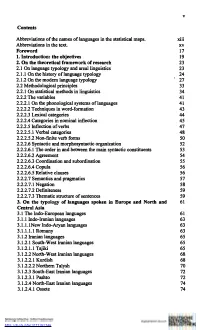
V Contents Abbreviations of the names of languages in the statistical maps. xiii Abbreviations in the text. xv Foreword 17 1. Introduction: the objectives 19 2. On the theoretical framework of research 23 2.1 On language typology and areal linguistics 23 2.1.1 On the history of language typology 24 2.1.2 On the modern language typology ' 27 2.2 Methodological principles 33 2.2.1 On statistical methods in linguistics 34 2.2.2 The variables 41 2.2.2.1 On the phonological systems of languages 41 2.2.2.2 Techniques in word-formation 43 2.2.2.3 Lexical categories 44 2.2.2.4 Categories in nominal inflection 45 2.2.2.5 Inflection of verbs 47 2.2.2.5.1 Verbal categories 48 2.2.2.5.2 Non-finite verb forms 50 2.2.2.6 Syntactic and morphosyntactic organization 52 2.2.2.6.1 The order in and between the main syntactic constituents 53 2.2.2.6.2 Agreement 54 2.2.2.6.3 Coordination and subordination 55 2.2.2.6.4 Copula 56 2.2.2.6.5 Relative clauses 56 2.2.2.7 Semantics and pragmatics 57 2.2.2.7.1 Negation 58 2.2.2.7.2 Definiteness 59 2.2.2.7.3 Thematic structure of sentences 59 3. On the typology of languages spoken in Europe and North and 61 Central Asia 3.1 The Indo-European languages 61 3.1.1 Indo-Iranian languages 63 3.1.1.1New Indo-Aryan languages 63 3.1.1.1.1 Romany 63 3.1.2 Iranian languages 65 3.1.2.1 South-West Iranian languages 65 3.1.2.1.1 Tajiki 65 3.1.2.2 North-West Iranian languages 68 3.1.2.2.1 Kurdish 68 3.1.2.2.2 Northern Talysh 70 3.1.2.3 South-East Iranian languages 72 3.1.2.3.1 Pashto 72 3.1.2.4 North-East Iranian languages 74 3.1.2.4.1 -

Journal Vol. LX. No. 2. 2018
JOURNAL OF THE ASIATIC SOCIETY VOLUME LX No. 4 2018 THE ASIATIC SOCIETY 1 PARK STREET KOLKATA © The Asiatic Society ISSN 0368-3308 Edited and published by Dr. Satyabrata Chakrabarti General Secretary The Asiatic Society 1 Park Street Kolkata 700 016 Published in February 2019 Printed at Desktop Printers 3A, Garstin Place, 4th Floor Kolkata 700 001 Price : 400 (Complete vol. of four nos.) CONTENTS ARTICLES The East Asian Linguistic Phylum : A Reconstruction Based on Language and Genes George v an Driem ... ... 1 Situating Buddhism in Mithila Region : Presence or Absence ? Nisha Thakur ... ... 39 Another Inscribed Image Dated in the Reign of Vigrahapäla III Rajat Sanyal ... ... 63 A Scottish Watchmaker — Educationist and Bengal Renaissance Saptarshi Mallick ... ... 79 GLEANINGS FROM THE PAST Notes on Charaka Sanhitá Dr. Mahendra Lal Sircar ... ... 97 Review on Dr. Mahendra Lal Sircar’s studies on Äyurveda Anjalika Mukhopadhyay ... ... 101 BOOK REVIEW Coin Hoards of the Bengal Sultans 1205-1576 AD from West Bengal, Bihar, Jharkhand, Assam and Bangladesh by Sutapa Sinha Danish Moin ... ... 107 THE EAST ASIAN LINGUISTIC PHYLUM : A RECONSTRUCTION BASED ON LANGUAGE AND GENES GEORGE VAN DRIEM 1. Trans-Himalayan Mandarin, Cantonese, Hakka, Xiâng, Hokkien, Teochew, Pínghuà, Gàn, Jìn, Wú and a number of other languages and dialects together comprise the Sinitic branch of the Trans-Himalayan language family. These languages all collectively descend from a prehistorical Sinitic language, the earliest reconstructible form of which was called Archaic Chinese by Bernard Karlgren and is currently referred to in the anglophone literature as Old Chinese. Today, Sinitic linguistic diversity is under threat by the advance of Mandarin as a standard language throughout China because Mandarin is gradually taking over domains of language use that were originally conducted primarily in the local Sinitic languages. -
The Finnish Korean Connection: an Initial Analysis
The Finnish Korean Connection: An Initial Analysis J ulian Hadland It has traditionally been accepted in circles of comparative linguistics that Finnish is related to Hungarian, and that Korean is related to Mongolian, Tungus, Turkish and other Turkic languages. N.A. Baskakov, in his research into Altaic languages categorised Finnish as belonging to the Uralic family of languages, and Korean as a member of the Altaic family. Yet there is evidence to suggest that Finnish is closer to Korean than to Hungarian, and that likewise Korean is closer to Finnish than to Turkic languages . In his analytic work, "The Altaic Family of Languages", there is strong evidence to suggest that Mongolian, Turkic and Manchurian are closely related, yet in his illustrative examples he is only able to cite SIX cases where Korean bears any resemblance to these languages, and several of these examples are not well-supported. It was only in 1927 that Korean was incorporated into the Altaic family of languages (E.D. Polivanov) . Moreover, as Baskakov points out, "the Japanese-Korean branch appeared, according to (linguistic) scien tists, as a result of mixing altaic dialects with the neighbouring non-altaic languages". For this reason many researchers exclude Korean and Japanese from the Altaic family. However, the question is, what linguistic group did those "non-altaic" languages belong to? If one is familiar with the migrations of tribes, and even nations in the first five centuries AD, one will know that the Finnish (and Ugric) tribes entered the areas of Eastern Europe across the Siberian plane and the Volga. -

"Evolution of Human Languages": Current State of Affairs
«Evolution of Human Languages»: current state of affairs (03.2014) Contents: I. Currently active members of the project . 2 II. Linguistic experts associated with the project . 4 III. General description of EHL's goals and major lines of research . 6 IV. Up-to-date results / achievements of EHL research . 9 V. A concise list of actual problems and tasks for future resolution. 18 VI. EHL resources and links . 20 2 I. Currently active members of the project. Primary affiliation: Senior researcher, Center for Comparative Studies, Russian State University for the Humanities (Moscow). Web info: http://ivka.rsuh.ru/article.html?id=80197 George Publications: http://rggu.academia.edu/GeorgeStarostin Starostin Research interests: Methodology of historical linguistics; long- vs. short-range linguistic comparison; history and classification of African languages; history of the Chinese language; comparative and historical linguistics of various language families (Indo-European, Altaic, Yeniseian, Dravidian, etc.). Primary affiliation: Visiting researcher, Santa Fe Institute. Formerly, professor of linguistics at the University of Melbourne. Ilia Publications: http://orlabs.oclc.org/identities/lccn-n97-4759 Research interests: Genetic and areal language relationships in Southeast Asia; Peiros history and classification of Sino-Tibetan, Austronesian, Austroasiatic languages; macro- and micro-families of the Americas; methodology of historical linguistics. Primary affiliation: Senior researcher, Institute of Slavic Studies, Russian Academy of Sciences (Moscow / Novosibirsk). Web info / publications list (in Russian): Sergei http://www.inslav.ru/index.php?option- Nikolayev =com_content&view=article&id=358:2010-06-09-18-14-01 Research interests: Comparative Indo-European and Slavic studies; internal and external genetic relations of North Caucasian languages; internal and external genetic relations of North American languages (Na-Dene; Algic; Mosan). -
Causative/Inchoative Verb Alternation in Altaic Languages: Turkish, Turkmen, Nanai and Mongolian
International Journal of English Linguistics; Vol. 10, No. 5; 2020 ISSN 1923-869X E-ISSN 1923-8703 Published by Canadian Center of Science and Education Causative/Inchoative Verb Alternation in Altaic Languages: Turkish, Turkmen, Nanai and Mongolian Wenchao Li1 1 Department of Japanese Studies, Zhejiang University, Hangzhou, China Correspondence: Wenchao Li, Department of Japanese Studies, Zhejiang University, Hangzhou, China. E-mail: widelia@zju.edu.cn Received: July 30, 2020 Accepted: September 25, 2020 Online Published: September 29, 2020 doi:10.5539/ijel.v10n5p399 URL: https://doi.org/10.5539/ijel.v10n5p399 Abstract The purpose of the study is two-fold. First, a statistical analysis of the morphology of causative/inchoative verb alternation is carried out in Japanese and in 13 Altaic languages, i.e., Turkish, Turkmen, Nanai, Khakas, Udihe, Uzbek, Sakha, Manchu, Kyrgyz, Mongolian, Kazakh, Ewen, and Azerbaijani. The findings reveal that causative/inchoative verb alternation (a) can be realised via the insertion of an infix (‘-uul-’, ‘-e-’, ‘-g-’, etc.); (b) can be inchoative root-based, with transitive verbs derived via attaching a suffix to the inchoative verb roots (‘-dur-’, ‘-t-’, ‘-ir-’, ‘-dyr-’, ‘-wəən-’, ‘-buwəən-’, ‘-r-’, ‘-wənə-’, ‘-nar-’, ‘-ier-’, ‘-er-’, ‘-bu-’, ‘-ʊkan-’); (c) can be causative verb-based, with inchoative verbs being derived via attaching a suffix to the causative verb roots (‘-p-’, ‘-n-’, ‘-ul-’, ‘-il-’); and (d) can be realised via consonant alternation (‘-r-’ (transitive) / ‘-n-’ (intransitive); ‘-t-’ (transitive) / ‘-n-’ (intransitive)). This study further attempts to pin down the affiliation of these languages with the Japanese language. It compares the morphological findings with Japanese bound morphemes in causative/inchoative verb alternation and then delves into the phonological issues, i.e., consonant alternation and vowel harmony. -
Survey of the World's Languages
Survey of the world’s languages The languages of the world can be divided into a number of families of related languages, possibly grouped into larger stocks, plus a residue of isolates, languages that appear not to be genetically related to any other known languages, languages that form one-member families on their own. The number of families, stocks, and isolates is hotly disputed. The disagreements centre around differences of opinion as to what constitutes a family or stock, as well as the acceptable criteria and methods for establishing them. Linguists are sometimes divided into lumpers and splitters according to whether they lump many languages together into large stocks, or divide them into numerous smaller family groups. Merritt Ruhlen is an extreme lumper: in his classification of the world’s languages (1991) he identifies just nineteen language families or stocks, and five isolates. More towards the splitting end is Ethnologue, the 18th edition of which identifies some 141 top-level genetic groupings. In addition, it distinguishes 1 constructed language, 88 creoles, 137 or 138 deaf sign languages (the figures differ in different places, and this category actually includes alternate sign languages — see also website for Chapter 12), 75 language isolates, 21 mixed languages, 13 pidgins, and 51 unclassified languages. Even so, in terms of what has actually been established by application of the comparative method, the Ethnologue system is wildly lumping! Some families, for instance Austronesian and Indo-European, are well established, and few serious doubts exist as to their genetic unity. Others are quite contentious. Both Ruhlen (1991) and Ethnologue identify an Australian family, although there is as yet no firm evidence that the languages of the continent are all genetically related. -
Divergence of Altai Macro System Languages and Issues of Their Genetic Relationship O. Sapashev* A. Smailova** B. Zhaksymov
Türkbilig, 2016/31: 109-126. DIVERGENCE OF ALTAI MACRO SYSTEM LANGUAGES AND ISSUES OF THEIR GENETIC RELATIONSHIP O. SAPASHEV* A. SMAILOVA** B. ZHAKSYMOV*** Abstract: Scientists recognize the difficulties associated with final and perfect solution of the problem of origin of the Altai community. The most important issue according to their opinion is a difficulty in differentiation of elements of a possible genetic commonality, the traces of which can be found in all Altaic languages, from the secondary elements of community, developing in different periods of close contacts of various Altaic peoples for at least of two millennia period. Mutual lexical borrowings of not only from single Altaic languages, but also borrowings from non-Altaic languages (the phenomenon of the substrate or super stratum) led to a significant lexical generality of secondary order and gave the reasons for establishment of various kinds of correspondences not relating to common Altaic protolanguage heritage that creates a large difficult to apply comparative- historical method. Keywords: Altaic, macro-system, genetic kinship, language typology, the rudiments Altay Makro Sistemi Dillerinin Farklılıkları ve Onların Genetik İlişkilerine Dair Konular Özet: Altayistik çalışan araştırmacıları, Altay toplumun kökeni sorununun nihai ve mükemmel bir çözümüyle ilişkili olan zorluklar bekler. Araştırmacıların görüşüne göre en önemli konu, olası genetik ortaklık unsurlarının ve Altay dillerinde bulunabilecek izlerin farklılaşması zorluğudur. Bu zorluklar, toplumun ikincil unsurlarından kaynaklanır ve farklı zamanlarda çeşitli Altay topluluklarının en az iki bin yıllık yakın ilişkiler sonucu gelişmiştir. Sadece Altay dilleri ve Altay dilleri dışındaki dillerden karşılıklı sözcük alışverişi (altkatman ve üstkatman olgusu) ikincil seviyede önemli sözcüksel genellemeler ortaya çıkardı ve tarihi-karşılaştırmalı metodun uygulanmasını zorlaştıran ortak proto Altay dil mirasıyla ilgili olmayan bir yapının oluşmasına neden oldu. -

Japanese As an Altaic Language: an Investigation of Japanese Genetic Affiliation Through Biological Findings
JAPANESE AS AN ALTAIC LANGUAGE: AN INVESTIGATION OF JAPANESE GENETIC AFFILIATION THROUGH BIOLOGICAL FINDINGS Yuko Igarashi Department of Linguistics University of Victoria, B.C., Canada 1. INTRODUCTION Japanese is one of the language isolates (Shibatani, 1990). In the 18 th century, however, Sir William Jones hypothesized all languages in the world are derived from a single mother tongue; thus they are genetically related to others (Lamb & Mitchell, 1991). Led by this hypothesis, scholars have engaged in comparing languages systematically to observe their genetic affiliations through the linguistic correspondences between them (Crystal, 1997). The genetic classification of languages in Europe was successfully achieved by their efforts; in addition, they have thought that the methods used to establish the Indo-European language family can be applied to the categorization of other languages (Crystal, 1997; Lehmann, 1992). Based on this hypothesis, scholars have been searching for the genetic affiliation of Japanese for more than a century (Miller, 1991; Vovin, 1994); however, they have not reached any agreement yet. Fujiwara and Ono compared Japanese to Dravidian languages (Martin, 1991). Maruyama researched the possibility of Japanese genetic affiliation to Ma1ayo-PolYnesian (Martin, 1991). Benedict attempted to find evidence for a genetic relationship between Japanese and the Austro-Tai language family (Vovin, 1994). Some scholars such as Chew (1976) and Martin (1996) have explored Japanese genetic affiliation to Korean because they think Japanese is structurally close to Korean. Korean is considered to be another language isolate (Shibatani, 1990); however, Poppe (1965) is of the opinion that Korean may be an Altaic language because it is structurally similar to Japanese and to Altaic and because many of its vocabularies have been successfully compared with Altaic languages. -
Permutation Test Applied to Lexical Reconstructions Partially Supports the Altaic Linguistic Macrofamily
Evolutionary Human Sciences (2021), 3, e32, page 1 of 10 doi:10.1017/ehs.2021.28 RESEARCH ARTICLE Permutation test applied to lexical reconstructions partially supports the Altaic linguistic macrofamily Alexei S. Kassian1* , George Starostin2,3* , Ilya M. Egorov1 , Ekaterina S. Logunova4 and Anna V. Dybo5 1School of Advanced Studies in the Humanities, The Russian Presidential Academy of National Economy and Public Administration, Moscow, Russia, 2Institute for Oriental and Classical Studies, National Research University Higher School of Economics, Moscow, Russia, 3Santa Fe Institute, New Mexico, USA, 4Institute of Linguistics, Russian State University for the Humanities, Moscow, Russia and 5Institute of Linguistics, Russian Academy of Sciences, Moscow, Russia *Corresponding authors. E-mails: a.kassian@gmail.com, gstarst1@gmail.com. Abstract In this paper, we present the results of our analysis of the 110-item basic wordlists for four reconstructed and one ancient languages, the linguistic ancestors of five language families which are hypothesized to constitute the Altaic (a.k.a. Transeurasian) macrofamily: Proto-Turkic, Proto-Mongolic, Proto- Tungusic, Middle Korean and Proto-Japonic wordlists. Protolanguage wordlists were reconstructed according to strict criteria of semantic reconstruction, based on accurate semantic glossing of forms in daughter languages. Each involved form was encoded into a bi-consonantal CC-shaped sequence using the consonant class method, after which a recently developed weighted permutation test was applied. In a typical situation, our algorithm makes a small number of type 1 errors (false positive), but the num- ber of type 2 errors (false negative) can be substantial. Our main finding is that pairs between the Nuclear Altaic taxa – Turkic, Mongolic and Tungusic – as well as the Turkic-Japonic and Tungusic-Japonic pairs demonstrate significant p-values. -

4 the Altaic Hypothesis
4 The Altaic Hypothesis To complete our overview of Altaic philology, we must say something about one of the most controversial aspects of Altaic studies, the so- called Altaic Hypothesis (AH). Also referred to as the Altaic Theory, the AH is a by-product of comparative research in the field of Uralic and Altaic linguistics. When, in the 19th c., enough data had been collected by individuals investigating the Finno-Ugric and Altaic languages (or, to be more precise, the ones we now call the Finno- Ugric and Altaic languages), certain apparent relationships between the languages of these groups were noticed. Further investigations caused a number of scholars interested in historical linguistics to establish correlations between these languages and propose a genetic rapport between them, as indeed was being done by their colleagues in the field of Indo-European languages. The way this process occurred is, briefly, as follows. Although the theory developed in the 19th c. and flourished in the 20th, it first germinated in the 18th c. with von Strahlenberg, whom we met in connection with his work on Kalmyk. On the basis of his knowledge of several languages (which he had acquired during his extensive travels) and the similarities which he discovered among them, he classified their speakers into six groups: 1) Uighurs, i.e. the Finno-Ugric speaking people, the Baraba Tatars and the Huns, 2) Turco-Tatars, 3) Samoyeds, 4) Mongols and Manchus, 5) Tungus, and 6) the tribes between the Black Sea and the Caspian. This first classification was rough, unscientific and incorrect. The Finno-Ugric people cannot be grouped together with the Baraba Tatars who are a Turkic tribe; and the tribes between the Black and Caspian Seas belonged to several different ethnic groups speaking different lan- guages: Turkic, Iranian and Caucasian languages. -

Families Indo-European Is Just One of Many Large Language Families in The
Contemporary Linguistics: An Introduction, 5th edition, Chapter 8: Families, 1 Families Indo-European is just one of many large language families in the world today. A brief survey of some other language families will help illustrate the extraordinary diversity of human language. [Add Anchors for the following families] [Uralic] [Austroasiatic] [Indo-Pacific] [Nilo-Saharan] [Altaic] [Tai-Kadai] [Australian] [Khoisan] [Caucasian] [Sino-Tibetan] [Afroasiatic] [The Americas] [Dravidian] [Austronesian] [Niger-Congo] Uralic The Uralic family (see Table 1) contains about twenty languages and has approximately 22 million speakers. Uralic languages are spoken in a band across the northern part of Europe, all the way from northern Norway to Siberia. Uralic has two major branches: Samoyed and Finno-Ugric. The Samoyed branch contains a handful of languages spoken in northern Russia, particularly in areas around the Ural Mountains, and also in Siberia. The most widely spoken Finno-Ugric language is Hungarian. Other Finno-Ugric languages are Finnish, Lapp (also known as Lappish or Saame, spoken in northern Scandinavia and northwestern Russia), Estonian (Estonia), Livonian (Latvia), Karelian (eastern Finland and northwestern Russia), Erzya, and Cheremis (both spoken in the former USSR). Uralic languages are primarily agglutinating and most have postpositions with SOV or SVO word order. The nouns often have many cases (Finnish has Contemporary Linguistics: An Introduction, 5th edition, Chapter 8: Families, 2 fifteen), which appear to have developed historically from postpositions that became attached to nouns as suffixes. [back to top] Altaic Languages belonging to the Altaic family are spoken in a continuum from Turkey to Siberia, and China. The membership of the Altaic family (see Table 2) includes three main branches—Turkic, Mongolian, and Tungusic. -

A Dictionary of Linguistics
MID-CENTURY REFERENCE LIBRARY DAGOBERT D. RUNES, Ph.D., General Editor AVAILABLE Dictionary of Ancient History Dictionary of the Arts Dictionary of European History Dictionary of Foreign Words and Phrases Dictionary of Linguistics Dictionary of Mysticism Dictionary of Mythology Dictionary of Philosophy Dictionary of Psychoanalysis Dictionary of Science and Technology Dictionary of Sociology Dictionary of Word Origins Dictionary of World Literature Encyclopedia of Aberrations Encyclopedia of the Arts Encyclopedia of Atomic Energy Encyclopedia of Criminology Encyclopedia of Literature Encyclopedia of Psychology Encyclopedia of Religion Encyclopedia of Substitutes and Synthetics Encyclopedia of Vocational Guidance Illustrated Technical Dictionary Labor Dictionary Liberal Arts Dictionary Military and Naval Dictionary New Dictionary of American History New Dictionary of Psychology Protestant Dictionary Slavonic Encyclopedia Theatre Dictionary Tobacco Dictionary FORTHCOMING Beethoven Encyclopedia Dictionary of American Folklore Dictionary of American Grammar and Usage Dictionary of American Literature Dictionary of American Maxims Dictionary of American Proverbs Dictionary of American Superstitions Dictionary of American Synonyms Dictionary of Anthropology Dictionary of Arts and Crafts Dictionary of Asiatic History Dictionary of Astronomy Dictionary of Child Guidance Dictionary of Christian Antiquity Dictionary of Discoveries and Inventions Dictionary of Etiquette Dictionary of Forgotten Words Dictionary of French Literature Dictionary of Geography