Princeville Plantation Papers Rhoda E. A. Hackler Travellers on The
Total Page:16
File Type:pdf, Size:1020Kb
Load more
Recommended publications
-

AMERICA's ANNEXATION of HAWAII by BECKY L. BRUCE
A LUSCIOUS FRUIT: AMERICA’S ANNEXATION OF HAWAII by BECKY L. BRUCE HOWARD JONES, COMMITTEE CHAIR JOSEPH A. FRY KARI FREDERICKSON LISA LIDQUIST-DORR STEVEN BUNKER A DISSERTATION Submitted in partial fulfillment of the requirements for the degree of Doctor of Philosophy in the Department of History in the Graduate School of The University of Alabama TUSCALOOSA, ALABAMA 2012 Copyright Becky L. Bruce 2012 ALL RIGHTS RESERVED ABSTRACT This dissertation argues that the annexation of Hawaii was not the result of an aggressive move by the United States to gain coaling stations or foreign markets, nor was it a means of preempting other foreign nations from acquiring the island or mending a psychic wound in the United States. Rather, the acquisition was the result of a seventy-year relationship brokered by Americans living on the islands and entered into by two nations attempting to find their place in the international system. Foreign policy decisions by both nations led to an increasingly dependent relationship linking Hawaii’s stability to the U.S. economy and the United States’ world power status to its access to Hawaiian ports. Analysis of this seventy-year relationship changed over time as the two nations evolved within the world system. In an attempt to maintain independence, the Hawaiian monarchy had introduced a westernized political and economic system to the islands to gain international recognition as a nation-state. This new system created a highly partisan atmosphere between natives and foreign residents who overthrew the monarchy to preserve their personal status against a rising native political challenge. These men then applied for annexation to the United States, forcing Washington to confront the final obstacle in its rise to first-tier status: its own reluctance to assume the burdens and responsibilities of an imperial policy abroad. -

A Portrait of EMMA KAʻILIKAPUOLONO METCALF
HĀNAU MA KA LOLO, FOR THE BENEFIT OF HER RACE: a portrait of EMMA KAʻILIKAPUOLONO METCALF BECKLEY NAKUINA A THESIS SUBMITTED TO THE GRADUATE DIVISION OF THE UNIVERSITY OF HAWAIʻI AT MĀNOA IN PARTIAL FULFILLMENT OF THE REQUIREMENTS FOR THE DEGREE OF MASTER OF ARTS IN HAWAIIAN STUDIES AUGUST 2012 By Jaime Uluwehi Hopkins Thesis Committee: Jonathan Kamakawiwoʻole Osorio, Chairperson Lilikalā Kameʻeleihiwa Wendell Kekailoa Perry DEDICATION This thesis is dedicated to Kanalu Young. When I was looking into getting a graduate degree, Kanalu was the graduate student advisor. He remembered me from my undergrad years, which at that point had been nine years earlier. He was open, inviting, and supportive of any idea I tossed at him. We had several more conversations after I joined the program, and every single one left me dizzy. I felt like I had just raced through two dozen different ideas streams in the span of ten minutes, and hoped that at some point I would recognize how many things I had just learned. I told him my thesis idea, and he went above and beyond to help. He also agreed to chair my committee. I was orignally going to write about Pana Oʻahu, the stories behind places on Oʻahu. Kanalu got the Pana Oʻahu (HWST 362) class put back on the schedule for the first time in a few years, and agreed to teach it with me as his assistant. The next summer, we started mapping out a whole new course stream of classes focusing on Pana Oʻahu. But that was his last summer. -
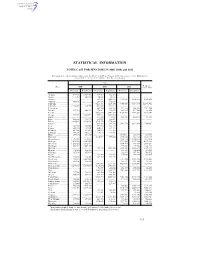
Statistical Information
STATISTICAL INFORMATION VOTES CAST FOR SENATORS IN 2008, 2010, and 2012 [Compiled from official statistics obtained by the Clerk of the House. Figures in the last column, for the 2012 election, may include totals for more candidates than the ones shown.] Vote Total vote State 2008 2010 2012 cast in 2012 Democrat Republican Democrat Republican Democrat Republican Alabama ....................... 752,391 1,305,383 515,619 968,181 .................... .................... .................... Alaska .......................... 1,51,767 147,814 60,045 90,839 .................... .................... .................... Arizona ........................ .................... .................... 592,011 1,005,615 1,036,542 1,104,457 2,243,422 Arkansas ...................... 804,678 .................... 288,156 451,618 .................... .................... .................... California ..................... .................... .................... 5,218,441 4,217,366 7,864,624 4,713,887 12,578,511 Colorado ...................... 1,230,994 990,755 851,590 822,731 .................... .................... .................... Connecticut .................. .................... .................... 605,204 498,341 792,983 604,569 1,511,764 Delaware ...................... 257,539 140,595 174,012 123,053 265,415 115,700 399,606 Florida .......................... .................... .................... 1,092,936 2,645,743 4,523,451 3,458,267 8,189,946 Georgia ........................ 909,923 1,228,033 996,516 1,489,904 ................... -

253537449.Pdf
CD 105402 HAWAII ISLES OF ENCHANTMENT By CLIFFORD GESSLER Illustrated by E. H. SUYDAM D. APPLETON- CENTURY COMPANY INCORPORATED NEW YORK LONDON 1938 COPYRIGHT, 1937, BY JD. APPLETON-CENTURY COMPANY, INC. rights reserved. This book, or part** thereof, must not be reproduced in any form without permission of the publisher. Illustrations copyright, 937, by JE. HL Suydam Printed in the United States of America INTRODUCTION write of it or must RO away from Hawaii to is bewildered by KO away and return. A newcomer dazed the sharp impact of ONEits contradictions, by resident of long standing, on the thronging impressions. A so for that he other hand, tends to take the islands granted them to the stranger. may he handicapped in interpreting to be in a sense both One is fortunate, therefore, perhaps with the zeal kamaaina and malihini, neither exaggerating V Introduction *$: new convert the charm of those bright islands nor al~ dulled lotting it to be obscured with sensitivity by prolonged and not too daily familiarity. Time, not too long, distance, great, help to attain balance. The aim of this book is to write a national biography a character illumi- and to paint, in broad strokes, portrait, nated here and there by anecdote, of a country and a people that I have loved. Nor shall I tell here all I know about any one aspect of the islands. Not now, at any rate; this is not that kind of book. Scandal seldom reveals the true spirit of a community. The exception is not a reliable index, and controversies are like the shattered window which caused the policeman, after inspecting it without and within, to exclaim: "It's worse than I thought; it's broke on both sides!" Here again the long view is the clearest. -

Voyages to Hawaii Before 1860
Voyages to Hawaii before 1860 Voyages to Hawaii before 1860 A Record, Based on Historical Narratives in the Libraries of the Hawaiian Mission Children’s Society and The Hawaiian Historical Society, Extended to March 1860 BERNICE JUDD enlarged and edited by HELEN YONGE LIND THE UNIVERSITY PRESS OF HAWAII for HAWAIIAN MISSION CHILDREN’S SOCIETY Honolulu Open Access edition funded by the National En- dowment for the Humanities / Andrew W. Mellon Foundation Humanities Open Book Program. Licensed under the terms of Creative Commons Attribution-NonCommercial-NoDerivatives 4.0 In- ternational (CC BY-NC-ND 4.0), which permits readers to freely download and share the work in print or electronic format for non-commercial purposes, so long as credit is given to the au- thor. Derivative works and commercial uses require permission from the publisher. For details, see https://creativecommons.org/licenses/by-nc-nd/4.0/. The Cre- ative Commons license described above does not apply to any material that is separately copyrighted. Open Access ISBNs: 9780824883928 (PDF) 9780824883935 (EPUB) This version created: 5 September, 2019 Please visit www.hawaiiopen.org for more Open Access works from University of Hawai‘i Press. This edition is a revision of that originally published in 1929 by the Hawaiian Mission Children’s Society. Copyright © 1974 by The University Press of Hawaii All rights reserved IN MEMORY OF BERNICE JUDD The earlier edition of this book, published in 1929, was written by Bernice Judd. She kept two interleaved copies in which she noted further entries during her thirty-three years’ work in the Hawaiian Mission Children’s Society library. -

1 DRAFT 5-13-15 1778 ROAD to STATEHOOD 1959 Prior to 1778 and Captain Cook the Following Is Quoted From
DRAFT 5-13-15 1778 ROAD TO STATEHOOD 1959 Prior to 1778 and Captain Cook The following is quoted from www.freehawaii.org which obtained it from <http;//www.vrmaui.com/pray4hawaii/> History 1 - The Beginning to Pa‘ao All quotes, unless otherwise noted, are taken from Daniel Kikawa's excellent book, Perpetuated in Righteousness. The language of the Polynesian peoples is basically one language, the missionary translators who first assigned a written spelling for the different island groups, heard the words differently and represented these sounds that they heard with different letters. For instance the Hawaiian word for 'woman' is wahine (vah-hee-nee), the Tongan word for 'woman' is fahine (fah-hee-nee). Much like the differences between American English and British English - there is understanding but differences in accents and idioms. So, the oral traditions of the Polynesian peoples, with minor differences, give a remarkably similar account of their history and beliefs. There are Polynesians today, who can recite their lineage back to one common ancestor. Here are some excerpts from those accounts. Note that these predate the coming of the missionaries and were not influenced by Biblical record. These legends include stories from Hawaii, Tahiti, Samoa, Tonga, Marquesa and the Maori of New Zealand. `Fornander (leading foreign source of Hawaiian history) said, ". I learned that the ancient Hawaiians at one time worshipped one god, comprised of three beings, and respectively called Kane, Ku and Lono, equal in nature, but distinctive in attributes..." This Polynesian god had many titles, but one name, too holy to be mentioned in casual conversation and this name was`Io. -

The Beginnings of Sugar Production in Hawai'i
The Beginnings of Sugar Production in Hawai'i Robert L. Cushing The sesquicentennial of sugar production in Hawai'i is being observed in 1985 because Ladd & Go. initiated its sugar operation at Koloa, Kaua'i in 1835. Successors to the Ladd & Co. enterprise have continued to grow sugarcane on some of the same lands, and the cane has been milled in factories located near the same site as that of the first mill. While the Ladd operation is reckoned as the beginning of sugar production in Hawai'i, there are reports, most of them fragmentary, of other even earlier efforts. One report says, "Old residents speak of sugar and molasses of a coarse quality having been manufactured here in sufficient quantities for ordinary domestic consumption in 1828."1 Reports of the early attempts are scattered, most are documented poorly, if at all, there are inconsistencies among them, and there has never been a comprehensive summary of them. It is the purpose of this paper to review and compare the reports of sugar making in Hawai'i prior to 1835. SUGARCANE IN HAWAl'l FIRST INTRODUCTION Sugarcane is not indigenous to Hawai'i. Its center of origin is in the Indonesian Archipelago, where abundant variation can still be found in the genus Saccharum.2 Long before there was recorded history, sugarcane was distributed throughout the lands of the South Pacific. It also moved, but somewhat later, to India, China and, eventually, to the lands of the Mediterranean Sea.3 Sugarcane was among the food crops brought by the Polynesians from islands to the south, who settled in Hawai'i a thousand or more Robert L. -

A Multinational Fraternity: Freemasonry in Hawai'i, 1843-1905
FRANK J. KARPIEL A Multinational Fraternity: Freemasonry in Hawai'i, 1843-1905 ON MARCH 30, 1843, in the midst of a short-lived British occupa- tion of the Hawaiian kingdom's capital, the Ajax, one of the few French whaling vessels in the Pacific, sailed into Honolulu harbor. It had been seven months since it had collided with an American whale ship in the Indian Ocean, and her captain, Joseph Marie Le Tellier, needed the repair facilities of the mid-Pacific port. Le Tellier also had another purpose during his stopover: Named a "Special Inspec- tor" by the Supreme Council of France, he was specially authorized to create new Masonic lodges. Within days after arriving in Honolulu, Captain Le Tellier contacted the local representative of the French government, the Mauritius-born merchant Jules Dudoit, and they recognized each other as Masons. Little more than a week later, Le Tellier acted on his commission, gathering Dudoit and fourteen other men to organize the first Masonic lodge in the Pacific, Lodge Le Progres de l'Oceanie.1 Initially meeting aboard the Ajax and then at Dudoit's store, the group soon moved its meetings to an adobe house owned by another charter member, John Meek, an American seafarer. A system of fraternal societies centered on convivial sociability and complex ritual, Freemasonry originated in the British Isles and had spread like wildfire throughout Europe and America during the eigh- teenth century. Although entering into a decades-long decline in the Frank J. Karpiel teaches at Ramapo College of New Jersey in Mahwah, New Jersey. -

PAU PAGE 224 11=15-14 1778 ROAD to STATEHOOD 1959 The
PAU PAGE 224 11=15-14 1778 ROAD TO STATEHOOD 1959 The following is quoted from www.freehawaii.org: History 1 - The Beginning to Pa‘ao All quotes, unless otherwise noted, are taken from Daniel Kikawa's excellent book, Perpetuated in Righteousness. The language of the Polynesian peoples is basically one language, the missionary translators who first assigned a written spelling for the different island groups, heard the words differently and represented these sounds that they heard with different letters. For instance the Hawaiian word for 'woman' is wahine (vah-hee-nee), the Tongan word for 'woman' is fahine (fah-hee-nee). Much like the differences between American English and British English - there is understanding but differences in accents and idioms. So, the oral traditions of the Polynesian peoples, with minor differences, give a remarkably similar account of their history and beliefs. There are Polynesians today, who can recite their lineage back to one common ancestor. Here are some excerpts from those accounts. Note that these predate the coming of the missionaries and were not influenced by Biblical record. These legends include stories from Hawaii, Tahiti, Samoa, Tonga, Marquesa and the Maori of New Zealand. Fornander (leading foreign source of Hawaiian history) said, ". I learned that the ancient Hawaiians at one time worshipped one god, comprised of three beings, and respectively called Kane, Ku and Lono, equal in nature, but distinctive in attributes..." This Polynesian god had many titles, but one name, too holy to be mentioned in casual conversation and this name was`Io. The first group of Proto-polynesians probably left the middle east around BC 2300, about the time of the tower of Babel heading toward Sumatra. -

THE AMERICAN ANNEXATION of HAWAII and TEXAS COMPARED: 1845 (Texas) and 1898 (Hawaii)
THE AMERICAN ANNEXATION OF HAWAII AND TEXAS COMPARED: 1845 (Texas) and 1898 (Hawaii) [Prepared by Title Guaranty Company, Honolulu, Hawaii] October, 1998 The steps taken to annex Hawaii in 1893 and 1898 are briefly outlined in the condensed Bicentennial Edition of the Encyclopedia of American History [1976, edited by Richard B. Morris, Henry Steele Commager, and Jeffrey B. Morris, hereinafter cited as Morris et. al.]. There is a larger story, as we well know, but the above-mentioned condensation is used herein as summary of principal facts and events: [1893] “Hawaiian Question. The most vital links between the U.S. and Hawaii were the Hawaiian sugar planters, mostly Americans. The planters, ranged against native dynastic interests, brought off a revolution (1887) that succeeded in securing a liberal constitution and a government under their influence. However they lost power in 1891. Meanwhile, the McKinley Tariff Act of 1890, which put imported sugar on the free list and authorized a bounty of 2 cts. a lb. for home-grown sugar cane, wiped out the reciprocity advantages hitherto enjoyed by Hawaiian sugar planters and broke sugar prices, with an estimated loss of $12 million. “Queen Liliuokalani, exponent of a firm pro-native policy, came to the Hawaiian throne in 1891. She revoked the liberal constitution of 1887 and by royal edict (14 Jan.) promulgated a new constitution giving her autocratic powers. The Americans under the leadership of Sanford B. Dole (p. 1014), had already established a revolutionary committee of safety to overthrow the native government, with the apparent support of the U.S. -

H. Doc. 108-222
BIOGRAPHIES [ 535 ] BIOGRAPHIES AANDAHL, Fred George, a Representative from North state house of representatives, 1799, 1802-1804, 1808, and Dakota; born in Litchville, Barnes County, N.Dak., April 1811; elected as a Republican to the Fifteenth and reelected 9, 1897; graduated from Litchville High School, Litchville, to the three succeeding Congresses (March 4, 1817-March N.Dak.; graduated from the University of North Dakota, 3, 1825); died on November 19, 1826, in Lexington, Ga.; Grand Forks, N.Dak., 1921; farmer; superintendent of interment in Rest Haven Cemetery, Washington, Ga. schools, Litchville, N.Dak., 1922-1927; member of the North Dakota state senate, 1931, 1939, and 1941; governor of ABBOTT, Joseph Carter, a Senator from North Caro- North Dakota, 1945-1950; elected as a Republican to the lina; born in Concord, N.H., July 15, 1825; graduated from Eighty-second Congress (January 3, 1951-January 3, 1953); Phillips Academy, Andover, Mass., in 1846; studied law; ad- was not a candidate for the Eighty-third Congress in 1952, mitted to the bar in 1852; owner and editor of the Daily but was an unsuccessful candidate for the United States American, in Manchester, N.H. 1852-1857; adjutant general Senate; appointed Assistant Secretary of the Department of New Hampshire 1855-1861; editor of the Boston Atlas of the Interior, 1953-1961; died April 7, 1966, in Fargo, in 1859; member of the commission to adjust the boundary N.Dak.; interment in Hillside Cemetery, Valley City, N.Dak. between New Hampshire and Canada; served in the Union Army during the Civil War 1861-1865, breveted as brigadier ABBITT, Watkins Moorman, a Representative from Vir- general; moved to Wilmington, N.C. -

The Journals and Letter Books of R.G. Wyllie: a Minor Historical Mystery
The Journals and Letter Books of R.G. Wyllie: A minor historical mystery James D. Raeside Robert Crichton Wyllie (1798-1865) was an outstanding figure in the politics of mid-19th Century Hawaii. He was fiercely dedicated to preserving the independence of the Hawaiian Kingdom and its native dynasty, and he was prepared to devote his private fortune to this end. In his 20 years as Hawaiian Foreign Minister, from 1845 to 1865, he was the intimate of three Hawaiian kings. He was widely travelled and highly literate and came to Hawaii with cosmopolitan interests and connections. He was also a methodical diarist, and the disappearance of his personal diary for a critical period in the history of Hawaii has deprived Hawaii of a valuable part of its historical record. The present writer, currently preparing a biography of Wyllie, has a particular interest in Wyllie's diaries and letter books, and believes that a review of what is known of them and the circum- stances surrounding their disappearance is long overdue. Wyllie had a varied and interesting career. He was born in Scotland, attended the University of Glasgow, and qualified as a physician, intending to practice in Russia under the patronage of a namesake who was physician to the Czar. He was practising as a physician in Valparaiso in 1818, then set up in practice in Coquimbo. After a few years in Chile, he abandoned medicine for commerce in association with a trader in Lima. On returning from a trading voyage to Calcutta in 1826, he went into partnership with a merchant in Mazatlan in Mexico.