Federal Register/Vol. 79, No. 202
Total Page:16
File Type:pdf, Size:1020Kb
Load more
Recommended publications
-

West Indian Iguana Husbandry Manual
1 Table of Contents Introduction ................................................................................................................................... 4 Natural history ............................................................................................................................... 7 Captive management ................................................................................................................... 25 Population management .............................................................................................................. 25 Quarantine ............................................................................................................................... 26 Housing..................................................................................................................................... 26 Proper animal capture, restraint, and handling ...................................................................... 32 Reproduction and nesting ........................................................................................................ 34 Hatchling care .......................................................................................................................... 40 Record keeping ........................................................................................................................ 42 Husbandry protocol for the Lesser Antillean iguana (Iguana delicatissima)................................. 43 Nutrition ...................................................................................................................................... -
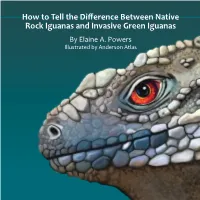
How to Tell the Difference Between Native Rock Iguanas and Invasive Green Iguanas by Elaine A
How to Tell the Difference Between Native Rock Iguanas and Invasive Green Iguanas By Elaine A. Powers Illustrated by Anderson Atlas Many of the islands in the Caribbean Sea, known as the West Rock Iguanas (Cyclura) Indies, have native iguanas. B Cuban Rock Iguana (Cyclura nubila), Cuba They are called Rock Iguanas. C Sister Isles Rock Iguana (Cyclura nubila caymanensis), Cayman Brac and Invasive Green Iguanas have been introduced on these islands and Little Cayman are a threat to the Rock Iguanas. They compete for food, territory D Grand Cayman Blue Iguana (Cyclura lewisi), Grand Cayman and nesting areas. E Jamaican Rock Iguana (Cyclura collei), Jamaica This booklet is designed to help you identify the native Rock F Turks & Caicos Rock Iguana (Cyclura carinata), Turks and Caicos. Iguanas from the invasive Greens. G Booby Cay Rock Iguana (Cyclura carinata bartschi), Booby Cay, Bahamas H Andros Rock Iguana (Cyclura cychlura), Andros, Bahamas West Indies I Exuma Rock Iguana (Cyclura cychlura figginsi), Exuma Islands, Bahamas Exumas BAHAMAS J Allen’s Cay Rock Iguana (Cyclura cychlura inornata), Exuma Islands, J Islands Bahamas M San Salvador Andros Island H Booby Cay K Anegada Iguana (Cyclura pinguis), British Virgin Islands Allens Cay White G I Cay Ricord’s Iguana (Cyclura ricordi), Hispaniola O F Turks & Caicos L CUBA NAcklins Island M San Salvador Rock Iguana (Cyclura rileyi), San Salvador, Bahamas Anegada HISPANIOLA CAYMAN ISLANDS K N Acklins Rock Iguana (Cyclura rileyi nuchalis), Acklins Islands, Bahamas B PUERTO RICO O White Cay Rock Iguana (Cyclura rileyi cristata), Exuma Islands, Bahamas Grand Cayman D C JAMAICA BRITISH P Rhinoceros Iguana (Cyclura cornuta), Hispanola Cayman Brac & VIRGIN Little Cayman E L P Q Mona ISLANDS Q Mona Island Iguana (Cyclura stegnegeri), Mona Island, Puerto Rico Island 2 3 When you see an iguana, ask: What kind do I see? Do you see a big face scale, as round as can be? What species is that iguana in front of me? It’s below the ear, that’s where it will be. -

ISG News 9(1).Indd
Iguana Specialist Group Newsletter Volume 9 • Number 1 • Summer 2006 The Iguana Specialist Group News & Comments prioritizes and facilitates conservation, science, and onservation Centers for Species Survival Formed j Cyclura spp. were awareness programs that help Cselected as a taxa of mutual concern under a new agreement between a select ensure the survival of wild group of American zoos and the U.S. Fish and Wildlife Service. The zoos - under iguanas and their habitats. the banner of Conservation Centers for Species Survival (C2S2) - and USFWS have pledged to work cooperatively to advance conservation of the selected spe- cies by identifying specific research projects, actions, and opportunities that will significantly and clearly support conservation efforts. Cyclura are the only lizards selected under the joint program. The zoos participating in the program include the San Diego Wild Animal Park, Fossil Rim Wildlife Center, The Wilds, White Oak Conservation Center and the National Zoo’s Conservation and Research Center. USFWS participation will be coordinated by Bruce Weissgold in the Division of Management Authority (bruce_weissgold @fws.gov). IN THIS ISSUE News & Comments ............... 1 RCC Facility at Fort Worth j The Fort Worth Zoo recently opened their Animal Outreach and Conservation Center (ARCC) in an off-exhibit Iguanas in the News ............... 3 A area of the zoo. The $1 million facility actually consists of three separate units. Taxon Reports ...................... 7 The primary facility houses the zoo’s outreach collection, while a state-of-the-art B. vitiensis ...................... 7 reptile conservation greenhouse will highlight the zoo’s work with endangered C. pinguis ..................... 9 iguanas and chelonians. -

TERRESTRIAL SPECIES Grand Cayman Blue Iguana Cyclura Lewisi Taxonomy and Range the Grand Cayman Blue Iguana, Cyclura Lewisi, Is
TERRESTRIAL SPECIES Grand Cayman Blue iguana Cyclura lewisi Taxonomy and Range Kingdom: Animalia, Phylum: Chordata, Class: Sauropsida, Order: Squamata, Family: Iguanidae Genus: Cyclura, Species: lewisi The Grand Cayman Blue iguana, Cyclura lewisi, is endemic to the island of Grand Cayman. Closest relatives are Cyclura nubila (Cuba), and Cyclura cychlura (Bahamas); all three having apparently diverged from a common ancestor some three million years ago. Status Distribution: Species endemic to Grand Cayman. Conservation: Critically endangered (IUCN Red List). In 2002 surveys indicated a wild population of 10-25 individuals. By 2005 any young being born into the unmanaged wild population were not surviving to breeding age, making the population functionally extinct. Cyclura lewisi is now the most endangered iguana on Earth. Legal: The Grand Cayman Blue iguana Cyclura lewisi is protected under the Animals Law (1976). Pending legislation, it would be protected under the National Conservation Law (Schedule I). The Department of Environment is the lead body for legal protection. The Blue Iguana Recovery Programme BIRP operates under an exemption to the Animals Law, granted to the National Trust for the Cayman Islands. Natural history While it is likely that the original population included many animals living in coastal shrubland environments, the Blue iguana now only occurs inland, in natural dry shrubland, and along the margins of dry forest. Adults are primarily terrestrial, occupying rock holes and low tree cavities. Younger individuals tend to be more arboreal. Like all Cyclura species the Blue iguana is primarily herbivorous, consuming leaves, flowers and fruits. This diet is very rarely supplemented with insect larvae, crabs, slugs, dead birds and fungi. -

Cyclura Cychlura) in the Exuma Islands, with a Dietary Review of Rock Iguanas (Genus Cyclura)
Herpetological Conservation and Biology 11(Monograph 6):121–138. Submitted: 15 September 2014; Accepted: 12 November 2015; Published: 12 June 2016. FOOD HABITS OF NORTHERN BAHAMIAN ROCK IGUANAS (CYCLURA CYCHLURA) IN THE EXUMA ISLANDS, WITH A DIETARY REVIEW OF ROCK IGUANAS (GENUS CYCLURA) KIRSTEN N. HINES 3109 Grand Ave #619, Coconut Grove, Florida 33133, USA e-mail: KirstenNatureTravel@gmail.com Abstract.—This study examined the natural diet of Northern Bahamian Rock Iguanas (Cyclura cychlura) in the Exuma Islands. The diet of Cyclura cychlura in the Exumas, based on fecal samples (scat), encompassed 74 food items, mainly plants but also animal matter, algae, soil, and rocks. This diet can be characterized overall as diverse. However, within this otherwise broad diet, only nine plant species occurred in more than 5% of the samples, indicating that the iguanas concentrate feeding on a relatively narrow core diet. These nine core foods were widely represented in the samples across years, seasons, and islands. A greater variety of plants were consumed in the dry season than in the wet season. There were significant differences in parts of plants eaten in dry season versus wet season for six of the nine core plants. Animal matter occurred in nearly 7% of samples. Supported by observations of active hunting, this result suggests that consumption of animal matter may be more important than previously appreciated. A synthesis of published information on food habits suggests that these results apply generally to all extant Cyclura species, although differing in composition of core and overall diets. Key Words.—Bahamas; Caribbean; carnivory; diet; herbivory; predation; West Indian Rock Iguanas INTRODUCTION versus food eaten in unaffected areas on the same island, finding differences in both diet and behavior (Hines Northern Bahamian Rock Iguanas (Cyclura cychlura) 2011). -

ISG News 5(1)
Iguana Specialist Group Newsletter IUCN - the World Conservation Union Species Survival Commission Volume 6 • Number 1 • Spring 2003 IN THIS ISSUE ○○○○○○○○○○○ Iguanas in the News ✾ Iguanas in the News .................. 1 ✾ News & Comments .................. 6 In the Bahamas, Some Islanders Indulge a Taste for the Dwindling Iguana Miami Herald - July 7, 2002 ✾ Taxon Reports ......................... 8 By Curtis Morgan Cyclura cychlura inornata........... 8 ○○○○○○○○○○○○○○○○○○○○○○○○○○○○○○○○○○○○○○○○○○○○○○○○○ “No, man, nobody eats the iguana anymore.” Rufus Saunders smiles into his taxi rear-view at the question from wildlife biologist Joe Wasilewski. The Cyclura cychlura ..................... 13 appetite for the spectacular lizards of Andros, among the largest iguanas in the Cyclura nubila nubila ............... 16 world, has all but vanished with old-timers, Saunders assures him. “But if you Brachylophus vitiensis .............. 17 catch one, Joe, bring it to me,’’ the taxi driver says, delivering his punch line with laughter. “Once you’ve had iguana, you’ll never want steak again.’’ Ctenosaura bakeri ................... 18 The iguana that Wasilewski has come to see is one of 17 sprinkled across ✾ Recent Literature .................... 20 the Bahamas, Jamaica, Cuba and other islands that the World Conservation Union ✾ ISG contact information .......... 20 collectively considers “among the most endangered of the world’s lizards.” They all face common threats. Development consumes arid forests where they dwell. Goats and cows munch native plants they feed on. Cats, dogs and hogs fatten up on eggs and young lizards. But there is an additional concern for the Andros Island iguana. Islanders may be helping to eat them toward oblivion. Though the iguana has been protected by Bahamian law for more than 30 years, its reputation as favored Androsian fare has stubbornly persisted, says Eric Carey, wildlife conservation officer for the Bahamas’ Department of Agriculture. -

Blue Iguana Tales Volume 3, Number 2 – 2005 Spring Edition – Quarterly Update on the Blue Iguana Recovery Program John Binns 2005 Binns John ©
Blue Iguana Tales Volume 3, Number 2 – 2005 Spring Edition – Quarterly update on the Blue Iguana Recovery Program John Binns 2005 Binns John © Out in the Wilds n the last issue of Blue Iguana Tales we reported on the release of 23 two-year-old Blue I Iguanas into the National Trust’s Salina Reserve (“Not just a walk in the Park,” BITs 3:1). Radio tracking of these animals continued up to the end of January, after which the radio transmitters were removed and the iguanas left to their new lives in the wild until the coming breeding season. In an article prepared for the program’s web site in mid- January, Program Director Fred Burton mused on the final stages of this fieldwork: “Yesterday in the Salina Reserve I held a young female Blue Iguana, and peeled off a radio transmitter that she’d been carrying for the last two months and more. It was Gypsy, one of the thirteen two-year-old female Blues that walked into the wild for the first time on 7 December last year. It’s been reassuring, measuring and weighing these plump, wriggling young iguanas, to see how well they’ve done since we let them go. All are alive and well, and some have even gained weight though food resources are getting scarce as we enter the dry season. Page 1 Volume 3, Number 2 – 2005 Spring Edition – Quarterly update on the Blue Iguana Recovery Program In another two weeks we’ll weigh and measure the males, then all that remains for this phase of the inaugural Salina Release project is weeks of data entry and analysis to tease out key conclusions from the months of meticulous monitoring. -

Download Helicobacter in Green Iguana Funding Project Proposal
Ioana Popescu, DVM MSc Conservation Medicine ioana.popescu@gmail.com PROJECT PROPOSAL PRELIMINARY PROJECT TITLE Investigations into green iguana (Iguana iguana) as a potential reservoir for a novel strain of Helicobacter spp, pathogenic for the endangered blue iguana (Cyclura lewisi). INTRODUCTION Cyclura lewisi is an iguana species indigenous to Grand Cayman. They were once classified as Critically Endangered with under 25 individuals left in the wild (Burton, 2004). However, thanks to intensive conservation efforts, they were re-classified as Endangered by IUCN in 2012. Current threats to the species include predation from feral dogs and cats, habitat conversion, traffic accidents, and indirect influences from the invasive green iguana (Iguana iguana) (IUCN, 2012). Due to a previously undescribed, “mystery illness," the Queen Elizabeth II Botanic Park (QEIIBP), located in Grand Cayman, encountered a series of casualties in both its wild population and captives within the breeding facility. Symptoms are unspecific and include lethargy, inappetence, weakness of the hind quarters, collapse and sudden death. Necropsies did not reveal any pathognomonic signs. After intensive investigations, a novel Helicobacter spp has been isolated from blood and faecal samples and linked to approximately half of the cases recorded. Presently there is no information regarding this bacteria, and nothing is known about its pathogenicity, epidemiology, geographical distribution or whether it is species specific or a multi-host pathogen. PROJECT RATIONALE This master’s thesis project is aimed at investigating the presence of the pathogenic Helicobacter spp. in green iguana populations adjacent to the QEIIBP wild and breeding facility populations in order to establish a primary disease reservoir. -

Spatial Ecology of the Endangered Iguana, Cyclura Lewisi, in A
402 L. KUHNZ ET AL. MILLER,C.M.1944.Ecologicalrelationshipsand STEBBINS, R. C. 1954. Amphibians and Reptiles of adaptations of the limbless lizards of the genus Western North America. McGraw-Hill Inc., New Anniella. Ecological Monographs 14:271–289. York. POWELL, J. A. 1978. Endangered habitats for insects: SZARO, R. C., S. C. BELFIT,K.J.AITKIN, AND R. D. BABB. California coastal sand dunes. Atala 6:41–50. 1988. The use of timed fixed-area plots and a mark- REIN, F. A. 1999. Vegetation Buffer Strips in a Mediter- recapture technique in assessing riparian garter ranean Climate: Potential for Protecting Soil and snake populations. In Proceedings of the Sympo- Water Resources. Unpubl. Ph.D. diss., Univ. of sium on Management of Amphibians, Reptiles, and California, Santa Cruz. Small Mammals in North America, pp. 239–246. SLATTERY, P. N., K. L. USCHYK, AND R. B. BURTON. 2003. U.S. Department of Agriculture General Technical Controlling weeds with weeds: disturbance, suc- Report RM-166, Washington, DC. cession, yellow lupines and their role in the R. L. TASSAN,K.S.HAGEN, AND D. V. CASSIDY. 1982. successful restoration of a native dune communi- Imported natural enemies established against ice- ty. In C. Piosko (ed.), Proceedings of the California plant scales in California. California Agriculture Invasive Plant Council Symposium. Vol. 7, p. 115. September–October. 36:16–17. California Invasive Plant Council, Berkeley. ZAR, J. H. 1984. Biostatistical Analysis. Prentice Hall, SLOBODCHIKOFF, C. N., AND J. T. DOYEN. 1977. Effects of Englewood Cliffs, NJ. Ammophila arenaria on sand dune arthropod com- munities. Ecology 58:1171–1175. -

The Grand Cayman Blue Iguana
The Grand Cayman Blue Iguana Cyclura nubila lewisi Species Recovery Plan 2001 – 2006 Developed in a workshop held on 11th-13th November 2001, in Grand Cayman, supported by a grant from the British Government - Foreign & Commonwealth Office, Environment Fund for the Overseas Territories. Last Edit : 27 July 2002 The Grand Cayman Blue Iguana - Species Recovery Plan 2001 – 2006 The Grand Cayman Blue Iguana Cyclura nubila lewisi Species Recovery Plan 2001 – 2006 © 2002 John Binns © 2002 John Developed in a workshop held on 11th-13th November 2001, in Grand Cayman, supported by a grant from the British Government - Foreign & Commonwealth Offi ce, Environment Fund for the Overseas Territories. IUCN-SSC Iguana Specialist Group International Iguana Foundation National Trust for the Cayman Islands Cayman Islands Government • Department of Environment • Department of Agriculture • Department of Environmental Health Durrell Wildlife Conservation Trust Page 2 The Grand Cayman Blue Iguana - Species Recovery Plan 2001 – 2006 © 2002 John Binns © 2002 John Foreword The rock iguanas of the West Indies are among the most endangered lizards in the world. Because they are important seed dispersers for native plants, their loss has serious consequences for the health of Caribbean dry tropical forest ecosystems. The Grand Cayman Blue Iguana, Cyclura nubila lewisi, is among the most critically endangered of the group, with no more than a few hundred individuals remaining. For this reason, support for conservation efforts aimed toward recovery of this unique animal have been a high priority of the IUCN Iguana Specialist Group (ISG) since its inception. In November, 2001, members of the ISG met with local biologists and government officials on Grand Cayman to draft this recovery plan, the purpose of which is to identify and prioritize the activities needed to ensure the long-term survival of the Grand Cayman blue iguana in its natural habitat. -

Iguanasociety.Org
VOLUME 11, NUMBER 3SEPTEMBER 2004 US$6.00 IJOURNAL OFG THE INTERNATIONAL IUANAGUANA SOCIETY WWW.IGUANASOCIETY.ORG Grand Cayman Blue Iguana, Cyclura lewisi, Grand Cayman, Cayman Islands (see story p. 148). Photograph by Fred Burton. Adult female Lesser Antillean Iguana (Iguana delicatissima): females retain the green color longer than males; however, eight months after this photo was taken, green was restricted to the lower flanks. See article on p. 138. Photograph by Robert Powell. Green Iguana populations continue to grow in the disturbed habitats of southern Florida. See article on p. 154. Photograph by John Binns. Color and pattern change with age in Grand Cayman Blue Iguanas Staff at the Gladys Porter Zoo in Brownsville, Texas, say a fond farewell (Cyclura lewisi), but are the most reliable means of diagnosing the to Godzilla, who died recently at an estimated age of 69. See story on species. See article on p. 148. Photograph by John Binns. p. 168. Photograph by John Binns. Iguana 11.3 b&w text 9/15/04 7:16 PM Page 137 TABLE OF CONTENTS IGUANA • VOLUME 11, NUMBER 3 • SEPTEMBER 2004 137 TABLE OF CONTENTS FEATURES Revisiting St. Eustatius: Estimating the Population Size of Lesser Antillean Iguanas, Iguana delicatissima . .Sean P. Fogarty, Victoria H. Zero, and Robert Powell 139 Species Profile: Red-bellied Racer (Alsophis rufiventris) . Abigail J. Maley 147 Color and Pattern in Grand Cayman Blue Iguanas . Fred Burton 148 Species Profile: Ground Boas (Tropidophis) of the Cayman Islands . A.C. Echternacht 151 Species Profile: Saw-scaled Curlytail (Leiocephalus carinatus) . Robert Powell 153 Colonization Success by Green Iguanas in Florida . -

The Biology and Distribution of Iguana Delicatissima on St. Eustatius
The Biology and Distribution of Iguana delicatissima on St. Eustatius. By Tim van Wagensveld (891217924090) 21st July – 23rd November, 2015 Supervisors: Marc Naguib (Wageningen University) Bart Kluskens (Stichting RAVON) Hannah Madden (STENAPA) Thesis code: BHE 70324 -39 List of Acronyms DCNA Dutch Caribbean Nature Alliance RAVON Reptiles Amphibians and Fish Conservation Netherlands STENAPA St. Eustatius National Parks UVA University of Amsterdam SVL Snout Vent Length VTL Vent Tail Length TL Total Length All images and maps by Tim van Wagensveld unless stated otherwise. Cover photograph: Sub adult Iguana delicatissima captured in a garden by Great Estates. Abstract The Lesser Antillean Iguana (Iguana delicatissima) is native to the Lesser Antilles, a group of islands in the Caribbean Sea. The species is in serious decline, and has been extirpated on islands throughout its geographic range. Therefore I. delicatissima now is classified as endangered on the IUCN red list. A better understanding of these animals can help in effectively protecting them. With little known on the behaviour and distribution of the Lesser Antillean iguana on St. Eustatius, I spent 4 months studying this increasingly rare animal. In the search for iguanas approximately 80-84% of the island of St. Eustatius was investigated. To get an idea of the distribution, total population and biology of iguanas, 286 iguanas in total were caught, which includes work done by Thijs van den Burg. Of these iguanas 195 were beaded and 78 were temporarily marked. Nesting sites, hatchling sightings and the distribution of iguanas has been mapped. These maps illustrate fragmentation of the iguana population on St.