From Gutenberg to Google: Five Jewish Diasporic Auto/Biographies
Total Page:16
File Type:pdf, Size:1020Kb
Load more
Recommended publications
-

TEMPLE ISRAEL OP HOLLYWOOD Preparing for Jewish Burial and Mourning
TRANSITIONS & CELEBRATIONS: Jewish Life Cycle Guides E EW A TEMPLE ISRAEL OP HOLLYWOOD Preparing for Jewish Burial and Mourning Written and compiled by Rabbi John L. Rosove Temple Israel of Hollywood INTRODUCTION The death of a loved one is so often a painful and confusing time for members of the family and dear friends. It is our hope that this “Guide” will assist you in planning the funeral as well as offer helpful information on our centuries-old Jewish burial and mourning practices. Hillside Memorial Park and Mortuary (“Hillside”) has served the Southern California Jewish Community for more than seven decades and we encourage you to contact them if you need assistance at the time of need or pre-need (310.641.0707 - hillsidememorial.org). CONTENTS Pre-need preparations .................................................................................. 3 Selecting a grave, arranging for family plots ................................................. 3 Contacting clergy .......................................................................................... 3 Contacting the Mortuary and arranging for the funeral ................................. 3 Preparation of the body ................................................................................ 3 Someone to watch over the body .................................................................. 3 The timing of the funeral ............................................................................... 3 The casket and dressing the deceased for burial .......................................... -
JONATHAN SAFRAN FOER an Analysis of the Novels and Selected Short Stories
JONATHAN SAFRAN FOER An Analysis of the Novels and Selected Short Stories Diplomarbeit zur Erlangung des akademischen Grades einer Magistra der Philosophie an der Karl-Franzens-Universität Graz vorgelegt von Sandra MALLI am Institut für Anglistik Begutachter: Ao. Univ. – Prof. Dr. Martin Löschnigg Graz, im Dezember 2011 CONTENTS 1 Introduction .................................................................................... 1 1.1 List of Abbreviations ................................................................................ 3 2 Everything is Illuminated .............................................................. 4 2.1 Introduction ............................................................................................... 4 2.2 Formal Analysis ........................................................................................ 5 2.2.1 Structure ............................................................................................................... 5 2.2.2 Narrative Situations .............................................................................................. 9 2.2.2.1 Alexander Perchov – Letters ......................................................................... 9 2.2.2.2 Alexander Perchov – Narration .................................................................. 11 2.2.2.3 The History of Trachimbrod ....................................................................... 13 2.3 Character Analysis .................................................................................. 19 2.3.1 -

Toward a Gender-Inclusive Hevra Kadisha
Toward A Gender-Inclusive Hevra Kadisha 1 Tahara I’m wondering about you, chevra kadisha, the “holy society,” who will prepare my body, once I’m no longer in it, for the earth. Will you know me already, or see me for the first time as you wash and shroud me, as my father was washed and dressed in simple white tachrichim, for those about to stand before God. Perhaps by then I’ll know if I believe in God. I like the democratic nature of the shroud, an equalizing garment. You may see a body that surprises you. You may not have seen a man’s body like this one before you, which I hope is very old, wrinkled, and (since I’m wishing) fit, muscled as much as an old man can be. You’ll see scars. Ragged dog bit forearm, elbow my father picked gravel from over the sink, then flushed with foaming iodine, and the long double horizons on my chest, which trunked my body like a tree. If I am unexpected, let me not seem grotesque to you, as I have to many people, perhaps even my own parents, and others whose highest kindness was to say nothing. Please let me return to dust in peace, as the others did, and recite those beautiful psalms, remembering, as you go about your holy ritual, how frightening it is to be naked before another, at the mercy of a stranger’s eyes, without even any breath. -Miller Oberman Copyright © 2019 by Miller Oberman Originally published in Poem-a-Day on December 10, 2019, by the Academy of American Poets. -

Poland and the Holocaust – Facts and Myths
The Good Name Redoubt The Polish League Against Defamation Poland and the Holocaust – facts and myths Summary 1. Poland was the first and one of the major victims of World War II. 2. The extermination camps, in which several million people were murdered, were not Polish. These were German camps in Poland occupied by Nazi Germany. The term “Polish death camps” is contradictory to historical facts and grossly unfair to Poland as a victim of Nazi Germany. 3. The Poles were the first to alert European and American leaders about the Holocaust. 4. Poland never collaborated with Nazi Germany. The largest resistance movement in occupied Europe was created in Poland. Moreover, in occupied Europe, Poland was one of the few countries where the Germans introduced and exercised the death penalty for helping Jews. 5. Hundreds of thousands of Poles – at the risk of their own lives – helped Jews survive the war and the Holocaust. Poles make up the largest group among the Righteous Among the Nations, i.e. citizens of various countries who saved Jews during the Holocaust. 6. As was the case in other countries during the war, there were cases of disgraceful behaviour towards Jews in occupied Poland, but this was a small minority compared to the Polish society as a whole. At the same time, there were also instances of disgraceful behaviour by Jews in relation to other Jews and to Poles. 7. During the war, pogroms of the Jewish people were observed in various European cities and were often inspired by Nazi Germans. Along with the Jews, Polish people, notably the intelligentsia and the political, socio-economic and cultural elites, were murdered on a massive scale by the Nazis and by the Soviets. -

Memories for a Blessing Jewish Mourning Rituals and Commemorative Practices in Postwar Belarus and Ukraine, 1944-1991
Memories for a Blessing Jewish Mourning Rituals and Commemorative Practices in Postwar Belarus and Ukraine, 1944-1991 by Sarah Garibov A dissertation submitted in partial fulfillment of the requirements for the degree of Doctor of Philosophy (History) in University of Michigan 2017 Doctoral Committee: Professor Ronald Suny, Co-Chair Professor Jeffrey Veidlinger, Co-Chair Emeritus Professor Todd Endelman Professor Zvi Gitelman Sarah Garibov sgaribov@umich.edu ORCID ID: 0000-0001-5417-6616 © Sarah Garibov 2017 DEDICATION To Grandma Grace (z”l), who took unbounded joy in the adventures and accomplishments of her grandchildren. ii ACKNOWLEDGMENTS First and foremost, I am forever indebted to my remarkable committee. The faculty labor involved in producing a single graduate is something I have never taken for granted, and I am extremely fortunate to have had a committee of outstanding academics and genuine mentshn. Jeffrey Veidlinger, thank you for arriving at Michigan at the perfect moment and for taking me on mid-degree. From the beginning, you have offered me a winning balance of autonomy and accountability. I appreciate your generous feedback on my drafts and your guidance on everything from fellowships to career development. Ronald Suny, thank you for always being a shining light of positivity and for contributing your profound insight at all the right moments. Todd Endelman, thank you for guiding me through modern Jewish history prelims with generosity and rigor. You were the first to embrace this dissertation project, and you have faithfully encouraged me throughout the writing process. Zvi Gitelman, where would I be without your wit and seykhl? Thank you for shepherding me through several tumultuous years and for remaining a steadfast mentor and ally. -

A Conservative Guide for Jewish Burial and Mourning
A Conservative Guide for Jewish Burial and Mourning Temple Emanuel of the Pascack Valley 87 Overlook Drive Woodcliff Lake, New Jersey 07677 201-391-0801 Shalom Chaverim, “Chazak v’amatz-May you be strong and of good courage”. These are the words that Moses spoke to Joshua as Moses neared death. Moses was aware that death and mourning, endings and beginnings, require strength and fortitude. And so, over three thousand years later, I say to you “Chazak v’amatz,-May you be strong and of good courage”. Whether you are reading this booklet as a one loved one is nearing death or simply because you are interested in Jewish traditions, may you be granted strength. In our death denying society, death and mourning is a subject most people would rather avoid. You have chosen to address this difficult yet important topic head on and for that you should be strengthened. Please note that this booklet is our congregation’s attempt to offer you a brief overview of death and mourning practices in Jewish tradition. We hope that it gives you the critical information you require in your time of need. For a more detailed description of Jewish laws and customs surrounding death and mourning, please feel free to contact me. Also, I encourage you to consult the books and websites at the end of this booklet for more detailed information. Finally, this booklet, produced entirely by a congregational volunteer, is a wonderful example of what kehilla means. When we see a community need and act on it; that is kehilla. -

Reconstructionist Tahara Handbook for Women and Men
Adat Shalom Reconstructionist Congregation Bethesda, Maryland 2005 Adat Shalom Chevra Kadisha Reconstructionist Tahara Handbook for Women and Men This booklet contains the service and instructions for performing tahara. It is one suggested liturgy, assembled by members of Adat Shalom Reconstructionist Congregation, rooted in tradition but revised in light of Reconstructionist principles. Introduction “Just as a newborn child is immediately washed and enters this world clean and pure, so [one] who departs this world must be cleansed and made pure through the religious ritual calledtaharah. In addition to the physical cleansing and preparation of the body for burial, theChevrah Kadishah recites required prayers asking Almighty God for forgiveness for any sins the deceased may have committed and praying that the All•Merciful may guard the deceased and grant him or her eternal peace.” • Maurice Lamm, The Jewish Way in Death and Mourning (1969) “The highest act of gemilut chesed [acts of loving kindness] is that which is done for the dead, for there can never by any question of repayment.” • Tanhuma Vayehi 107A Glossary Aron Coffin, casket. Chevra Kadisha Burial Society (literally, holy society). K’vod Hamet/ Respect for the dead (male/female). K’vod Hametah Met/Metah The deceased, also, the dead body. Mechilah Forgiveness, the forgiveness asked by thechevra kadisha for having disturbed themet. Tachrichim Shrouds: “All Jews are buried in the same type of garment . Nineteen hundred years ago, Rabbi Gamaliel instituted this practice so that the poor would not be shamed and the wealthy would not vie with each other in displaying the costliness of their burial clothes.” (Lamm, The Jewish Way in Death and Mourning) Tahara Purification, specifically, the ritual pouring of water before dressing the met for burial. -

Jewish Mourning Traditions
JEWISH MOURNING TRADITIONS Shmira / The Vigil (From Chevra Kadisha) When a person dies, the soul or neshama hovers around the body. This neshama is the essence of the person, the consciousness and totality, the thoughts, deeds, experiences and relationships. The body was its container and the neshama, now on the way to the Eternal World, refuses to leave until the body is buried. In effect, the totality of the person who died continues to exist for a while in the vicinity of the body. Jewish mourning ritual is therefore most concerned with the feelings of the deceased, not only the feelings of the mourners. How we treat the body and how we behave around the body must reflect how we would act around the very person himself. IMMEDIATELY AFTER DEATH Jacob is promised that when he dies, “Joseph’s hand shall close your eyes.” (Genesis 46:4). The 16th century “Code of Jewish Law” dictated that the eyes should be closed, arms and hands extended and brought close to the body and the lower jaw closed and bound. The body was placed on the floor, with the feet towards the door. The body was covered with a sheet and a lit candle placed near the head. The Midrash states that on Shabbat one does not close the eyes, bind the jaw or light a candle. Some Jewish communities would place potsherds on the eyes; Russians placed coins. Ancient superstitions in many cultures held that if the eyes were opened, the ghost of the deceased would return to fetch away another of the household. -
Tzitzit Teaching
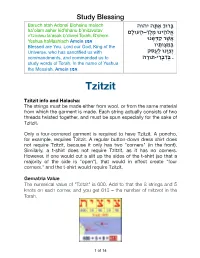
Study Blessing בָרוְ אַתָה יהוה Baruch atah Adonai Eloheinu melech אֱלהֵינו מֶלֶך–הָעולָם ha’olam asher kid’shanu b’mitzvotav v’tzivanu la’asok b’divrei Torah, B’shem אֲשֶר קדְשָנו אמן Yeshua haMashiach Amein בְמִצְותָיו Blessed are You, Lord our God, King of the וְצִוָנו לַעֲסק Universe, who has sanctified us with . בְדבְרי-תורה commandments, and commanded us to study words of Torah, In the name of Yeshua אמן the Messiah. Amein Tzitzit Tzitzit info and Halacha: The strings must be made either from wool, or from the same material from which the garment is made. Each string actually consists of two threads twisted together, and must be spun especially for the sake of Tzitzit. Only a four-cornered garment is required to have Tzitzit. A poncho, for example, requires Tzitzit. A regular button-down dress shirt does not require Tzitzit, because it only has two "corners" (in the front). Similarly, a t-shirt does not require Tzitzit, as it has no corners. However, if one would cut a slit up the sides of the t-shirt (so that a majority of the side is "open"), that would in effect create "four corners," and the t-shirt would require Tzitzit. Gematria Value The numerical value of "Tzitzit" is 600. Add to that the 8 strings and 5 knots on each corner, and you get 613 – the number of mitzvot in the Torah. #1 of #14 Prayer and Tzitzit: So the Shema has 3 parts to it, most of us coming into this walk only see the Shema as “Hear of Israel” the Shema prayer actually contains 3 parts: Part 1: Deuteronomy 6:4-9 4 "Hear O Israel, the Lord our God, the Lord is one. -

Meet Me at the Beth David Minyan! by Eleanor Weber Dickman in This Issue
November 2015 5776 Meet Me at the Beth David Minyan! By Eleanor Weber Dickman In This Issue: A minyan, as most people know, is a gathering of at least ten adults to worship or observe the death or the yahrzeit (anniversary) of a loved From the Rabbi one. Congregation Beth David is most fortunate in having a loyal cadre Page 3 of synagogue members who have made ongoing commitments to attend its daily minyanim. Minyan is held Monday through Thursday evenings at 7:00 pm, and Sunday mornings at 9:30 am, as well as during the reg- President’s ular Shabbat services on Friday nights (at 6:30pm), and Saturday morn- Perspective ings (at 9:30am). Page 5 It is comforting, even for those who do not attend services on a regular basis, to know that, in times of sorrow and loss, Beth David welcomes mem- Calendar bers and those from the community who wish to observe a yahrzeit. In addition, several members Pages 18 & 19 have made it a regular practice to attend these short but vital services even if they themselves are not observing a yahrzeit in order to provide a community for those who are grieving. November Anniversaries Beth David’s nightly minyan service is dependent upon the thoughtful- ness and commitment of all congregants, and enjoys the dedication of Page 29 several members who have made the minyan a regular part of their week. For their part, these attendees find meaning in the worship, as well as pleasure in being there to comfort friends, synagogue members, and Jews in the larger community. -

Jewish Traditions Regarding Death & Dying
JEWISH TRADITIONS REGARDING DEATH & DYING AS PRACTICED AT CONGREGATION SHAARIE TORAH Mourning and Bereavement Funerals Remembrance of the Dead January 2008 To the Members of Congregation Shaarie Torah The text you are about to read was prepared and researched by Cliff Hockley. To Cliff my personal thank you for allowing me as the new Rabbi to infuse this page prior to its publication. Cliff took an enormous amount of time and careful effort in documenting our Jewish Heritage and traditions. The following booklet codifies and discusses the many traditions we have in Judaism regarding illness, death, burial and mourning. From a Jewish perspective each one of these components make up the path, we as Jews follow. As a Kohen (a member of the Tribe of Levi and descendent of the children of Aaron) I am only to attend seven funerals, relatives (father, mother, wife, brother, son, daughter, and sister if she is not married; Code of Jewish Law, Yoreh Dayah, 373:3). Should a Kohen become “impure” by coming in contact with a deceased person, he would be required to follow a seven day cleansing process, including bringing a sacrifice. Since the requirement to offer sacrifices cannot be upheld since we longer have a functioning Temple in Jerusalem, all Kohanim of today are basically impure and would be null and void from ancient rituals. On festivals and holy days we still have the only opportunity to present the Kohen in a symbol of ritual by allowing them the “Blessing of the People”. Having explained the dilemma that any rabbi that is born a Kohen has in officiating congregational funerals, I am making every effort to officiate at funerals and unveilings without coming in contact with the deceased i.e. -

Copy of Sinai Mourner's Guide
WHAT TO DO FIRST WHEN A DEATH OCCURS ● Call your closest family members ● Contact the funeral home The funeral home will assist in all arrangements including transporting the body, locating a cemetery plot or arranging for cremation, and helping with a death notice and obituary. The funeral director will request: ● Information about the deceased, including both English and Hebrew names ● Social Security Number ● Date and place of birth and death ● Names and relationships of close relatives Jewish funeral homes serving the Chicago area are: Chicago Jewish Funerals Goldman Funeral Group Phone: (847) 229-8822 Phone: (847) 478-1600 Shalom Memorial Funeral Home Weinstein and Piser Funeral Home Phone: (847) 306-4928 Phone: (847) 256-5700 ● Call Chicago Sinai at (312) 867-7000. During office hours, tell the person answering the phone that there has been a death in your family. That person will assist you and connect you with one of the rabbis. After office hours, call the same number and listen to instructions for contacting the emergency contact, who will connect you with one of the rabbis. ● Designate a family member or friend who can make calls to other family and friends whom you want notified. INTRODUCTION This mourner’s guide is a resource for Chicago Sinai Congregation. We created it to help you understand Jewish funerals and mourning practices, whether you are pre-planning or have an immediate need. We hope this guide can help during by offering practical guidance on the choices to be made and the practices that may be followed when someone dies. There are traditional practices explained in this guide.