1975 The-Harradine-Affair-1959-1975.Pdf
Total Page:16
File Type:pdf, Size:1020Kb
Load more
Recommended publications
-

Z432 Waterside Workers' Federation of Australia, Federal Office Deposit
Z432 Waterside Workers’ Federation of Australia, Federal Office deposit 6 Download list Amended July 2008 _______________________________________________________________ ANU ARCHIVES PROGRAM Telephone: +61 2 6125 2219 Noel Butlin Archives Centre Facsimile: +61 2 6125 0140 Email: butlin.archives@anu.edu.au Incorporating the ANU Archives of Business & Labour Web: www.archives.anu.edu.au and the National AIDS Archive Collection WATERSIDE WORKERS FEDERATION Deposit No. Z432: Federal Office SITE LIST Receipt Dates Quantity Location 31 Mar 1992 5 cartons and 1 parcel (D1-D5) Stack 294-295 5 May 1992 12 cartons (D6-14) Stack 294-295 27 May 1992 9 cartons & 1 archives box (4-13) Stack 294-295 11 Nov 1992 69 cartons & 1 parcel (14-78) Stack 294-295 21 Dec 1992 2 cartons (80-81- No 79) Stack 294-295 18 May 1993 18 cartons Stack 294-295 13 Jul 1994 2 parcels Stack 294-295 13 Jun/23 Dec 1996 1 bundle (82-86) Stack 294-295 Notes: 31 Mar 1992 5 cartons and 1 parcel of donated ACTU material – circulars and Executive minutes (cartons D1 to D5) 5 May 1992 12 cartons containing donated material – newspaper clippings and ACTU Bulletins and Newsletters (cartons numbered D6 to D14) and copies of Port News in cartons 1-3 (Boxes 1-3) 27 May 1992 9 cartons and 1 archives box containing miscellaneous material, rules, instruction booklets, published histories, circulars and records of N. Docker. Records of CH Fitzgibbon were also sent, but these were removed to his personal collection at P101 (remaining cartons numbered Boxes 4-13) 11 Nov 1992 65 cartons and 1 parcel. -
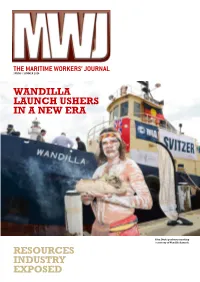
Wandilla Launch Ushers in a New Era Resources
THE MARITIME WORKERS’ JOURNAL SPRING / SUMMER 2014 WANDILLA LAUNCH USHERS IN A NEW ERA Glen Doyle performs smoking ceremony at Wandilla Launch. RESOURCES INDUSTRY EXPOSED p00_Cover.indd 1 19/11/13 9:07 AM CONTENTS 6 - 13 National Council: A meeting of minds 14 & 15 Chevron Campaign: BIS Shrapnel report shows resource industry loose with the truth 22 & 23 Vale Jimmy Tannock: Remembering retired National Deputy Secretary 35 Wandilla Launch: Tugboat signals beginning of new training initiative 41 Credit Union: MMPCU relocates as part of expansion 42 Financial Reports: MUA Concise Financial Report 2013 44 Dispute: Egyptian seafarers have a win in Kembla EDITOR IN CHIEF Paddy Crumlin COMMUNICATIONS DIRECTOR Jonathan Tasini EDITORIAL TEAM Ashleigh Telford Greig Kelbie DESIGN Magnesium Media PRINTER Printcraft Maritime Workers’ Journal 365-375 Sussex Street Sydney NSW 2000 Contact: 9267 - 9134 Fax: 9261 - 3481 Email: journal@mua.org.au Website: http://www.mua.org.au MWJ reserves the right at all times to edit and/or reduce any articles or letters to be published. Publication No: 1235 MUA members out in force to celebrate World Maritime Day at the For all story ideas, letters, obituaries please email Australian National Maritime Museum on Darling Harbour. journal@mua.org.au LOGGING ON LOGGING ON world economy down the toilet. The company negotiated an EBA without and Port of Convenience campaigns are Who knows really, because the Libs never telling its workforce what it was up to. illustrative of the capacity of international LOGGING had to say anything in opposition? The little Patrick, then, compounded this moral lapse maritime workers to effectively network in time Abbott has been in office doesn’t look by using a type of guerrilla management pursuing justice and accountability in the promising, though. -

Condolence Motion
CONDOLENCE MOTION 7 May 2014 [3.38 p.m.] Mr BARNETT (Lyons) - I stand in support of the motion moved by the Premier and support entirely the views expressed by the Leader for the Opposition and the member for Bass, Kim Booth. As a former senator, having worked with Brian Harradine in his role as a senator, it was a great privilege to know him. He was a very humble man. He did not seek publicity. He was honoured with a state funeral, as has been referred to, at St Mary's Cathedral in Hobart on Wednesday, 23 April. I know that many in this House were there, including the Premier and the Leader of the Opposition, together with the former Prime Minister, the Honourable John Howard, and also my former senate colleague, Don Farrell, a current senator for South Australia because Brian Harradine was born in South Australia and had a background with the Shop, Distributive and Allied Employees Association. Both gentlemen had quite a bit in common. They knew each other well and it was great to see Don Farrell again and catch up with him. He served as an independent member of parliament from 1975 to 2005, so for some 30 years, and was father of the Senate. Interestingly, when he concluded in his time as father of the Senate, a former senator, John Watson, took over as father of the Senate. Brian Harradine was a values- driven politician and he was a fighter for Tasmania. The principal celebrant at the service was Archbishop Julian Porteous and he did a terrific job. -
'Not One Pound of Wheat Will Go': Words and Actions
8. ‘Not one pound of wheat will go’: Words and actions The Holstein Express was crewed by Indonesian seamen, but it sailed under a Liberian flag.1 Its Australian agents, Dalgety and Patricks, had been charged with the shipment of 600 dairy cows to Chile. In the week of 4 December 1978, the ship attempted to dock in Newcastle to load but was black banned by Australian workers. Union members would not assist with loading the cargoes. They simply refused. After discussion between the workers’ representatives and the agents, it was agreed that the ship could anchor outside the harbour in Stockton Bight and receive water and stores.2 It remained off Newcastle for two weeks.3 In stop-work meetings on 19 December 1978, the Sydney, Port Kembla, Port Adelaide and Victorian branches of the SUA all passed motions of support for the actions of their Newcastle branch.4 And shortly thereafter a white flag was raised by the owners in the form of a communiqué shown to the maritime unions that the ship would depart for New Zealand without cattle if it was able to refuel. The maritime unions allowed the ship to dock and refuel and it set off on 22 December 1978, apparently without cows and apparently for New Zealand. The company was in the middle of a goosestep that spanned the State. The next day, Don Henderson, secretary of the Firemen and Deckhands’ Union, was urgently advised that the ship was in fact at the southern NSW town of Eden loading hay and cattle.5 The union delegate at Eden was contacted and subsequently the local fishermen who had been hired to load the cattle stopped work.6 The ship’s crew and the vendors were forced to load the cattle themselves and the vessel departed for New Zealand on Sunday, 24 December 1978. -
2009 Annual Report 25 Years of Linking Australian Workers with the World Executive Officer’S Report
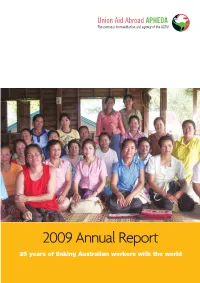
Union Aid Abroad APHEDA The overseas humanitarian aid agency of the ACTU 2009 Annual Report 25 years of linking Australian workers with the world Executive Officer’s Report Union Aid Abroad – APHEDA was established in 1984 by the ACTU under the name APHEDA (Australian People for Union Aid Abroad – APHEDA Health, Education and Development Abroad) as the Australian union movement’s celebrates 25 years overseas aid arm. We assist projects in South East Asia, the of international solidarity. Pacific, the Middle East and southern Africa, working through local partner organisations and unions to deliver training in vocational skills, health and workers’ rights so women and men may commitment to assisting for workers, especially for have decent work that provides other workers in greater women workers, for a living wage, reasonable need. Their generous disabled youth and for conditions and a safe support is a tribute to their trafficked women. workplace. Our international program seeks to empower belief in justice and a fair go women and men in developing for all. Thanks to donors and countries so they and their partners families might live with their Decent Work essential None of this training is human rights respected, both to overcome poverty possible, of course, without in their workplace and in their society. The ILO, the global union two very special groups of As Union Aid Abroad – movement and the ACTU people – our donors and OUR MISSION APHEDA celebrates 25 all advocate Decent Work our partners. Without the As the ACTU’s humanitarian aid agency, Union Aid Abroad years of international as essential to overcoming generous and growing – APHEDA expresses the solidarity on behalf of the poverty. -

ANTI-COMMUNISM in TASMANIA in the LATE 1950S with SPECIAL REFERENCE to the HURSEY CASE
ANTI-COMMUNISM IN TASMANIA IN THE LATE 1950s WITH SPECIAL REFERENCE TO THE HURSEY CASE Peter D. Jones M.A. (Oxon.), Dip.Ed. (Oxon.) Submitted in fulfilment of the requirements for the degree of Master of Humanities December 1995 UNIVERSITY OF TASMANIA This thesis contains no material which has been accepted for a degree or diploma by the University or any other institution, except by way of background information and duly acknowledged in the Thesis, and to the best of my knowledge and belief no material previously published or written by another person except when due acknowledgement is made in the text of the Thesis. This thesis may be made available for loan and limited copying in accordance with the Copyright Act 1968. SYNOPSIS. While the strength of the Democratic Labor Party (DLP) was concentrated in Victoria, Tasmania was also significant for several reasons : it was the electoral base of Senator George Cole, the DLP's leader in the Senate up to 1964; Hobart was the venue of the ALP Federal Conference when the Split occurred in 1955; and it was the only state with a Labor Government throughout the Menzies years. While the Anti-Communist Labour Party, later the DLP, contested all State and Federal elections after 1956, they failed to make significant inroads into the ALP vote, although Senator George Cole (first elected on the ALP ticket in 1949) was able to maintain his Senate seat until 1964 - largely because of the Tasmanian tradition of voting for personalities rather than ideologies. The DLP vote in both State and Federal elections failed to affect the overall results, except in the 1959 state election, when DLP preferences in Franklin gave an extra unexpected extra seat to the Liberal Party and resulted in a situation where two Independents held the balance of power. -

Irsgeneraldistributionpaper July 03
INFORMATION, ANALYSIS AND ADVICE FOR THE PARLIAMENT INFORMATION AND RESEARCH SERVICES Chronology No. 3 2003–04 Telstra Sale: Background and Chronology This chronology outlines the history of the Telstra privatisation process. It documents some of the key dates and policy processes associated with the first and second tranche sales of Telstra. It also outlines some of the key inquiries and legislative conditions required for each stage of the sale. Grahame O'Leary Economics, Commerce and Industrial Relations Group 15 September 2003 DEPARTMENT OF THE PARLIAMENTARY LIBRARY ISSN 1442-1992 Copyright Commonwealth of Australia 2003 Except to the extent of the uses permitted under the Copyright Act 1968, no part of this publication may be reproduced or transmitted in any form or by any means including information storage and retrieval systems, without the prior written consent of the Department of the Parliamentary Library, other than by Senators and Members of the Australian Parliament in the course of their official duties. This paper has been prepared for general distribution to Senators and Members of the Australian Parliament. While great care is taken to ensure that the paper is accurate and balanced, the paper is written using information publicly available at the time of production. The views expressed are those of the author and should not be attributed to the Information and Research Services (IRS). Advice on legislation or legal policy issues contained in this paper is provided for use in parliamentary debate and for related parliamentary purposes. This paper is not professional legal opinion. Readers are reminded that the paper is not an official parliamentary or Australian Government document. -

Independents in Australian Parliaments
The Age of Independence? Independents in Australian Parliaments Mark Rodrigues and Scott Brenton* Abstract Over the past 30 years, independent candidates have improved their share of the vote in Australian elections. The number of independents elected to sit in Australian parliaments is still small, but it is growing. In 2004 Brian Costar and Jennifer Curtin examined the rise of independents and noted that independents ‘hold an allure for an increasing number of electors disenchanted with the ageing party system’ (p. 8). This paper provides an overview of the current representation of independents in Australia’s parliaments taking into account the most recent election results. The second part of the paper examines trends and makes observations concerning the influence of former party affiliations to the success of independents, the representa- tion of independents in rural and regional areas, and the extent to which independ- ents, rather than minor parties, are threats to the major parities. There have been 14 Australian elections at the federal, state and territory level since Costar and Curtain observed the allure of independents. But do independents still hold such an allure? Introduction The year 2009 marks the centenary of the two-party system of parliamentary democracy in Australia. It was in May 1909 that the Protectionist and Anti-Socialist parties joined forces to create the Commonwealth Liberal Party and form a united opposition against the Australian Labor Party (ALP) Government at the federal level.1 Most states had seen the creation of Liberal and Labor parties by 1910. Following the 1910 federal election the number of parties represented in the House * Dr Mark Rodrigues (Senior Researcher) and Dr Scott Brenton (2009 Australian Parliamentary Fellow), Politics and Public Administration Section, Australian Parliamentary Library. -

The Waterside Workers' Federation Film Unit, 1953 - 1958
University of Wollongong Thesis Collections University of Wollongong Thesis Collection University of Wollongong Year ’We film the facts’: the Waterside Workers’ Federation film unit, 1953 - 1958 Lisa Milner University of Wollongong Milner, Lisa, ’We film the facts’: the Waterside Workers’ Federation film unit, 1953 - 1958, PhD thesis, Communication and Cultural Studies Program, University of Wollongong, 2000. http://ro.uow.edu.au/theses/580 This paper is posted at Research Online. http://ro.uow.edu.au/theses/580 'We Film the Facts': The Waterside Workers' Federation Film Unit, 1953 - 1958 A thesis submitted in fulfilment of the requirements for the award of the degree DOCTOR OF PHILOSOPHY from UNIVERSITY OF WOLLONGONG by Lisa Milner BA (Hons) Communication and Cultural Studies Program 2000 DEDICATION To the memory of Keith Gow (1921-1987) Contents Abstract Acknowledgments ii List of Abbreviations iii Note to the Reader iv List of Illustrations v Prologue: Scepticism and the Film Historian 1 Chapter One: Getting the Message Across: A History of the WWFFU 9 Formation 11 Production 15 Distribution and Exhibition 29 Reviews 42 Re-uses 46 Chapter Two: Blurred Boundaries: Theoretical Approaches 54 Cinema Studies 55 Labour History 60 Cultural Studies 65 Chapter Three: Context: Sydney in the 1950s 76 General Conditions 78 Industrial Context 86 Cultural Context 97 Sydney Screen Culture 121 Chapter Four: Three Films: Case Studies 136 The Hungry Miles 136 Hewers of Coal 158 Not Only the Need 174 Chapter Five: Reflections 194 Thesis Resonances 194 Class and the WWFFU 197 National Identity and the WWFFU 202 Why did the Unit's Work End? 204 Rethinking History and 'Filming the Facts' 208 Appendix A: Filmography 216 Appendix B: Biographies of the WWFFU filmmakers 242 Appendix C: List of Personal Interviews 244 Appendix D: The Wharfies' Film Unit. -

Oh 955 Nick Minchin
STATE LIBRARY OF SOUTH AUSTRALIA J. D. SOMERVILLE ORAL HISTORY COLLECTION OH 955 Full transcript of an interview with Nick Minchin on 19 October 2010 By Susan Marsden for the EMINENT AUSTRALIANS ORAL HISTORY PROJECT Recording available on CD Access for research: Unrestricted Right to photocopy: Copies may be made for research and study Right to quote or publish: Publication only with written permission from the State Library OH 955 NICK MINCHIN NOTES TO THE TRANSCRIPT This transcript was created by the J. D. Somerville Oral History Collection of the State Library. It conforms to the Somerville Collection's policies for transcription which are explained below. Readers of this oral history transcript should bear in mind that it is a record of the spoken word and reflects the informal, conversational style that is inherent in such historical sources. The State Library is not responsible for the factual accuracy of the interview, nor for the views expressed therein. As with any historical source, these are for the reader to judge. It is the Somerville Collection's policy to produce a transcript that is, so far as possible, a verbatim transcript that preserves the interviewee's manner of speaking and the conversational style of the interview. Certain conventions of transcription have been applied (ie. the omission of meaningless noises, false starts and a percentage of the interviewee's crutch words). Where the interviewee has had the opportunity to read the transcript, their suggested alterations have been incorporated in the text (see below). On the whole, the document can be regarded as a raw transcript. -
Proportional Representation in Theory and Practice the Australian Experience
Proportional Representation in Theory and Practice The Australian Experience Glynn Evans Department of Politics and International Relations School of Social Sciences The University of Adelaide June 2019 Table of Contents Abstract ii Statement of Authorship iii Acknowledgements iv Preface vi 1. Introduction 1 2. District Magnitude, Proportionality and the Number of 30 Parties 3. District Magnitude and Partisan Advantage in the 57 Senate 4. District Magnitude and Partisan Advantage in Western 102 Australia 5. District Magnitude and Partisan Advantage in South Eastern Jurisdictions 132 6. Proportional Representation and Minor Parties: Some 170 Deviating Cases 7. Does Proportional Representation Favour 204 Independents? 8. Proportional Representation and Women – How Much 231 Help? 9. Conclusion 247 Bibliography 251 Appendices 260 i Abstract While all houses of Australian parliaments using proportional representation use the Single Transferable Vote arrangement, district magnitudes (the numbers of members elected per division) and requirements for casting a formal vote vary considerably. Early chapters of this thesis analyse election results in search for distinct patterns of proportionality, the numbers of effective parties and partisan advantage under different conditions. This thesis argues that while district magnitude remains the decisive factor in determining proportionality (the higher the magnitude, the more proportional the system), ballot paper numbering requirements play a more important role in determining the number of (especially) parliamentary parties. The general pattern is that, somewhat paradoxically, the more freedom voters have to choose their own preference allocations, or lack of them, the smaller the number of parliamentary parties. Even numbered magnitudes in general, and six member divisions in particular, provide some advantage to the Liberal and National Parties, while the Greens are disadvantaged in five member divisions as compared to six or seven member divisions. -

Official Hansard No
COMMONWEALTH OF AUSTRALIA PARLIAMENTARY DEBATES SENATE Official Hansard No. 6, 2003 WEDNESDAY, 18 JUNE 2003 FORTIETH PARLIAMENT FIRST SESSION—FIFTH PERIOD BY AUTHORITY OF THE SENATE INTERNET The Journals for the Senate are available at: http://www.aph.gov.au/senate/work/journals/index.htm Proof and Official Hansards for the House of Representatives, the Senate and committee hearings are available at: http://www.aph.gov.au/hansard SITTING DAYS—2003 Month Date February 4, 5, 6 March 3, 4, 5, 6, 18, 19, 20, 24, 25, 26, 27 May 13, 14, 15 June 16, 17, 18, 19, 23, 24, 25, 26 August 11, 12, 13, 14, 18, 19, 20, 21 September 8, 9, 10, 11, 15, 16, 17, 18 October 7, 8, 9, 13, 14, 15, 16, 27, 28, 29, 30 November 3, 4, 24, 25, 26, 27 December 1, 2, 3, 4 RADIO BROADCASTS Broadcasts of proceedings of the Parliament can be heard on the following Parliamentary and News Network radio stations, in the areas identified. CANBERRA 1440 AM SYDNEY 630 AM NEWCASTLE 1458 AM BRISBANE 936 AM MELBOURNE 1026 AM ADELAIDE 972 AM PERTH 585 AM HOBART 729 AM DARWIN 102.5 FM CONTENTS WEDNESDAY, 18 JUNE Australian Security Intelligence Organisation Legislation Amendment (Terrorism) Bill 2002 [No. 2]— In Committee................................................................................................................ 11793 Matters of Public Interest— Queensland Government .............................................................................................. 11831 Environment: Great Barrier Reef Marine Park Authority ...........................................