Anatomia Foliar De Espécies De Flacourtiaceae
Total Page:16
File Type:pdf, Size:1020Kb
Load more
Recommended publications
-

Edaphic Factors and the Landscape-Scale Distributions of Tropical Rain Forest Trees
Ecology, 80(8), 1999, pp. 2662±2675 q 1999 by the Ecological Society of America EDAPHIC FACTORS AND THE LANDSCAPE-SCALE DISTRIBUTIONS OF TROPICAL RAIN FOREST TREES DAVID B. CLARK,1,3 MICHAEL W. P ALMER,2 AND DEBORAH A. CLARK1 1Department of Biology, University of Missouri, 8001 Natural Bridge Road, St. Louis, Missouri 63121 USA 2Department of Botany, Oklahoma State University, Stillwater, Oklahoma 74078 USA Abstract. Tropical rain forests have the highest tree diversity on earth. Nonrandom spatial distributions of these species in relation to edaphic factors could be one mechanism responsible for maintaining this diversity. We examined the prevalence of nonrandom dis- tributions of trees and palms in relation to soil type and topographic position (``edaphic biases'') over a mesoscale (573 ha) old-growth tropical rain forest (TRF) landscape at the La Selva Biological Station, Costa Rica. All trees and palms $10 cm diameter were mea- sured and identi®ed in 1170 circular 0.01-ha plots centered on an existing 50 3 100 m grid. Topographic position was classi®ed for each plot, and slope and aspect were measured. Soil type data were taken from a previous study (Clark et al. 1998). A total of 5127 trees and palms were identi®ed in 267 species. Detrended Correspondence Analysis and Canon- ical Correspondence Analysis showed that highly signi®cant edaphic gradients were present, with swamp or highly fertile soils separated from the less fertile, well-drained upland soils. Species composition remained signi®cantly related to topographic position when soil type was controlled for. The main ¯oristic gradients were still signi®cant when ¯ooded sites were excluded from the analyses. -
Chec List What Survived from the PLANAFLORO Project
Check List 10(1): 33–45, 2014 © 2014 Check List and Authors Chec List ISSN 1809-127X (available at www.checklist.org.br) Journal of species lists and distribution What survived from the PLANAFLORO Project: PECIES S Angiosperms of Rondônia State, Brazil OF 1* 2 ISTS L Samuel1 UniCarleialversity of Konstanz, and Narcísio Department C.of Biology, Bigio M842, PLZ 78457, Konstanz, Germany. samuel.carleial@gmail.com 2 Universidade Federal de Rondônia, Campus José Ribeiro Filho, BR 364, Km 9.5, CEP 76801-059. Porto Velho, RO, Brasil. * Corresponding author. E-mail: Abstract: The Rondônia Natural Resources Management Project (PLANAFLORO) was a strategic program developed in partnership between the Brazilian Government and The World Bank in 1992, with the purpose of stimulating the sustainable development and protection of the Amazon in the state of Rondônia. More than a decade after the PLANAFORO program concluded, the aim of the present work is to recover and share the information from the long-abandoned plant collections made during the project’s ecological-economic zoning phase. Most of the material analyzed was sterile, but the fertile voucher specimens recovered are listed here. The material examined represents 378 species in 234 genera and 76 families of angiosperms. Some 8 genera, 68 species, 3 subspecies and 1 variety are new records for Rondônia State. It is our intention that this information will stimulate future studies and contribute to a better understanding and more effective conservation of the plant diversity in the southwestern Amazon of Brazil. Introduction The PLANAFLORO Project funded botanical expeditions In early 1990, Brazilian Amazon was facing remarkably in different areas of the state to inventory arboreal plants high rates of forest conversion (Laurance et al. -

Plants and Gall Hosts of the Tirimbina Biological Reserve
DOI 10.15517/RBT.V67I2SUPL.37233 Artículo Plants and gall hosts of the Tirimbina Biological Reserve, Sarapiqui, Costa Rica: Combining field sampling with herbarium records Plantas y hospederos de agallas de la Reserva Biológica Tirimbina, Sarapiquí, Costa Rica: combinando muestras del campo con registros del herbario Juan Manuel Ley-López1 José González2 Paul E. Hanson3* 1 Departamento Académico, Reserva Biológica Tirimbina. Sarapiquí, Heredia, Costa Rica; juanmacrbiol@gmail.com 2 Independent consultant, Costa Rica; jagragave@gmail.com 3 Escuela de Biología, Universidad de Costa Rica; San Pedro, 11501-2060 San José, Costa Rica; phanson91@gmail.com * Correspondence Received 03-X-2018 Corrected 10-I-2018 Accepted 24-I-2019 Abstract There has been an increasing number of inventories of gall-inducing arthropods in the Neotropics. Nonetheless, very few inventories have been carried out in areas where the flora is well documented, and records of galls from herbaria and sites outside the study area have seldom been utilized. In this study we provide a checklist of the native vascular plants of a 345 ha forest reserve in the Caribbean lowlands of Costa Rica and document which of these plants were found to harbor galls. The gall surveys were carried out between November 2013 and December 2016. We also cross-checked our plant list with the previous gall records from elsewhere in the country and searched for galls on herbarium specimens of dicots reported from the reserve. In total, we recorded 143 families and 1174 plant species, of which 401 were hosts of galls. Plant hosts of galls were found in the following non-mutually exclusive categories: 209 in our field sampling, 257 from previous records, and 158 in herbarium specimens. -

Variation in Potential for Isoprene Emissions Among Neotropical Forest Sites
Global Change Biology (2004) 10, 1–21, doi: 10.1111/j.1529-8817.2003.00760.x Variation in potential for isoprene emissions among Neotropical forest sites PETER HARLEY*,Pe´ ROLA VASCONCELLOSw , LEE VIERLINGz, CARLOS CLEOMIR DE S. PINHEIRO§, JAMES GREENBERG*, ALEX GUENTHER*,LEEKLINGER*, SAMUEL SOARES DE ALMEIDA} ,DAVIDNEILLk**,TIMBAKERww, OLIVER PHILLIPSww and YADVINDER MALHIzz *Atmospheric Chemistry Division, National Center for Atmospheric Research (NCAR), 1850 Table Mesa Drive, Boulder, CO 80307- 3000, USA, wDepartamento de Quı´mica e Meio Ambiente, Instituto de Pesquisas Energe´ticas e Nucleares (IPEN), Sa˜o Paulo, Brazil, zInstitute of Atmospheric Sciences, South Dakota School of Mines and Technology, Rapid City, SD, USA, §Instituto Nacional de Pesquisas da Amazoˆnia (INPA), Manaus, Brazil, }Museu Paraense Emilio Goeldi, Bele´m, Brazil, k Missouri Botanical Garden, St Louis, MO, USA, **Herbario Nacional del Ecuador, Quito, Ecuador, wwCentre for Biodiversity and Conservation, School of Geography, University of Leeds, UK, zzInstitute of Ecology and Resource Management, University of Edinburgh, UK Abstract As part of the Large Scale Biosphere–Atmosphere Experiment in Amazoˆnia (LBA), we have developed a bottom-up approach for estimating canopy-scale fluxes of isoprene. Estimating isoprene fluxes for a given forest ecosystem requires knowledge of foliar biomass, segregated by species, and the isoprene emission characteristics of the individual tree species comprising the forest. In this study, approximately 38% of 125 tree species examined at six sites in the Brazilian Amazon emitted isoprene. Given logistical difficulties and extremely high species diversity, it was possible to screen only a small percentage of tree species, and we propose a protocol for estimating the emission capacity of unmeasured taxa using a taxonomic approach, in which we assign to an unmeasured genus a value based on the percentage of genera within its plant family which have been shown to emit isoprene. -
2002 Compendium of Philippine Environment Statistics
Compendium of Philippine Environment Statistics 2002 Republika ng Pilipinas PAMBANSANG LUPON SA UGNAYANG PANG-ESTADISTIKA (NATIONAL STATISTICAL COORDINATION BOARD) November 2002 The Compendium of Philippine Environment Statistics (CPES) 2002 is a publication prepared by the Environment Accounts Division of the Economic Statistics Office of the NATIONAL STATISTICAL COORDINATION BOARD (NSCB). For technical inquiries, please direct calls at: (632) 899-3444. Please direct your subscription and inquiries to the: NATIONAL STATISTICAL INFORMATION CENTER National Statistical Coordination Board Ground Floor Midland Buendia Bldg., 403 Sen. Gil J. Puyat Avenue, Makati City Tel nos.: Telefax nos.: (632) 895-2767 (632) 890-8456 (632) 890-9405 e-mail address: info@nscb.gov.ph (peenra@nscb.gov.ph) (epl.dee@nscb.gov.ph) website: http://www.nscb.gov.ph The NSIC is a one-stop shop of statistical information and services in the Philippines. Compendium of Philippine Environment Statistics 2002 November 2002 Republika ng Pilipinas PAMBANSANG LUPON SA UGNAYANG PANG-ESTADISTIKA (NATIONAL STATISTICAL COORDINATION BOARD) FOREWORD This is the second edition of the Compendium of Philippine Environment Statistics. The compendium is a compilation of statistical information collected from data produced by various government agencies and from data available in different statistical publications. The compilation of statistical data in this compendium is based on the Philippine Framework of Environment Statistics (PFDES) which in turn is based on the United Nations Framework for the Development of Environment Statistics. It covers data for the period 1992 to 2000, whenever possible. Latest figures presented vary depending on the availability of data. The PFDES provides a systematic approach to the development of environment statistics and is an instrument for compiling and integrating data coming from various data collecting institutions to make them more useful in the formulation and evaluation of socio-economic and environmental programs and policies. -
Nepenthes Maximoides (Nepenthaceae) a New, Critically Endangered (Possibly Extinct) Species in Sect
bioRxiv preprint doi: https://doi.org/10.1101/2020.06.27.175182; this version posted June 29, 2020. The copyright holder for this preprint (which was not certified by peer review) is the author/funder. All rights reserved. No reuse allowed without permission. Nepenthes maximoides (Nepenthaceae) a new, Critically Endangered (Possibly Extinct) species in Sect. Alatae from Luzon, Philippines showing striking pitcher convergence with N. maxima (Sect. Regiae) of Indonesia. Charles King¹, Martin Cheek¹ ¹Science, Royal Botanic Gardens, Kew, Richmond, Surrey, U.K. Email address: m.cheek@kew.org ABSTRACT Nepenthes maximoides sp. nov. (Sect. Alatae) is described and assessed as Critically Endangered (Possibly Extinct) from Luzon, Philippines and appears unrecorded in 110 years. The spectacular, large, narrowly funnel-shaped upper pitchers, lids with recurved basal, and filiform apical appendages, unlike any other species in the Philippines, closely resemble those of N. maxima (Sect. Regiae) of Sulawesi-New Guinea, likely due to convergent evolution. Following recent phylogenomic analysis, sect. Alatae is divided into two, Sect. Alatae sensu stricto of Luzon to Sibuyan (including N. maximoides), and Sect. Micramphorae, expanded and recircumscribed to encompass those species of the southern Visayas, and Mindanao. A key is provided to the six species now recognised in the narrowly recircumscribed Sect. Alatae. The number of Nepenthes species recorded from Luzon has increased from two in 2001, to eight in 2020, all but one of which are endemic to that island, and four of which appear to be point endemics. Key words. Mt Banahaw, H.M.Curran, Extinct, Tayabas Province INTRODUCTION This paper is one in a series leading to a monograph of the genus Nepenthes building on a skeletal revision of the genus (Jebb & Cheek, 1997) and the account for Flora Malesiana (Cheek & Jebb, 2001). -
Acetolysed Thin Layer Of
Pollen morphology of the genus Hydnocarpus (Flacourtiaceae) with notes on related genera J. Schaeffer Rijksherbarium, Leiden Contents Summary 65 I Introduction 65 II General morphology 66 III Systematic descriptions 66 IV Pollen types 76 Pollen and V morphology taxonomy 77 References 79 Summary Pollen of ofthe described. Two grains 34 species genus Hydnocarpus(Flacourtiaceae) are pollen types, one of which is subdivided in two subtypes, are distinguished. Within Flacourtiaceae the pollen of Hydnocarpus In is more or less isolated, but the related genus Chlorocarpa has rather similar pollen. sculpture there exists some resemblance to Paropsia (Passifloraceae). I. Introduction The present study forms part of a general pollenmorphological survey of the family Flacourtiaceae, initiated at the Rijksherbarium in collaboration with Dr. H. Sleumer. The selected for the first detailed because genus Hydnocarpus was study it proved to have rather characteristic pollen types and is concentrated in SE. Asia and the Malesian region. Moreover, an adequate amountof well-determinedmaterial as well as a recent revision ot In the genus (Sleumer, 1954) were available. total 34 species could be investigated, of the total numberof known. representing 85 % species In addition, the pollen of a large other number of Flacourtiaceae was cursorily examined, in order to asses the pollen of within the morphological relationships Hydnocarpus family. The pollen of the genera and which resemble that of described Neoptychocarpus Chlorocarpa, Hydnocarpus most, is in more detail. Erdtman described Previously, only (1952) has, very briefly, the pollen of Hydnocarpus rather the elmeri which, however, proved to be atypical of genus. The pollen material was acetolysed for two minutes, mounted in glycerin jelly and photographed with a Leitz apochromatic OI objective (90/1.40). -
00008-2004 ( .Pdf )
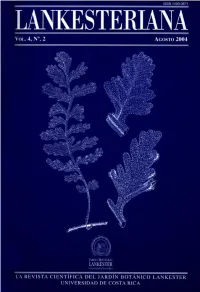
ISSN 1409-3871 LANKESTERIANA VOL. 4, Nº. 2 AGOSTO 2004 Fritz Hamer. In memoriam CARLOS OSSENBACH 101 Scaphosepalum manningii Luer (Orchidaceae: Pleurothallidinae), a new species for Costa Rica STIG DALSTRÖM 105 A new species of Stanhopea (Orchidaceae) from Peru RUDOLF JENNY 109 Lista con anotaciones de las Angiospermas de la Reserva Biológica Alberto Brenes (microcuencas de lo Ríos San Lorenzo y San Lorencito),Costa Rica JORGE GÓMEEZ-LAURITO & RODOLFO ORTIZ 113 Una nueva especie de Hymenophyllum y una variedad nueva de Trichomanes collariatum Bosch (Filicales: Hymenophyllaceae) en Costa Rica ALEXANDER FCO. ROJAS ALVARADO 143 Un nuevo híbrido de Tectaria (Filicales: Tectariaceae) en Costa Rica ALEXANDER FCO. ROJAS ALVARADO 149 Botánica y numismática: las plantas en las monedas de Costa Rica (1709-2004) JOSÉ A. VARGAS ZAMORA & ORGE GÓMEEZ-LAURITO 155 Reseñas de libros 169 LA REVISTA CIENTÍFICA DEL JARDÍN BOTÁNICO LANKESTER UNIVERSIDAD DE COSTA RICA LANKESTERIANA LA REVISTA CIENTÍFICA DEL JARDÍN BOTÁNICO LANKESTER UNIVERSIDAD DE COSTA RICA Copyright © 2003 Jardín Botánico Lankester, Universidad de Costa Rica Fecha efectiva de publicación / Effective publication date: 27 de octubre del 2003 Diagramación: Jardín Botánico Lankester Imprenta: Litografía Ediciones Sanabria S.A. Tiraje: 500 copias Impreso en Costa Rica / Printed in Costa Rica R Lankesteriana / La revista científica del Jardín Botánico Lankester, Universidad de Costa Rica. No. 1 (2001)-- . -- San José, Costa Rica: Editorial Universidad de Costa Rica, 2001-- v. ISSN-1409-3871 1. Botánica - Publicaciones periódicas, 2. Publicaciones periódicas costarricenses LANKESTERIANA 4(2): 101-104. 2004. FRITZ HAMER (1912-2004) – IN MEMORIAM – CARLOS OSSENBACH Investigador Asociado, Jardín Botánico Lankester, Universidad de Costa Rica P.O. -

A New Miocene Malpighialean Tree from Panama
Rodriguez-ReyesIAWA Journal et al. – New38 (4), Miocene 2017: malpighialean437–455 wood 437 Panascleroticoxylon crystallosa gen. et sp. nov.: a new Miocene malpighialean tree from Panama Oris Rodriguez-Reyes1, 2, Peter Gasson3, Carolyn Thornton4, Howard J. Falcon-Lang5, and Nathan A. Jud6 1Smithsonian Tropical Research Institute, Box 0843-03092, Balboa, Ancón Republic of Panamá 2Facultad de Ciencias Naturales, Exactas y Tecnología, Universidad de Panamá, Apartado 000 17, Panamá 0824, Panamá 3Jodrell Laboratory, Royal Botanic Gardens, Kew, Richmond, Surrey TW9 3DS, United Kingdom 4Florissant Fossil Beds National Monument, P.O. Box 185, 15807 Teller County Road 1, Florissant, CO 80816, U.S.A. 5Department of Earth Sciences, Royal Holloway, University of London, Egham, Surrey TW20 0EX, United Kingdom 6L.H. Bailey Hortorium, Department of Plant Biology, 412 Mann Library Building, Cornell University, Ithaca, NY 14853, U.S.A. *Corresponding author; e-mail: orisrodriguez@gmail.com ABSTRACT We report fossil wood specimens from two Miocene sites in Panama, Central America: Hodges Hill (Cucaracha Formation; Burdigalian, c.19 Ma) and Lago Alajuela (Alajuela Formation; Tortonian, c.10 Ma), where material is preserved as calcic and silicic permineralizations, respectively. The fossils show an unusual combination of features: diffuse porous vessel arrangement, simple perforation plates, alternate intervessel pitting, vessel–ray parenchyma pits either with much reduced borders or similar to the intervessel pits, abundant sclerotic tyloses, rays markedly heterocellular with long uniseriate tails, and rare to absent axial parenchyma. This combination of features allows assignment of the fossils to Malpighiales, and we note similarities with four predominantly tropical families: Salicaceae, Achariaceae, and especially, Phyllanthaceae, and Euphorbiaceae. -
JAROSLAV SOUKUP SDB. Jaroslav SOUKUP SDB
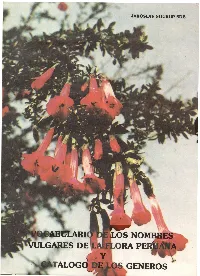
JAROSLAV SOUKUP SDB. JAROSlAV SOUKUP SDB. VOCABULARIO DE LOS NOMBRES VULGARES DE LA FLORA PERUANA· y CATALOGO DE LOS GENEROS EDITORIAL SALESIANA - LIMA PERU Preliminar La presente edición es la fusión corregida y aumentada del "Vocabulario" pu blicado en 1970 y de "Genera Peruviana", publicado en "Raymondiana" vol.3 pp.5-97, de fecha Diciembre de 1970. La primera edición del vocabulario tenía 1360 géneros con más de 4900 nombres populares. La presente edición sobre pasa los 2700 géneros y unos 6300 nombres vulgares. Se ha suprimido la Bibliografíay los pocos grabados pues requerfan unas 200 páginas más. Los interesados en la Bibliografía empleada la pueden encontrar casi en su totalidad en "Biota", vo/umenes /-IX. (1954-1979.) Notas En algunas familias, a continuación del nombre, hay entre paréntesis, dos nú meros: el primero indica el número de géneros que contiene la f ami/ia, y el otro el número de las especies conocidas. En los géneros, el primer número indica el total de especies descritas y el se gundo las que se han encontrado en el Perú. Si en Jugar del segundo número se encuentra un signo de interrogación, sig nifica que se desconoce el número de ellas en el Perú. En algunos casos, el nombre popular está seguido de una vocal entre parén tesis; esto indica que se pueden usar ambas formas, sin cambio de signmcado: conuca(o), Jo mismo es conuca o conuco; ckagne(i) Igual ckagne o ckagni. Para los nombres populares de la Amazonía peruana, nos fue útil el "Vocabu lario del Oriente Peruano" de Enrique Tovar (1888-1947) publicado en 1966. -

Multilayered Structure of Tension Wood Cell Walls in Salicaceae Sensu Lato
Multilayered structure of tension wood cell walls in Salicaceae sensu lato and its taxonomic significance Barbara Ghislain, Eric-André Nicolini, Raïssa Romain, Julien Ruelle, Arata Yoshinaga, Mac H. Alford, Bruno Clair To cite this version: Barbara Ghislain, Eric-André Nicolini, Raïssa Romain, Julien Ruelle, Arata Yoshinaga, et al.. Mul- tilayered structure of tension wood cell walls in Salicaceae sensu lato and its taxonomic significance. Botanical Journal of the Linnean Society, Linnean Society of London, 2016, 182 (4), pp.744-756. 10.1111/boj.12471. hal-01392845 HAL Id: hal-01392845 https://hal.archives-ouvertes.fr/hal-01392845 Submitted on 4 Nov 2016 HAL is a multi-disciplinary open access L’archive ouverte pluridisciplinaire HAL, est archive for the deposit and dissemination of sci- destinée au dépôt et à la diffusion de documents entific research documents, whether they are pub- scientifiques de niveau recherche, publiés ou non, lished or not. The documents may come from émanant des établissements d’enseignement et de teaching and research institutions in France or recherche français ou étrangers, des laboratoires abroad, or from public or private research centers. publics ou privés. Multilayered structure of tension wood cell walls in Salicaceae sensu lato and its taxonomic significance Barbara Ghislain1*, Eric-André Nicolini2, Raïssa Romain1, Julien Ruelle3, Arata Yoshinaga4, Mac H. Alford5, Bruno Clair1 1 CNRS, UMR EcoFoG, AgroParisTech, Cirad, INRA, Université des Antilles, Université de Guyane, 97310 Kourou, France 2 CIRAD, AMAP, botAnique et bioinforMatique de l’Architecture des Plantes, Campus Agronomique BP 701, 97387 Kourou, French Guiana, France 3 INRA, Laboratoire d’Etude des Ressources Forêt-Bois (LERFoB), 54280 Champenoux, Nancy, France 4 Laboratory of Tree Cell Biology, Graduate School of Agriculture, Kyoto University, Sakyo- ku, Kyoto 606-8502, Japan 5 Department of Biological Sciences, University of Southern Mississippi, 118 College Drive #5018, Hattiesburg, Mississippi 39406, U.S.A. -
CONFERENCE Service on IMPROVED U.S
0 N A4 1978 Issued by: PROCEEDINGS Forest Products OF Laboratory Forest CONFERENCE Service ON IMPROVED U.S. Department UTILIZATION of Agriculture OF TROPICAL FORESTS PROCEEDINGS OF CONFERENCE ON IMPROVED UTILIZATION OF TROPICAL FORESTS Held May 21-26, 1978 Madison, Wisconsin Conference Sponsored By: Forest Products Laboratory Forest Service U.S. Department of Agriculture and Agency for International Development U.S. Department of State TABLE OF CONTENTS Page Summation of Conference ............................ .. 1..... Technical Program ............................. ............ 23 Introductory Remarks, R. L. Youngs ........................ 28 Welcoming Remarks, Henry Arnold ........................... 31 Keynote Address, K. F. S. King ..................... ....... 36 Speaker, Conference Dinner, Dave L. Luke, III ............. 43 Papers by Individual Conference Sections: I--Tropical Forest Resource ........................ 50 II--Environment and Silviculture ................... 83 III--Harvesting, Transport, and Storage ............ 195 IV--Wood Fiber and Reconstitured Products Research . 259 V--Wood Fiber and Reconstituted Products Research .. 331 VI--Industrial Plans and Practices ................. 426 VII--Investment Considerations ..................... 518 SUMMATION of Conference Overall coordination by R. J. AUCHTER from individual summaries by FRANK H. WADSWORTH JOHN G. BENE RISTO EKLUND Summary Sections Page Resource.................. .. 2 Utilization Research............. .. 8 Industrial Practice............ ... 11 Industrial