Rencontres Internationales De Cécidologie
Total Page:16
File Type:pdf, Size:1020Kb
Load more
Recommended publications
-

List of Species Observed Along the Riverbank Between GARRICK's
HURST PARK 15th and 17th August 2015 ‐ list of species observed along the riverbank between GARRICK’S AIT ‐ TAGG’S ISLAND PLANTS Hirschfeldia incana common Acer negundo near tow path, car park area Hypericum perforatum local Acer platanoides young trees Hypericum x inodorum? Frequent along Acer pseudoplatanus trees & saplings along riverbank river bank Hypochaeris radicata near car park Achillea millefolium frequent Ilex aquifolium sapling Aesculus hippocastanum trees & saplings Impatiens glandulifera local by riverbank Agrimonia eupatoria a few Iris pseudacorus river bank, local Alliaria petiolata scattered Lactuca serriola near car park Allium vineale a few Lamium album occasional Alnus glutinosa trees, riverbank Lathyrus pratensis frequent Anthriscus sylvestris scattered Ligustrum ovalifolium sapling on riverbank Arctium minus scattered Lolium pratense common Artemisia vulgaris scattered Lotus corniculatus occasional Arum maculatum few Lycopus europaeus local Ballota nigra fairly frequent Lythrum salicaria local Bellis perennis scattered Malus domestica small tree Betula pendula near tow path, car park area Malva moschata scarce, by river bank Buddleia davidii a few Malva sylvestris occasional Calystegia sepium sensu stricto frequent Medicago arabica scattered Capsella bursa‐pastoris scarce Medicago lupulina scattered Carex sp. (no flower spikes) river bank Melilotus sp. (no flowers, needs checking) Centaurea nigra frequent Odontites verna local Chenopodium album scattered Oenanthe crocata riverbank, local/frequent Cirsium arvense -

Species Common Name Type of Causer Host
Species Common Name Type of Causer Host Locations JH New Host Gen etc What3Words Grid Ref Acalitus brevitarsus Mite - - WP 15/07/2017 Alder Only few galls found TQ 41749 87181 Acalitus stenaspis Beech leaf roll mite Mite - - RW 15/07/2017 Beech Only few galls found (Reservoir Wood) tribune.acted.finest TQ 40735 87259 Aceria artemisiae Mite - - OSW 15/07/2017 Mugwort Several specimens found in OSW TQ 42257 87053 Aceria cephalonea Acer gall mite Mite - - BW 24/06/2017 Sycamore Common across patch TQ 40364 87404 Aceria erinea Mite Walnut Wanstead Park 11/06/2010 WF 08/07/2017 Walnut Galls found on both walnut tree specimens on Wanstead Flats TQ 41740 86164 Aceria fraxinivora Mite - - WP 24/06/2017 Ash Common especially on mature Ash on patch TQ 41701 87169 Aceria genistae Mite Broom Wanstead Park 02/08/2011 Aceria ilicis Mite Holm Oak City of London Cemetery, 05/03/2013 BW 17/06/2017 Holm Oak Several specimens found TQ 40020 87562 Aceria lateannulatus Mite Lime Wanstead Park 04/07/2005 Aceria macrochela Mite Field Maple Wanstead Flats, 25/08/2011 WF 08/07/2017 Field Maple A few specimens near Changing rooms by Cat and Dog TQ 39763 86462 Aceria macrorhynchus Mite Sycamore Wanstead Park, 11/06/2010 Aceria myriadeum Mite Field Maple - WF 17/06/2017 Field Maple Specimens found in Bush Wood TQ 40340 87381 Aceria nervisequa Beech felt gall Mite Beech - WP 18/06/2017 Beech Specimens found in Wanstead Park TQ 41974 87302 Aceria tenella Mite - - RW 24/06/2017 Hornbeam Only a couple of specimens found in Reservoir Wood TQ 40494 87201 Aceria ulmicola -

Parrotia Persica) Over the Last 3 Million Years
Structures des paléoforêts européennes de la fin du Cénozoïque : apport des interactions plante-insecte Benjamin Adroit To cite this version: Benjamin Adroit. Structures des paléoforêts européennes de la fin du Cénozoïque : apport des in- teractions plante-insecte. Biodiversité et Ecologie. Université Montpellier; Institut für Geologie, Mineralogie und Paläontologie (Bonn), 2018. Français. NNT : 2018MONTG008. tel-01815989 HAL Id: tel-01815989 https://tel.archives-ouvertes.fr/tel-01815989 Submitted on 14 Jun 2018 HAL is a multi-disciplinary open access L’archive ouverte pluridisciplinaire HAL, est archive for the deposit and dissemination of sci- destinée au dépôt et à la diffusion de documents entific research documents, whether they are pub- scientifiques de niveau recherche, publiés ou non, lished or not. The documents may come from émanant des établissements d’enseignement et de teaching and research institutions in France or recherche français ou étrangers, des laboratoires abroad, or from public or private research centers. publics ou privés. THÈSE POUR OBTENIR LE GRADE DE DOCTEUR DE L’UNIVERSITÉ DE MONTPELLIER En EERGP - Écologie, Evolution, Ressources Génétique, Paléobiologie École doctorale GAIA - Biodiversité, Agriculture, Alimentation, Environnement, Terre, Eau Unité de recherche Institut des Sciences de l’Evolution de Montpellier UMR 5554 Structures des paléoforêts Européennes de la fin du Cénozoïque : apport des interactions plante-insecte Présentée par Benjamin ADROIT 0DUV 2018 Sous la direction de Jean-Frédéric TERRAL de l’Université de Montpellier et Torsten WAPPLER de l’Université de Bonn Devant le jury composé de Mme. Brigitte MEYER-BERTHAUD, Directrice de recherche, Université de Montpellier Présidente du jury M. Dieter UHL, apl. Professeur, Senckenberg Research Institute Frankfurt am Main Rapporteur M. -
Species List 21/11/2014 1
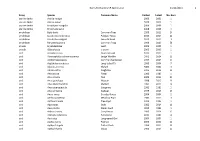
Dams To Darnley CP Species List 21/11/2014 1 Group Species Common Name Earliest Latest No. Recs acarine (mite) Aceria nalepai 2006 2006 1 acarine (mite) Aceria populi 2010 2010 1 acarine (mite) Eriophyes inangulis 2006 2006 1 acarine (mite) Eriophyes laevis 2008 2008 1 amphibian Bufo bufo Common Toad 1998 2013 14 amphibian Lissotriton helveticus Palmate Newt 2010 2013 12 amphibian Lissotriton vulgaris Smooth Newt 2010 2010 3 amphibian Rana temporaria Common Frog 1996 2013 58 annelid Erpobdellidae leech 2005 2005 1 annelid Oligochaeta a worm 2005 2005 1 bird Accipiter nisus Sparrowhawk 2013 2013 1 bird Acrocephalus schoenobaenus Sedge Warbler 1992 2014 13 bird Actitis hypoleucos Common Sandpiper 1957 2014 8 bird Aegithalos caudatus Long-tailed Tit 1993 2004 7 bird Alauda arvensis Skylark 2003 2004 3 bird Alcedo atthis Kingfisher 1993 2014 22 bird Anas acuta Pintail 1983 1983 1 bird Anas crecca Teal 2003 2013 20 bird Anas penelope Wigeon 1998 2013 11 bird Anas platyrhynchos Mallard 1997 2013 54 bird Anas querquedula Garganey 1982 1982 1 bird Anas strepera Gadwall 1979 2013 15 bird Anser anser Greylag Goose 2004 2004 2 bird Anthus pratensis Meadow Pipit 1982 2013 3 bird Anthus trivialis Tree Pipit 1992 1992 1 bird Apus apus Swift 1982 2014 11 bird Apus melba Alpine Swift 1992 1992 1 bird Ardea cinerea Grey Heron 1990 2014 52 bird Arenaria interpres Turnstone 1911 1981 4 bird Asio otus Long-eared Owl 2004 2004 1 bird Aythya ferina Pochard 2003 2004 11 bird Aythya fuligula Tufted Duck 1999 2013 66 bird Aythya marila Scaup 1900 2013 12 Dams To Darnley CP Species List 21/11/2014 2 Group Species Common Name Earliest Latest No. -

Catalogue of Phytophagous Insects and Mites on Trees in Great Britain
A Catalogue of Phytophagous Insects and Mites on Trees in Great Britain Forestry Commission T G Winter ARCHIVE Forestry Commission Booklet 53 Front Cover: Larva of the Pine hawk mothHyloicus pinastri (Linnaeus) on Scots pine foliage.C 3064 FORESTRY COMMISSION Booklet 53 A Catalogue of Phytophagous Insects and Mites on Trees in Great Britain Compiled by T. G. Winter Entomologist, Forest Research Station, Alice Holt Lodge, Wrecclesham, Farnham, Surrey, GU10 4LH CONTENTS Pag. Introduction v Abbreviations and symbols vi Phytophagous insects and mites on trees in Great Britain Scientific names 1 Common names 29 Host plants 41 iii A Catalogue of Phytophagous Insects and Mites on Trees in Great Britain Compiled by T G Winter Entomologist, Forestry Commission INTRODUCTION The main objective of this catalogue is to bring some uniformity into exchanges concerning forest entomology. It consists of three lists: a basic one and two supplementaries. The basic list includes all species inPests and Diseases o f Forest Plantation Trees (F G Brown, 1968) occurring in Britain, to which have been added many others from both the literature and from records kept by the Entomology Branch of the Forestry Commission Research and Development Division. Besides insects the list also includes some mites and several nematodes. This list was originally designed for use within the F.C. Research Division as a source of valid insect names and authors together with a selected synonymy for all species with some claim to forest importance or significance. The species included show great variability in status, some being pests of economic importance, while others are of interest only. -

Acer Pseudoplatanus) En De Mogelijkheden Van Deze Boomsoort in Landschaps- En Bosbeheer
De ecologische positie van gewone esdoorn (Acer pseudoplatanus) en de mogelijkheden van deze boomsoort in landschaps- en bosbeheer Luc De Keersmaeker, Arthur De Haeck, Bruno De Vos, Anja Leyman, Peter Roskams, Arno Thomaes, Beatrijs van der Aa, Kris Vandekerkhov INSTITUUT NATUUR- EN BOSONDERZOEK Auteurs: Luc De Keersmaeker, Arthur De Haeck, Bruno De Vos, Anja Leyman, Peter Roskams, Arno Thomaes, Beatrijs van der Aa, Kris Vandekerkhove Instituut voor Natuur- en Bosonderzoek Het Instituut voor Natuur- en Bosonderzoek (INBO) is het Vlaams onderzoeks- en kenniscentrum voor natuur en het duurzame beheer en gebruik ervan. Het INBO verricht onderzoek en levert kennis aan al wie het beleid voorbereidt, uitvoert of erin geïnteresseerd is. Vestiging: INBO Geraardsbergen Gaverstraat 4 9500 Geraardsbergen www.inbo.be e-mail: luc.dekeersmaeker@inbo.be Wijze van citeren: De Keersmaeker L., De Haeck A., De Vos B., Leyman A., Roskams P., Thomaes A., Van der Aa B., Vandekerkhove K.(2016). De ecologische positie van gewone esdoorn (Acer pseudoplatanus) en de mogelijkheden van deze boomsoort in landschaps- en bosbeheer. Rapporten van het Instituut voor Natuur- en Bosonderzoek 2016 (INBO.R.2016.12186866). Instituut voor Natuur- en Bosonderzoek, Brussel. D/2016/3241/208 INBO.R.2016.12186866 ISSN: 1782-9054 Verantwoordelijke uitgever: Maurice Hoffmann Druk: Managementondersteunende Diensten van de Vlaamse overheid Foto cover: Verjonging van gewone esdoorn (Luc De Keersmaeker) © 2016, Instituut voor Natuur- en Bosonderzoek De ecologische positie van gewone esdoorn (Acer pseudoplatanus) en de mogelijkheden van deze boomsoort in landschaps‐ en bosbeheer Luc De Keersmaeker, Arthur De Haeck, Bruno De Vos, Anja Leyman, Peter Roskams, Arno Thomaes, Beatrijs Van der Aa, Kris Vandekerkhove INBO.R.2016.12186866 Voorwoord/Dankwoord Gewone esdoorn (Acer pseudoplatanus) is in uitbreiding is in Vlaanderen, vooral omdat de boomsoort zich talrijk verjongt, zowel in bossen als in open terrein. -
Bioblitz Report Draft 2010 Vs 2
Leicestershire 2010 Watermead Country Park th st 30 – 31 May 2010 Dr Helen O’Brien Dr Catherine Tregaskes Table of Contents Acknowledgements ……………………………………………………. ii Executive Summary ......................................................................... 1 1 Introduction 2 1.1 Introduction to Bioblitz …………………………………………………………… 2 1.2 Partners in Bioblitz ………………………………………………………………. 3 1.3 Publicity …………………………………………………………………………… 3 1.4 Funding …………………………………………………………………………… 4 1.5 Participation ………………………………………………………………………. 4 1.6 Displays and Information ………………………………………………………... 5 2 Watermead Country Park ……………………………………………... 6 3 Participation …………………………………………………………….. 8 3.1 Public Involvement and Wildlife Recording …………………………………… 8 3.2 Guided Walks …………………………………………………………………… 9 3.3 Naturalists and Experienced Surveyors ……………………………………… 10 3.3.1 Recording Forms and Site Maps ………………………………………………. 10 3.3.2 Accuracy of Information and Verification 10 3.3.3 Surveying Techniques ……………………………………………………..……. 11 4 Results ………………………………………………………………….. 12 4.1 Public Participation ………………………………………………………………. 12 4.2 Results – Overall for the Park ………………………………………………….. 13 5 Analysis ………………………………………………………………….. 16 5.1 Public Participation ………………………………………………………………. 16 5.2 Duplication of Records in North and South of Watermead Country Park …. 16 6 Discussion ………………………………………………………………. 19 6.1 Public Participation ………………………………………………………………. 19 6.2 Species Groups ………………………………………………………………….. 20 6.2.1 Birds ……………………………………………………………………………….. 20 6.2.2 Invertebrates ……………………………………………………………………… -

Contribution À La Connaissance Des Galles D'eriophyides Du Luxembourg
Bull. Soc. Nat. luxemb. 101 (2001) p. 75-97 Contribution à la connaissance des galles d’Eriophyides du Luxembourg (Acari, Eriophyidae) par Jacques LAMBINON 1), Nico SCHNEIDER 2) & Fernand FEITZ 3) Zusammenfassung: Im Beitrag werden 47 Gallmilbenarten genannt sowie deren im Grossherzogtum Luxemburg nachgewiesene Gallen vorgestellt und deren Fundorte aufgezählt. Bei 40 Arten handelt es sich um Erstnachweise für Luxemburg. 1. Introduction Les zoocécidies du grand-duché de Luxembourg sont très mal connues et seules quelques données occasionnelles ont été publiées, essentiellement dans les années 1950. L’un de nous (J.L.), intéressé par les galles de Belgique et des régions voisines, a continué à récolter de temps à autre de telles galles lors de journées d’herborisation au Luxembourg. Le deuxième auteur de ce travail (N.S.) a entrepris depuis quelques années un inventaire des galles du pays, avec l’aide de collègues entomologistes, dont surtout le troisième auteur du présent rapport. Cette première contribution sera, nous l’espérons, suivie d’autres portant sur les galles causées par les divers groupes d’animaux cécidogènes. Elle concerne les déformations dues à des Eriophyides, celles-ci allant de taches pileuses (érinoses) à de véritables cécidies. Les Eriophyides sont des Acariens minuscules, vermiformes et aveugles qui ne portent que deux paires de pattes locomotrices (g. 1). Leurs chélicères sont en forme de stylets capables de percer des cellules végétales et d’en aspirer le hyaloplasme. De nombreuses espèces sont gallicoles. En général les cécidies sont produites par la plante en réaction à l’injection de salive toxique au moment de la prise de nourriture (Docters van Leeuwen 1982, Alford et al. -

List of Nalepa Species by Genus and Species with Hosts
List of Nalepa species by genus + host names 460 species (≈9% of currently described number of eriophyoid species) from 41 genera from 3 families: Phytoptidae (3 genera / 10 species), Diptilomiopidae (4 genera/ 8 species), Eriophyidae (35 genera / 442 species) Abacarus – 2 Aculus – 44 Colomerus – 2 Monochetus – 1 Stenacis – 2 Acalitus – 12 Aequsomatus – 1 Criotacus – 1 Neotegonotus – 2 Tegonotus – 10 Acaphylla – 1 Anthocoptes – 9 Cupacarus – 1 Paraphytoptus – 4 Tegoprionus – 1 Acaphyllisa – 1 Baileyna – 2 Diptacus – 1 Phyllocoptes – 34 Trisetacus – 3 Acaricalus – 1 Calepitrimerus – 1 Diptilomiopus – 1 Phytoptochetus – 2 Vasates – 1 Acaricalus – 2 Callyntrotus – 2 Epitrimerus – 12 Phytoptus – 6 (?) Aceria – 196 Cecidodectes – 1 Eriophyes – 59 Rhinophytoptus – 1 Aculodes – 1 Cecidophyes – 10 Fragariocoptes – 1 Rhyncaphytoptus – 5 Aculops – 13 Cecidophyopsis – 7 Leipothrix – 1 Shevtchenkella – 4 1. Abacarus hystrix (Nalepa, 1896) - Elymus repens (L.) Gould 42. Aceria brevipes (Nalepa, 1899) - Atriplex halimus L. 2. Abacarus rechingeri (Nalepa, 1909) - Spiraeanthemum samoense A. Gray 43. Aceria brevipunctata (Nalepa, 1889) - Ulmus laevis Pallas 3. Acalitus blastophthirus (Nalepa, 1917) - Fagus sylvatica L. ,X jun syn of Acalitus 44. Aceria brevirostris (Nalepa, 1892) - Polygala amara L. stenaspsis (Nalepa, 1891) 45. Aceria calathina (Nalepa, 1917) - Tanacetum vulgare L. 4. Acalitus? calycophthirus (Nalepa, 1891) - Betula pendula Roth 46. Aceria calycina (Nalepa, 1920) - Quercus ilex L. X, junior synonym of Aceria rudis 5. Acalitus? cotoneastri (Nalepa, 1926) - Cotoneaster integerrimus Medik. (Nalepa, 1902). 6. Acalitus? longisetosus (Nalepa, 1892) - Betula pendula Roth. 47. Aceria capsellae (Nalepa, 1891) - Capsella bursapastoris (L.) Medik. 7. Acalitus? notolius (Nalepa, 1919) - Betula pubescens Ehrh. 48. Aceria carlinae (Nalepa, 1905) - Chamaeleon gummifer (L.) Cass. 8. Acalitus phloeocoptes (Nalepa, 1890) - Prunus domestica L. -

A Management Plan for Apex Park, Highbridge, 2017 - 2021
A Management Plan for Apex Park, Highbridge, 2017 - 2021. Pete Grainger, Ecologist for Sedgemoor District Council 1 Contents Page Introduction 4 Part 1 Description 5 Section 1.1 – Location 5 1.1.1 Location 5 1.1.2 Surroundings 6 Section 1.2 Land tenure and responsibilities 6 1.2.1 Land tenure 6 1.2.2 Responsibilities 6 Section 1.3 Site status, designations and legal responsibilities 7 1.3.1 Site status and designations 7 1.3.2 Site legal responsibilities. 8 Section 1.4 Physical features 9 1.4.1 Semi-natural features 9 1.4.2 Buildings and other man-made features 9 Section 1.5 Biological features 10 1.5.1 Habitats 11 1.5.2 Species 16 Section 1.6 Cultural features 17 1.6.1 Landscape 17 1.6.2 Archaeological and historical features 17 1.6.3 Land use history 17 1.6.4 Socio-economic use 18 1.6.5 Education, research and demonstration 20 Section 1.7 Access and visitor facilities 20 1.7.1 Visitor appeal and suitability for access 20 1.7.2 Access to the park 22 1.7.3 Visitor facilities 22 Section 1.8 Summary of site features 25 1.8.1 Geological and biological features 25 1.8.2 Socio-economic use – recreation, public access, education and 25 research. Part 2 Evaluation, formulation of vision and site objectives 26 Section 2.1 Site analysis 26 2.1.1 Site strengths 26 2.1.2 Site weaknesses 26 2.1.3 External opportunities 26 2.1.4 External challenges 27 Section 2.2 Site management policy and vision 27 2.2.1 The Council’s Vision for Apex Park 27 2.2.2 What the local community want. -

Faunistik Der Gallmilben Südtirols (Acari: Eriophyoidea)
Gredleriana Vol. 3 / 2003 pp. 77- 142 Faunistik der Gallmilben Südtirols (Acari: Eriophyoidea) Klaus Hellrigl Abstract Faunistics of Eriophyid mites (Acari: Eriophyoidea) in South Tyrol (Northern Italy) The author gives a survey on the occurrence of the Eriophyid mites so far recorded in South Tyrol (Prov. Bozen). The records are largely based on old information given by DALLA TORRE (1892-96) who, in a comprehensive work titled „Zoocecidien und Cecidozoen Tirols“, collated the results of contemporary research from literature and collections and listed a total of 150 gall-formations, induced by eriophyid mites (Phytoptocecidia) from North Tyrol, South Tyrol and Trentino. They included 125 species, 98 from North Tyrol, 81 from South Tyrol and 30 from Trentino. 62% of the species were named, while the remaining 38% were only represented by descriptions of their at- tack patterns (symptoms of injury). – The present studies aimed at revising DALLA TORRE’S long forgotten information, at updating the nomenclature and at interpreting the described deformities (symptoms of injury) in order to permit their allocations to species names. For comparative purposes, the old data from North Tyrol and Trentino were included, since they can give indications on possible occurrences in South Tyrol. The author adds recent observations on, and collections of over 50 species from South Tyrol. – The present studies treat a total of 155 taxa of Eriophyid mites and their gall-formations on some 200 host plants. For South Tyrol, a total of 110 Eriophyid mites are listed, including some that were missing from the last checklist of Italy (1995). 1 Einleitung Die „Gallmilben“ (Acari: Eriophyoidea) gehören – ebenso wie die „Gallmücken“ (Diptera: Cecidomyiidae) – zu den taxonomisch schwierigeren Gruppen von Arthropoden, weshalb sich nur wenige Forscher mit ihnen befassen. -

Contribution to the Knowledge of Leaf Galls from Western Romania
Annals of West University of Timişoara, ser. Biology, vol XIII, pp.135-144 CONTRIBUTION TO THE KNOWLEDGE OF LEAF GALLS FROM WESTERN ROMANIA Nicoleta IANOVICI, Adina MATICA, Mădălina SCURTU West University of Timisoara, Faculty of Chemistry-Biology-Geography, Department of Biology, Pestalozzi 16, Romania ABSTRACT The present study contains the results of our research on the galls makers that attack the woody species in the urban environment. The presence of a gall-forming arthropods within leaves has been observed on 8 species: Juglans regia, Prunus domestica, Malus domestica, Tilia tomentosa, Alnus glutinosa, Aesculus hippocastanum, Ribes rubrum and Vitis vinifera. We identified a number of 10 gall- forming species. These species belong to 8 different genera, from 5 families and 4 orders. Levels of infestation with Cameraria ohridella are high. INTRODUCERE Galele (cecidiile) sunt excrescenţe anormale ale ţesutului plantei, neoformaţiuni proliferative localizate (Gheţea et al, 2002; Neacşu, 2006; Sturz & Cupsa 2006; Hac, 2009). Celulele plantelor sunt stimulate să crească în mărime şi/sau în număr de către activităţile de hrănire, secreţiile chimice şi/sau simpla prezenţă a organismelor străine (inducători de gale, organisme galigene sau organisme cecidogene). Aceste organisme sunt de obicei insecte sau acarieni, dar pot fi şi fungi, nematode, bacterii sau virusuri. Galele plantelor se numesc fitocecidii iar cele provocate de animale, zoocecidii (Ionescu,1973). Forma, mărimea şi locaţia galei depind de speciile de plante şi de tipul de organism care le cauzează. Galele pot fi găsite pe rădăcini, tulpini, frunze, flori şi seminţe. Fiind creşteri tumorale, unele gale pot fi foarte dăunătoare pentru plantele gazdă. Galele (închise sau deschise) pot conţine comunităţi complexe formate din multe alte organisme în afară de cel care a cauzat fomarea galei.