No.7–8 И Изучает Английский Язык Eng.1September.Ru Учебно-Методический Журнал Английский Язык
Total Page:16
File Type:pdf, Size:1020Kb
Load more
Recommended publications
-

The KNIGHT REVISION of HORNBOSTEL-SACHS: a New Look at Musical Instrument Classification
The KNIGHT REVISION of HORNBOSTEL-SACHS: a new look at musical instrument classification by Roderic C. Knight, Professor of Ethnomusicology Oberlin College Conservatory of Music, © 2015, Rev. 2017 Introduction The year 2015 marks the beginning of the second century for Hornbostel-Sachs, the venerable classification system for musical instruments, created by Erich M. von Hornbostel and Curt Sachs as Systematik der Musikinstrumente in 1914. In addition to pursuing their own interest in the subject, the authors were answering a need for museum scientists and musicologists to accurately identify musical instruments that were being brought to museums from around the globe. As a guiding principle for their classification, they focused on the mechanism by which an instrument sets the air in motion. The idea was not new. The Indian sage Bharata, working nearly 2000 years earlier, in compiling the knowledge of his era on dance, drama and music in the treatise Natyashastra, (ca. 200 C.E.) grouped musical instruments into four great classes, or vadya, based on this very idea: sushira, instruments you blow into; tata, instruments with strings to set the air in motion; avanaddha, instruments with membranes (i.e. drums), and ghana, instruments, usually of metal, that you strike. (This itemization and Bharata’s further discussion of the instruments is in Chapter 28 of the Natyashastra, first translated into English in 1961 by Manomohan Ghosh (Calcutta: The Asiatic Society, v.2). The immediate predecessor of the Systematik was a catalog for a newly-acquired collection at the Royal Conservatory of Music in Brussels. The collection included a large number of instruments from India, and the curator, Victor-Charles Mahillon, familiar with the Indian four-part system, decided to apply it in preparing his catalog, published in 1880 (this is best documented by Nazir Jairazbhoy in Selected Reports in Ethnomusicology – see 1990 in the timeline below). -

A Sampling of Twenty-First-Century American Baroque Flute Pedagogy" (2018)
University of Nebraska - Lincoln DigitalCommons@University of Nebraska - Lincoln Student Research, Creative Activity, and Music, School of Performance - School of Music 4-2018 State of the Art: A Sampling of Twenty-First- Century American Baroque Flute Pedagogy Tamara Tanner University of Nebraska-Lincoln, tammytanner1106@gmail.com Follow this and additional works at: https://digitalcommons.unl.edu/musicstudent Part of the Music Pedagogy Commons, and the Music Performance Commons Tanner, Tamara, "State of the Art: A Sampling of Twenty-First-Century American Baroque Flute Pedagogy" (2018). Student Research, Creative Activity, and Performance - School of Music. 115. https://digitalcommons.unl.edu/musicstudent/115 This Article is brought to you for free and open access by the Music, School of at DigitalCommons@University of Nebraska - Lincoln. It has been accepted for inclusion in Student Research, Creative Activity, and Performance - School of Music by an authorized administrator of DigitalCommons@University of Nebraska - Lincoln. STATE OF THE ART: A SAMPLING OF TWENTY-FIRST-CENTURY AMERICAN BAROQUE FLUTE PEDAGOGY by Tamara J. Tanner A Doctoral Document Presented to the Faculty of The Graduate College at the University of Nebraska In Partial Fulfillment of Requirements For the Degree of Doctor of Musical Arts Major: Flute Performance Under the Supervision of Professor John R. Bailey Lincoln, Nebraska April, 2018 STATE OF THE ART: A SAMPLING OF TWENTY-FIRST-CENTURY AMERICAN BAROQUE FLUTE PEDAGOGY Tamara J. Tanner, D.M.A. University of Nebraska, 2018 Advisor: John R. Bailey During the Baroque flute revival in 1970s Europe, American modern flute instructors who were interested in studying Baroque flute traveled to Europe to work with professional instructors. -

Dayton C. Miller Flute Collection
Guides to Special Collections in the Music Division at the Library of Congress Dayton C. Miller Flute Collection LIBRARY OF CONGRESS WASHINGTON 2004 Table of Contents Introduction...........................................................................................................................................................iii Biographical Sketch...............................................................................................................................................vi Scope and Content Note......................................................................................................................................viii Description of Series..............................................................................................................................................xi Container List..........................................................................................................................................................1 FLUTES OF DAYTON C. MILLER................................................................................................................1 ii Introduction Thomas Jefferson's library is the foundation of the collections of the Library of Congress. Congress purchased it to replace the books that had been destroyed in 1814, when the Capitol was burned during the War of 1812. Reflecting Jefferson's universal interests and knowledge, the acquisition established the broad scope of the Library's future collections, which, over the years, were enriched by copyright -
2018 Available in Carbon Fibre
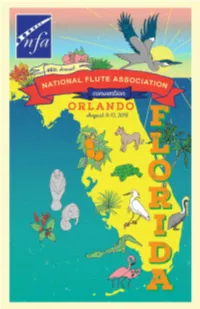
NFAc_Obsession_18_Ad_1.pdf 1 6/4/18 3:56 PM Brannen & LaFIn Come see how fast your obsession can begin. C M Y CM MY CY CMY K Booth 301 · brannenutes.com Brannen Brothers Flutemakers, Inc. HANDMADE CUSTOM 18K ROSE GOLD TRY ONE TODAY AT BOOTH #515 #WEAREVQPOWELL POWELLFLUTES.COM Wiseman Flute Cases Compact. Strong. Comfortable. Stylish. And Guaranteed for life. All Wiseman cases are hand- crafted in England from the Visit us at finest materials. booth 408 in All instrument combinations the exhibit hall, supplied – choose from a range of lining colours. Now also NFA 2018 available in Carbon Fibre. Orlando! 00 44 (0)20 8778 0752 sales@wisemancases.com www.wisemanlondon.com MAKE YOUR MUSIC MATTER Longy has created one of the most outstanding flute departments in the country! Seize the opportunity to study with our world-class faculty including: Cobus du Toit, Antero Winds Clint Foreman, Boston Symphony Orchestra Vanessa Breault Mulvey, Body Mapping Expert Sergio Pallottelli, Flute Faculty at the Zodiac Music Festival Continue your journey towards a meaningful life in music at Longy.edu/apply TABLE OF CONTENTS Letter from the President ................................................................... 11 Officers, Directors, Staff, Convention Volunteers, and Competition Committees ................................................................ 14 From the Convention Program Chair ................................................. 21 2018 Lifetime Achievement and Distinguished Service Awards ........ 22 Previous Lifetime Achievement and Distinguished -

Georgian Country and Culture Guide
Georgian Country and Culture Guide მშვიდობის კორპუსი საქართველოში Peace Corps Georgia 2017 Forward What you have in your hands right now is the collaborate effort of numerous Peace Corps Volunteers and staff, who researched, wrote and edited the entire book. The process began in the fall of 2011, when the Language and Cross-Culture component of Peace Corps Georgia launched a Georgian Country and Culture Guide project and PCVs from different regions volunteered to do research and gather information on their specific areas. After the initial information was gathered, the arduous process of merging the researched information began. Extensive editing followed and this is the end result. The book is accompanied by a CD with Georgian music and dance audio and video files. We hope that this book is both informative and useful for you during your service. Sincerely, The Culture Book Team Initial Researchers/Writers Culture Sara Bushman (Director Programming and Training, PC Staff, 2010-11) History Jack Brands (G11), Samantha Oliver (G10) Adjara Jen Geerlings (G10), Emily New (G10) Guria Michelle Anderl (G11), Goodloe Harman (G11), Conor Hartnett (G11), Kaitlin Schaefer (G10) Imereti Caitlin Lowery (G11) Kakheti Jack Brands (G11), Jana Price (G11), Danielle Roe (G10) Kvemo Kartli Anastasia Skoybedo (G11), Chase Johnson (G11) Samstkhe-Javakheti Sam Harris (G10) Tbilisi Keti Chikovani (Language and Cross-Culture Coordinator, PC Staff) Workplace Culture Kimberly Tramel (G11), Shannon Knudsen (G11), Tami Timmer (G11), Connie Ross (G11) Compilers/Final Editors Jack Brands (G11) Caitlin Lowery (G11) Conor Hartnett (G11) Emily New (G10) Keti Chikovani (Language and Cross-Culture Coordinator, PC Staff) Compilers of Audio and Video Files Keti Chikovani (Language and Cross-Culture Coordinator, PC Staff) Irakli Elizbarashvili (IT Specialist, PC Staff) Revised and updated by Tea Sakvarelidze (Language and Cross-Culture Coordinator) and Kakha Gordadze (Training Manager). -
Dissertation Chapter 4 for Peter Westbrook
The 19th-Century French Five-Key Flute and the Modern Boehm-System Flute in Cuban Charanga by Jessica Valiente Of interest to many flutists working in charanga is the kind of flute that is commonly associated with the genre. For those who are not familiar with the term, a charanga is a Cuban dance-music ensemble consisting of a solo flute lead, vocals, violins, piano, bass, congas, and timbales. It has a history that reaches back 100 years,1 and it is most strongly associated with Cuban popular dance styles such as the danzón, the mambo, the chachachá, and the pachanga. This dance music ensemble achieved international popularity, beginning in the 1950’s. Charanga has a characteristic that distinguishes it from most other western music styles that utilize the flute today. Charanga flutists play in an extraordinarily high register, inhabiting the third and fourth octaves most of the time, seldom venturing down into the second octave. This is because charanga developed at a time before sound amplification. As the lead voice, the flute must be heard over a large ensemble that includes at least two (frequently three) percussionists. The high register cuts through the din. Unfortunately, many flutists today are not usually aware of the fingerings for notes more than a whole step into the fourth octave. Charanga flutists 1 For more about charanga, there are graduate theses by John Murphy, Danilo Lozano, Ruth Witmer, myself, and a monograph by Sue Miller, listed in the Suggested Reading section at the end of this article. 1 have had to create the necessary technique via experimentation. -

Info Sheet Piccolo 2 for an Article on Embouchure Holes) Should Be Used When Playing Traditional Irish Music
STEVE TADD WOODWIND REPAIRS (.co.uk) 07734 543011 Traditional ‘Irish’ Marching Band and Session Flutes (Nov 2017) There is no such thing as a ‘traditional’ Irish Flute but there is a traditional style of playing (defined by metre, articulation, tone, and ornamentation) that is much easier to achieve on some instruments compared to others. Irish ‘Session’ Flutes These are simple system ‘concert’ flutes pitched in ‘C’ (originally used in concert bands and Orchestras) and are often used nowadays to play traditional Irish dance music. The naming system for these flutes is based on the orchestral naming system – the instrument is named according to what note is actually heard when the note referred to as ‘C’ on the instrument is played – so whether the lowest note is D or C these flutes are ‘in C’ (in contrast the note referred to as C on Tenor Sax actually sounds a Bb - so Tenor Saxes are ‘in Bb’). With study and close attention to detail the metres and articulation of traditional Irish dance music can be replicated on any Flute, it is the tone and ornamentation which is more problematic. A wooden Flute is considered to produce a more traditional tone and certainly at least a wooden head- joint (with a traditional embouchure – refer to Info sheet Piccolo 2 for an article on Embouchure holes) should be used when playing traditional Irish music. The ornamentation used in traditional Irish Flute playing ought to mimic the ornamentation used when playing the Tin whistle and Uillean pipes; not only is this different from modern Flute ornamentation but it is acoustically impossible to achieve on all but true Simple System Flutes. -

Theobald Boehm
Listaháskóli Íslands Tónlistardeild Hljóðfærabraut Theobald Boehm Elva Lind Þorsteinsdóttir Leiðbeinandi: Atli Ingólfsson Vor 2010 Listaháskóli Íslands Tónlistardeild Hljóðfærabraut Theobald Boehm - The Reinvention of the Flute - Elva Lind Þorsteinsdóttir Leiðbeinandi: Atli Ingólfsson Vor 2010 2 Contents Introduction ……………………………………………………………… 4 Method of research and presentation ……………………………………. 4 Theobald Boehm ………………………………………………………… 5 The early 19th century flute ……………………………………………… 6 Boehm’s flute workshop and his 1829 model flute ……………………… 7 The 1831 model ………………………………………………………….. 8 The 1832 model ………………………………………………………….. 9 The 1847 model ………………………………………………………….. 12 Material ………………………………………………………………....... 14 The effect of the Boehm flute on composers …………………………….. 15 The Schema ……………………………………………………………..... 15 Boehm vs. Gordon ………………………………………………………... 18 Conclusion ………………………………………………………………... 20 Illustrations ………………………………………………………….......... 21 References ………………………………………………………………… 25 3 Introduction The late 19th century is often referred to as the golden age of flute playing. This was a time when the flute became fully developed and came to be a popular virtuoso instrument, a time when an increasing number of composers composed great pieces for the flute, causing the repertoire to expand greatly in only a few decades. What is the reason for this sudden change? The answer is Theobald Boehm. When I learned that the flute as we know it today is the result of the work of one man I became curious. Who was Theobald Boehm? Why did he reinvent the flute? What was the flute like before he started his work, and what was the difference between the old flute and the new? How was the new version received? In trying to answer these questions, I will be looking at his life, the different stages of his work, and find out if he was alone in developing the flute or if ideas or improvements came from other sources. -

2017 CMS INTERNATIONAL CONFERENCE July 9–13, 2017 Sydney, Australia
2017 CMS INTERNATIONAL CONFERENCE July 9–13, 2017 Sydney, Australia ABSTRACTS & PROGRAM NOTES updated June 19, 2017 Adams, Daniel C. Composition: Congruent Verses The Latin origin of congruent is “congruere,” to fit together. In modern usage the term means in a general context “to be in agreement” and in a geometrical context figures that coincide exactly when superimposed, even if they exist at different angles The “verses” in this solo refer to groupings of short irregular phrase-like structures with no apparent antecedent or consequent relationships. They are “congruent” however, in both contexts of the term. First, they are unified by a common basis of continually varied thematic materials. Second, most of the melodic passages are based on similar or identical structures, continually shifting and placed in contrasting orientations such as different part of a measure, different rhythmic subdivisions, and different times signatures. Congruent Verses is held together by a succession of asymmetrical but interrelated musical statements. The piece begins with a slow, contemplative section, which is interrupted midway by a very brief and rapid passage that is later developed in a subsequent section. A more rhythmically active section follows, as short motives are repeated with slight variation. Tongue slaps and key clicks are introduced as the piece builds to a climax. A contrasting slow section played in the highest register follows, and includes harmonics. The piece closes with a rapid coda based on materials from the first fast section. Albonetti, Viara S. Paper: Instrument of Song – Klezmer in Australia Klezmer, kle (instrument), and zemer (song), Instrument of Song, a musical heritage of the Ashkenazi Jews of Eastern Europe, has a history of more than four centuries. -
World History--Part 1. Teacher's Guide [And Student Guide]
DOCUMENT RESUME ED 462 784 EC 308 847 AUTHOR Schaap, Eileen, Ed.; Fresen, Sue, Ed. TITLE World History--Part 1. Teacher's Guide [and Student Guide]. Parallel Alternative Strategies for Students (PASS). INSTITUTION Leon County Schools, Tallahassee, FL. Exceptibnal Student Education. SPONS AGENCY Florida State Dept. of Education, Tallahassee. Bureau of Instructional Support and Community Services. PUB DATE 2000-00-00 NOTE 841p.; Course No. 2109310. Part of the Curriculum Improvement Project funded under the Individuals with Disabilities Education Act (IDEA), Part B. AVAILABLE FROM Florida State Dept. of Education, Div. of Public Schools and Community Education, Bureau of Instructional Support and Community Services, Turlington Bldg., Room 628, 325 West Gaines St., Tallahassee, FL 32399-0400. Tel: 850-488-1879; Fax: 850-487-2679; e-mail: cicbisca.mail.doe.state.fl.us; Web site: http://www.leon.k12.fl.us/public/pass. PUB TYPE Guides - Classroom - Learner (051) Guides Classroom Teacher (052) EDRS PRICE MF05/PC34 Plus Postage. DESCRIPTORS *Academic Accommodations (Disabilities); *Academic Standards; Curriculum; *Disabilities; Educational Strategies; Enrichment Activities; European History; Greek Civilization; Inclusive Schools; Instructional Materials; Latin American History; Non Western Civilization; Secondary Education; Social Studies; Teaching Guides; *Teaching Methods; Textbooks; Units of Study; World Affairs; *World History IDENTIFIERS *Florida ABSTRACT This teacher's guide and student guide unit contains supplemental readings, activities, -

The French Flute Tradition
The French Flute Tradition by Liesl Stoltz Dissertation presented as partial fulfilment of the requirements for the degree Master of Music (Performance) Faculty of Humanities University of Cape Town Supervisor: Prof. James May February 2003 The copyright of this thesis vests in the author. No quotation from it or information derived from it is to be published without full acknowledgement of the source. The thesis is to be used for private study or non- commercial research purposes only. Published by the University of Cape Town (UCT) in terms of the non-exclusive license granted to UCT by the author. University of Cape Town DECLARATION I, the undersigned, declare that this dissertation is my own, unaided work. It is being submitted in part fulfilment of the requirements for the degree of Master of Music (Performance). It has not been previously submitted in its entirety or in part for any degree or examination at any other university. ~. : ~~o!f\ ......... ......~~ '.. ~Q~3 ..... Liesl StoI'tZ ii ABSTRACT The French flute tradition is remarkable and is admired by flautists, teachers and students of the flute all over the world. The dissertation researched the development of this tradition from the pre-Baroque period through to the modern era and tried to determine the underlying factors that stimulated its development specifically in France. The first key was added to the flute in France and with this the Hotteteres created the blueprint for the modern flute of today. During the Classical period the conservative French retarded the development of the instrument and the repertoire for the flute by initially rejecting additional keys. -

The Hacker Crackdown
LITERARY FREEWARE — Not for Commercial Use by Bruce Sterling <bruces@well.sf.ca.us> Sideways PDF version 0.1 by E-Scribe <info@e-scribe.com> C O N T E N T S Preface to the Electronic Release of The Hacker Crackdown Chronology of the Hacker Crackdown Introduction Part 1: CRASHING THE SYSTEM A Brief History of Telephony / Bell's Golden Vaporware / Universal Service / Wild Boys and Wire Women / The Electronic Communities / The Ungentle Giant / The Breakup / In Defense of the System / The Crash Post- Mortem / Landslides in Cyberspace Part 2: THE DIGITAL UNDERGROUND Steal This Phone / Phreaking and Hacking / The View From Under the Floorboards / Boards: Core of the Underground / Phile Phun / The Rake's Progress / Strongholds of the Elite / Sting Boards / Hot Potatoes / War on the Legion / Terminus / Phile 9-1-1 / War Games / Real Cyberpunk Part 3: LAW AND ORDER Crooked Boards / The World's Biggest Hacker Bust / Teach Them a Lesson / The U.S. Secret Service / The Secret Service Battles the Boodlers / A Walk Downtown / FCIC: The Cutting-Edge Mess / Cyberspace Rangers / FLETC: Training the Hacker-Trackers Part 4: THE CIVIL LIBERTARIANS NuPrometheus + FBI = Grateful Dead / Whole Earth + Computer Revolution = WELL / Phiber Runs Underground and Acid Spikes the Well / The Trial of Knight Lightning / Shadowhawk Plummets to Earth / Kyrie in the Confessional / $79,499 / A Scholar Investigates / Computers, Freedom, and Privacy Electronic Afterwordto *The Hacker Crackdown,* New Years' Day 1994 BRUCE STERLING — THE HACKER CRACKDOWN NOT FOR COMMERCIAL USE 2 Preface to the Electronic Release of The Hacker Crackdown January 1, 1994 — Austin, Texas Hi, I'm Bruce Sterling, the author of this electronic book.