Microsoft Outlook
Total Page:16
File Type:pdf, Size:1020Kb
Load more
Recommended publications
-

PHILIP ROTH and the STRUGGLE of MODERN FICTION by JACK
PHILIP ROTH AND THE STRUGGLE OF MODERN FICTION by JACK FRANCIS KNOWLES A THESIS SUBMITTED IN PARTIAL FULFILLMENT OF THE REQUIREMENTS FOR THE DEGREE OF DOCTOR OF PHILOSOPHY in THE FACULTY OF GRADUATE AND POSTDOCTORAL STUDIES (English) THE UNIVERSITY OF BRITISH COLUMBIA (Vancouver) July 2020 © Jack Francis Knowles, 2020 The following individuals certify that they have read, and recommend to the Faculty of Graduate and Postdoctoral Studies for acceptance, the dissertation entitled: Philip Roth and The Struggle of Modern Fiction in partial fulfillment of the requirements submitted by Jack Francis Knowles for the degree of Doctor of Philosophy in English Examining Committee: Ira Nadel, Professor, English, UBC Supervisor Jeffrey Severs, Associate Professor, English, UBC Supervisory Committee Member Michael Zeitlin, Associate Professor, English, UBC Supervisory Committee Member Lisa Coulthard, Associate Professor, Film Studies, UBC University Examiner Adam Frank, Professor, English, UBC University Examiner ii ABSTRACT “Philip Roth and The Struggle of Modern Fiction” examines the work of Philip Roth in the context of postwar modernism, tracing evolutions in Roth’s shifting approach to literary form across the broad arc of his career. Scholarship on Roth has expanded in both range and complexity over recent years, propelled in large part by the critical esteem surrounding his major fiction of the 1990s. But comprehensive studies of Roth’s development rarely stray beyond certain prominent subjects, homing in on the author’s complicated meditations on Jewish identity, a perceived predilection for postmodern experimentation, and, more recently, his meditations on the powerful claims of the American nation. This study argues that a preoccupation with the efficacies of fiction—probing its epistemological purchase, questioning its autonomy, and examining the shaping force of its contexts of production and circulation— roots each of Roth’s major phases and drives various innovations in his approach. -
Saul Bellow As a Novelist of Ideas: Introduction to the Forum Victoria Aarons Trinity University, Vaarons@Trinity.Edu
Trinity University Digital Commons @ Trinity English Faculty Research English Department 1-2016 Saul Bellow as a Novelist of Ideas: Introduction to the Forum Victoria Aarons Trinity University, vaarons@trinity.edu Gustavo Sánchez-Canales Follow this and additional works at: https://digitalcommons.trinity.edu/eng_faculty Part of the English Language and Literature Commons Repository Citation Aarons, V., & Sánchez-Canales, G. (2016). Saul Bellow as a novelist of ideas: Introduction to the forum. Partial Answers: Journal of Literature and the History of Ideas, 14(1), 57-62. doi: 10.1353/pan.2016.0004 This Article is brought to you for free and open access by the English Department at Digital Commons @ Trinity. It has been accepted for inclusion in English Faculty Research by an authorized administrator of Digital Commons @ Trinity. For more information, please contact jcostanz@trinity.edu. Saul Bellow as a Novelist of Ideas: Introduction to the Forum Victoria Aarons Trinity University, San Antonio, TX Gustavo Sánchez-Canales Universidad Autónoma de Madrid On the occasion of his acceptance of the Nobel Prize for Literature, Saul Bellow asked, “What is at the center now?” (2015a: 299). This question gets at the heart of a lifetime of literary attempts to find “the center,” to expose the core of what it means to be human in the volatile, unstable, and explosive twentieth century. In defense of what, for Bellow, was the singular preoccupation of his lengthy and distinguished literary career, he insists that “[o]ut of the struggle at the center has come an immense, painful longing for a broader, more flexible, fuller, more coherent, more comprehensive account of what we human beings are, who we are, and what this life is for” (299). -

2011/2012 Omnium Gatherum & Newsletter
omnium gatherum & newsletter 2 0 1 1 - 2 0 1 2 i s s u e 1 6 COMMUNITY OF WRITERS AT SQUAW VALLEY OUR SUPPORTERS OMNIUM GATHERUM & NEWSLETTER TABLE 2011-2012, Issue 16 The Community of Writers gratefully acknowledges the financial support that OF Community of Writers at Squaw Valley makes our programs possible: A Non-Profit Corporation #629182 The many friends of the Community of P.O. Box 1416, Nevada City, CA 95959 Writers and its Scholarship Fund CONTENTS E-mail: brett@squawvalleywriters .org University of California/ Irvine for www .squawvalleywriters .org scholarships for UCI MFAs UC/ Riverside for scholarships for UCR Newsletter edited and designed by MFAs Maxima Kahn Click on an item below to go directly to that page with support and advice from Fresno State University Announcing Our 2012 Summer Programs . .4 Brett Hall Jones National Endowment for the Arts The Academy Foundation of The Note from the Editor . .5 BOARD OF DIRECTORS Academy of Motion Picture Arts & C .D . Wright Receives Lenore Marshall Award . .6 President James Naify Sciences Vice President Joanne Meschery The Anne & Gordon Getty Foundation Dean Young Gets a New Heart . .6 Secretary Eddy Ancinas The LEF Foundation Poetry Staff News . .7 Financial OfficerBurnett Miller Squaw Valley Ski Corporation Osvaldo Ancinas Participant Profile: Sarah Maclay . .10 The San Francisco Foundation Jan Buscho PoetWatch: Poetry Participant News . .11 Max Byrd The Bookshelf Bookstores Alan Cheuse The Depot Bookstore Summer 2011 Special Thanks and Gallery of Photos . .20 Mark Childress For major contributions to the Screenwriting Staff News . .22 Nancy Cushing Community of Writers and its Rene Encinas Endowment: Participant Profile: Gayla Kraetsch Hartsough . -
SPRING 2019 Coursebook
SCHOOL COLUMBIA UNIVERSITY OF THE ARTS SPRING 2019 Coursebook Workshops Seminars Lectures Master Classes Updated: February 13, 2019 TABLE OF CONTENTS LIST OF COURSES BY DAY AND TIME WORKSHOPS 1 SEMINARS 2 LECTURES 5 MASTER CLASSES 6 COURSE DESCRIPTIONS SEMINARS 7 Translations Workshops 24 Hybrid Forms Lab 26 LECTURES 27 MASTER CLASSES 31 SPECIAL PROJECTS WORKSHOP 41 WORKSHOPS FICTION – OPEN (6 points) FICTION – THESIS (9 points)* Lynn Steger Strong Sam Lipsyte Tue., 10am-1pm Mon., 12:05pm-3:05pm Charles Bock Joshua Furst Tue., 12:05pm-3:05pm Mon., 3:10pm-6:10pm Paul La Farge Rivka Galchen Tue., 5:15pm-8:15pm Mon., 3:10pm-6:10pm Eli Gottlieb Ben Marcus Wed., 12:35pm-3:35pm Tue., 1:05pm-4:05pm Gary Shteyngart Binnie Kirshenbaum Wed., 3:40pm-6:40pm Wed., 3:40pm-6:40pm Anelise Chen Paul Beatty Fri., 10am-1pm Thu., 1:05pm-4:05pm Elissa Schappell Thu., 1:35pm-4:35pm Ben Metcalf Thu., 4:40pm-7:40pm POETRY – OPEN (6 points) NONFICTION – OPEN (6 points) Lynn Melnick Leslie Jamison Mon., 12:05pm-3:05pm Mon., 10am-1pm Major Jackson Morgan Jerkins Tue., 10am-1pm Mon., 10am-1pm Mark Bibbins Phillip Lopate Fri., 1:10pm-4:10pm Mon, 1:05pm-4:05pm Lis Harris POETRY – THESIS (9 points)* Tue., 1:05pm-4:05pm Richard Locke Alan Gilbert Tue., 2:10pm-5:10pm Tue., 4:30pm-7:30pm Michael Greenberg Dorothea Lasky Tue., 4:15pm-7:15pm Tue., 4:30pm-7:30pm Meghan Daum Timothy Donnelly Wed., 12:35pm-3:35pm Thu., 4:10pm-7:10pm Mitchell Jackson Shane McCrae Thu., 10am-1pm Thu., 10am-1pm *Second-Years only SEMINARS ——MONDAY—— ——TUESDAY—— Rob Spillman (FI) Monica Ferrell -

The Obedient Bellow APRIL 28, 2011
The Obedient Bellow APRIL 28, 2011 Edward Mendelson Saul Bellow: Letters edited by Benjamin Taylor Viking, 571 pp., $35.00 In almost everything he wrote, Saul Bellow asserted his authority as artist, thinker, moralist, and lover. His admirers rejoiced in his authority and celebrated a new kind of dominant voice in American fiction: expansively ambitious, philosophical, and demotic, the voice of a moralizing comic hero unlike anything in the genteel or frontier traditions. “Someone has to stand up for Jews and democrats,” he said in a letter, “and when better champions are lacking, squirts must do what they can.” His detractors, meanwhile, rejected his authority, writing whole books denouncing him as if he were a lecherous and corrupt literary tyrant. Both sides misunderstood him. His letters make clear what was always implicit in his fiction, that he asserted his authority half-unwillingly and only as a last resort—because those who ought to be in charge had failed in the job, or had given it up entirely. In Mr. Sammler’s Planet (1970), he writes: Mr. Sammler was testy with White Protestant America for not keeping better order. Cowardly surrender. Not a strong ruling class. Eager in a secret humiliating way, to come down and mingle with all the minority mobs, and scream against themselves. And the clergy? Beating swords into plowshares? No, rather converting dog collars into G strings. Bellow accepts a friend’s judgment that he is an outlaw, but adds: “In outlaw bravado I have no interest. I only meant that I wish to obey better laws.” That celebrated rebel Augie March, Bellow explains to another friend, has the same wish to obey: Augie misses the love, harmony and safety that should compensate our obedience…. -

Download Winter 2016
Grove Press Atlantic Monthly Press Black Cat The Mysterious Press Winter 2016 NOW AVAILABLE IN PAPERBACK “ The is the book of the Sixties that we have been waiting for.”—Norman Mailer Edie American Girl Jean Stein Edited with George Plimpton Revised, with a new cover MARKETING “Extraordinary . a fascinating narrative that is both meticulously reported and First published by Knopf in 1982, Edie was a expertly orchestrated.” —Michiko Kakutani, New York Times bestseller and has gone on to become a seminal oral history of the 1960s hen Edie: American Girl was first published, it quickly became an Draws on dozens of interviews with Edie’s international bestseller and then took a place among the classic friends, family, and acquaintances, books about the 1960s. Edie Sedgwick exploded into the public eye including Andy Warhol, Billy Name, Gerard W like a comet. She seemed to have it all: She was aristocratic and glamorous, Malanga, Bob Neuwirth, Viva, Patti Smith, Truman Capote, and many more vivacious and young, Andy Warhol’s superstar. But within a few years she flared out as quickly as she had appeared, and before she turned twenty-nine Photos printed throughout the text she was dead from a drug overdose. backlist eBook promotions In a dazzling tapestry of voices—family, friends, lovers, rivals—the entire meteoric trajectory of Edie Sedgwick’s life is brilliantly captured. And so is the Pop Art world of the sixties: the sex, drugs, fashion, music, and the mad rush for pleasure and fame. All glitter and flash on the outside, it was hollow and desperate within—like Edie herself, and like her mentor, Andy Warhol. -
Saul Bellow in His Times
Cambridge University Press 978-1-107-10893-6 — The Cambridge Companion to Saul Bellow Edited by Victoria Aarons Excerpt More Information VICTORIA AARONS Introduction: Saul Bellow in His Times Saul Bellow, recipient of the Nobel Prize in Literature (1976), remains one of the major literary figures of the twentieth century. A defining voice of post- World War II America, Bellow continues to be a celebrated icon of twentieth- century letters, a writer whose penetrating prose has influenced writers and readers in America and abroad since the late 1940s. Bellow’s novels, begin- ning with Dangling Man (1944) and concluding with Ravelstein (2000), span over half a century and reflect the erratic, mutating, and often torturous political, cultural, and intellectual character of his times. Bellow’s literary oeuvre articulates some of the most significant cultural experiences of the American twentieth century. His fiction represents and comments on some of the century’s major cultural events and issues: the urban experience of European immigrants, especially Jewish immigrants; the socio-cultural ascendance of an influential Jewish middle-class; the ideological seductions of Marxism and Modernism; the tensions between residual European intel- lectual culture and emergent popular culture; the fraught failures of the Vietnam War; the changing attitudes about gender and race; the “culture wars” in 1990s America; and the underlying fault-lines of anti-Semitism. Moreover, the span of Bellow’s career witnessed the impact in America of the Holocaust: as Bellow once put it, “a crime so vast that it brings all Being into Judgment.”1 Bellow’s fiction casts its moral gaze upon the spectacle of a civilization in anxious flux, the spinning out-of-control of its impelling desires. -

In Case of Emergency... ART Ecent Events—Namely the Global Quarantine
NEWS | SPRING 2020 YADDO ARTISTS JOIN US FOR A #CHEERSATFIVE. PHOTO: RU FREEMAN • Mentors and more in Yaddo Connections • Summer Reads: 15 books on our must-read list • Introducing... the Yaddo Composer Playlist! • Virtual Reality join us in the zone In case of emergency... ART ecent events—namely the global quarantine. Books are oxygen. Films pandemic and state-mandated are queued. Poetry is blooming, closure of businesses deemed and the digital space is filled with “non-essential”—beg some impromptu interviews with artists. A Letter from Our Co-Chairs Rquestions: Is Yaddo essential? Is art It’s enough to create art for its own necessary? What happens to artists in a sake, even when doing so seems As the world struggles to get ahead of the Covid-19 pandemic, we here at Yaddo time of global crisis, and how can we help? impossible. are working to make decisions to put us on the best path going forward, one In her brilliant “In times when people are suffering, that will allow us to recover from this time and sustain our mission for decades to essay collection, a constant everywhere on the globe, come. After much thoughtful discussion on the part of the Board, we decided the Funny Weather: I question the importance of art,” soundest course of action was to close Yaddo for the remainder of the year. Art in an painter Josh Dorman told Koplin Why is this necessary? For Yaddo to reopen, we need a global all-clear. Emergency Del Rio. “But it’s also in these Epidemiologists agree that the apex of this pandemic will occur in rolling waves (forthcoming moments when I’m reminded of the and may return in the fall after a dormant period. -
PRPL Master List 6-7-21
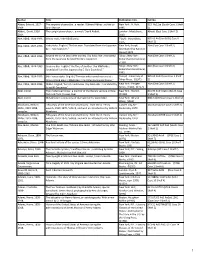
Author Title Publication Info. Call No. Abbey, Edward, 1927- The serpents of paradise : a reader / Edward Abbey ; edited by New York : H. Holt, 813 Ab12se (South Case 1 Shelf 1989. John Macrae. 1995. 2) Abbott, David, 1938- The upright piano player : a novel / David Abbott. London : MacLehose, Abbott (East Case 1 Shelf 2) 2014. 2010. Abe, Kōbō, 1924-1993. Warau tsuki / Abe Kōbō [cho]. Tōkyō : Shinchōsha, 895.63 Ab32wa(STGE Case 6 1975. Shelf 5) Abe, Kōbō, 1924-1993. Hakootoko. English;"The box man. Translated from the Japanese New York, Knopf; Abe (East Case 1 Shelf 2) by E. Dale Saunders." [distributed by Random House] 1974. Abe, Kōbō, 1924-1993. Beyond the curve (and other stories) / by Kobo Abe ; translated Tokyo ; New York : Abe (East Case 1 Shelf 2) from the Japanese by Juliet Winters Carpenter. Kodansha International, c1990. Abe, Kōbō, 1924-1993. Tanin no kao. English;"The face of another / by Kōbō Abe ; Tokyo ; New York : Abe (East Case 1 Shelf 2) [translated from the Japanese by E. Dale Saunders]." Kodansha International, 1992. Abe, Kōbō, 1924-1993. Bō ni natta otoko. English;"The man who turned into a stick : [Tokyo] : University of 895.62 Ab33 (East Case 1 Shelf three related plays / Kōbō Abe ; translated by Donald Keene." Tokyo Press, ©1975. 2) Abe, Kōbō, 1924-1993. Mikkai. English;"Secret rendezvous / by Kōbō Abe ; translated by New York : Perigee Abe (East Case 1 Shelf 2) Juliet W. Carpenter." Books, [1980], ©1979. Abel, Lionel. The intellectual follies : a memoir of the literary venture in New New York : Norton, 801.95 Ab34 Aa1in (South Case York and Paris / Lionel Abel. -

Spring 2020 Rights Guide
Spring 2020 Rights Guide Visit our website at www.strothmanagency.com Enquiries to: The Strothman Agency, LLC Email Lauren MacLeod: Lauren@strothmanagency.com Brazil: Laura Riff, The Riff Agency China: Annie Chen, Bardon Chinese Media Agency France: Anna Jarota, Anna Jarota Agency (Children’s: Robin Batet) Germany: Sebastian Ritscher, Mohrbooks, (Children’s: Annelie Geissler) Greece: Evangelia Avloniti, Ersilia Literary Agency Hungary: Peter Bolza, Katai & Bolza Agency Italy: Erica Berla, Berla & Griffini Rights (Children’s: Vanessa Maus) Japan: Hamish McCaskill, The English Agency Korea: Duran Kim, Duran Kim Agency Poland & Eastern Europe (Albania, Bulgaria, Bosnia and Herzegovina, Czech Republic, Croatia, Estonia, Latvia, Lithuania, Romania, Serbia, Slovakia, Slovenia): Filip Wojciechowski, Graal Russia: Zuzanna Brzezinska, Anna Jarota Agency Scandanavia, The Netherlands: Philip Sane, Lennart Sane Spain & Portugal: Teresa Vilarrubla, The Foreign Office Turkey: Amy Spangler and Dogan Terzi, Anatolia (Children's: Dilek Akdemir ) Early Warning: Upcoming & Recently Sold Yanis Varoufakis: Another Now: Dispatches from an Alternative Present (previously The Shaken Superflux)………..….………….………….………….………….………….………….………….………….…………………..…..4 Kathryn Miles: Shenandoah: Love, Murder And The Quest For Justice In America’s Wilderness.…5 Sashi Kaufman: Sardines (Middle-Grade Novel) ………….…….…….…….…….…….…….…….…….…….……6 Caleb Smith: Disciplines of Attention: A History, a Critique, a Devotional….……….……….……….…….7 Catherine McNeur: Sister Scientists: The Forgotten -

The Other Susan Sontag | the New Yorker
12/16/2017 The Other Susan Sontag | The New Yorker A Critic at Large December 11, 2017 Issue The Other Susan Sontag Her essays emanated authority, but her ction betrayed an aching sense of uncertainty. By Tobi Haslett eriousness, for Susan Sontag, was a ashing machete to swing at the thriving vegetation of American S philistinism. The philistinism sprang from our barbarism—and our barbarism had conquered the world. “Today’s America,” she wrote in 1966, “with Ronald Reagan the new daddy of California and John Wayne chawing spareribs in the White House, is pretty much the same Yahooland that Mencken was describing.” Intellectuals, doomed to tramp through an absurd century, were to inict their seriousness on Governor Reagan and President Johnson—and on John Wayne, spareribs, and the whole shattered, voluptuous culture. The point was to be serious about power and serious about pleasure: cherish literature, relish lms, challenge domination, release yourself into the rapture of sexual need—but be thorough about it. “Seriousness is really a virtue for me,” Sontag wrote in her journal after a night at the Paris opera. She was twenty-four. Decades later, and months before she died, she mounted a stage in South Africa to declare that all writers should “love words, agonize over sentences,” “pay attention to the world,” and, crucially, “be serious.” Only a gure of such impossible status would dare to glorify a mood. Here was a woman who had barged into the culture with valiant attempts at experimental ction (largely unread) and experimental cinema (largely unseen) and yet whose blazing essays in Partisan Review and The New York Review of Books won her that rare combination of https://www.newyorker.com/magazine/2017/12/11/the-other-susan-sontag 1/16 12/16/2017 The Other Susan Sontag | The New Yorker aesthetic and moral prestige.