Comprehensive Livestock Environmental Assessment For
Total Page:16
File Type:pdf, Size:1020Kb
Load more
Recommended publications
-

Socio-Economic Baseline Survey of Villages Adjacent to the Vidunda Catchment Area, Bordering Udzungwa Mountains National Park
Socio-Economic Baseline Survey of Villages Adjacent to the Vidunda Catchment Area, Bordering Udzungwa Mountains National Park Incorporating a Socio-Economic Monitoring Plan for 29 Villages North and East of the Udzungwa Mountains National Park Paul Harrison November 2006 WORLD WIDE FUND FOR NATURE TANZANIA PROGRAMME OFFICE (WWF-TPO) WITH SUPPORT FROM WWF NORWAY AND NORAD Socio-Economic Baseline Survey of Villages Adjacent to the Vidunda Catchment Area, Bordering Udzungwa Mountains National Park Report compiled by Paul Harrison, Kilimanyika Produced on behalf of WWF Tanzania Programme Office, P. O. Box 63117, Dar es Salaam, Tanzania Co-Financed by NORAD and WWF Norway All photographs © Kilimanyika, unless otherwise stated. A series of photographs accompanying this report may be obtained by contacting Kilimanyika The views expressed in this report do not necessarily reflect those of WWF Tanzania, WWF Norway or NORAD. Bankipore House High Street Brill, Bucks HP18 9ST, UK Tel. +44 7739 803 704 Email: paul@kilimanyika.com Web: www.kilimanyika.com 2 Paul Harrison/Kilimanyika for WWF Tanzania Table of Contents Tables and Figures..............................................................................................................................................4 Abbreviations and Acronyms .............................................................................................................................5 Acknowledgements ............................................................................................................................................6 -
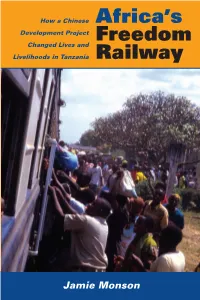
Africa's Freedom Railway
AFRICA HistORY Monson TRANSPOrtatiON How a Chinese JamiE MONSON is Professor of History at Africa’s “An extremely nuanced and Carleton College. She is editor of Women as On a hot afternoon in the Development Project textured history of negotiated in- Food Producers in Developing Countries and Freedom terests that includes international The Maji Maji War: National History and Local early 1970s, a historic Changed Lives and Memory. She is a past president of the Tanzania A masterful encounter took place near stakeholders, local actors, and— Studies Assocation. the town of Chimala in Livelihoods in Tanzania Railway importantly—early Chinese poli- cies of development assistance.” the southern highlands of history of the Africa —James McCann, Boston University Tanzania. A team of Chinese railway workers and their construction “Blessedly economical and Tanzanian counterparts came unpretentious . no one else and impact of face-to-face with a rival is capable of writing about this team of American-led road region with such nuance.” rail power in workers advancing across ’ —James Giblin, University of Iowa the same rural landscape. s Africa The Americans were building The TAZARA (Tanzania Zambia Railway Author- Freedom ity) or Freedom Railway stretches from Dar es a paved highway from Dar Salaam on the Tanzanian coast to the copper es Salaam to Zambia, in belt region of Zambia. The railway, built during direct competition with the the height of the Cold War, was intended to redirect the mineral wealth of the interior away Chinese railway project. The from routes through South Africa and Rhodesia. path of the railway and the After being rebuffed by Western donors, newly path of the roadway came independent Tanzania and Zambia accepted help from communist China to construct what would together at this point, and become one of Africa’s most vital transportation a tense standoff reportedly corridors. -

The Case of Sugarcane Outgrowers in Kilombero District, Tanzania
Working Paper Working The role of the state and foreign capital in agricultural commercialisation: The case of sugarcane outgrowers in Kilombero District, Tanzania Rebecca Smalley, Emmanuel Sulle and Lameck Malale September 2014 Working Paper 106 www.future-agricultures.org Acknowledgements The authors would like to thank Ruth Hall for her comments on a previous draft, Ellen Sprenger for sending us her report and all the people who contributed their time to this research, including company staff, grower representatives, civil servants, researchers and local residents. Working Paper 106 2 www.future-agricultures.org 1 Introduction Our main research question is: what effect has privatisation of Kilombero Sugar Company had on its Since the launch of the Kilimo Kwanza (‘Agriculture operations and surrounding communities? The study was First’) slogan in 2009, the Tanzanian government has undertaken within the context of the Future Agricultures been part of efforts to inject foreign capital into its Consortium (FAC) and our analytical framework draws 1 country’s agricultural sector. A range of domestic and from its Land theme, especially its questions around international players have developed plans to facilitate agrarian structure; social differentiation; land and private acquisition of farmland; increase investment in property; and livelihoods and food security. The paper irrigation and value addition; deepen the penetration contributes to the debate on large-scale land acquisition of agribusiness; and bring more of Tanzania’s small- and agricultural commercialisation in sub-Saharan Africa, scale farmers into commercial agriculture, particularly as well as providing insights for Tanzanian agricultural through outgrower arrangements. The plans include the policymaking and giving a history of the company and Southern Agricultural Growth Corridor project (SAGCOT), local area. -

Report on the State of Pastoralists' Human Rights in Tanzania
REPORT ON THE STATE OF PASTORALISTS’ HUMAN RIGHTS IN TANZANIA: SURVEY OF TEN DISTRICTS OF TANZANIA MAINLAND 2010/2011 [Area Surveyed: Handeni, Kilindi, Bagamoyo, Kibaha, Iringa-Rural, Morogoro, Mvomero, Kilosa, Mbarali and Kiteto Districts] Cover Picture: Maasai warriors dancing at the initiation ceremony of Mr. Kipulelia Kadege’s children in Handeni District, Tanga Region, April 2006. PAICODEO Tanzania Funded By: IWGIA, Denmark 1 REPORT ON THE STATE OF PASTORALISTS’ HUMAN RIGHTS IN TANZANIA: SURVEY OF TEN DISTRICTS OF TANZANIA MAINLAND 2010/2011 [Area Surveyed: Handeni, Kilindi, Bagamoyo, Kibaha, Iringa-Rural, Morogoro-Rural, Mvomero, Kilosa, Mbarali and Kiteto Districts] PARAKUIYO PASTORALISTS INDIGENOUS COMMUNITY DEVELOPMENT ORGANISATION-(PAICODEO) Funded By: IWGIA, Denmark i REPORT ON THE STATE OF PASTORALISTS’ RIGHTS IN TANZANIA: SURVEY OF TEN DISTRICTS OF TANZANIA MAINLAND 2010/2011 Researchers Legal and Development Consultants Limited (LEDECO Advocates) Writer Adv. Clarence KIPOBOTA (Advocate of the High Court) Publisher Parakuiyo Pastoralists Indigenous Community Development Organization © PAICODEO March, 2013 ISBN: 978-9987-9726-1-6 ii TABLE OF CONTENTS ACKNOWLEDGEMENTS ..................................................................................................... vii FOREWORD ........................................................................................................................viii Legal Status and Objectives of PAICODEO ...........................................................viii Vision ......................................................................................................................viii -

UNCTAD/LDC/115 20 July 2001
UNCTAD/LDC/115 20 July 2001 ENGLISH ONLY TRADE AND DEVELOPMENT BOARD Fifth Meeting of Governmental Experts from Land-locked and Transit Developing Countries and Representatives of Donor Countries and Financial and Development Institutions New York, 30 July - 3 August 2001 REVIEW OF PROGRESS IN THE DEVELOPMENT OF TRANSIT TRANSPORT SYSTEMS IN EASTERN AND SOUTHERN AFRICA Report prepared by InfraAfrica (Pty) Ltd UNCTAD consultant * / _________________ * / The views expressed in this study are those of the author and do not necessarily reflect the views of the UNCTAD secretariat or of any official administration. The designations employed and the presentation of the material do not imply the expression of any opinion whatsoever on the part of the secretariat of the United Nations concerning the legal status of any country, territory, city or area, or of its authorities, or concerning the delimitation of its frontiers or boundaries. 2 CONTENTS INTRODUCTION ................................................................................................................. 3-4 I. Objectives and scope of report..................................................................................... 4-5 II. Approach and methodology........................................................................................... 5-6 III. Layout of report.................................................................................................................6 IV. Inventory of transit-transport systems and facilities................................................... -

Case Study: Kilombero Sugar Company Ltd. in Tanzania
Case Study: Kilombero Sugar Company Ltd. in Tanzania Prepared for Landesa’s Responsible Investments in Property and Land Project Landesa – February 2017 Case Study: Kilombero Sugar Company Ltd. in Tanzania. Prepared for Landesa’s Responsible Investments in Property and Land (RIPL) Project February 2017 Disclaimer: The authors' views expressed in this report do not necessarily reflect the views of the Department for International Development, Kilombero Sugar Company Ltd., or Illovo Sugar Group. Contact Lukasz Czerwinski at lukaszc@landesa.org with any questions. Landesa is a U.S.-based international NGO that partners with governments, local organizations, and corporations to improve land laws, policies, and practices, with the primary goal of improving land tenure security, especially for the rural poor. Landesa specialists have land property rights experience in over 50 countries throughout Africa, Asia, Latin America, the Middle East, Eastern Europe, and the former Soviet Union. Case Study: Kilombero Sugar Company Ltd. in Tanzania: Prepared for Landesa’s Responsible Investments in Property and Land (RIPL) Project TABLE OF CONTENTS Executive Summary .................................................................................... 3 Background on the Responsible Investments in Property and Land Project…..…3 Tanzania Case Study: Kilombero Sugar Company Ltd.………………………………....3 Key Findings………………………………………………………………………………….……………3 Case Study Background ............................................................................... 5 Methodology -

Trends in Rail Transport in Zambia and Tanzania
The African e-Journals Project has digitized full text of articles of eleven social science and humanities journals. This item is from the digital archive maintained by Michigan State University Library. Find more at: http://digital.lib.msu.edu/projects/africanjournals/ Available through a partnership with Scroll down to read the article. Trends in Rail Transport in Zambia and Tanzania John F. Due Professor of Economics" Ut4fiti Vol VIII No.2, 1986, Journal University of Illinois of the FacUlty of Arts and Social Sciences Urbana - Champaign University of Oar es Sal~ , Rail tr~sport in Africa began in the colonial days. The lines were built partly for milItary reasons and partly to allow exploitation of mineral deposits, export of farm products, and import of manufactured goods. Built inland from the coast, they were not designed for inter-country trade nor were they ideal' 'for internal economic development. They were built cheaply, and to a narrow gauge of 1.067 meters (3 Y2feet) in the British colonies (but not in all) and I meter in most others. After independence one major line (Tazara) was built, some ,lines were extended, and some connecting links built. On the whole, however, despite some improvements, hi manyrespectsmost systems have de- teriorated in recent decades. Itis the purpose of this paper to review the recent expsrience in detail in Zambia and Tanzania Zambia Railways Much of Zambia has never had rail service. The Zambia Railway ..: line was built by Rhodesian Railways, crossmg the Zambezi at Victoria Falls nearLiviIIg- stone in l~3, reaching Kabwe (then Broken Hill) in 1906,'andCopper Belt (then little deveioped) In 1909. -
Transport: Highway to Development
REVUE TANZANIE 7 - 256P OK:REVUE TANZANIE 7 - 256P 17/08/10 10:02 Page 219 TANZANIA Transport: Highway to development Introduction and financially sustainable opment and maintenance There has been a sus- transportation must be cost- programmes and reforms tained effort on the part of effective and continuously aimed at enhancing the Government of Tanzania to responsive to changing de- provision of an efficient, cost- create essential transport mands through the creation effective and safe transport infrastructure and services of a more competitive trans- system in the country. to improve access to jobs, port sector. Therefore, the education and health facil- availability of proper trans- Allocation of funds to the ities and also to facilitate port infrastructure and effi- transport sector has increased domestic and international cient transport services are consistently over the past trade as well as strengthen crucial determinants for decade from around 170 regional integration and socio-economic development billion in 2001/2002 to over attract foreign investment. and industrial development. 1,100 billion in 2010/2011. This socio-economic develop- mental scenario underscores In the past five years, the Despite the progress made, the fact that transportation transport sector in Tanzania transport in Tanzania is char- is pivotal to the overall devel- has helped to integrate market- acterized by the following: opment of Tanzania. Indeed, strengthening competition, • Inadequate transport net- it is a key infrastructure sector increase access to farming work length leading to inade- that acts as a stimulus to techniques, promote trade, quate accessibility to econom- socio-economic growth and tourism, and foreign invest- ically potential areas; also accounts for a large pro- ment, and has contributed to • High transport costs; portion of public investment. -
The Unexpected Successes of a Cold War Development Project
Carleton College Carleton Digital Commons Faculty Work History 2005 Freedom Railway: The Unexpected Successes of a Cold War Development Project Jamie Monson Carleton College Follow this and additional works at: https://digitalcommons.carleton.edu/hist_faculty Part of the African History Commons, African Languages and Societies Commons, Asian History Commons, and the History of Science, Technology, and Medicine Commons Recommended Citation Monson, Jamie. "Freedom Railway: The Unexpected Successes of a Cold War Development Project." Boston Review, (2005): 1-6. Accessed via Faculty Work. History. Carleton Digital Commons. https://digitalcommons.carleton.edu/hist_faculty/2 This Article is brought to you for free and open access by the History at Carleton Digital Commons. It has been accepted for inclusion in Faculty Work by an authorized administrator of Carleton Digital Commons. For more information, please contact digitalcommons.group@carleton.edu. 10/8/2018 Boston Review — Jamie Monson: Freedom Railway DECEMBER 2004/JANUARY 2005 archives (http://bostonreview.net/archives.html) Freedom Railway The unexpected successes of a Cold War development project Jamie Monson When the local train pulls into Makambako station on Tanzania’s TAZARA railway, porters scramble to load the heavy bags of maize and baskets of vegetables stacked high on the platform. The noise grows as traders shout and quarrel over the limited space in the baggage wagons, which, like the passenger compartments, seem always to be filled to capacity on these “ordinary trains” running between Dar es Salaam and Mbeya, challenging the railway authorities to keep order both at stations and at small stops along the route. Passengers haggle with traders over prices through the windows of the train, buying sacks of highland potatoes, onions, and cabbages. -

United Republic of Tanzania Ministry of Transport
UNITED REPUBLIC OF TANZANIA MINISTRY OF TRANSPORT Public Disclosure Authorized PROPOSED TANZANIA INTERMODAL AND RAIL PROJECT (TIRP) REHABILITATION OF RAILWAY LINE INCLUDING TRACK RENEWAL AND BRIDGES UPGRADING BETWEEN DAR ES SALAAM AND ISAKA ALONG THE CORE CORRIDOR TO MWANZA Public Disclosure Authorized ENVIRONMENTAL AND SOCIAL IMPACT ASSESSMENT (ESIA) Public Disclosure Authorized FINAL REPORT Prepared by Juma Kayonko, MSc Registered Environmental Expert (NEMC/EIA 0162), P.O. Box 30, Dar es Salaam, Tanzania Mobile: (+255) 0787/0754 616 700 Email: kayonkoj@gmail.com Public Disclosure Authorized NOVEMBER 2013 REHABILITATION OF RAILWAY LINE INCLUDING TRACK RENEWAL AND BRIDGES UPGRADING BETWEEN DAR ES SALAAM AND ISAKA ALONG THE CORE CORRIDOR TO MWANZA ENVIRONMENTAL AND SOCIAL IMPACT ASSESSMENT FINAL REPORT Prepared by: Juma Kayonko, MSc Registered Environmental Expert (NEMC/EIA 0162), P.O. Box 30, Dar es Salaam, Tanzania Mobile: (+255) 0787/0754 616700 Email: kayonkoj@gmail.com NOVEMBER 2013 Table of Contents Table of Contents ______________________________________________________ ii List of Tables __________________________________________________________ vi List of Figures _________________________________________________________ vii Abbreviations and Acronyms ________________________________________ viii Acknowledgement ____________________________________________________ ix Executive Summary ____________________________________________________ x Chapter 1: Introduction ________________________________________________ 1 1.1 General Background -

This Work Is Licensed Under a Creative Commons Attribuiion-Noncommercial- Noderivs 3.0 Licence
This work is licensed under a Creative Commons Attribuiion-NonCommercial- NoDerivs 3.0 Licence. To view a copy of the licence please see: http://creativecornmons.0rg/licenses/by-nc-nd/3.0/ SOME OBSERVATIONS ON RAIL AND ROAD TRANS- PORT IN COMMONWEALTH TROPICAL AFRICA by John F. Due DISCUSSION PAPER NO„ 257 INSTITUTE FOR DEVELOPMENT STUDIES UNIVERSITY OF NAIROBI P.O. Box 30197 NAIROBI, Kenyao AUGUST, 1977 The author of this paper is Professor of Economics at the University of Illinois at Urbana-Champaign. He is greatly indebted to the officials of the ministries of transport and the railways in the various countries covered in this paper. However, views expressed here are solely those of the author, and should not be interpreted as reflecting the views of the Institute for Development Studies, the University of Nairobi or any other individual or organisation. This paper is not for quotation without permission of the author, as specified in the Copyright Act, Cap. 130 of the Laws of Kenya. SOME OBSERVATIONS ON RAIL AND ROAD TRANS- PORT IN COMMONWEALTH TROPICAL AFRICA by John F. Due DISCUSSION PAPER NO. 257 ABSTRACT The railways of tropical Africa have undergone drastic changes in the past two decades. On the one hand, some major extensions and improvements have been made, of which the most significant is TAZARA, linking Zambia with Dar es Salaam. On the other hand, the near monopoly position has been shattered by the development of road transport, which has deflected substantial traffic that would otherwise have gone by rail, particularly high-value commodities. At the same time with emphasis on road building, the rail systems, except in Central Africa, have been neglected to varying degrees by governments, with a resulting inability even to carry all the traffic that is available, and there has been considerable deterioration in performance. -

Mapping Potential 2028 Scenarios for Mang'ula A
MAPPING POTENTIAL 2028 SCENARIOS FOR MANG’ULA A, TANZANIA AND MANG’ULA B, TANZANIA AFTER THE KIDATU-IFAKARA ROAD CONSTRUCTION: Suitability Analysis for Human Settlement, Scenario Building Based on Varying Policy Focus, and Analysis of Capacity for Population Growth Hope Bodenschatz LArch 499.5 June 16, 2018 Bodenschatz 2 TABLE OF CONTENTS INTRODUCTION......................................................................................................................... 3 BACKGROUND ........................................................................................................................... 4 Infrastructure Improvements as Drivers of Change ........................................................................ 4 Introduction to Mang’ula A and B .................................................................................................. 4 REGROW and SAGCOT ............................................................................................................... 5 Population Growth due to Migration in Mang’ula A and B ........................................................... 5 Conservation and Udzungwa Mountains National Park ................................................................. 6 Agriculture in Mang’ula A and B ................................................................................................... 6 Ecotourism for Udzungwa Mountains National Park ..................................................................... 7 Suitability Analysis Method ..........................................................................................................