US EPA-Pesticides; Clothianidin
Total Page:16
File Type:pdf, Size:1020Kb
Load more
Recommended publications
-

Bexar County Karst Invertebrates Draft Recovery Plan
Bexar County Karst Invertebrates Draft Recovery Plan March 2008 Bexar County Karst Invertebrates Draft Recovery Plan BEXAR COUNTY KARST INVERTEBRATES DRAFT RECOVERY PLAN Southwest Region U.S. Fish and Wildlife Service Albuquerque, New Mexico March 2008 Approved: ___DRAFT_______________________________________ Regional Director, Southwest Region Date U.S. Fish and Wildlife Service Concur: __DRAFT____________________________________________ Executive Director Date Texas Parks and Wildlife Department ii Bexar County Karst Invertebrates Draft Recovery Plan DISCLAIMER Recovery plans delineate reasonable actions that the best available science indicates are necessary to recover or protect listed species. Plans are published by the U.S. Fish and Wildlife Service (Service), but are sometimes prepared with the assistance of recovery teams, contractors, state agencies, and others. Objectives will be attained and any necessary funds made available subject to budgetary and other constraints affecting the parties involved, as well as the need to address other priorities. Recovery plans are guidance and planning documents only. Identification of an action to be implemented by any private or public party does not create a legal obligation beyond existing legal requirements. Nothing in this plan should be construed as a commitment or requirement that any Federal agency obligate or pay funds in contravention of the Anti-Deficiency Act (U.S.C. 1341) or any other law or regulation. Recovery plans do not necessarily represent the views or the official positions or approval of any individuals or agencies involved in the plan formulation, other than the Service. They represent the official position of the Service only after the plan has been signed by the Regional Director as approved. -

Reprint Covers
TEXAS MEMORIAL MUSEUM Speleological Monographs, Number 7 Studies on the CAVE AND ENDOGEAN FAUNA of North America Part V Edited by James C. Cokendolpher and James R. Reddell TEXAS MEMORIAL MUSEUM SPELEOLOGICAL MONOGRAPHS, NUMBER 7 STUDIES ON THE CAVE AND ENDOGEAN FAUNA OF NORTH AMERICA, PART V Edited by James C. Cokendolpher Invertebrate Zoology, Natural Science Research Laboratory Museum of Texas Tech University, 3301 4th Street Lubbock, Texas 79409 U.S.A. Email: james.cokendolpher@ttu.edu and James R. Reddell Texas Natural Science Center The University of Texas at Austin, PRC 176, 10100 Burnet Austin, Texas 78758 U.S.A. Email: jreddell.caves@mail.utexas.edu March 2009 TEXAS MEMORIAL MUSEUM and the TEXAS NATURAL SCIENCE CENTER THE UNIVERSITY OF TEXAS AT AUSTIN, AUSTIN, TEXAS 78705 Copyright 2009 by the Texas Natural Science Center The University of Texas at Austin All rights rereserved. No portion of this book may be reproduced in any form or by any means, including electronic storage and retrival systems, except by explict, prior written permission of the publisher Printed in the United States of America Cover, The first troglobitic weevil in North America, Lymantes Illustration by Nadine Dupérré Layout and design by James C. Cokendolpher Printed by the Texas Natural Science Center, The University of Texas at Austin, Austin, Texas PREFACE This is the fifth volume in a series devoted to the cavernicole and endogean fauna of the Americas. Previous volumes have been limited to North and Central America. Most of the species described herein are from Texas and Mexico, but one new troglophilic spider is from Colorado (U.S.A.) and a remarkable new eyeless endogean scorpion is described from Colombia, South America. -

SEP-HCP Conservation Plan
FINAL FINAL NOVEMBER 13, 2015 BOWMAN PROJECT NO. 005520-01-001 SOUTHERN EDWARDS PLATEAU HABITAT CONSERVATION PLAN PREPARED FOR COUNTY OF BEXAR INFRASTRUCTURE SERVICES DEPARTMENT 233 N. PECOS, SUITE 420 SAN ANTONIO, TX 78207 PREPARED BY BOWMAN CONSULTING GROUP, LTD. 3101 BEE CAVE ROAD, SUITE 100 AUSTIN, TX 78746 WITH JACKSON WALKER LLP ZARA ENVIRONMENTAL, LLC WENDELL DAVIS AND ASSOCIATES M.E. ALLISON & ASSOCIATES FINAL SOUTHERN EDWARDS PLATEAU HABITAT CONSERVATION PLAN BOWMAN © 2015 PROJECT NO. 005520-01-001 EXECUTIVE SUMMARY WHAT IS THE SOUTHERN EDWARDS PLATEAU HABITAT CONSERVATION PLAN? The Southern Edwards Plateau Habitat Conservation Plan (“SEP-HCP” or the “Plan”) is a way for Bexar County and the City of San Antonio (the “Permittees”) to assist with compliance of the Endangered Species Act. These compliance issues threaten the economic growth of the greater San Antonio region. The purposes of the SEP-HCP are to: (1) Promote regional conservation; (2) Provide support for Camp Bullis; (3) Involve local stakeholders in conservation planning; (4) Streamline endangered species permitting; (5) Implement locally appropriate and cost-effective permitting and conservation strategies; and (6) Leverage available resources. Upon approval of the SEP-HCP by the U.S. Fish and Wildlife Service (the “Service”), a 30-year Incidental Take Permit (ITP) under section 10(a)(1)(B) of the Endangered Species Act (“ESA”) would be issued. The Permit would authorize a limited amount of “incidental taking” of nine federally listed endangered species (the “Covered Species”) within the jurisdictions of Bexar County and the City of San Antonio. In return, the SEP-HCP will promote the conservation of the Covered Species and related natural resources in Bexar County and other counties of the Southern Edwards Plateau. -
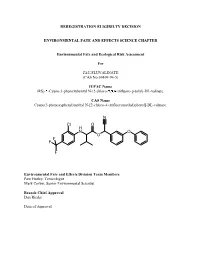
O O O N H N Cl F
REREGISTRATION ELIGIBILTY DECISION ENVIRONMENTAL FATE AND EFFECTS SCIENCE CHAPTER Environmental Fate and Ecological Risk Assessment For TAU-FLUVALINATE (CAS No.69409-94-5) IUPAC Name (RS)-α-Cyano-3-phenoxybenzyl N-(2-chloro-α,α,α-trifluoro-p-tolyl)-DL-valinate. CAS Name Cyano(3-phenoxyphenyl)methyl N-[2-chloro-4-(trifluoromethyl)phenyl]-DL-valinate. N Cl O H N O O F F F Environmental Fate and Effects Division Team Members Pam Hurley, Toxicologist Mark Corbin, Senior Environmental Scientist Branch Chief Approval Dan Rieder Date of Approval Table of Contents 1 Executive Summary....................................................1 1.1 Nature of Chemical Stressor........................................1 1.2 Potential Risks to Non-target Organisms ..............................2 1.3 Conclusions - Exposure Characterization..............................6 1.4 Conclusions - Effects Characterization................................6 1.5 Uncertainties and Data Gaps........................................7 2 Problem Formulation..................................................10 2.1 Stressor Source and Distribution ...................................10 2.1.1 Source and Intensity.......................................10 2.1.2 Physical/Chemical/Fate and Transport Properties .................11 2.1.3 Pesticide Type, Class, and Mode of Action......................12 2.1.4 Overview of Pesticide Usage.................................13 2.2 Receptors .....................................................14 2.2.1 Aquatic Effects...........................................15 -
Monsanto Petition (19-091-01P) for Determination of Nonregulated Status for Insect-Protected MON 88702 Cotton
Monsanto Petition (19-091-01p) for Determination of Nonregulated Status for Insect-Protected MON 88702 Cotton OECD Unique Identifier: MON-887Ø2-4 Final Environmental Assessment December 2020 Agency Contact Cindy Eck Biotechnology Regulatory Services 4700 River Road USDA, APHIS Riverdale, MD 20737 In accordance with federal civil rights law and U.S. Department of Agriculture (USDA) civil rights regulations and policies, the USDA, its Agencies, offices, and employees, and institutions participating in or administering USDA programs are prohibited from discriminating based on race, color, national origin, religion, sex, gender identity (including gender expression), sexual orientation, disability, age, marital status, family/parental status, income derived from a public assistance program, political beliefs, or reprisal or retaliation for prior civil rights activity, in any program or activity conducted or funded by USDA (not all bases apply to all programs). Remedies and complaint filing deadlines vary by program or incident. Persons with disabilities who require alternative means of communication for program information (e.g., Braille, large print, audiotape, American Sign Language, etc.) should contact the responsible Agency or USDA's TARGET Center at (202) 720-2600 (voice and TTY) or contact USDA through the Federal Relay Service at (800) 877-8339. Additionally, program information may be made available in languages other than English. To file a program discrimination complaint, complete the USDA Program Discrimination Complaint Form, AD-3027, found online at How to File a Program Discrimination Complaint and at any USDA office or write a letter addressed to USDA and provide in the letter all of the information requested in the form. -

Federal Register/Vol. 63, No. 250/Wednesday, December 30
Federal Register / Vol. 63, No. 250 / Wednesday, December 30, 1998 / Proposed Rules 71855 DEPARTMENT OF THE INTERIOR during normal business hours at the of each cave visited during the study above address. and presents information obtained from Fish and Wildlife Service FOR FURTHER INFORMATION CONTACT: invertebrate collections. Veni's (1994a) report delineates six 50 CFR Part 17 Alisa Shull, Supervisory Fish and Wildlife Biologist (see ADDRESSES karst areas (hereafter referred to as karst RIN 1018±AF33 section) (telephone 512/490±0057; fauna regions) within Bexar County. The facsimile 512/490±0974). karst fauna regions he discusses are Endangered and Threatened Wildlife Stone Oak, UTSA (University of Texas SUPPLEMENTARY INFORMATION: and Plants; Proposal to List Nine at San Antonio), Helotes, Government Bexar County, Texas Invertebrate Background Canyon, Culebra Anticline, and Alamo Species as Endangered Rhadine exilis and Rhadine infernalis Heights. The boundaries of these karst fauna regions are geological or AGENCY: were first collected in 1959 and Fish and Wildlife Service geographical features that may represent Interior. described by Barr and Lawrence (1960) as Agonum exile and Agonum infernale, obstructions to troglobite movement (on ACTION: Proposed rule. an evolutionary time scale) that have respectively. Barr (1974) assigned the resulted in the present-day distribution SUMMARY: We, the Fish and Wildlife species to the genus Rhadine. Batrisodes of endemic (restricted in distribution) Service, propose to list nine cave- venyivi was first collected in 1984 and karst invertebrates in the San Antonio dwelling invertebrates from Bexar described by Chandler (1992). Texella County, Texas as endangered species region. cokendolpheri was first collected in The harvestman Texella under the Endangered Species Act of 1982 and described in Ubick and Briggs 1973, as amended (Act). -

Black and Yellow Letter Law: Managing Rusty Patched Bumble Bee Conservation Under the Endangered Species Act
COLORADO NATURAL RESOURCES, ENERGY & ENVIRONMENTAL LAW REVIEW Black and Yellow Letter Law: Managing Rusty Patched Bumble Bee Conservation Under the Endangered Species Act Daniel Franz* Table of Contents INTRODUCTION ..................................................................................... 194 I. IMPORTANCE, DECLINE, AND PROTECTION OF BEES ........................ 195 A. Economic and Ecological Importance of Bees .................... 196 B. Bumble Bee Decline ............................................................. 197 C. Different Avenues for Legal Protection of Bees .................. 201 II. THE RUSTY PATCHED BUMBLE BEE AND THE ENDANGERED SPECIES ACT ............................................................................................ 205 A. Rusty Patched Bumble Bee Decline..................................... 205 B. Listing as an Endangered Species ........................................ 207 C. Unique Management Needs of the Rusty Patched Bumble Bee ............................................................................................ 208 1. The Rusty Patched Bumble Bee’s Life Cycle................ 208 2. Habitat-Related Needs ................................................... 210 3. Genetic Needs ................................................................ 212 III. MAXIMIZING PROTECTION OF THE RUSTY PATCHED BUMBLE BEE UNDER THE ENDANGERED SPECIES ACT ................................... 213 A. Maximizing Protections for the Rusty Patched Bumble Bee Using Critical Habitat ........................................................ -

Emamectin Benzoate (PC Code: 122806); Insecticide Product Proclaim@ (EPA Reg
TEXT SEARCHABLE DOCUMENT DP Barcode: D345948 July 25,2008 MEMORANDUM SUBJECT: Section 3 Request for Additional Uses of Emamectin Benzoate (PC Code: 122806); Insecticide Product Proclaim@ (EPA Reg. No. 100-904) for Tree Nuts (Group 14) and Pistachios ?/L7/08 FROM: Lucy Shanaman, Chemist 4~ Stephen Carey, Biologist F/z~/"' Environmental Risk Branch 111 Environmental Fate and Effects Division (7507P) TO: John Herbert, RM 07 Amer Al-Muddallal Insecticide-Rodenticide Branch Registration Division (7505P) 7 /z~/DP THRU: Thomas Bailey, Acting Branch C Mark Corbin, Acting RAPL 7:~s- 0% Environmental Risk Branch I11 Environmental Fate and Effects ~ivision(7507P) Attached please find the Environmental Fate and Effects Division's (EFED) environmental risk assessment for the proposed new uses of emamectin benzoate as an insecticide on tree nuts, pistachios and almond hulls. This risk assessment covers one formulated product, Proclaim@ Insecticide, a water-soluble granular product. The proposed maximum labeled application rate for tree nuts and pistachios depend on the degree of infestation of the target pests. The label recommends an application rate of 3.2 oz (0.01 lbs a.i./A) for low to moderate infestations and 4.8 oz (0.015 lbs a.i.lA) for severe infestations. Multiple applications are allowed with a 7-day interval up to the maximum seasonal load of 14.4 oz (0.045 lbs a.i./A). Emamectin benzoate can be applied via ground, air blast, or air. The application rates for the proposed new uses are the same of the registered uses on pome fruits. The application methods for the proposed new uses are ground and air blast applications while aerial applications are not permitted. -

Bexar County Karst Invertebrates Recovery Plan
Bexar County Karst Invertebrates Recovery Plan August 2011 DISCLAIMER Recovery plans delineate reasonable actions that the best available science indicates are necessary to recover or protect listed species. Plans are published by the U.S. Fish and Wildlife Service (Service), but are sometimes prepared with the assistance of recovery teams, contractors, state agencies, and others. Recovery plans do not necessarily represent the views, official positions, or approval of any individuals or agencies involved in the plan formulation, other than the Service. They represent the official position of the Service only after the plan has been signed by the Regional Director as approved. Recovery plans are guidance and planning documents only. Identification of an action to be implemented by any private or public party does not create a legal obligation beyond existing legal requirements. Objectives will be attained and any necessary funds made available subject to budgetary and other constraints affecting the parties involved, as well as the need to address other priorities. Nothing in this plan should be construed as a commitment or requirement that any Federal agency obligate or pay funds in any one fiscal year in excess of appropriations made by Congress for that fiscal year in contravention of the Anti-Deficiency Act (31 U.S.C. 1341) or any other law or regulation. Approved recovery plans are subject to modification as dictated by new information, changes in species status, and the completion of recovery actions. Please check for updates or revisions at the website below before using. LITERATURE CITATION SHOULD READ AS FOLLOWS: U.S. Fish and Wildlife Service. -

Corel Ventura
Principles and Practice for Design of Cave Preserve Management and Monitoring Plans for Invertebrate Species of Concern, San Antonio, Texas Kemble White SWCA, Inc. Environmental Consultants. 1712 Rio Grande Austin, Texas 78701-1124 (512) 476-0891 email: kwhite@swca.com Kenneth J. Kingsley SWCA, Inc. Environmental Consultants. 343 South Scott Ave. Tucson, Arizona 85701 (520) 325-9194 email: kkingsley@swca.com Abstract Karst areas around San Antonio, Texas contain over 300 known caves, some of which contain invertebrate animal species that are unique to the area. The U.S. Fish and Wildlife Service have proposed nine invertebrate species as Endangered Species. Concerned landowners and local agencies, hoping to obviate listing (which would be economically costly and an impediment to use of private property), have formed a coalition to protect, preserve, and manage caves known to have the species. Preserve Manage- ment and Monitoring Plans have been prepared for several caves based on guidelines promulgated by Fish and Wildlife Service and evaluation of conditions at each site. Important factors include protection of surface and sub-surface drainage areas, preservation of adequate foraging areas for trogloxenes, reduction of disruptive human access, control of non-native fire ants, and periodic monitoring to evaluate conditions and populations of species of concern. This paper will discuss the principles for design of Monitoring Plans and their practical application at one specific site. Introduction the petition; and Rhadine infernalis, another beetle, with two described subspecies: R. infer- In 1991, nine species of invertebrates known nalis infernalis, known from two caves, and R. only from caves in Bexar County, Texas, were infernalis ewersi, known only from one cave, petitioned for listing as Endangered Species and specimens that could not be identified to under the Federal Endangered Species Act. -

Department of the Interior
Vol. 76 Tuesday, No. 35 February 22, 2011 Part II Department of the Interior Fish and Wildlife Service 50 CFR Part 17 Endangered and Threatened Wildlife and Plants; Designation of Critical Habitat for Nine Bexar County, Texas, Invertebrates; Proposed Rule VerDate Mar<15>2010 17:30 Feb 18, 2011 Jkt 223001 PO 00000 Frm 00001 Fmt 4717 Sfmt 4717 E:\FR\FM\22FEP2.SGM 22FEP2 mstockstill on DSKH9S0YB1PROD with PROPOSALS2 9872 Federal Register / Vol. 76, No. 35 / Tuesday, February 22, 2011 / Proposed Rules DEPARTMENT OF THE INTERIOR means that we will post any personal species should be included in the information you provide us (see the designation and why; Fish and Wildlife Service Public Comments section below for • Special management considerations more information). or protections that the features essential 50 CFR Part 17 FOR FURTHER INFORMATION CONTACT: to the conservation of the nine Bexar [Docket No. FWS–R2–ES–2010–0091; MO Adam Zerrenner, Field Supervisor, U.S. County invertebrates identified in this 92210–0–009] Fish and Wildlife Service, Austin proposal may require, including Ecological Services Field Office, 10711 managing for the potential effects of RIN 1018–AX11 climate change; Burnet Road, Suite 200, Austin, TX • 78758; by telephone at 512–490–0057 What areas not occupied at the time Endangered and Threatened Wildlife of listing are essential for the and Plants; Designation of Critical x248; or by facsimile at 512–490–0974. If you use a telecommunications device conservation of the species and why; Habitat for Nine Bexar County, Texas, and Invertebrates for the deaf (TDD), call the Federal • Information Relay Service (FIRS) at Site-specific information on AGENCY: Fish and Wildlife Service, 800–877–8339. -

Karst Invertebrate Habitat Requirements
Karst Invertebrate Habitat Requirements U.S. Fish and Wildlife Service 10711 Burnet Road Suite #200 Austin, TX 78749 July 28, 2011 TABLE OF CONTENTS 1.0 INTRODUCTION....................................................................................................................1 2.0 HABITAT REQUIREMENTS ...............................................................................................2 2.1 Adaptation to the Cave Environment ....................................................................................2 2.1.1 Retreat to Subsurface ..................................................................................................2 2.1.2 Cave Formation ...........................................................................................................2 2.1.3 Physical Adaptations and Life History of Cave Life ..................................................3 2.2 Habitat Requirements ............................................................................................................3 2.2.1 Cave and Karst Habitat ...............................................................................................3 2.2.2 Mesocaverns ...............................................................................................................4 2.2.3 Microhabitat ................................................................................................................5 2.2.4 Drainage Basins ..........................................................................................................6 2.2.5 Humidity