Middle Jurassic Cyclostome Bryozoans from the Polish Jura
Total Page:16
File Type:pdf, Size:1020Kb
Load more
Recommended publications
-

Bryozoan Studies 2019
BRYOZOAN STUDIES 2019 Edited by Patrick Wyse Jackson & Kamil Zágoršek Czech Geological Survey 1 BRYOZOAN STUDIES 2019 2 Dedication This volume is dedicated with deep gratitude to Paul Taylor. Throughout his career Paul has worked at the Natural History Museum, London which he joined soon after completing post-doctoral studies in Swansea which in turn followed his completion of a PhD in Durham. Paul’s research interests are polymatic within the sphere of bryozoology – he has studied fossil bryozoans from all of the geological periods, and modern bryozoans from all oceanic basins. His interests include taxonomy, biodiversity, skeletal structure, ecology, evolution, history to name a few subject areas; in fact there are probably none in bryozoology that have not been the subject of his many publications. His office in the Natural History Museum quickly became a magnet for visiting bryozoological colleagues whom he always welcomed: he has always been highly encouraging of the research efforts of others, quick to collaborate, and generous with advice and information. A long-standing member of the International Bryozoology Association, Paul presided over the conference held in Boone in 2007. 3 BRYOZOAN STUDIES 2019 Contents Kamil Zágoršek and Patrick N. Wyse Jackson Foreword ...................................................................................................................................................... 6 Caroline J. Buttler and Paul D. Taylor Review of symbioses between bryozoans and primary and secondary occupants of gastropod -

Contributions in BIOLOGY and GEOLOGY
MILWAUKEE PUBLIC MUSEUM Contributions In BIOLOGY and GEOLOGY Number 51 November 29, 1982 A Compendium of Fossil Marine Families J. John Sepkoski, Jr. MILWAUKEE PUBLIC MUSEUM Contributions in BIOLOGY and GEOLOGY Number 51 November 29, 1982 A COMPENDIUM OF FOSSIL MARINE FAMILIES J. JOHN SEPKOSKI, JR. Department of the Geophysical Sciences University of Chicago REVIEWERS FOR THIS PUBLICATION: Robert Gernant, University of Wisconsin-Milwaukee David M. Raup, Field Museum of Natural History Frederick R. Schram, San Diego Natural History Museum Peter M. Sheehan, Milwaukee Public Museum ISBN 0-893260-081-9 Milwaukee Public Museum Press Published by the Order of the Board of Trustees CONTENTS Abstract ---- ---------- -- - ----------------------- 2 Introduction -- --- -- ------ - - - ------- - ----------- - - - 2 Compendium ----------------------------- -- ------ 6 Protozoa ----- - ------- - - - -- -- - -------- - ------ - 6 Porifera------------- --- ---------------------- 9 Archaeocyatha -- - ------ - ------ - - -- ---------- - - - - 14 Coelenterata -- - -- --- -- - - -- - - - - -- - -- - -- - - -- -- - -- 17 Platyhelminthes - - -- - - - -- - - -- - -- - -- - -- -- --- - - - - - - 24 Rhynchocoela - ---- - - - - ---- --- ---- - - ----------- - 24 Priapulida ------ ---- - - - - -- - - -- - ------ - -- ------ 24 Nematoda - -- - --- --- -- - -- --- - -- --- ---- -- - - -- -- 24 Mollusca ------------- --- --------------- ------ 24 Sipunculida ---------- --- ------------ ---- -- --- - 46 Echiurida ------ - --- - - - - - --- --- - -- --- - -- - - --- -
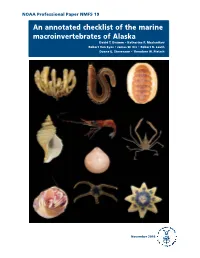
An Annotated Checklist of the Marine Macroinvertebrates of Alaska David T
NOAA Professional Paper NMFS 19 An annotated checklist of the marine macroinvertebrates of Alaska David T. Drumm • Katherine P. Maslenikov Robert Van Syoc • James W. Orr • Robert R. Lauth Duane E. Stevenson • Theodore W. Pietsch November 2016 U.S. Department of Commerce NOAA Professional Penny Pritzker Secretary of Commerce National Oceanic Papers NMFS and Atmospheric Administration Kathryn D. Sullivan Scientific Editor* Administrator Richard Langton National Marine National Marine Fisheries Service Fisheries Service Northeast Fisheries Science Center Maine Field Station Eileen Sobeck 17 Godfrey Drive, Suite 1 Assistant Administrator Orono, Maine 04473 for Fisheries Associate Editor Kathryn Dennis National Marine Fisheries Service Office of Science and Technology Economics and Social Analysis Division 1845 Wasp Blvd., Bldg. 178 Honolulu, Hawaii 96818 Managing Editor Shelley Arenas National Marine Fisheries Service Scientific Publications Office 7600 Sand Point Way NE Seattle, Washington 98115 Editorial Committee Ann C. Matarese National Marine Fisheries Service James W. Orr National Marine Fisheries Service The NOAA Professional Paper NMFS (ISSN 1931-4590) series is pub- lished by the Scientific Publications Of- *Bruce Mundy (PIFSC) was Scientific Editor during the fice, National Marine Fisheries Service, scientific editing and preparation of this report. NOAA, 7600 Sand Point Way NE, Seattle, WA 98115. The Secretary of Commerce has The NOAA Professional Paper NMFS series carries peer-reviewed, lengthy original determined that the publication of research reports, taxonomic keys, species synopses, flora and fauna studies, and data- this series is necessary in the transac- intensive reports on investigations in fishery science, engineering, and economics. tion of the public business required by law of this Department. -

Northern Adriatic Bryozoa from the Vicinity of Rovinj, Croatia
NORTHERN ADRIATIC BRYOZOA FROM THE VICINITY OF ROVINJ, CROATIA PETER J. HAYWARD School of Biological Sciences, University of Wales Singleton Park, Swansea SA2 8PP, United Kingdom Honorary Research Fellow, Department of Zoology The Natural History Museum, London SW7 5BD, UK FRANK K. MCKINNEY Research Associate, Division of Paleontology American Museum of Natural History Professor Emeritus, Department of Geology Appalachian State University, Boone, NC 28608 BULLETIN OF THE AMERICAN MUSEUM OF NATURAL HISTORY CENTRAL PARK WEST AT 79TH STREET, NEW YORK, NY 10024 Number 270, 139 pp., 63 ®gures, 1 table Issued June 24, 2002 Copyright q American Museum of Natural History 2002 ISSN 0003-0090 2 BULLETIN AMERICAN MUSEUM OF NATURAL HISTORY NO. 270 CONTENTS Abstract ....................................................................... 5 Introduction .................................................................... 5 Materials and Methods .......................................................... 7 Systematic Accounts ........................................................... 10 Order Ctenostomata ............................................................ 10 Nolella dilatata (Hincks, 1860) ................................................ 10 Walkeria tuberosa (Heller, 1867) .............................................. 10 Bowerbankia spp. ............................................................ 11 Amathia pruvoti Calvet, 1911 ................................................. 12 Amathia vidovici (Heller, 1867) .............................................. -

A New Large−Bodied Theropod Dinosaur from the Middle Jurassic of Warwickshire, United Kingdom
A new large−bodied theropod dinosaur from the Middle Jurassic of Warwickshire, United Kingdom ROGER B.J. BENSON and JONATHAN D. RADLEY Benson, R.B.J. and Radley, J.D. 2010. A new large−bodied theropod dinosaur from the Middle Jurassic of Warwickshire, United Kingdom. Acta Palaeontologica Polonica 55 (1): 35–42. Previously undocumented postcranial material from the Chipping Norton Limestone Formation (Middle Jurassic: Lower Bathonian) of Cross Hands Quarry, near Little Compton, Warwickshire represents a new large−bodied theropod dinosaur, distinct from the contemporaneous Megalosaurus bucklandii. Cruxicheiros newmanorum gen. et sp. nov. is diagnosed by a single autapomorphy, the presence of a proximomedially inclined ridge within the groove that marks the lateral extent of the posterior flange of the femoral caput (trochanteric fossa). C. newmanorum shows three tetanuran features: widely separated cervical zygapophyses, a swollen ridge on the lateral surface of the iliac blade and an anterior spur of the caudal neural spines. However, due to fragmentary preservation its affinities within Tetanurae remain uncertain: phylogenetic analysis places it as the most basal tetanuran, the most basal megalosauroid (= spinosauroid) or the most basal neotetanuran. Key words: Dinosauria, Theropoda, Tetanurae, Megalosaurus, Cruxicheiros, Bathonian, Chipping Norton Limestone Formation, England. Roger B.J. Benson [rbb27@cam.ac.uk], Department of Earth Science, University of Cambridge, Downing Street, Cam− bridge, UK, CB2 3EQ; Jonathan D. Radley [jonradley@warwickshire.gov.uk], Warwickshire Museum, Market Place, Warwick, UK CV34 4SA; School of Geography, Earth and Environmental Sciences, University of Birmingham, Edgbaston, Birmingham, UK B15 2TT. Received 8 July 2009, accepted 18 November 2009, available online 20 November 2009. -
1 Class Stenolaemata Order Cyclostomata Philip E
1 Class Stenolaemata Order Cyclostomata Philip E. Bock, Paul D. Taylor, Peter J. Hayward and Dennis P. Gordon 1.1 Definition and general description may be encrusting or erect and branching or foli- Stenolaemata is the most ancient bryozoan class, ose. They are typically dense, opaque white in with a fossil record beginning in the earliest Ordo- colour, occasionally flushed pink or purple, and vician, ~500 million years ago (Taylor and Ernst the calcification can appear speckled because of the 2004; Ma et al. 2015). Seven orders are recognised presence of numerous tissue-plugged pseudopores. currently (Taylor and Waeschenbach 2015), of In the Crisiidae, exemplifying the erect, branching which only Cyclostomata survives and includes all Articulata, the zooids are arranged in narrow rows living stenolaemate species. Globally, the order with openings on only one side of the slender, flex- Cyclostomata includes some 543 species assigned ible colony of branches linked by cuticular joints to 98 genera and 23 families (Bock and Gordon (nodes). Erect colonies of species of Tubuliporina, 2013). The group comprises, on average, ~11% of Cancellata and Cerioporina are unjointed (with the the species in any Recent bryozoan fauna (range single exception of the tubuliporine genus Crisuli- 0–24%, Banta 1991) and only rarely dominates in pora), gracile to robust, and have zooids arranged terms of numbers of colonies or biomass. evenly, in clusters or in ordered transverse rows. Stenolaemates are commonly termed ‘tubular Many species of Tubuliporina have encrusting col- bryozoans’, in reference to their elongate, slender, onies, occasionally taking the form of simple, uni- usually cylindrical zooids. -

Sepkoski, J.J. 1992. Compendium of Fossil Marine Animal Families
MILWAUKEE PUBLIC MUSEUM Contributions . In BIOLOGY and GEOLOGY Number 83 March 1,1992 A Compendium of Fossil Marine Animal Families 2nd edition J. John Sepkoski, Jr. MILWAUKEE PUBLIC MUSEUM Contributions . In BIOLOGY and GEOLOGY Number 83 March 1,1992 A Compendium of Fossil Marine Animal Families 2nd edition J. John Sepkoski, Jr. Department of the Geophysical Sciences University of Chicago Chicago, Illinois 60637 Milwaukee Public Museum Contributions in Biology and Geology Rodney Watkins, Editor (Reviewer for this paper was P.M. Sheehan) This publication is priced at $25.00 and may be obtained by writing to the Museum Gift Shop, Milwaukee Public Museum, 800 West Wells Street, Milwaukee, WI 53233. Orders must also include $3.00 for shipping and handling ($4.00 for foreign destinations) and must be accompanied by money order or check drawn on U.S. bank. Money orders or checks should be made payable to the Milwaukee Public Museum. Wisconsin residents please add 5% sales tax. In addition, a diskette in ASCII format (DOS) containing the data in this publication is priced at $25.00. Diskettes should be ordered from the Geology Section, Milwaukee Public Museum, 800 West Wells Street, Milwaukee, WI 53233. Specify 3Y. inch or 5Y. inch diskette size when ordering. Checks or money orders for diskettes should be made payable to "GeologySection, Milwaukee Public Museum," and fees for shipping and handling included as stated above. Profits support the research effort of the GeologySection. ISBN 0-89326-168-8 ©1992Milwaukee Public Museum Sponsored by Milwaukee County Contents Abstract ....... 1 Introduction.. ... 2 Stratigraphic codes. 8 The Compendium 14 Actinopoda. -

(Middle Jurassic): a Key Interval in the Early Mesozoic Phytoplankton Radiation
View metadata, citation and similar papers at core.ac.uk brought to you by CORE provided by NERC Open Research Archive 1 The Bajocian (Middle Jurassic): a key interval in the early Mesozoic phytoplankton radiation 2 3 Nickolas J. Wiggan a.b*, James B. Riding b, Robert A. Fensome c, Emanuela Mattioli d 4 5 Insert addresses here 6 7 ABSTRACT 8 Dinoflagellates and coccolithophores are two of the most important groups of phytoplankton 9 in the modern oceans. These groups originated in the Triassic and radiated through the early 10 Mesozoic, rising to ecological prominence. Within this long-term radiation, important short- 11 term intervals of evolutionary and ecological change can be recognised. The Bajocian 12 (Middle Jurassic, ~170–168 Ma) was characterised by an important ecological transition 13 within the coccolithophores, and the radiation of one of the principal families of cyst-forming 14 dinoflagellates, the Gonyaulacaceae. During the Early Bajocian, the coccolith genus 15 Watznaueria diversified and expanded ecologically to dominate coccolith floras, a situation 16 which continued for the remainder of the Mesozoic. This pattern was paralleled within 17 dinoflagellate cyst floras by the ecological dominance of the genus Dissiliodinium in the mid- 18 palaeolatitudes. These phenomena appear to be linked to a positive carbon isotope shift, and 19 an interval of enhanced productivity driven by a shift to a more humid climate, enhanced 20 continental weathering and nutrient flux. The latest Early Bajocian to earliest Bathonian was 21 then characterised by the rapid increase in diversity of dinoflagellate cysts within the family 22 Gonyaulacaceae. Through this interval, the Gonyaulacaceae transitioned from being a 23 relatively minor component of dinoflagellate cyst floras, to becoming one of the prominent 24 groups of cyst-forming dinoflagellates, which has persisted to the Holocene. -

Bryozoans from the Eocene of Seymour Island, Antarctic Peninsula
BRYOZOANS FROM THE EOCENE OF SEYMOUR ISLAND, ANTARCTIC PENINSULA URSZULA HARA Hara, U. 2001. Bryozoans from the Eocene of Seymour Island, Antarctic Peninsula. In: A. Gaździcki (ed.), Palaeontological Results of the Polish Antarctic Expeditions. Part III. Palaeontologia Polonica 60, 33–156. Bryozoans are a significant component of the rich biota of the Eocene La Meseta Formation on Seymour (Marambio) Island, Antarctic Peninsula. Within the formation thirty genera and forty−three species are recognized, of which 15 are cyclostomes and 28 are cheilostomes. Two genera and nineteen species are described as new taxa: Retecrisina antarctica sp. n., Ceriopora hemisphaerica sp. n., Neofungella capitula sp. n., Reptomulticava clavaeformis sp. n., Reptomulticava seymourensis sp. n., Disporella marambioensis sp. n., Reticrescis plicatus gen. et sp. n., Aspidostoma multiformis sp. n., Aspidostoma pyriformis sp. n., Aspidostoma taylori sp. n., Celleporaria australis sp. n., Celleporaria gondwanae sp. n., Celleporaria mesetaensis sp. n., Celleporaria ovata sp. n., Dennisia eocenica gen. et sp. n., Smittoidea gazdzickii sp. n., Aimulosia lamellosa sp. n., Osthimosia globosa sp. n., and Rhynchozoon quadratus sp. n. The most abundant bryozoan assemblage occurs in the transgressive facies of the lower part of the formation (Telm1 unit). The bryozoans from the upper part of the formation are represented by only two taxa, Reticrescis plicatus gen. et sp. n. and Smittina sp. The following genera are herein recorded for the first time from Antarctica: Retecrisina, Crassohornera, Borgella, Ceriopora, Reptomulticava, Cellepora− ria, and Metroperiella. Others such as Crisia, Fasciculipora, Hornera, Cellaria, Smittina, and Reteporella have been previously noted from the Oligocene of King George Island in the South Shetland Islands, and some of them from the Pliocene of adjacent Cockburn Island. -

1 the Literature on Triassic, Jurassic and Earliest Cretaceous Dinoflagellate Cysts: Supplement 4 2 3 James B
1 The literature on Triassic, Jurassic and earliest Cretaceous dinoflagellate cysts: supplement 4 2 3 James B. Riding 4 5 British Geological Survey, Environmental Science Centre, Keyworth, Nottingham NG12 6 5GG, United Kingdom 7 8 CONTACT James B. Riding email jbri@bgs.ac.uk 9 10 ABSTRACT 11 Since the publication of four compilations issued between 2012 and 2019, 93 further 12 published contributions on Triassic, Jurassic and earliest Cretaceous (Berriasian) 13 dinoflagellate cysts from Africa, North America, South America, the Arctic, Australasia, East 14 Europe, West Europe, the Middle East and Russia have been discovered in the literature, or 15 were issued in the last 12 months (i.e. between February 2018 and January 2019). Of these, 16 55 were published during 2018 and 2019, making this period a very productive one. These 17 studies are mostly on the Late Triassic and Early Jurassic of Europe. All the 93 items are 18 listed herein with digital object identifier (doi) numbers where available, as well as a 19 description of each item as a string of keywords. Publications on West Europe comprise 20 31.2% of the total, and items on Africa, the Arctic, Australasia, East Europe and Russia are 21 also significant (15.1%, 6.5%, 7.5%, 9.7% and 14.0% respectively). The least well- 22 represented regions are North America, South America and the Middle East (2.2%, 1.1% and 23 1.1% respectively). 24 25 KEYWORDS dinoflagellate cysts; earliest Cretaceous (Berriasian); Jurassic; literature 26 analysis and compilation; Triassic; worldwide 27 28 29 1. Introduction 30 The literature on Triassic to earliest Cretaceous (Berriasian) dinoflagellate cysts is extensive, 31 and was listed and reviewed by Riding (2012, 2013, 2014, 2019). -

United States National Museum
Q 11 U563 CRLSSI SMITHSONIAN INSTITUTION UNITED STATES NATIONAL MUSEUM Bulletin 165 THE BRYOZOAN FAUNA OF THE VINCENTOWN LIMESAND BY FERDINAND CANU Versailles, France and RAY S. BASSLER Head Curator, Department of Geology United States National Museum UNITED STATES GOVERNMENT PRINTING OFFICE WASHINGTON : 1933 For sale by the Superintendent of Documents, Washington, D.C. Price 202 cents ADVERTISEMENT The scientific publications of the National Museum include two series, known, respectively, as Proceedings and Bulletin. The Proceedings series, begun in 1878, is intended primarily as a medium for the publication of original papers, based on the collec- tions of the National Museum, that set forth newly acquired facts in biology, anthropology, and geology, with descriptions of new forms and revisions of limited groups. Copies of each paper, in pamphlet form, are distributed as published to libraries and scientific organi- zations and to specialists and others interested in the different subjects. The dates at which these separate papers are published are recorded in the table of contents of each of the volumes. The series of Bulletins, the first of which was issued in 1875, con- tains separate publications comprising monographs of large zoologi- cal groups and other general systematic treatises (occasionally in several volumes), faunal works, reports of expeditions, catalogues of type specimens and special collections, and other material of similar nature. The majority of the volumes are octavo in size, but quarto size has been adopted in a few instances in which large plates were regarded as indispensable. In the Bulletin series appear volumes under the heading Contributions from the United States National Herbarium, in octavo form, published by the National Museum since 1902, which contain papers relating to the botanical collections of the Museum. -
Ammonite Succession at the Bajocian/Bathonian Boundary in the Cabo Mondego Region
View metadata, citation and similar papers at core.ac.uk brought to you by CORE Ammonite succeSSIon at the Bajocian/Bathonian boundary provided by EPrints Complutense in the Cabo Mondego region (Portugal) SIXTO R. FERNANDEZ-LOPEZ, MARIA HELENA HENRIQUES AND CHARLES MANGOLD The Cabo Mondego outcrops exposed along the cliffs, on the western margin of the Iberian Plate, show an expanded strati graphic section of Lower Bathonian deposits containing abundant ammonoids. Upper Bajocian deposits correspond to similar facies, of muddy limestones alternating with marlstones, although ammonoids are scarce. A detailed succession of ammonites across the Bajocian/Bathonian boundary has been recognized at Cabo Mondego, which can form a useful bio- and chronostratigraphic standard for the Lusitanian Basin. The revision of previous collections from the classical section and new field samplings of two other separate sections allow the recognition through up to twenty metres of thickness, the highest zone of Bajocian (Parkinsoni Zone) and the lowest zone of Bathonian (Zigzag Zone). The Parkinsoni and the Zigzag zones established for NW European areas and belonging to the Northwest European Province, can be identified in the Lusitanian Basin, although the ammonite fossil assemblages are composed of Submediterranean taxa. However, a subdivision of the Parkinsoni Zone is not possible, due to the scarcity of well preserved ammonoids. The Zigzag Zone can be recognized and characterized as composed of two subunits (Parvum and Macrescens subzones) as represented in diverse European basins of the Submedi terranean Province. Ammonite fossil assemblages of the Parvum Subzone may be grouped into two successive horizons, which are biochronostratigraphically equivalent to the subdivisions of the Convergens Subzone distinguished in the Digne-Barreme area (SE France).