! Letter-Triersto Be Appointed by the Special Agents Of
Total Page:16
File Type:pdf, Size:1020Kb
Load more
Recommended publications
-

A Brief History of the Hawaiian People
0 A BRIEF HISTORY OP 'Ill& HAWAIIAN PEOPLE ff W. D. ALEXANDER PUBLISHED BY ORDER OF THE BOARD OF EDUCATION OF THE HAWAIIAN KINGDOM NEW YORK,: . CINCINNATI•:• CHICAGO AMERICAN BOOK C.OMPANY Digitized by Google ' .. HARVARD COLLEGELIBRAllY BEQUESTOF RCLANOBUr.ll,' , ,E DIXOII f,'.AY 19, 1936 0oPYBIGRT, 1891, BY AlilBIOAN BooK Co)[PA.NY. W. P. 2 1 Digit zed by Google \ PREFACE AT the request of the Board of Education, I have .fi. endeavored to write a simple and concise history of the Hawaiian people, which, it is hoped, may be useful to the teachers and higher classes in our schools. As there is, however, no book in existence that covers the whole ground, and as the earlier histories are entirely out of print, it has been deemed best to prepare not merely a school-book, but a history for the benefit of the general public. This book has been written in the intervals of a labo rious occupation, from the stand-point of a patriotic Hawaiian, for the young people of this country rather than for foreign readers. This fact will account for its local coloring, and for the prominence given to certain topics of local interest. Especial pains have been taken to supply the want of a correct account of the ancient civil polity and religion of the Hawaiian race. This history is not merely a compilation. It is based upon a careful study of the original authorities, the writer having had the use of the principal existing collections of Hawaiian manuscripts, and having examined the early archives of the government, as well as nearly all the existing materials in print. -

Melville's Copy of Thomas Beale's the Natural History of the Sperm
Melville’s copy of Thomas Beale’s "The natural history of the sperm whale and the composition of Moby-Dick" The Harvard community has made this article openly available. Please share how this access benefits you. Your story matters Citation Olsen-Smith, Steven. 2011. Melville’s copy of Thomas Beale’s "The natural history of the sperm whale and the composition of Moby- Dick". Harvard Library Bulletin 21 (3): 1-78. Citable link https://nrs.harvard.edu/URN-3:HUL.INSTREPOS:37363364 Terms of Use This article was downloaded from Harvard University’s DASH repository, and is made available under the terms and conditions applicable to Other Posted Material, as set forth at http:// nrs.harvard.edu/urn-3:HUL.InstRepos:dash.current.terms-of- use#LAA Melville’s Copy of Tomas Beale’s Te Natural History of the Sperm Whale and the Composition of Moby-Dick Steven Olsen-Smith erman Melville’s copy of Thomas Beale’s Te Natural History of the Sperm Whale, discovered in the 1930s and then owned by successive Hprivate collectors until Houghton Library acquired it in 1960, contains the closest evidence available to the lost manuscript of Moby-Dick and illuminates more fully than any other archival resource Melville’s use of source materials in his writing. Howard P. Vincent frst consulted Melville’s copy for Te Trying-out of Moby-Dick (1949), where he observed that most of Melville’s marginalia had been erased from the book. Judging “not many words were erased,” Vincent expressed hope for “a future examination of the markings under infra-red rays.”1 But in Melville’s Marginalia, Walker Cowen deciphered many of Melville’s erased markings without technical assistance, and although he did not recover many of Melville’s erased words, Cowen showed that the book had once been heavily annotated.2 With fnancial support from the William Reese Company and Boise State University, technical assistance at the Fogg Art Museum, and support from staf at Houghton Library, I worked collaboratively with Dennis C. -

Hawaiian History: the Dispossession of Native Hawaiians' Identity, and Their Struggle for Sovereignty
California State University, San Bernardino CSUSB ScholarWorks Electronic Theses, Projects, and Dissertations Office of aduateGr Studies 6-2017 Hawaiian History: The Dispossession of Native Hawaiians' Identity, and Their Struggle for Sovereignty Megan Medeiros CSUSB Follow this and additional works at: https://scholarworks.lib.csusb.edu/etd Part of the Law Commons, Other Social and Behavioral Sciences Commons, Political Science Commons, and the Sociology Commons Recommended Citation Medeiros, Megan, "Hawaiian History: The Dispossession of Native Hawaiians' Identity, and Their Struggle for Sovereignty" (2017). Electronic Theses, Projects, and Dissertations. 557. https://scholarworks.lib.csusb.edu/etd/557 This Thesis is brought to you for free and open access by the Office of aduateGr Studies at CSUSB ScholarWorks. It has been accepted for inclusion in Electronic Theses, Projects, and Dissertations by an authorized administrator of CSUSB ScholarWorks. For more information, please contact scholarworks@csusb.edu. HAWAIIAN HISTORY: THE DISPOSSESSION OF NATIVE HAWAIIANS’ IDENTITY, AND THEIR STRUGGLE FOR SOVEREIGNTY ______________________ A Thesis Presented to the Faculty of California State University, San Bernardino _______________________ In Partial Fulfillment of the Requirements for the Degree Master of Arts in Social Sciences and Globalization ______________________ by Megan Theresa Ualaniha’aha’a Medeiros June 2017 HAWAIIAN HISTORY: THE DISPOSSESSION OF NATIVE HAWAIIANS’ IDENTITY, AND THEIR STRUGGLE FOR SOVEREIGNTY ______________________ -

Voyages to Hawaii Before 1860
Voyages to Hawaii before 1860 Voyages to Hawaii before 1860 A Record, Based on Historical Narratives in the Libraries of the Hawaiian Mission Children’s Society and The Hawaiian Historical Society, Extended to March 1860 BERNICE JUDD enlarged and edited by HELEN YONGE LIND THE UNIVERSITY PRESS OF HAWAII for HAWAIIAN MISSION CHILDREN’S SOCIETY Honolulu Open Access edition funded by the National En- dowment for the Humanities / Andrew W. Mellon Foundation Humanities Open Book Program. Licensed under the terms of Creative Commons Attribution-NonCommercial-NoDerivatives 4.0 In- ternational (CC BY-NC-ND 4.0), which permits readers to freely download and share the work in print or electronic format for non-commercial purposes, so long as credit is given to the au- thor. Derivative works and commercial uses require permission from the publisher. For details, see https://creativecommons.org/licenses/by-nc-nd/4.0/. The Cre- ative Commons license described above does not apply to any material that is separately copyrighted. Open Access ISBNs: 9780824883928 (PDF) 9780824883935 (EPUB) This version created: 5 September, 2019 Please visit www.hawaiiopen.org for more Open Access works from University of Hawai‘i Press. This edition is a revision of that originally published in 1929 by the Hawaiian Mission Children’s Society. Copyright © 1974 by The University Press of Hawaii All rights reserved IN MEMORY OF BERNICE JUDD The earlier edition of this book, published in 1929, was written by Bernice Judd. She kept two interleaved copies in which she noted further entries during her thirty-three years’ work in the Hawaiian Mission Children’s Society library. -

Command Rank Officers of the United States Navy (Spring 1839)
Command Rank Officers of the United States Navy (Spring 1839) No. In Rank Name Present Duty or Station grade 1 Captain James Barron Waiting orders 2 Captain Charles Stewart Commandant, Navy Yard, Philadelphia 3 Captain Isaac Hull Commander, Mediterranean Squadron 4 Captain Isaac Chauncey President, Navy Board 5 Captain Jacob Jones Commanding Naval Officer, Baltimore 6 Captain Charles Morris Commissioner, Navy Board 7 Captain Lewis Warrington Commandant, Navy Yard, Norfolk 8 Captain William M. Crane Commandant, Navy Yard, Portsmouth 9 Captain James Biddle Governor, Naval Asylum, Philadelphia 10 Captain Charles G. Ridgely Commandant, Navy Yard, New York 11 Captain Daniel T. Patterson Commandant, Navy Yard, Washington 12 Captain John Downes Commandant, Navy Yard, Boston 13 Captain Jesse D. Elliott Waiting orders 14 Captain Stephen Cassin Waiting orders 15 Captain James Renshaw Waiting orders 16 Captain Alexander S. Wadsworth Commissioner, Navy Board 17 Captain George C. Read Commander, East India Squadron 18 Captain Henry E. Ballard On his return from command of the Pacific Squadron 19 Captain David Deacon Waiting orders 20 Captain Samuel Woodhouse Waiting orders 21 Captain Edmund P. Kennedy Inspector of Ordnance and Ammunition 22 Captain Alexander J. Dallas Commandant, Navy Yard, Pensacola 23 Captain John B. Nicolson Commander, Brazil Squadron 24 Captain Jesse Wilkinson Waiting orders 25 Captain Thomas Ap Catesby Jones Waiting orders 26 Captain William Compton Bolton Waiting orders 27 Captain William Branford Shubrick Commander, West India Squadron 28 Captain Alexander Claxton Commander, Pacific Squadron 29 Captain Charles W. Morgan Waiting orders 30 Captain Lawrence Kearny Waiting orders 31 Captain Foxhall A. Parker Waiting orders 32 Captain Edward R. -

The US Navy and Control of the Mississippi River, 1806-1815 Gene
Preventing the “Eggs of Insurrection” from Hatching: The U.S. Navy and Control of the Mississippi River, 1806-1815 Gene Allen Smith La station de la marine américaine à la Nouvelle-Orléans a joué un rôle clef en affirmant le contrôle américain du territoire de la Louisiane alors nouvellement acheté au début du 19ème siècle. Bien que la force disponible ait inclus principalement de petites canonnières, elle a répondu effectivement à la menace d'insurrection parmi la population multinationale, la contrebande effrénée, et la présence voisine de forces espagnoles. Cette expérience a permis aux forces de la station de contribuer sur une échelle bien plus grande que n'ait été précédemment appréciée à la défaite de l'assaut britannique sur la Nouvelle-Orléans à la fin de la guerre de 1812. During the summer of 1806 Captain Thomas Truxtun, who had become privy to one of Aaron Burr’s plans for a western revolution, eagerly suggested to President Thomas Jefferson that the naval force stationed on the Mississippi River should be used to keep the “eggs of insurrection” from hatching. Louisiana had only recently been purchased by the United States and there was still great uncertainty about the loyalty of the region’s multi-ethnic inhabitants; this fear had increased considerably after Burr’s 1805 tour of the west. According to Truxtun, the government needed to be prepared for Burr and this could be accomplished only by using the ships of the New Orleans Naval Station to blockade the city, control commerce on the Mississippi River, and prevent the arrival of foreign aid, all of which would be necessary for Burr’s success. -
Introduction Chapter 1 War Stories: a Militarized History of Hawai'i
Notes Introduction 1 According to Schmitt, the highest number of military personnel in Hawai‘i was 400,000 during World War Two. More recently, the highest number of military personnel and dependents peaked at 134,000 in 1988 (Hawai‘i Data 158). 2 In a 1926 study of the US invasion of the Philippines, authors Moorfield Story and Marcial Lichauco tell how ‘the President of the United States [in 1925] still asserts that the islands came to us “unsought”’ (Loewen, Lies Across 141). 3 Unless stated, all other data is from this source. 4 For example, in his book John Tyler: the Accidental President, historian Edward P. Crapol describes a ‘classic display of French gunboat diplomacy’ in the islands (137), and a second incident of ‘unauthorized gunboat diplomacy’ by the British (158). However, he chooses not to describe similar actions by Americans as ‘gunboat diplomacy.’ 5 A notable exception is Professor William R. Chapman, Director of the Graduate Program in Historic Preservation at the University of Hawai‘i. As a preservation- ist, Chapman believes the memorial is an important part of Hawai‘i history and should be conserved. He states, ‘There are so few major important buildings from the territorial period that to lose any one at this point would be a tragedy’ (Leidemann). Chapter 1 War Stories: A Militarized History of Hawai‘i 1 The ‘ap’ in Captain Thomas ap Catesby Jones, is a Welsh term meaning ‘son of’. 2 According to Ralph S. Kuykendall, conspirator Lorrin Thurston would later admit that the new constitution ‘was not in accordance with law’ (371). -

The Battle of New Orleans
Louisiana State University LSU Digital Commons LSU Master's Theses Graduate School 2005 The aB ttle of ewN Orleans Gregory Morris Thomas Louisiana State University and Agricultural and Mechanical College, gregory.thomas@leavenworth.army.mil Follow this and additional works at: https://digitalcommons.lsu.edu/gradschool_theses Part of the Arts and Humanities Commons Recommended Citation Thomas, Gregory Morris, "The aB ttle of eN w Orleans" (2005). LSU Master's Theses. 3781. https://digitalcommons.lsu.edu/gradschool_theses/3781 This Thesis is brought to you for free and open access by the Graduate School at LSU Digital Commons. It has been accepted for inclusion in LSU Master's Theses by an authorized graduate school editor of LSU Digital Commons. For more information, please contact gradetd@lsu.edu. THE BATTLE OF NEW ORLEANS A Thesis Submitted to the Graduate Faculty of the Louisiana State University and Agriculture and Mechanical College in partial fulfillment of the requirements for the degree of Master of Arts in Liberal Arts in The Interdepartmental Program in Liberal Arts by Gregory Morris Thomas B.A. History, The Citadel, 1986 December, 2005 To my grandparents, who sparked my interest in history. To my parents, who always encouraged and supported me. To my children, my greatest treasure. ii ACKNOWLEDGMENTS This work would not exist without the love, support and sacrifice of my two children Justin and Emily. I thank them for enduring by absences and always welcoming me back home. I am greatly indebted to Dr. Karl Roider and Dr. Bill Clark for their support and guidance. I also want to thank Dr. -

"The Kind-Eyed Chief": Forgotten Champion of Hawaii's Freedom
"The Kind-Eyed Chief": Forgotten Champion of Hawaii's Freedom Frank W. Gapp His name was Thomas ap Gatesby Jones, or, translated from the Welsh, "Thomas, the son of Gatesby Jones." He was a Virginian, a U.S. naval officer who twice sailed into Hawaiian waters to oppose British domination of the Islands and who achieved some success both times and was rewarded both times by praise from his govern- ment and abuse from his countrymen. Historians, generally, have picked up the abuse, not the praise. Few writers have understood the life and times of Lieutenant Jones, later Commodore Jones. It is the purpose of the present writer, who, if he had lived in Virginia early in the 19th Century would have been a neighbor of the gallant old sea dog, to recall events that have been overlooked by others. In 1841, the Commonwealth of Virginia presented a sword to Commodore Jones in recognition of "his patriotic services during the late war with Great Britain, and more particularly for the gallantry and good conduct he displayed in the capture of the pirates of Barataria, on the 16th of September, 1814. ,'n Although Jones didn't capture Jean Lafitte, he did seize one of his vessels and put the pirates to flight in a raid on their headquarters. His action against the British consisted of a desperate stand in the defense of New Orleans, with five small gunboats against a British armada of some 80 vessels of all sizes. Jones was wounded and captured in December of 1814, but his daring fight against overwhelming odds gave Andrew Jackson time to shift his troops from Mobile to New Orleans and win a notable victory on December 8, 1815. -

UC Santa Cruz UC Santa Cruz Electronic Theses and Dissertations
UC Santa Cruz UC Santa Cruz Electronic Theses and Dissertations Title Las Aguas De Los Mares Occidentales: The Latin Pacific Imaginary Permalink https://escholarship.org/uc/item/0b95g0fr Author Poppy, Kendra Publication Date 2015 Peer reviewed|Thesis/dissertation eScholarship.org Powered by the California Digital Library University of California UNIVERSITY OF CALIFORNIA SANTA CRUZ LAS AGUAS DE LOS MARES OCCIDENTALES: THE LATIN PACIFIC IMAGINARY A thesis submitted in partial satisfaction of the requirements for the degree of MASTER OF ARTS in LITERATURE by Kendra Poppy June 2015 The Thesis of Kendra Poppy is approved: ______________________________ Professor Kirsten Silva Gruesz, Chair ______________________________ Professor Susan Gillman ______________________________ Professor Rob Wilson __________________________________ Tyrus Miller Vice Provost and Dean of Graduate Studies Table of Contents I. Table of Contents iii II. Abstract iv III. Acknowledgements v IV. Introduction 1 V. The Latin Pacific Imaginary 8 VI. Herman Melville as Latin Pacific Author 25 VII. Conclusion 41 VIII. Work Cited 43 iii Abstract Kendra Poppy Las Aguas de Los Mares Occidentales: The Latin Pacific Imaginary To date, there is a dearth of scholarship on the intellectual and mercantile networks that unified the ocean the west coast of the hemisphere; this is especially striking in context of the hemispheric and oceanic “turn” in American studies. Here, I begin to redress this absence by assembling an archive of work by Independence-era politicans and writers from throughout North and South America who envisioned a geographically and ideologically “western” ocean, which I call the Latin Pacific. From the end of the 16th century to the middle of the 19th century, the Latin Pacific was portrayed as a cohesive region, a space of abundant resources and the domain of interconnected traders and travelers. -
Mo'olelo Ea O Na¯ Hawai'i History of Native Hawaiian Governance In
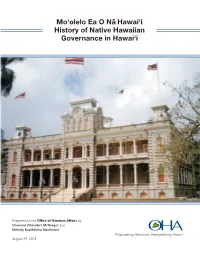
Mo‘olelo Ea O Na¯ Hawai‘i History of Native Hawaiian Governance in Hawai‘i Courtesy photo Prepared for the Office of Hawaiian Affairs by Davianna Pōmaika‘i McGregor and Melody Kapilialoha MacKenzie Empowering Hawaiians, Strengthening Hawai‘i August 19, 2014 Authors Dr. Davianna Pōmaika‘i McGregor is a Professor and founding member of the Ethnic Studies Department at the University of Hawai‘i-Mānoa. Melody Kapilialoha MacKenzie is a Professor at the William S. Richardson School of Law, University of Hawaiʻi–Mānoa, and Director of Ka Huli Ao Center for Excellence in Native Hawaiian Law. Acknowledgements The authors would like to acknowledge the many people who have contributed to this work over the years including Richardson School of Law graduates Nāpali Souza, Adam P. Roversi, and Nicole Torres. We are particularly grateful for the comments and review of this manuscript by Lilikalā Kameʻeleihiwa, Senior Professor, Kamakakūokalani Center for Hawaiian Studies at the University of Hawaiʻi-Mānoa, whose depth of knowledge and expertise were invaluable in refining this moʻolelo. We are also thankful for the help of the staff of the OHA Advocacy Division who, under the direction of Kawika Riley, spent many hours proofreading and formatting this manuscript. Copyright © 2014 OFFICE OF HAWAIIAN AFFAIRS. All Rights Reserved. No part of this report may be reproduced or transmitted in whole or in part in any form without the express written permission of the Office of Hawaiian Affairs, except that the United States Department of the Interior may reproduce or transmit this report as needed for the purpose of including the report in the public docket for Regulation Identifier Number 1090- AB05. -

The Battle of New Orleans from Two Points of View: a Scholar and An
The Battle of New Orleans from Two Points of View: A Scholar and an Eyewitness 1 The Historic The Battle of New Orleans New Orleans from Two Points of View: Collection A Scholar and an Eyewitness MUSEUM • RESEARCH CENTER • PUBLISHER . Teacher’s guide: grade levels 7–9 Number of lesson plans: 4 Copyright © 2014 The Historic New Orleans Collection; copyright © 2014 The Gilder Lehrman Institute of American History All rights reserved © 2014 The Historic New Orleans Collection | www.hnoc.org | © 2014 The Gilder Lehrman Institute of American History | www.gilderlehrman.org 2 The Battle of New Orleans from Two Points of View: A Scholar and an Eyewitness The Battle of New Orleans from Two Points of View: A Scholar and an Eyewitness The Battle of New Orleans from Two Points of View: A Scholar and an Eyewitness Grade levels 7–9 Number of lesson plans: 4 What’s Inside: Lesson One .... p. 3 Lesson Two .... p. 6 Lesson Three .... p. 11 Lesson Four .... p. 22 Academic standards CCSS.ELA-LITERACY.RH.6-8.1: Cite specific textual evidence to support analysis of primary and secondary sources. CCSS.ELA-LITERACY.RH.6-8.2: Determine the central ideas or information of a primary or secondary source; provide an accurate summary of the source distinct from prior knowledge or opinions. CCSS.ELA-LITERACY.RH.6-8.4: Determine the meaning of words and phrases as they are used in a text, including vocabulary specific to domains related to history/social studies. CCSS.ELA-LITERACY.RH.6-8.6: Identify aspects of a text that reveal an author’s point of view or purpose (e.g., loaded language, inclusion or avoidance of particular facts).