Salsa : Du Barrio New-Yorkais Aux Festivals Internationaux
Total Page:16
File Type:pdf, Size:1020Kb
Load more
Recommended publications
-

View Centro's Film List
About the Centro Film Collection The Centro Library and Archives houses one of the most extensive collections of films documenting the Puerto Rican experience. The collection includes documentaries, public service news programs; Hollywood produced feature films, as well as cinema films produced by the film industry in Puerto Rico. Presently we house over 500 titles, both in DVD and VHS format. Films from the collection may be borrowed, and are available for teaching, study, as well as for entertainment purposes with due consideration for copyright and intellectual property laws. Film Lending Policy Our policy requires that films be picked-up at our facility, we do not mail out. Films maybe borrowed by college professors, as well as public school teachers for classroom presentations during the school year. We also lend to student clubs and community-based organizations. For individuals conducting personal research, or for students who need to view films for class assignments, we ask that they call and make an appointment for viewing the film(s) at our facilities. Overview of collections: 366 documentary/special programs 67 feature films 11 Banco Popular programs on Puerto Rican Music 2 films (rough-cut copies) Roz Payne Archives 95 copies of WNBC Visiones programs 20 titles of WNET Realidades programs Total # of titles=559 (As of 9/2019) 1 Procedures for Borrowing Films 1. Reserve films one week in advance. 2. A maximum of 2 FILMS may be borrowed at a time. 3. Pick-up film(s) at the Centro Library and Archives with proper ID, and sign contract which specifies obligations and responsibilities while the film(s) is in your possession. -

Mario Ortiz Jr
Hom e | Features | Columns | Hit Parades | Reviews | Calendar | News | Contacts | Shopping | E-Back Issues NOVEMBER 2009 ISSUE FROM THE EDITOR Welcome to the home of Latin Beat Magazine Digital! After publishing Latin Beat Magazine for 19 years in both print and online, Yvette and I have decided to continue pursuing our passion for Latin music with a digital version only. Latin Beat Magazine will continue its coverage of Latin music through monthly in-depth articles, informative Streaming Music columns, concert and CD reviews, and extensive news and information for everyone. Access to Somos Son www.lbmo.com or www.latinbeatmagazine.com (Latin Beat Magazine Online) is free for a limited Bilongo time only. Windows Media Quicktime Your events and new music submissions are welcome and encouraged by emailing to: info@latinbeatmagazine.com. The Estrada Brothers Latin beat is number one in the world of authentic Latin music. For advertising opportunities in Mr. Ray lbmo.com, call (310) 516-6767 or request advertising information at Windows Media sales@latinbeatmagazine.com. Quicktime Back issues are still in print! Please order thru the Shopping section! Manny Silvera Bassed in America This issue of Latin Beat Magazine Volume 19, Number 9, November 2009, is our annual "Special Windows Media Percussion/Drum Issue", which celebrates "National Drum Month" throughout North America. Our Quicktime featured artist this month is Puerto Rican percussionist/bandleader Richie Flores. In addition, also featured are Poncho Sanchez (who's enjoying the release of his latest production Psychedelic Blues), and trumpeter/bandleader Mario Ortiz Jr. (who has one of the hottest salsa Bobby Matos productions of the year). -
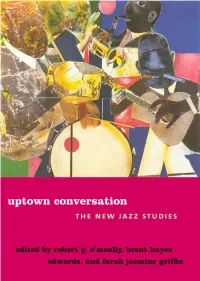
Uptown Conversation : the New Jazz Studies / Edited by Robert G
uptown conversation uptown conver columbia university press new york the new jazz studies sation edited by robert g. o’meally, brent hayes edwards, and farah jasmine griffin Columbia University Press Publishers Since 1893 New York Chichester, West Sussex Copyright © 2004 Robert G. O’Meally, Brent Hayes Edwards, and Farah Jasmine Griffin All rights reserved Library of Congress Cataloging-in-Publication Data Uptown conversation : the new jazz studies / edited by Robert G. O’Meally, Brent Hayes Edwards, and Farah Jasmine Griffin. p. cm. Includes index. ISBN 0-231-12350-7 — ISBN 0-231-12351-5 1. Jazz—History and criticism. I. O’Meally, Robert G., 1948– II. Edwards, Brent Hayes. III. Griffin, Farah Jasmine. ML3507.U68 2004 781.65′09—dc22 2003067480 Columbia University Press books are printed on permanent and durable acid-free paper. Printed in the United States of America c 10 9 8 7 6 5 4 3 2 1 p 10 9 8 7 6 5 4 3 2 1 contents Acknowledgments ix Introductory Notes 1 Robert G. O’Meally, Brent Hayes Edwards, and Farah Jasmine Griffin part 1 Songs of the Unsung: The Darby Hicks History of Jazz 9 George Lipsitz “All the Things You Could Be by Now”: Charles Mingus Presents Charles Mingus and the Limits of Avant-Garde Jazz 27 Salim Washington Experimental Music in Black and White: The AACM in New York, 1970–1985 50 George Lewis When Malindy Sings: A Meditation on Black Women’s Vocality 102 Farah Jasmine Griffin Hipsters, Bluebloods, Rebels, and Hooligans: The Cultural Politics of the Newport Jazz Festival, 1954–1960 126 John Gennari Mainstreaming Monk: The Ellington Album 150 Mark Tucker The Man 166 John Szwed part 2 The Real Ambassadors 189 Penny M. -

True Exciting Classic Salsa
Luis González TRUE EXCITING CLASSIC SALSA n the mid 80s, Luis González scored one of the most inspiring and career transforming gigs, touring and recording with one of his heroes, Ilegendary percussionist and bandleader Ray Barretto (renowned by the masses for his 60s hit “El Watusi”). The Puerto Rican born, Milwaukee WI raised trumpeter was flattered when he heard Barretto tell a large TV audience that members of his large ensemble would someday become bandleaders and solo artists in their own right. A few decades later, after an extraordinary career working with some of his native island’s greatest artists (Tito Allen, Santitos Colon, Adalberto Santiago, Jerry Rivera) and the world-renowned salsa orchestras of Willie Rosario, Mulenze, Luis Perico Ortiz and Tommy Olivencia, González fulfilled Barretto’s powerful prophecy by launching his career as a recording artist. At the urging of Rosario, González formed The Luis González nickname. While fashioning the ensemble’s debut to introduce Orchestra, which released its critically acclaimed debut album his unique style, he and his team of composers, arrangers and Tributo a Un Gigante in 2010. The title was a reference to musicians made the new collection more aggressive, with more Barretto, the chief inspiration behind the approach the trumpeter complex, multi-faceted, highly danceable arrangements. took to creating his multi-faceted, high energy, brass intensive 12-piece salsa band. Inviting top Puerto Rican musicians and “When I’m making an album, I think about the audience first vocalists to join him, he mixed New York style and Puerto Rican and what we want to accomplish as musicians second,” says style salsa, and as he says, “put it in a big kettle, boiled it together González. -

LBMO.Com - Latin Beat Magazine - Latin Music Magazine - Columns
LBMO.com - Latin Beat Magazine - Latin Music Magazine - Columns http://www.latinbeatmagazine.com/columns.html Home |Features | Columns |Hit Parades | Rev iews | Calendar |News |LB Style |Contacts | Shopping | E-Back Issues JUNE/JULY 2012 ISSUE QUÉ PASA IN LA By Rudy Mangual Bloque 53 Cogelo Ahi Windows Media Quicktime Chico Álvarez El Indio Caonabo Windows Media Quicktime Bio Ritmo La Muralla 1 of 23 7/14/2005 9:03 PM LBMO.com - Latin Beat Magazine - Latin Music Magazine - Columns http://www.latinbeatmagazine.com/columns.html Streaming Music Louie Cruz Beltran The 34th Annual Playboy Jazz Festival will present a world-class lineup of jazz icons and rising Paint the Rhythm stars on Saturday, June 16th, and Sunday, June 17th, at the Hollywood Bowl. Headliners include Windows Media Ramsey Lewis, Robin Thicke, Ozomatli, Sheila E, Boney James, Chico Trujillo, and Christian Quicktime McBride (and just added, local favorite Louie Cruz Beltrán). For tickets and more information, visit www.playboyjazzfestival.com. Cintron Band Live "Grand Performances" —Los Angeles’ premiere free outdoor summer performing arts series Human Nature ―invites everyone to their 26th annual summer events. Grand Performances’ 10-week Windows Media season (Friday, June 22, to Saturday, August 25) features 33 events and more than 100 artists Quicktime and ensembles. All events are free of charge, providing everyone the opportunity to experience a handpicked selection of emerging and established world music, jazz, dance and theater acts. Most events begin at 8:00 p.m. and take place at California Plaza in Downtown Los Angeles. Vanelis Performances range from the “Intimate Puppetry of Mexico: Unexpected", (July 12 & 13), to the Como Lo Extraño extravagant Jazz Mafia (San Francisco’s 38-piece ensemble), and the 70-member orchestra and Windows Media 40-voice choir of Symphony of Hope (August 3). -

Instead Draws Upon a Much More Generic Sort of Free-Jazz Tenor Saxophone Musical Vocabulary
Funding for the Smithsonian Jazz Oral History Program NEA Jazz Master interview was provided by the National Endowment for the Arts. BOBBY HUTCHERSON NEA Jazz Master (2010) Interviewee: Bobby Hutcherson (January 27, 1941 – August 15, 2016) with his wife Rosemary Hutcherson Interviewer: Anthony Brown with recording engineer Ken Kimery Date: December 8-9, 2010 Repository: Archives Center, National Museum of American History Description: Transcript, 60 pp. Brown: Today is December 8th, 2010. Bobby Hutcherson: Oooo, December 8th. Brown: This is the Smithsonian NEA Jazz Oral History interview with Bobby Hutcherson in his home in Montero, California. Good afternoon, Bobby. Hutcherson: Good afternoon. Brown: It’s indeed a pleasure to be here, be in your home and be able to talk to you, one of my heroes for so many years, a fellow Californian. If we could just start by you stating your full name at birth and your birth place and birth date, please. Hutcherson: Robert Howard Hutcherson. I was born January 27, 1941, in Los Angeles, but I grew up in Pasadena, California. Brown: But you say you were born in Los Angeles. Hutcherson: Um-hmm. Brown: Is that where your parents were living at the time of your birth? For additional information contact the Archives Center at 202.633.3270 or archivescenter@si.edu 1 Hutcherson: No. It was – they were living in Pasadena, but a lot of my relatives were living in Los Angeles, Watts and stuff like that. So it worked out, because they could be there. My mom had me very late in her life, in those days, and so it was better for my father to take my mother to the Los Angeles hospital, because he was – his work, he was a bricklayer. -
THIGPEN-DISSERTATION-2020.Pdf (1.774Mb)
THE YAMULEÉ EFFECT: SOCIAL DANCE, PEDAGOGY, AND PERFORMANCE OF AN AFRO-DIASPORIC SALSA DANCE COMPANY IN THE BRONX AND BEYOND A DISSERTATION SUBMITTED IN PARTIAL FULFILLMENT OF THE REQUIREMENTS FOR THE DEGREE DOCTOR OF PHILOSOPHY IN THE GRADUATE SCHOOL OF THE TEXAS WOMAN’S UNIVERSITY DEPARTMENT OF DANCE COLLEGE OF ARTS AND SCIENCES BY MILA THIGPEN, BA, EDM, MFA DENTON, TEXAS AUGUST 2020 © 2020 by Mila Thigpen DEDICATION For my mother, Cassandra. ii ACKNOWLEDGEMENTS I would like to take this opportunity to express my gratitude to the many people and places that have supported during my research. I would like to thank My advisor Dr. RoseMary Candelario for her enduring support. I aM deeply indebted to my comMittee MeMbers. Dr. Matthew Henley and the late Dr. Linda Caldwell who started me on this journey; and for Mary Williford Shade, Dr. Priya Thomas, and Dr. Thomas DeFrantz who have ushered me towards completion I cannot begin to express my thanks to Dr. Anna B. Scott for guiding me through a holistic, generative writing process. I aM also grateful to my editors, Alexandra Hoerl and Meghann Ridley. I extended my sincerest thanks to the generous mentors, colleagues, and friends across disciplines and institutions who have lovingly challenged, encouraged, and engaged with me and My research. I aM grateful to my teaching and learning comMunities at CaMbridge Rindge & Latin School, Harvard Graduate School of Education, and Boston Conservatory at Berklee/Berklee College of Music. I want to thank the Texas Woman’s University Dance DepartMent for their continuous support and for honoring me as the first recipient of the Linda Caldwell iii Scholarship. -

59Th Press List
NATIONAL ACADEMY OF RECORDING ARTS & SCIENCES, INC. FINAL NOMINATIONS LIST THE NATIONAL ACADEMY OF RECORDING ARTS & SCIENCES, INC. Final Nominations List 59th Annual GRAMMY® Awards For recordings released during the Eligibility Year October 1, 2015 through September 30, 2016 Note: More or less than 5 nominations in a category is the result of ties. General Field Category 1 Record Of The Year Award to the Artist and to the Producer(s), Recording Engineer(s) and/or Mixer(s) and mastering engineer(s), if other than the artist. 1. HELLO Adele Greg Kurstin, producer; Julian Burg, Tom Elmhirst, Greg Kurstin, Liam Nolan & Alex Pasco, engineers/mixers; Tom Coyne & Randy Merrill, mastering engineers Track from: 25 [XL Recordings/Columbia Records] 2. FORMATION Beyoncé Beyoncé Knowles, Mike Will Made-It & Pluss, producers; Jaycen Joshua & Stuart White, engineers/mixers; Dave Kutch, mastering engineer Track from: Lemonade [Parkwood Entertainment/Columbia Records] 3. 7 YEARS Lukas Graham Future Animals & Pilo, producers; Delbert Bowers, Sebastian Fogh, Stefan Forrest & David LaBrel, engineers/mixers; Tom Coyne, mastering engineer Track from: Lukas Graham [Warner Bros. Records] 4. WORK Rihanna Featuring Drake Boi-1da, producer; Noel "Gadget" Campbell, Kuk Harrell, Manny Marroquin, Noah "40" Shebib & Marcos Tovar, engineers/mixers; Chris Gehringer, mastering engineer [Westbury Road Entertainment] 5. STRESSED OUT Twenty One Pilots Mike Elizondo & Tyler Joseph, producers; Neal Avron & Adam Hawkins, engineers/mixers; Chris Gehringer, mastering engineer Track from: Blurryface [Fueled By Ramen] © The Recording Academy 2016 - all rights reserved 1 Not for copy or distribution 59th Finals - Press List General Field Category 2 4. VIEWS Album Of The Year Drake Award to the Artist(s) and to the Album Producer(s), Recording dvsn, Future, Kyla, PartyNextDoor, Rihanna & Wizkid, Engineer(s) and/or Mixer(s) & Mastering Engineer(s), if other than featured artists; Brian Alexander-Morgan, Axlfoliethc, Beat the artist. -

Salsa Songs. Cha- Cha's Merengues Boleros
SALSA SONGS. CHA- CHA’S Ahora Quien - Marc Anthony Azucar Negra - Celia Cruz Bemba Colora - Celia Cruz Carnaval - Celia Cruz Esta Noche - Manolito y su Trabuco Cucala - Celia Cruz El Yerberito Moderno - Celia Cruz Hay Que Empezar Otra Vez - Celia Cruz Mi Negrita Me Espera - Ismael Rivera La Sopa En Botella - Celia Cruz Guajira - Yari More Mi Vida Es Cantar - Celia Cruz Guantanamera - Celia Cruz Quimbara - Celia Cruz Oye Como Va - Tito Puente Toro Mata - Celia Cruz Perfidia - Linda Ronstad Yerbero Moderno - Celia Cruz Son Montuno - Mercado Negro Anacaona - Cheo feliciano Suavecito - Malo Amame - Yari More Toño Miguel - Cesar Mora Asi Se Compone un Son - Justo Betancourt Where is Benji - Harry Scorzo Apiadate De Mi - Victor manuelle Vacilon Que Rico Vacilon – Rene touset Aguzate - Richie Ray Pa Gozar!! - Spanish Harlem Baila Que Baila - El Canario Betcha By Golly Wow - MERENGUES Brujeria - El Gran Combo Capullito de aleli - Choco Orta Abusadora - Wilfrido Vargas Cali Pachanguero - Grupo Niche Ahora soy Mala - Olga Tanon Una Aventura - Grupo Niche A Lui - Michelle Tore El Cuarto de Tula - Buena Vista social Club Jurame - Gisele Comparsas Medley - Tony Vega El Negrito del Batey - Johnny Ventura Como Me Duele - Grupo Caneo El Vicio De Tus Labios - Freddy Herrera Cuando Hablan Las Miradas - Guayacan El Rey - Kinito Mendes De Mi Enamorate - Tito Nieves Es Mentiroso - Olga Tanon Don Toribio - Fruco y sus Tesos La Dueña Del Swing - Los Hermanos Rosario Despacito – Luis Fonsi La Ventanita - Freddy Herrera El Agua - Luisito Carrion Que Grande Es -

Carla Bley, Paul Haines
Carla Bley Escalator Over The Hill mp3, flac, wma DOWNLOAD LINKS (Clickable) Genre: Jazz Album: Escalator Over The Hill Country: France Released: 1974 Style: Big Band, Contemporary Jazz MP3 version RAR size: 1222 mb FLAC version RAR size: 1180 mb WMA version RAR size: 1301 mb Rating: 4.4 Votes: 720 Other Formats: AHX MP3 WAV ADX RA AC3 MOD Tracklist A Hotel Overture B1 ... This Is Here B2 Like Animals B3 Escalator Over The Hill B4 Stay Awake B5 Ginger And David B6 Song To Anything That Moves C1 Eoth Theme C2 Businessmen C3 Ginger And David Theme C4 Why C5 It's Not What You Do C6 Detective Writer Daughter C7 Doctor Why C8 Slow Dance (Transductory Music) C9 Smalltown Agonist D1 End Of Head D2 Over Her Head D3 Little Pony Soldier D4 Oh Say Can You Do? D5 Holiday In Risk D6 Holiday In Risk Theme E1 A.I.R. (All India Radio) E2 Rawalpindi Blues F1 End Of Rawalpindi F2 End Of Animals F3 ... And It's Again Credits Acoustic Guitar – Sam Brown Alto Saxophone – Dewey Redman, Jimmy Lyons Baritone Saxophone – Chris Woods Bass – Charlie Haden, Jack Bruce, Richard Youngstein, Ron McClure Bass Trombone – Jack Jeffers Bells – Bill Morimando Celesta – Bill Morimando Cello – Calo Scott Clarinet – Perry Robinson, Souren Baronian Clarinet, Tenor Saxophone – Peggy Imig Congas – Roger Dawson Drums – Paul Motian French Horn – Bob Carlisle, Sharon Freeman Guitar – John McLaughlin Organ, Celesta, Organ [Calliope] – Carla Bley Producer – Michael Mantler Synthesizer [Moog ] – Don Preston Tenor Saxophone – Gato Barbieri Trombone – Jimmy Knepper, Roswell Rudd, Sam -
Read the Introduction (Pdf)
Introduction Salsa in New York ugust 1992. Hector Lavoe is putting together a new band, making a comeback after a self-imposed hiatus during which he fought for his life, tried to beat addiction, and, as we would find out later, battled A1 AIDS. A rehearsal is scheduled for 7 p.m. in the basement of the Boys and Girls Harbor School (“Boys Harbor”), located in El Barrio (Spanish Harlem) on the corner of East 104th Street and 5th Avenue, a favorite spot for salsa bands to work out new arrangements. Why? Cheap rates, an out-of-the-way place that fans don’t know about, and a location in the most historically sig- nificant neighborhood for Latin music in New York City. In fact, just blocks from Boys Harbor is where it all began back in the 1930s: Machito, Tito Puente, Eddie and Charlie Palmieri, everyone lived there. Most salsa musi- cians do not live in the neighborhood anymore, although many teach Latin music to kids and novices at the Harbor’s after-school program, one of the few places where 15 bucks will get you a lesson with Tito Puente’s bongocero. Rehearsal begins just shy of 8 p.m. It was delayed while several musicians copped in the neighborhood. Copped what? Blow, perico, cocaine. Other mu- sicians just straggled in late with no explanation, but no real need: No one complains about the late start. It’s par for the course. Regardless of their tardi- ness, everyone who enters the room makes his rounds greeting everyone else. -
Historia De La Salsa, Desde Las Raíces Hasta El 1975
Historia de la Salsa, desde las raíces hasta el 1975 Prof. Nicolás Ramos Gandía (niramos@arecibo.inter.edu ) Catedrático Asociado de Matemática Universidad Interamericana de Puerto Rico Recinto de Arecibo Resumen Estudio de la evolución histórica e influencia de los géneros musicales de Cuba: el Son, la Rumba y el Danzón con sus variantes y de otros movimientos musicales en la Salsa. Se explica cómo, desde los años 20 hasta principio de los 60, dichos géneros fueron evolucionando hasta forjar los contornos sonoros de la Salsa. Analizamos los procesos que llevan a la adaptación de esas vertientes musicales redefiniéndose como la música urbana de la Salsa cultivada por músicos latinos y neoyorquinos. Examinamos el período decisivo de su germinación y consolidación que va desde fines de la década de los 60 hasta el año clave del 1975. Se expone el papel definitorio de la compañía Fania, para que músicos latinoamericanos y de otros grupos étnicos hicieran suya esas influencias y la transmutaran en un fenómeno social, discográfico y comercial de trascendencia mundial. A Catalino ("Tite") Curet Alonso Los creadores de la Música Popular nuestra tienen que ser reconocidos sin cortapisa y en su justa perspectiva, para así aquilatar sus aportaciones a esa vertiente de la historia social nuestra. Introducción La Salsa, como manifestación musical de un entorno social marginado, fue atacada desde distintos flancos, tanto musicales como sociales. Sus detractores alegaban que era: "música cubana vieja y poco innovadora" ; "música de barrio de mala muerte" ; "música sin contenido y simplista" ; y mil frases más que, en este momento, está de más citar.