How the U.S. Built a Navy and Faced Down the Barbary Pirates by Christopher L
Total Page:16
File Type:pdf, Size:1020Kb
Load more
Recommended publications
-
NPRC) VIP List, 2009
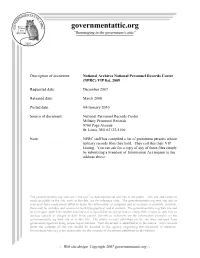
Description of document: National Archives National Personnel Records Center (NPRC) VIP list, 2009 Requested date: December 2007 Released date: March 2008 Posted date: 04-January-2010 Source of document: National Personnel Records Center Military Personnel Records 9700 Page Avenue St. Louis, MO 63132-5100 Note: NPRC staff has compiled a list of prominent persons whose military records files they hold. They call this their VIP Listing. You can ask for a copy of any of these files simply by submitting a Freedom of Information Act request to the address above. The governmentattic.org web site (“the site”) is noncommercial and free to the public. The site and materials made available on the site, such as this file, are for reference only. The governmentattic.org web site and its principals have made every effort to make this information as complete and as accurate as possible, however, there may be mistakes and omissions, both typographical and in content. The governmentattic.org web site and its principals shall have neither liability nor responsibility to any person or entity with respect to any loss or damage caused, or alleged to have been caused, directly or indirectly, by the information provided on the governmentattic.org web site or in this file. The public records published on the site were obtained from government agencies using proper legal channels. Each document is identified as to the source. Any concerns about the contents of the site should be directed to the agency originating the document in question. GovernmentAttic.org is not responsible for the contents of documents published on the website. -

Senate Armed Services Committee Testimony Of
SENATE ARMED SERVICES COMMITTEE TESTIMONY OF ADMIRAL JAMES G. STAVRIDIS, UNITED STATES NAVY COMMANDER, UNITED STATES EUROPEAN COMMAND BEFORE THE 112TH CONGRESS MARCH 1, 2012 INTRODUCTION Mr. Chairman, Ranking Member, Distinguished Members of the Committee: Thank you for the opportunity to appear before you today. For nearly three years now, I’ve had the privilege to command the exceptional men and women of the United States European Command and the North Atlantic Treaty Organization (NATO), Allied Command Operations. As you know, it has been a busy year for these commands, for the NATO Alliance, and for our international and interagency partners who are such a vital part of our mission, our many initiatives, and our team. Working together, we have accomplished some important objectives since I saw you last: saving tens of thousands of lives from a despotic and unstable regime in Libya; supporting continued progress and transition in Afghanistan; maintaining a safe environment in the Balkans; sustaining vital relationships with our key allies and emerging partners in the region; and developing the necessary capabilities to meet the rising—and, in many cases, different—security challenges of the 21st century. I am happy to report that we continue to make sound and efficient progress, in concert with our allies and partners, toward ensuring continued security and stability across our theater and, in so doing, are providing for the forward defense of the United States. But before reporting our progress and achievements over the past year, I want to take a moment to examine a fundamental question on many minds here in Washington and abroad: How does the U.S. -

Proquest Dissertations
NOTE TO USERS This reproduction is the best copy available. ® UMI yyyyy u Ottawa l/Uniwrsitf'1 ammiionno C'fiisadii's umvvrshy FACULTE DES ETUDES SUPERIEURES l===l FACULTY OF GRADUATE AND ET POSTOCTORALES U Ottawa POSDOCTORAL STUDIES L'Universite canadierme Canada's university Henry Trim AUTEUR DE LA THESE / AUTHOR OF THESIS M.A. (History) GRADE/DEGREE Department of History >7cTjlTOc"6LTblpW The Making of Stephen Decatur: A Study of Heroism and Myth Building in America TITRE DE LA THESE / TITLE OF THESIS Dr. Lofti Ben Rejeb DIRECTEUR (DIRECTRICE) DE LA THESE / THESIS SUPERVISOR CO-DIRECTEUR (CO-DIRECTRICE) DE LA THESE / THESIS CO-SUPERVISOR EXAMINATEURS (EXAMINATRICES) DE LA THESE / THESIS EXAMINERS Dr. Ryme Seferdjeli Dr. Galen Perras Gary W. Slater Le Doyen de la Faculte des etudes superieures et postdoctorales / Dean of the Faculty of Graduate and Postdoctoral Studies The Making of Stephen Decatur: A Study of Heroism and Myth Building in America By Henry Trim Submitted to the Faculty of History in Partial Fulfillment of the Requirements for the Degree of Master of Arts at the University of Ottawa University of Ottawa 2008 © 2008 Henry Trim Library and Bibliotheque et 1*1 Archives Canada Archives Canada Published Heritage Direction du Branch Patrimoine de I'edition 395 Wellington Street 395, rue Wellington Ottawa ON K1A0N4 Ottawa ON K1A0N4 Canada Canada Your file Votre reference ISBN: 978-0-494-48514-9 Our file Notre reference ISBN: 978-0-494-48514-9 NOTICE: AVIS: The author has granted a non L'auteur a accorde une licence non exclusive -

Naval Accidents 1945-1988, Neptune Papers No. 3
-- Neptune Papers -- Neptune Paper No. 3: Naval Accidents 1945 - 1988 by William M. Arkin and Joshua Handler Greenpeace/Institute for Policy Studies Washington, D.C. June 1989 Neptune Paper No. 3: Naval Accidents 1945-1988 Table of Contents Introduction ................................................................................................................................... 1 Overview ........................................................................................................................................ 2 Nuclear Weapons Accidents......................................................................................................... 3 Nuclear Reactor Accidents ........................................................................................................... 7 Submarine Accidents .................................................................................................................... 9 Dangers of Routine Naval Operations....................................................................................... 12 Chronology of Naval Accidents: 1945 - 1988........................................................................... 16 Appendix A: Sources and Acknowledgements........................................................................ 73 Appendix B: U.S. Ship Type Abbreviations ............................................................................ 76 Table 1: Number of Ships by Type Involved in Accidents, 1945 - 1988................................ 78 Table 2: Naval Accidents by Type -

Barbary Pirates: Thomas Jefferson, William Eaton, and the Evolution of U.S
East Tennessee State University Digital Commons @ East Tennessee State University Electronic Theses and Dissertations Student Works 8-2013 Barbary Pirates: Thomas Jefferson, William Eaton, and the Evolution of U.S. Diplomacy in the Mediterranean Patrick N. Teye East Tennessee State University Follow this and additional works at: https://dc.etsu.edu/etd Part of the Diplomatic History Commons, and the United States History Commons Recommended Citation Teye, Patrick N., "Barbary Pirates: Thomas Jefferson, William Eaton, and the Evolution of U.S. Diplomacy in the Mediterranean" (2013). Electronic Theses and Dissertations. Paper 1183. https://dc.etsu.edu/etd/1183 This Thesis - Open Access is brought to you for free and open access by the Student Works at Digital Commons @ East Tennessee State University. It has been accepted for inclusion in Electronic Theses and Dissertations by an authorized administrator of Digital Commons @ East Tennessee State University. For more information, please contact digilib@etsu.edu. Barbary Pirates: Thomas Jefferson, William Eaton, and the Evolution of U.S. Diplomacy in the Mediterranean A thesis presented to the faculty of the Department of History In partial fulfillment of the requirements for the degree Master of Arts in History by Patrick Nartey Teye August 2013 Dinah Mayo-Bobee, PhD, Chair Melvin Page, PhD Daryl Carter, PhD John Rankin Keywords: William Eaton, Thomas Jefferson, Yusef Caramanli, Hamet Caramanli, Piracy, Barbary, Mediterranean, Diplomacy, Tributes, Treaties, Tripolitan War, North Africa ABSTRACT Barbary Pirates: Thomas Jefferson, William Eaton, and the Evolution of U.S. Diplomacy in the Mediterranean by Patrick Nartey Teye This study analyzes U.S. relations with the Barbary States from 1784 to 1805. -

Pull Together Winter/Spring 2013
Preservation, Education, and Commemoration Vol. 52, No. 1 Winter 2012-2013 PULL TOGETHER Newsletter of the Naval Historical Foundation Doing History the Royal Navy Way Interview with former First Sea Lord Adm. Sir Jonathon Band GCB DL—page 3 Unsung American Naval Hero —page 9 Also in this issue: Message From the Chairman, p. 2; Navy Museum News, pp. 15-18; Lady Franklin Bay Relief Expedition, pp. 20–21; Naval History News, pp. 22-24; News From the NHF, pp. 25–31. Message From the Chairman In recent weeks you should have received a letter from our new president, Rear Adm. John Mitchell, detailing many of the accomplishments made by your Naval Historical Foundation (NHF) during 2012. This annual appeal generates needed funds to sustain the day-to-day operations of the NHF. Copy paper, paper clips, pens, sticky notes, and most especially our people are the motor oil that keep the Foundation engine running; past year- end appeals have generated the sums needed to strengthen our fi nancial base. Thus, I hope that you can respond with a check or an online contribution. If you are in government service, also think about us as a designated charity for the Combined Federal Campaign. Your contributions make a big difference in our ability to preserve our naval history, commemorate the accomplishments of our Sailors, and educate Americans about our Navy’s great history and heritage. Education is one of our most important priorities. Current Navy leaders are a key component of the audiences we seek to enlighten. In that regard, we received much positive feedback on our last edition of Pull Together, which opened with a reprint of Dudley Knox’s 1926 “Our Vanishing History and Traditions” article that led to the creation of our organization. -
Thomas Jefferson and Relations with Barbary, 1785-1805
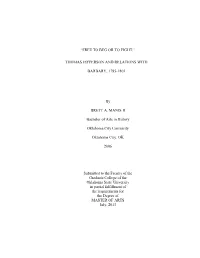
“FREE TO BEG OR TO FIGHT:” THOMAS JEFFERSON AND RELATIONS WITH BARBARY, 1785-1805 By BRETT A. MANIS II Bachelor of Arts in History Oklahoma City University Oklahoma City, OK 2006 Submitted to the Faculty of the Graduate College of the Oklahoma State University in partial fulfillment of the requirements for the Degree of MASTER OF ARTS July, 2013 “FREE TO BEG OR TO FIGHT”: THOMAS JEFFERSON AND RELATIONS WITH BARBARY, 1785-1805 Thesis Approved: Dr. Richard C. Rohrs Thesis Adviser Dr. L.G. Moses Dr. David M. D’Andrea ii ACKNOWLEDGEMENTS To Lauren and my girls (Avery, Teryn, and Lillee): Without your love and support, I could not have finished. This paper is for you. To Mom and Dad: For helping in any way I needed. To Lace and Ralph, Terry and Claudia: For taking care of Lauren and the girls while I spent far too much time in the library. To Dr. C. Michelle McCargish, for being a great friend and an even better grad school mentor (whether you knew you were or not). To Dr. Richard Rohrs, for patience, as well as teaching me to be a much better writer and historian. iii Acknowledgements reflect the views of the author and are not endorsed by committee members or Oklahoma State University. Name: BRETT A MANIS II Date of Degree: JULY, 2013 Title of Study: FREE TO BEG OR TO FIGHT: THOMAS JEFFERSON AND RELATIONS WITH BARBARY, 1785-1805 Major Field: HISTORY Abstract: Thomas Jefferson, with great consistency, supported American action against the threat of the Barbary pirates. -

Pull Together As a Joint Edition with Their Fine Daybook
Daybook A PUBLICATION OF THE HAMPTON ROADS NAVAL MUSEUM Volume 17 Issue 3 ULL OGETHER P TVolume 53 No. 3 Summer 2014 HAMPTON ROADS NAVAL MUSEUM • MARITIME HERITAGE CONFERENCE • NAVAL HISTORICAL FOUNDATION The Daybook® Volume 17 Issue 3 In This Issue 2 Message from the Chairman, Naval Historical Foundation 4 Naval History to be featured at the 10th Maritime Heritage Conference 5 Nuclear Navy Afloat: Operation Sea Orbit and Its Legacy 8 “Quasi” War: Commodore Dudley Wright Knox, USN (Ret.) and the Naval Historical Strategy of Franklin D. Roosevelt 12 Naval Historians to Receive Knox Award Honors 14 Behind the Scenes: A War of 1812 Artifact in the Hampton Roads Naval Museum’s Collection 16 Three Lives of the Whaleboat The Daybook® is a registered trademark of the Hampton Roads Naval Museum (HRNM), Department of the Navy, an agency of the United States Government. It is an authorized publication of HRNM. Its contents do not necessarily reflect the official view of the U.S. Government, the Department of Defense, the U.S. Navy, or the U.S. Marine Corps and do not imply endorsement thereof. Book reviews are solely the opinion of the reviewer. The HRNM reports to the Naval History and Heritage Command, Museums Division (www.history.navy.mil). The museum is dedicated to the study of 237 years of naval history in the Hampton Roads region. HRNM was accredited by the American Association of Museums in 2008. The Daybook’s purpose is to educate and inform readers on historical topics and museum-related events. It is written by staff and volunteers. -

The Most Daring Act of the Age—Principles for Naval Irregular War
Naval War College Review Volume 63 Article 11 Number 4 Autumn 2010 The oM st Daring Act of the Age—Principles for Naval Irregular Warfare Benjamin Armstrong U.S. Navy Follow this and additional works at: https://digital-commons.usnwc.edu/nwc-review Recommended Citation Armstrong, Benjamin (2010) "The osM t Daring Act of the Age—Principles for Naval Irregular Warfare," Naval War College Review: Vol. 63 : No. 4 , Article 11. Available at: https://digital-commons.usnwc.edu/nwc-review/vol63/iss4/11 This Article is brought to you for free and open access by the Journals at U.S. Naval War College Digital Commons. It has been accepted for inclusion in Naval War College Review by an authorized editor of U.S. Naval War College Digital Commons. For more information, please contact repository.inquiries@usnwc.edu. Color profile: Generic CMYK printer profile Composite Default screen Armstrong: The Most Daring Act of the Age—Principles for Naval Irregular War THE MOST DARING ACT OF THE AGE Principles for Naval Irregular Warfare Lieutenant Commander Benjamin Armstrong, U.S. Navy s the American military confronts the challenges of the twenty-first century Athere is a great deal of discussion of counterinsurgency, hybrid conflict, and irregular warfare. In military history none of these concepts are new. Much of the recent scholarship and writing on these forms of warfare has focused on to- day’s operations ashore, particularly in Iraq and Afghanistan. However, there are significant implications for naval warfare as well. The leaders of the sea services stated in the “Cooperative Strategy for 21st Century Seapower”that “preventing wars is as important as winning wars.”1 IftheU.S.Navyisgoingtoembracethis belief as it sails deeper into the twenty-first century, development of naval irreg- ular warfare will become vital to its future success and relevance. -

Download The
September 2011 Anthony Bell & David Witter THE LIBYAN REVOLUTION ESCALATION & INTERVENTION PART 2 Photo Credit: March 21, 2011- A French navy AS365 F Dauphin rescue helicopter from French aircraft carrier Charles de Gaulle (R91) test lands aboard the amphibious command ship USS Mount Whitney (LCC/JCC 20). (U.S. Navy photo by Mass Communication Specialist 1st Class Gary Keen/Released) All rights reserved. Printed in the United States of America. No part of this publication may be reproduced or transmitted in any form or by any means, electronic or mechanical, including photocopy, recording, or any information storage or retrieval system, without permission in writing from the publisher. ©2011 by the Institute for the Study of War. Published in 2011 in the United States of America by the Institute for the Study of War. 1400 16th Street NW, Suite 515 Washington, DC 20036. http://www.understandingwar.org Anthony Bell & David Witter THE LIBYAN REVOLUTION ESCALATION & INTERVENTION PART 2 ABOUT THE AUTHORS Anthony Bell is a Research Assistant at ISW, where he conducts research on political and security dynamics on Libya. He has previously studied the conflicts in Afghanistan and Iraq, and published the ISW report Reversing the Northeastern Insurgency. Anthony holds a bachelor’s degree from the George Washington University in International Affairs with a concentration in Conflict and Security. He graduated magna cum laude and received special honors for his senior thesis on the history of U.S. policy towards Afghanistan. He is currently a graduate student in the Security Studies Program at Georgetown University. David Witter is a Research Assistant at ISW, where he studies the NATO intervention in Libya as well as security dynamics in Afghanistan. -

An Environmental Military History Examining Wind's Influence on The
University of Nebraska - Lincoln DigitalCommons@University of Nebraska - Lincoln Dissertations, Theses, & Student Research, History, Department of Department of History 11-2014 Close on the Wind: An Environmental Military History Examining Wind’s Influence on the Early United States Navy Scott .J Beehler University of Nebraska-Lincoln Follow this and additional works at: http://digitalcommons.unl.edu/historydiss Part of the Military History Commons, and the United States History Commons Beehler, Scott .,J "Close on the Wind: An Environmental Military History Examining Wind’s Influence on the Early United States Navy" (2014). Dissertations, Theses, & Student Research, Department of History. 80. http://digitalcommons.unl.edu/historydiss/80 This Article is brought to you for free and open access by the History, Department of at DigitalCommons@University of Nebraska - Lincoln. It has been accepted for inclusion in Dissertations, Theses, & Student Research, Department of History by an authorized administrator of DigitalCommons@University of Nebraska - Lincoln. Close on the Wind: An Environmental Military History Examining Wind’s Influence on the Early United States Navy by Scott J. Beehler A Thesis Presented to the Faculty of The Graduate College at the University of Nebraska In Partial Fulfillment of the Requirements For the Degree of Master of Arts Major: History Under the Supervision of Professor Lloyd Ambrosius Lincoln, Nebraska November, 2014 Close on the Wind: An Environmental Military History Examining Wind’s Influence on the Early United States Navy Scott J. Beehler, M.A. University of Nebraska, 2014 Adviser: Lloyd Ambrosius Utilizing General Carl von Clausewitz’s theory of friction in combat, Close on the Wind examines wind’s historical influence on early United States naval warfare, specifically small scale engagements fought during the Quasi War, First Barbary War, and the War of 1812. -

National Archives National Personnel Records Center (NPRC) VIP List, 2009
Description of document: National Archives National Personnel Records Center (NPRC) VIP list, 2009 Requested date: December 2007 Released date: March 2008 Posted date: 04-January-2010 Updated 19-March-2010 (release letter added to file) Source of document: National Personnel Records Center Military Personnel Records 9700 Page Avenue St. Louis, MO 63132-5100 Note: NPRC staff has compiled a list of prominent persons whose military records files they hold. They call this their VIP Listing. You can ask for a copy of any of these files simply by submitting a Freedom of Information Act request to the address above. The governmentattic.org web site (“the site”) is noncommercial and free to the public. The site and materials made available on the site, such as this file, are for reference only. The governmentattic.org web site and its principals have made every effort to make this information as complete and as accurate as possible, however, there may be mistakes and omissions, both typographical and in content. The governmentattic.org web site and its principals shall have neither liability nor responsibility to any person or entity with respect to any loss or damage caused, or alleged to have been caused, directly or indirectly, by the information provided on the governmentattic.org web site or in this file. The public records published on the site were obtained from government agencies using proper legal channels. Each document is identified as to the source. Any concerns about the contents of the site should be directed to the agency originating the document in question. GovernmentAttic.org is not responsible for the contents of documents published on the website.