Are Subordinate Officials Penally Reponsible for Obeying Superior
Total Page:16
File Type:pdf, Size:1020Kb
Load more
Recommended publications
-

Die Neufassung Des § 1A Bundesversorgungsgesetz (BVG): Streichung Von Kriegsopferrenten Für NS-Täter – Schlussbericht –
FORSCHUNGSBERICHT 472 Die Neufassung des § 1a Bundesversorgungsgesetz (BVG): Streichung von Kriegsopferrenten für NS-Täter – Schlussbericht – November 2016 ISSN 0174-4992 Die Neufassung des § 1a Bundesversorgungsgesetz (BVG): Streichung von Kriegsopferrenten für NS-Täter - Gründe für die geringe Zahl der Streichungen trotz der Vielzahl der vom Simon Wiesenthal Center übermittelten Daten - Ein Gemeinschaftsprojekt des Bundesministeriums für Arbeit und Soziales und des Simon Wiesenthal Centers Schlussbericht September 2016 2 Die Neufassung des § 1a Bundesversorgungsgesetz (BVG): Streichung von Kriegsopferrenten für NS-Täter - Gründe für die geringe Zahl der Streichungen trotz der Vielzahl der vom Simon Wiesenthal Center übermittelten Daten - Ein Gemeinschaftsprojekt des Bundesministeriums für Arbeit und Soziales und des Simon Wiesenthal Centers Schlussbericht Autoren: Dr. Stefan Klemp (Simon Wiesenthal Center) Martin Hölzl (Simon Wiesenthal Center) Ort: Bonn im September 2016 ISBN/ISSN: Auftraggeberschaft / Inhaltliche Verantwortung Erstellt im Auftrag des Bundesministeriums für Arbeit und Soziales. Die Durchführung der Untersuchungen sowie die Schlussfolgerungen aus den Unter- suchungen sind von den Auftragnehmern in eigener wissenschaftlicher Verantwor- tung vorgenommen worden. Das Bundesministerium für Arbeit und Soziales über- nimmt insbesondere keine Gewähr für die Richtigkeit, Genauigkeit und Vollständig- keit der Untersuchungen. Copyright Alle Rechte einschließlich der fotomechanischen Wiedergabe und des auszugswei- sen Nachdrucks -

Criminals with Doctorates: an SS Officer in the Killing Fields of Russia
1 Criminals with Doctorates An SS Officer in the Killing Fields of Russia, as Told by the Novelist Jonathan Littell Henry A. Lea University of Massachusetts-Amherst Lecture Delivered at the University of Vermont November 18, 2009 This is a report about the Holocaust novel The Kindly Ones which deals with events that were the subject of a war crimes trial in Nuremberg. By coincidence I was one of the courtroom interpreters at that trial; several defendants whose testimony I translated appear as major characters in Mr. Littell's novel. This is as much a personal report as an historical one. The purpose of this paper is to call attention to the murders committed by Nazi units in Russia in World War II. These crimes remain largely unknown to the general public. My reasons for combining a discussion of the actual trial with a critique of the novel are twofold: to highlight a work that, as far as I know, is the first extensive literary treatment of these events published in the West and to compare the author's account with what I witnessed at the trial. In the spring of 1947, an article in a Philadelphia newspaper reported that translators were needed at the Nuremberg Trials. I applied successfully and soon found myself in Nuremberg translating documents that were needed for the ongoing cases. After 2 passing a test for courtroom interpreters I was assigned to the so-called Einsatzgruppen Case. Einsatzgruppen is a jargon word denoting special task forces that were sent to Russia to kill Jews, Gypsies, so-called Asiatics, Communist officials and some mental patients. -

Clemency in a Nazi War Crimes Trial By: Allison Ernest
Evading the Hangman’s Noose: Clemency in a Nazi War Crimes Trial By: Allison Ernest Ernest 2 Contents Introduction: The Foundations for a War Crimes Trial Program 3 Background and Historiography 10 Chapter 1: Investigations into Other Trials Erode the United States’ Resolve 17 Chapter 2: The Onset of Trial Fatigue Due to Public Outcry 25 Chapter 3: High Commissioner McCloy Authorizes Sentence Reviews 38 Chapter 4: McCloy and the United States Set the War Criminals Free 45 Conclusion: A Lesson to be Learned 52 Chart: A Complicated Timeline Simplified 57 Bibliography 58 Ernest 3 Introduction: The Foundations for a War Crimes Trial Program “There is a supervening affirmative duty to prosecute the doers of serious offenses that falls on those who are empowered to do so on behalf of a civilized community. This duty corresponds to our fundamental rights as citizens and as persons to receive and give respect to each other in view of our possession of such rights.” Such duty, outlined by contemporary philosopher Alan S. Rosenbaum, was no better exemplified than in the case of Nazi war criminals in the aftermath of World War II. Even before the floundering Axis powers of Germany and Japan declared their respective official surrenders in 1945, the leaders of the Allies prepared possible courses of action for the surviving criminals in the inevitable collapse of the Nazi regime. Since the beginning of the war in 1939, the Nazi regime in Germany implemented a policy of waging a war so barbaric in its execution that the total numbers of casualties rivaled whole populations of countries. -

The Jews of Simferopol
BE'H The Jews of Simferopol This article is dedicated to two of our grandsons who are now Israeli soldiers: Daniel Prigozin and Yonaton Inegram. Esther (Herschman) Rechtschafner Kibbutz Ein-Zurim 2019 Table of Contents Page Introduction 1 Basic Information about Simferopol 2 Geography 2 History 3 Jewish History 4 The Community 4 The Holocaust 6 After the Holocaust 8 Conclusion 11 Appendices 12 Maps 12 Photos 14 Bibliography 16 Internet 16 Introduction The story of why I decided to write about the history of Simferopol is as follows. As many know, I have written a few articles and organized a few websites1. All of these are in connection to the places in Eastern Europe that my extend family comes from. A short while ago Professor Jerome Shapiro2,who had previously sent me material about his family for my Sveksna website wrote me an email and mentioned that he would like to have an article written about the place where his wife's family comes from: Simferopol, Crimea. Since I did not know anything about this place, I decided to take this upon myself as a challenge. This meant: 1. researching a place that I am not emotionally attached to 2. finding material about a place that is not well known 3. finding a website for placement of the article With the help of people I know by way of my previous researching3, people I met while looking for information, the internet (and the help of G-d), I felt that I had enough information to write an article. While researching for material for this article, I became acquainted with Dr. -

Reichskommissariat Ukraine from Wikipedia, the Free Encyclopedia
Create account Log in Article Talk Read Edit View history Reichskommissariat Ukraine From Wikipedia, the free encyclopedia During World War II, Reichskommissariat Ukraine (abbreviated as RKU), was the civilian Navigation occupation regime of much of German-occupied Ukraine (which included adjacent areas of Reichskommissariat Ukraine Main page modern Belarus and pre-war Poland). Between September 1941 and March 1944, the Reichskommissariat of Germany Contents Reichskommissariat was administered by Reichskommissar Erich Koch. The ← → Featured content administration's tasks included the pacification of the region and the exploitation, for 1941–1944 Current events German benefit, of its resources and people. Adolf Hitler issued a Führer Decree defining Random article the administration of the newly occupied Eastern territories on 17 July 1941.[1] Donate to Wikipedia Before the German invasion, Ukraine was a constituent republic of the USSR, inhabited by Ukrainians with Russian, Polish, Jewish, Belarusian, German, Roma and Crimean Tatar Interaction minorities. It was a key subject of Nazi planning for the post-war expansion of the German Flag Emblem state and civilization. Help About Wikipedia Contents Community portal 1 History Recent changes 2 Geography Contact Wikipedia 3 Administration 3.1 Political figures related with the German administration of Ukraine Toolbox 3.2 Military commanders linked with the German administration of Ukraine 3.3 Administrative divisions What links here 3.3.1 Further eastward expansion Capital Rowno (Rivne) Related changes 4 Demographics Upload file Languages German (official) 5 Security Ukrainian Special pages 6 Economic exploitation Polish · Crimean Tatar Permanent link 7 German intentions Government Civil administration Page information 8 See also Reichskommissar Data item 9 References - 1941–1944 Erich Koch Cite this page 10 Further reading Historical era World War II 11 External links - Established 1941 Print/export - Disestablished 1944 [edit] Create a book History Download as PDF Population This section requires expansion. -

Holocaust and Genocide 16:1
“Anticipatory Obedience” and the Nazi Implementation of the Holocaust in the Ukraine: A Case Study of Central and Peripheral Forces in the Generalbezirk Zhytomyr, 1941–1944 Wendy Lower Center for Advanced Holocaust Studies United States Holocaust Memorial Museum Numerous recent studies of the Holocaust as it occurred in the occupied So- viet territories have shifted attention from the central German leadership to the role of regional officials and administrators. The following case study offers an example of the ways central Nazi leaders directly and indirectly shaped the Holocaust at the regional level. In Zhytomyr the presence of Himmler, Hitler, and their SS-Police retinues created a unique setting in which the interaction of center and periphery can be traced. On this basis the author argues for the reconsideration of Berlin’s role in regional events generally. Since the appearance of Raul Hilberg’s path-breaking study The Destruction of the European Jews, which masterfully reconstructed the “machinery of destruction” that drove the Holocaust, historians have placed differing emphases on the role of the oper- ative functionaries and the leaders. In the past decade several young German historians (inspired by the work of Götz Aly and the sudden deluge of Nazi material from the former Soviet regional archives) have followed Hilberg’s lead by stressing both the role of district-level leaders in the “Final Solution” and the regional features of the Holo- caust itself. Indeed these scholars have impressively demonstrated the inner workings of what might be called the “regional Holocaust.” Recent Holocaust scholarship has shifted our attention away from the origins of the genocide at the level of state policy to the role of regional leaders and events on the ground in the former Soviet Union. -

Legacies of the Nuremberg SS-Einsatzgruppen Trial After 70 Years
Loyola of Los Angeles International and Comparative Law Review Volume 39 Number 1 Special Edition: The Nuremberg Laws Article 7 and the Nuremberg Trials Winter 2017 Legacies of the Nuremberg SS-Einsatzgruppen Trial After 70 Years Hilary C. Earl Nipissing University, hearl@nipissingu.ca Follow this and additional works at: https://digitalcommons.lmu.edu/ilr Recommended Citation Hilary C. Earl, Legacies of the Nuremberg SS-Einsatzgruppen Trial After 70 Years, 39 Loy. L.A. Int'l & Comp. L. Rev. 95 (2017). Available at: https://digitalcommons.lmu.edu/ilr/vol39/iss1/7 This Article is brought to you for free and open access by the Law Reviews at Digital Commons @ Loyola Marymount University and Loyola Law School. It has been accepted for inclusion in Loyola of Los Angeles International and Comparative Law Review by an authorized administrator of Digital Commons@Loyola Marymount University and Loyola Law School. For more information, please contact digitalcommons@lmu.edu. 07 EARL .DOCX (DO NOT DELETE) 1/16/17 4:45 PM Legacies of the Nuremberg SS- Einsatzgruppen Trial after 70 Years HILARY EARL* I. INTRODUCTION War crimes trials are almost commonplace today as the normal course of events that follow modern-day wars and atrocities. In the North Atlantic, we use the liberal legal tradition to redress the harm caused to civilians by the state and its agents during periods of State and inter-State conflict. The truth is, war crimes trials are a recent invention. There were so-called war crimes trials after World War I, but they were not prosecuted with any real conviction or political will. -

Jewish Genocide in Galicia
Jewish Genocide in Galicia Jewish Genocide in Galicia 2nd Edition With Appendix: Vernichtungslager ‘Bełżec’ Robin O’Neil Published by © Copyright Robin O’Neil 2015 JEWISH GENOCIDE IN GALICIA All rights reserved. The right of Robin O’Nei to be identified as the author of this work has been asserted in accordance with the Copyright, Designs and Patents Act 1988. No part of this publication may be reproduced, stored in a retrieval system, or transmitted, in any form or by any means, electronic, mechanical, photocopying, recording or otherwise, nor translated into a machine language, without the written permission of the publisher. Condition of sale This book is sold subject to the condition that it shall not, by way of trade or otherwise, be lent, re-sold, hired out or otherwise circulated in any form of binding or cover other than that in which it is published and without a similar condition including this condition being imposed on the subsequent purchaser. ISBN Frontispiece: The Rabka 4 + 1 - incorporating the original book cover of Rudolf Reder’s ‘Bełżec’, 1946. 2nd Edition Part 1 2016: The Rabka Four + 1. First published 2011 under the title ‘The Rabka Four’. Contents Academic Excellence In Murder......................................i Dedication....................................................................... ii Lives Remembered .........................................................iv Note on Language...........................................................vi The Hunting Grounds for the Rabka 4 + 1 (zbV) 1941-1944 .........................................................................x -
Begin Block Quote
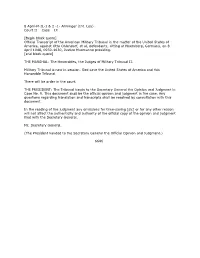
8 April-M-IL-1 & 2 -1- Arminger (Int. Lea) Court II Case IX [Begin block quote] Official Transcript of the American Military Tribunal in the matter of the United States of America, against Otto Ohlendorf, et al, defendants, sitting at Nuernberg, Germany, on 8 April 1948, 0930-1630, Justice Musmanno presiding. [end block quote] THE MARSHAL: The Honorables, the Judges of Military Tribunal II. Military Tribunal is now in session. God save the United States of America and this Honorable Tribunal. There will be order in the court. THE PRESIDENT: The Tribunal hands to the Secretary General the Opinion and Judgment in Case No. 9. This document shall be the official opinion and judgment in the case. Any questions regarding translation and transcripts shall be resolved by consultation with this document. In the reading of the judgment any omissions for time-saving [sic] or for any other reason will not affect the authenticity and authority of the official copy of the opinion and judgment filed with the Secretary General. Mr. Secretary General. (The President handed to the Secretary General the Official Opinion and Judgment.) 6646 8 April-M-IL-1 & 2 -2- Arminger (Int. Lea) Court II Case IX [begin block quote] THE UNITED STATES OF AMERICA - VS - OTTO OHLENDORF, HEINZ JOST, ERICH NAUMAN [sic],: OTTO RASCH, cancelled, ERWIN SCHULZ, FRANZ SIX, PAUL: BLOBEL, WALTER BLUME, MARTIN SANDBERG [sic],: OPINION AND JUDGMENT WILLY SEIBERT, EUGEN STEIMLE, ERNST BIBER-: STEIN, WERNER BRAUNE, WALTER HAENSCH, : GUSTAV NOSSKE, ADOLF OTT, EDUARD STRAUCH : WOLDEMAR KLINGELHOEFER, LOTHAR FENDLER : Case No. 9 WALDEMAR VON RADETSKY, FELIZ RUEHL, HEINZ : SCHUBERT, and MATHIAS GRAF, Defendants : [end block quote] The indictment filed in this case on July 25, 1947, charged the twenty-four defendants enumerated therein with crimes against humanity, war crimes and membership in criminal organizations. -

Die Charlottenburger
Dieter Schenk Die Führerschule der NS-Sicherheitspolizei und die „Charlottenburger“ im Bundeskriminalamt „Reichskristallnacht“ bezeichnete den reichsweiten Pogrom gegen Juden vor siebzig Jahren am 9./10. November 1938. Die Herkunft des Begriffs ist nicht geklärt. Die Auslösung erfolgte durch eine Hetzrede Goebbels nach Zustimmung Hitlers. Die offizielle Propaganda begründete die Massaker mit der Ermordung des Diplomaten Ernst vom Rath in Paris durch den siebzehnjährigen Juden Herschel Grünspan. In einem barbarischen Terrorakt setzten SA- und NSDAP-Mitglieder Synagogen in Brand, zerstörten etwa 7000 Geschäfte jüdischer Einzelhändler und verwüsteten Wohnungen der Juden. Sie töten nach offiziellen Angaben insgesamt 91 Personen. Die Zahl derer, die infolge von Leid und Schrecken umkamen, ist nicht bekannt. An den Aktionen beteiligten sich auch Angehörige der HJ und weiterer SS-Organisationen. Der Mob nutzte die Chance zu Plünderungen. Die Gestapo organisierte die Verschleppung von etwa 26 000 jüdischer Männer und Jugendlicher in die KZ Buchenwald, Dachau und Sachsenhausen. Viele von ihnen kamen dort infolge körperlicher und psychischer Schikanen oder durch Medikamentenentzug ums Leben. Anderen wurde der Verzicht auf Eigentum abgezwungen. Die Masse der Inhaftierten kam erst nach Auswanderungserklärungen frei. Als „Sühneleistung“ wurde den Juden der Betrag von einer Milliarde Reichsmark auferlegt. ****** Die NS-Täter, auf die ich noch näher eingehen will, begannen ihren Lehrgang an der Führerschule der Sicherheitspolizei in Charlottenburg am 12. Oktober 1938, also knapp vier Wochen vor der Reichspogromnacht. Ob sie daran beteiligt waren oder wie sie darauf reagierten, ist nicht überliefert. Dass sie Mitleid oder Bedauern empfanden, wird man wohl ausschließen können. ****** Ursprünglich war das 1927 errichtete Polizeiinstitut Charlottenburg eine Ausbildungs- und Forschungsstätte der preußischen Polizei neben der Höheren Polizeischule in Eiche. -

Library Collection 20-08-23 Changes
Temple Sholom Library 8/24/2020 BOOK PUB CALL TITLE AUTHOR FORMAT CATEGORY KEYWORDS DATE NUMBER Foundation, The Blue #QuietingTheSilence: Personal Stories Dove Paperback Spiritual SelfHelp (Books) 246.7 BDF .The Lion Seeker Bonert, Kenneth Paperback Fiction 2013 F Bo 10 Things I Can Do to Help My World Walsh, Melanie Paperback Children's Diet & Nutrition Books (Books) mitzvah, tikkun olam J Wa Children's Books : Literature : Classics by Age 10 Traditional Jewish Children's Stories Goldreich, Gloria Hardcover : General Children's stories, Hebrew, Legends, Jewish 1996 J 185.6 Go 100+ Jewish Art Projects for Children Feldman, Margaret A. Paperback Religion Biblical Studies Bible. O.T. Pentateuch Textbooks 1984 1001 Yiddish Proverbs Kogos, Fred Paperback Language selfstudy & phrasebooks 101 Classic Jewish Jokes : Jewish Humor from Groucho Marx to Jerry Seinfeld Menchin, Robert Paperback Entertainment : Humor : General Jewish wit and humor 1998 550.7 101 Myths of the Bible Greenberg, Gary Hardcover Bible Commentaries 2000 .002 Gr 1918: War and Peace Dallas, Gregor Hardcover 20th Century World History World War, 19141918 Peace, World War, 19141918 Armistices IsraelArab War, 19481949Armistices, Palestinian ArabsGovernment policy 1949 the First Israelis Segev, Tom Paperback History of Judaism Israel, ImmigrantsIsraelSocial conditions, Orthodox JudaismRelationsIsrael 1967: Israel, the War, and the Year that Transformed the Middle East Segev, Tom Hardcover 20th Century World History IsraelArab War, 1967, IsraelPolitics and government20th century -
Front Matter
Cambridge University Press 978-0-521-45608-1 - The Nuremberg SS-Einsatzgruppen Trial, 1945-1958: Atrocity, Law, and History Hilary Earl Frontmatter More information The Nuremberg SS-Einsatzgruppen Trial, 1945–1958 Atrocity, Law, and History Based on extensive archival research, this book offers the first historical examination of the arrest, trial, and punishment of the leaders of the SS-Einsatzgruppen – the mobile security and killing units employed by the Nazis in their racial war on the eastern front. Sent to the Soviet Union in the summer of 1941, four units of Einsatzgruppen, along with reinforcements, murdered approximately 1 million Soviet civilians in open air shootings and in gas vans and, in 1947, twenty-four leaders of these units were indicted for crimes against humanity and war crimes for their part in the murders. In addition to describing the legal proceedings that held these men accountable, this book also examines recent histo- riographical trends and perpetrator paradigms and expounds on such contested issues as the timing and genesis of the Final Solution, the perpetrators’ route to crime, and their motivation for killing, as well as discussing the tensions between law and history. Hilary Earl is Assistant Professor of History at Nipissing University, North Bay, Ontario, Canada. Her research has been featured in several collections, including Lessons and Legacies IV (2004), Secret Intel- ligence and the Holocaust (2006), and Biography between Structure and Agency: Central European Lives in International Historiography (2008). Her most recent project, The Genocide Paradox: Prosecuting Genocide from Nuremberg to The Hague, is a historical examination of the legal outcomes of war crimes trials from the post–World War II period through the trials conducted by the International Criminal Tribunals for the former Yugoslavia.