Western Cape Nature Conservation Laws Amendment Act, 2000
Total Page:16
File Type:pdf, Size:1020Kb
Load more
Recommended publications
-

Freshwater Fishes
WESTERN CAPE PROVINCE state oF BIODIVERSITY 2007 TABLE OF CONTENTS Chapter 1 Introduction 2 Chapter 2 Methods 17 Chapter 3 Freshwater fishes 18 Chapter 4 Amphibians 36 Chapter 5 Reptiles 55 Chapter 6 Mammals 75 Chapter 7 Avifauna 89 Chapter 8 Flora & Vegetation 112 Chapter 9 Land and Protected Areas 139 Chapter 10 Status of River Health 159 Cover page photographs by Andrew Turner (CapeNature), Roger Bills (SAIAB) & Wicus Leeuwner. ISBN 978-0-620-39289-1 SCIENTIFIC SERVICES 2 Western Cape Province State of Biodiversity 2007 CHAPTER 1 INTRODUCTION Andrew Turner aaturner@cncjnk.pgwc.gov.za 1 “We live at a historic moment, a time in which the world’s biological diversity is being rapidly destroyed. The present geological period has more species than any other, yet the current rate of extinction of species is greater now than at any time in the past. Ecosystems and communities are being degraded and destroyed, and species are being driven to extinction. The species that persist are losing genetic variation as the number of individuals in populations shrinks, unique populations and subspecies are destroyed, and remaining populations become increasingly isolated from one another. The cause of this loss of biological diversity at all levels is the range of human activity that alters and destroys natural habitats to suit human needs.” (Primack, 2002). CapeNature launched its State of Biodiversity Programme (SoBP) to assess and monitor the state of biodiversity in the Western Cape in 1999. This programme delivered its first report in 2002 and these reports are updated every five years. The current report (2007) reports on the changes to the state of vertebrate biodiversity and land under conservation usage. -
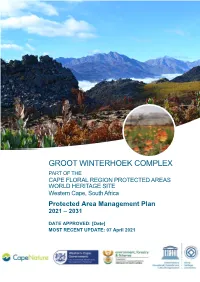
Groot Winterhoek Complex PAMP
GROOT WINTERHOEK COMPLEX PART OF THE CAPE FLORAL REGION PROTECTED AREAS WORLD HERITAGE SITE Western Cape, South Africa Protected Area Management Plan 2021 – 2031 DATE APPROVED: [Date] MOST RECENT UPDATE: 07 April 2021 GROOT WINTERHOEK COMPLEX PART OF THE CAPE FLORAL REGION PROTECTED AREAS WORLD HERITAGE SITE Western Cape, South Africa Protected Area Management Plan 2021 – 2031 DATE APPROVED: [Date] MOST RECENT UPDATE: 07 April 2021 CITATION CapeNature. 2021. Groot Winterhoek Complex: Protected Area Management Plan 2021- 2031. Internal Report, CapeNature. Cape Town. GROOT WINTERHOEK COMPLEX II MANAGEMENT PLAN AUTHORISATIONS The National Minister is authorised under section 25(1) of the National World Heritage Convention Act, 1999 (Act No. 49 of 1999) to approve the management plan for a World Heritage Site, so nominated or declared under the Act. Furthermore, both the National Minister and Member of Executive Council (MEC) in a particular province, has concurrent jurisdiction to approve a management plan for a protected area submitted under section 39(2) and section 41(4) of the National Environmental Management: Protected Areas Act, 2003 (Act No. 57 of 2003). TITLE NAME SIGNATURE DATE NATIONAL MINISTER: Ms Barbara Forestry, Fisheries and Creecy the Environment PROVINCIAL MINISTER: Mr Anton Department of Environmental Affairs Bredell and Development Planning Recommended: TITLE NAME SIGNATURE DATE CHAIRPERSON OF Assoc Prof THE BOARD: Denver Western Cape Nature 8 April 2021 Hendricks Conservation Board CHIEF EXECUTIVE Dr Razeena OFFICER: Omar 7 April 2021 CapeNature Review Date: 10 years from the date of approval by the MEC or Minister. GROOT WINTERHOEK COMPLEX III MANAGEMENT PLAN ACKNOWLEDGEMENTS CapeNature would like to thank everybody who participated and had input into the formulation of the Groot Winterhoek Complex management plan. -
Proceedings of the 8Th Yellowfish Working Group Conference
FOSAF THE FEDERATION OF SOUTHERN AFRICAN FLYFISHERS PROCEEDINGS OF THE 8TH YELLOWFISH WORKING GROUP CONFERENCE LE PARADISE RESORT, BADPLAAS 13 – 15 MAY 2004 Edited by Peter Arderne PRINTING & DISTRIBUTION SPONSORED BY: sappi CONTENTS Page List of Participants 2 Press Release 4 Welcome address -Bill Mincher (presented by Peter Mills) 6 Fishing Strategies & Tactics for the Nine Yellowfish species – Turner Wilkinson 8 Keynote Address: Mpumalanga Parks Board – Andre Coetzee 10 South African Freshwater Resources: Rights, Duties & Remedies – Morne Viljoen 11 Towards the fomulation of a Waste Discharge Charge System for South Africa - 24 Pieter Viljoen Catchment Management Approach to Conservation: What does it mean? – 34 Dr Wynand Vlok Establishment of the Elands River Conservation Area (ERYCA) – Gordon O’Brien 38 The Effect of Alien Plant Species on the Riparian Zone Water Management – 43 Hannes de Lange & Tony Poulter Fish kills in the Olifants River: Any Solution? – Dr Thomas Gyedu-Ababio 45 Yellowfish Sport Fisheries: Opportunities & Responsibilities – Kobus Fourie 48 Conservancies – A tool for river conservation involving the landowner – Peter Mills 49 Proposed project: Radio Telemetry on Labeobarbus marequensis in the Crocodile River, 54 Kruger National Park – Francois Roux The yellowfish fishery on the upper Komati: A landowners perspective – John Clarke 56 River Health: Managing and Monitoring Rivers on Sappi Plantations – Douglas 60 Macfarlane Iscor Newcastle: Water Strategy – Martin Bezuidenhout 63 Aquatic Biodiversity Conservation in South Africa – Pierre de Villiers 66 Field research update: Assessing the impact of smallmouth bass on the indigenous 67 fish community of the Rondegat River, Western Cape – Darragh Woodford Threatened fishes of Swaziland – Richard Boycott 70 Yellowfishes of Zambia & Mozambique – Roger Bills 76 Identification of conservation units of two yellowfish species: Labeobarbus 78 kimberleyensis & L. -

Acacia Flat Mite (Brevipalpus Acadiae Ryke & Meyer, Tenuipalpidae, Acarina): Doringboomplatmyt
Creepie-crawlies and such comprising: Common Names of Insects 1963, indicated as CNI Butterfly List 1959, indicated as BL Some names the sources of which are unknown, and indicated as such Gewone Insekname SKOENLAPPERLYS INSLUITENDE BOSLUISE, MYTE, SAAMGESTEL DEUR DIE AALWURMS EN SPINNEKOPPE LANDBOUTAALKOMITEE Saamgestel deur die MET MEDEWERKING VAN NAVORSINGSINSTITUUT VIR DIE PLANTBESKERMING TAALDIENSBURO Departement van Landbou-tegniese Dienste VAN DIE met medewerking van die DEPARTEMENT VAN ONDERWYS, KUNS EN LANDBOUTAALKOMITEE WETENSKAP van die Taaldiensburo 1959 1963 BUTTERFLY LIST Common Names of Insects COMPILED BY THE INCLUDING TICKS, MITES, EELWORMS AGRICULTURAL TERMINOLOGY AND SPIDERS COMMITTEE Compiled by the IN COLLABORATION WiTH PLANT PROTECTION RESEARCH THE INSTITUTE LANGUAGE SERVICES BUREAU Department of Agricultural Technical Services OF THE in collaboration with the DEPARTMENT OF EDUCATION, ARTS AND AGRICULTURAL TERMINOLOGY SCIENCE COMMITTEE DIE STAATSDRUKKER + PRETORIA + THE of the Language Service Bureau GOVERNMENT PRINTER 1963 1959 Rekenaarmatig en leksikografies herverwerk deur PJ Taljaard e-mail enquiries: fritzwolff@absamail.co.za EXPLANATORY NOTES 1 The list was alphabetised electronically. 2 On the target-language side, ie to the right of the :, synonyms are separated by a comma, e.g.: fission: klowing, splyting The sequence of the translated terms does NOT indicate any preference. Preferred terms are underlined. 3 Where catchwords of similar form are used as different parts of speech and confusion may therefore -

DRAFT Scoping Report for Coega Mining, NMBM
Coega Mining (PTY) LTD FINAL Scoping Report for Coega Mining, NMBM Report prepared for 722 Sardinia Bay Road P.O. Box 5780 Sardinia Bay Walmer Port Elizabeth Port Elizabeth South Africa South Africa 6070 6065 Report prepared by No.2 Deer Park Lane ; Deer Park Estate ; Port Elizabeth ; 6070 PO Box 16501 ; Emerald Hill ; 6011 Telephone : +27 (0) 41 379 1899 Mobile : +27(0) 82 653 2568 Facsimile : +27 (0) 86 657 7703 e-mail : rudi@algoacme.co.za Coega Mining (PTY) LTD ALL CHANGES TO THE DRAFT REPORT ARE SHOWN IN RED Contents Table of Figures .................................................................................................................... 3 List of Tables ........................................................................................................................ 4 Acronyms and Abbreviations ................................................................................................. 5 1. The objective of the scoping process is to, through a consultative process— .................... 9 2. Contact Person and correspondence address ................................................................. 10 a) Details of ..................................................................................................................... 10 Details of the EAP ..................................................................................................... 10 Expertise of the EAP. ............................................................................................... 10 b) Location of the overall Activity. -

Report on the Terrestrial Ecology (Flora and Fauna)
Kudusberg WEF REPORT ON THE TERRESTRIAL ECOLOGY (FLORA AND FAUNA) Basic Assessment report for the proposed development of the 325 MW Kudusberg Wind Energy Facility located west of the R354 Between Matjiesfontein and Sutherland in the Northern and Western Cape Report prepared for: Report prepared by: CSIR – Environmental Management Services Ekotrust cc (CK90/05465/23) P O Box 17001 7 St George Street, Lionviham Congella, Durban, 4013 Somerset West 7130 South Africa South Africa OCTOBER 2018 Ekotrust CC - 2018 1 CONTENTS EXECUTIVE SUMMARY .................................................................................................................... i SPECIALISTS DECLARATION ........................................................................................................... iv TERMS OF REFERENCE ................................................................................................................... v LIMITATIONS, ASSUMPTIONS & UNCERTAINTIES ........................................................................ vi ACRONYMS ................................................................................................................................... vii ABBREVIATIONS ........................................................................................................................... vii GLOSSARY .................................................................................................................................... viii LIST OF FIGURES ........................................................................................................................... -

Alien Fish Removals: a New Beginning for the Rondegat River
Alien fish removals: A new beginning for the Rondegat River Olaf Weyl tells QUEST how rivers are being rehabilitated after alien invasions. he Cape Floristic Region of South Africa is a global biodiversity hotspot with an exceptional degree of Tbiodiversity and endemism. Better known for its rich plant communities, the region is also home to 17 fish species which occur nowhere else on earth. Most are restricted to a single river or tributary within a river, which makes them particularly vulnerable to human impacts such as alien fish introductions, habitat destruction, and pollution. Human impacts are particularly severe in lowland rivers which receive run- off from agricultural and urban areas or modified by canal and dam building. This has caused many of our indigenous fishes to now only occur in small headwater streams located high up in mountain catchments where these impacts are absent. More than half of the endemic fishes in A collage showing the indigenous fish of the Cape Floristic Region. Image: Olaf Weyl South Africa are considered to be in imminent danger of extinction Top: Rhodes University Department of Ichthyology and Fisheries Science BSc Honours class of 2015 and have been IUCN Red-listed assisting with electrofishing surveys to determine Clanwilliam rock catfish abundance. Image: Olaf Weyl 11|2 2015 11 A school of fiery redfin minnows (Pseudobarbus phlegethon). Image: Olaf Weyl as Endangered and Critically Endangered. The rivers in the Cape Floristic Region are key areas for conservation of biodiversity and in headwater refuges the main threat to the native fishes are alien fish introductions. Sport fishing Indigenous fish in the Cape Floristic Region are typically small, insectivorous species. -

Conservation Biology of Endangered Freshwater Fishes – Linking Conservation of Endangered Freshwater Fishes with River Conservation, Focussing on the Cederberg
CONSERVATION BIOLOGY OF ENDANGERED FRESHWATER FISHES – LINKING CONSERVATION OF ENDANGERED FRESHWATER FISHES WITH RIVER CONSERVATION, FOCUSSING ON THE CEDERBERG Report to the Water Research Commission Edited by IR Bills1 and ND Impson2 1South African Institute of Aquatic Biodiversity 2CapeNature WRC Report No. KV 305/12 ISBN 978-1-4312-0348-2 JANUARY 2013 OBTAINABLE FROM Water Research Commission Private Bag X03 Gezina, Pretoria, 0031 South Africa orders@wrc.org.za or download from www.wrc.org.za The publication of this report emanates from a WRC project entitled Conservation biology of endangered freshwater fishes – Linking conservation of endangered freshwater fishes with river conservation, focusing on the Cederberg. (WRC Project No.K8/592) DISCLAIMER This report has been reviewed by the Water Research Commission (WRC) and approved for publication. Approval does not signify that the contents necessarily reflect the views and policies of the WRC, nor does mention of trade names or commercial products constitute endorsement or recommendation for use. © WATER RESEARCH COMMISSION ii ACKNOWLEDGEMENTS We thank the Water Research Commission for providing the funding for this work. Cape Nature and the South African Institute for Aquatic Biodiversity provided varied logistical support for most of the sub-projects. In particular Mrs. Sally Terry (SAIAB) helped with all aspects of coordination and curation of samples at SAIAB. Dr Olaf Weyl co-supervised Vusi Mthombeni’s MSc work and together with R. Bills provided additional funding for the catfish biology study. iii iv TABLE OF CONTENTS Page No 1 Introduction .………………………………………………………….…………….......1 Roger Bills and Dean Impson 2 Barnard’s rock catfish (Austroglanis barnardi).…………………….…………….5 Roger Bills 3 Clanwilliam roc catfish (Austroglanis gilli).………………………………………17 Roger Bills 4 Twee River redfin (Barbus erubescens) …………………………….……………30 Roger Bills 5 A study of the maintenance and culture requirements of Barbus erubescens, Austroglanis barnardi and A. -

Protected Areas and Endemic Freshwater Fishes of the Cape Fold Ecoregion: Missing the Boat for Fish Conservation?
fenvs-08-502042 December 4, 2020 Time: 11:34 # 1 ORIGINAL RESEARCH published: 07 December 2020 doi: 10.3389/fenvs.2020.502042 Protected Areas and Endemic Freshwater Fishes of the Cape Fold Ecoregion: Missing the Boat for Fish Conservation? Martine S. Jordaan1,2,3*, Albert Chakona2,4 and Dewidine van der Colff5,6 1 CapeNature Biodiversity Capabilities Unit, Stellenbosch, South Africa, 2 National Research Foundation (NRF)-South African Institute for Aquatic Biodiversity, Makhanda, South Africa, 3 CapeNature Biodiversity Capabilities Unit, Center of Excellence for Invasion Biology, Stellenbosch, South Africa, 4 Department of Ichthyology and Fisheries Science, Rhodes University, Makhanda, South Africa, 5 South African National Biodiversity Institute Threatened Species Program, Kirstenbosch National Botanical Gardens, Cape Town, South Africa, 6 Center of Excellence for Invasion Biology, South African National Biodiversity Institute Threatened Species Program, Kirstenbosch National Botanical Gardens, Cape Town, South Africa Freshwater systems and their associated biodiversity are among the most threatened Edited by: ecosystems globally. The greatest threats to freshwater fishes are the introduction Rebecca Elizabeth Tharme, and spread of non-native species, pollution, habitat degradation and loss, and Riverfutures Ltd., United Kingdom overexploitation. While many regions across the world contain extensive networks of Reviewed by: Stephen John Beatty, protected areas, these are largely ineffective for protecting riverine systems and their Murdoch University, Australia biodiversity. This is because they were designed with the aim of prioritising conservation Gordon O’Brien, of terrestrial biodiversity, with limited or no consideration for aquatic systems. The Cape University of Mpumalanga, South Africa Fold Ecoregion, located within the Western and Eastern Cape Provinces of South Africa, *Correspondence: is home to the highest percentage of threatened freshwater fishes in the country. -

African Butterfly News Can Be Downloaded Here
MARCH 2019 EDITION: ABN 2019 - 2 AFRICAN JANUARY AND FEBRUARY 2019 BUTTERFLY THE LEPIDOPTERISTS’ SOCIETY OF AFRICA NEWS LATEST NEWS Welcome to March’s newsletter! The drought – at least on the Highveld – appears to be over; the Brown-veined White (Belenois aurota) migration has passed its peak, but is still going strong. Unfortunately, the rain is too late for our rare local butterflies, such as the Highveld Blue (Lepidochrysops praeterita), but here’s hoping that there will be lots of late-summer butterflies in the months ahead. Please support the newsletter and forward photographs, trip reports or comments to jchdobson@gmail.com Restructuring of LepSoc Africa Council To accommodate the retirement of Mark Williams as Metamorphosis editor, LSA Council have made the following changes: • Dave Edge will take over Mark’s position as Editor of Metamorphosis. Alan Gardiner and Silvia Kirkman will be assisting Dave (refer to Metamorphosis under the PUBLICATIONS section). • Peter Ward has – gallantly – taken over Dave’s role as Treasurer of the Society. To assist Peter, Hanna Edge will perform a bookkeeping function. • Reinier Terblanche will remain LepSoc Africa’s Conservation and Research officer, but will incorporate Peter’s National Permit responsibilities into his portfolio. Highveld Butterfly Club Braai The HBC held its traditional year-starting braai at Hermann Staude’s farm on 10 February. The weather was good and more than 20 LSA members and their friends pitched up. 1 There weren’t too many butterflies – I counted 25 species (Abundance Index: 3.9 – Average), but we saw a couple of Marsh Sylph (Metisella meninx). Thanks to everyone who attended and to Hermann and Louisa who were, as usual, great hosts! NBA Photographic Competition As part of the National Biodiversity Assessment (NBA) synthesis report – of which SALCA was a component – SANBI have asked LepSoc Africa to choose a picture of a butterfly, to be displayed on the front cover of the report. -

Project Summary: Thee River Rehabilitation
PROJECT SUMMARY: THEE RIVER REHABILITATION AND MANUAL ERADICATION OF SPOTTED BASS MICROPTERUS PUNCTULATUS IN THE THEE RIVER, WESTERN CAPE PROVINCE. Riaan van der Walt Greater Cederberg Biodiversity Corridor, CapeNature P.O. Box 26, Porterville 6810, South Africa. E-mail: rvanderwalt@capenature.co.za 1. Introduction The rivers of the Cape Floristic Region (CFR) are known for their unique and largely endemic fish fauna, which exists within very restricted ranges (Skelton 2001). Nineteen endemic fish species are associated with the CFR of which 15 are threatened with extinction, primarily due to the impacts of invasive alien sport fish species and habitat degradation (Impson et al ., 2002). The Olifants-Doorn River system, which includes the Thee River, is arguably South Africa’s most important catchment for the conservation of freshwater fishes, as eight of its 10 species are both endemic and threatened (Impson et al . 2002). Certain freshwater fish species used for recreational angling have been transported around the globe and placed in rivers, dams and lakes, frequently without environmental impact assessments or monitoring, for the sole purpose of providing ‘enjoyment’ for anglers (Cambray 2003). Spotted bass, Micropterus punctulatus was introduced into South Africa in 1939 for angling purposes (Shelton, 2001). North American freshwater bass, Micropterus spp. are regarded as the species with the highest impact on the fishes of the Cape Floral Kingdom (Skelton 2001) and numerous local studies have shown that Micropterus spp. have a negative effect on the indigenous fish population when introduced out its native range (de Moor & Bruton 1988, Shelton 2001, Woodford et al. 2005, Weyl et al. -

Rotenone Use South Africa
This article was downloaded by: [196.215.57.16] On: 18 June 2014, At: 11:16 Publisher: Taylor & Francis Informa Ltd Registered in England and Wales Registered Number: 1072954 Registered office: Mortimer House, 37-41 Mortimer Street, London W1T 3JH, UK Fisheries Publication details, including instructions for authors and subscription information: http://www.tandfonline.com/loi/ufsh20 Threatened Endemic Fishes in South Africa's Cape Floristic Region: A New Beginning for the Rondegat River Olaf L. F. Weyla, Brian Finlaysonb, N. Dean Impsonc, Darragh J. Woodfordd & Jarle Steinkjere a South African Institute for Aquatic Biodiversity (SAIAB), Private Bag 1015, Grahamstown 6140, South Africa. E-mail: b California Department of Fish and Game (retired), Camino, CA c CapeNature, Stellenbosch, South Africa d Center for Invasion Biology, South African Institute for Aquatic Biodiversity (SAIAB), Grahamstown, South Africa e Norwegian Directorate for Nature Management, Sluppen, Trondheim, Norway Published online: 16 Jun 2014. To cite this article: Olaf L. F. Weyl, Brian Finlayson, N. Dean Impson, Darragh J. Woodford & Jarle Steinkjer (2014) Threatened Endemic Fishes in South Africa's Cape Floristic Region: A New Beginning for the Rondegat River, Fisheries, 39:6, 270-279, DOI: 10.1080/03632415.2014.914924 To link to this article: http://dx.doi.org/10.1080/03632415.2014.914924 PLEASE SCROLL DOWN FOR ARTICLE Taylor & Francis makes every effort to ensure the accuracy of all the information (the “Content”) contained in the publications on our platform. However, Taylor & Francis, our agents, and our licensors make no representations or warranties whatsoever as to the accuracy, completeness, or suitability for any purpose of the Content.