Vol 7, December 2019 Biogenesis 117
Total Page:16
File Type:pdf, Size:1020Kb
Load more
Recommended publications
-

Phylogenetic Relationship on Genus Leptobrachi Um(Amphibia: Anura: Megophryidae) in Sarawak
PHYLOGENETIC RELATIONSHIP ON GENUS LEPTOBRACHI UM(AMPHIBIA: ANURA: MEGOPHRYIDAE) IN SARAWAK Norhasimah Binti Jakariah (31890) Bachelor of Science with Honours QL (Animal Resource Science Management) 47 and N839 2014 2014 UNIVERSITI MALAYSIA SARAWAK Grade: Please tick ('I) Final Year Project Report 0 Masters ý PhD 0 DECLARATION OF ORIGINAL WORK Student's Declaration: I Norhasimah binti Jakariah (31890) Faculty of Resource Science and Technology (FRST) hereby declare that the work Phylogenetic Relationship of Genus Leptobrachium (Amphibia: Anura: Megophryidae) In Sarawak is my original work. I have not copied from any other students' work or from any other sources except where due reference or acknowledgement is made explicitly in the text, nor has any part been written for me by another person. 2a1q6/201ý Date submitted Name of the student (Matric No.) %wjft«nnw WTI CIA M44 (11810) Supervisor's Declaration: I Ramlah binti Zainudin hereby certifies that the work Phylogenetic Relationship of Genus Leptobrachium (Amphibia: Anura: Megophryidae) In Sarawak was prepared by the above named student, and was submitted to the "FACULTY" as a full fulfillment for the conferment of Bachelor of Science with Honours (Animal Resource Science and Management) and the aforementioned work, to the best of my knowledge, is the said student's work. M Ppw Received for examination by: 149 (Name of the supervisor) Assoc. Prof Dr Raaüah Zain th, Deputy Dean Centrefor Pre-UniversityStudies UNMMM MALAYSIAS&R,4WA c are that ProjectfMesis is dassified as (Please ti Q CONFIDENTIAL (Contains confidential information under the Official Secret Act 1972)* TRICTED (Contains restricted information as specified by the organisation where research was done)* PEN ACCESS Validation of Project/Thesis I duly free therefore affirm with consent and willingly declare that this said Project/Thesis shall be for placed officially in the Centre Academic Information Services with the abiding interest and rights as follows: " This ProjectlThesis is the sole legal property of Universiti Malaysia Sarawak (UNIMAS). -

Warta Herpetofauna/Volume Vii, No 4 Maret 2015 1
WARTA HERPETOFAUNA/VOLUME VII, NO 4 MARET 2015 1 DA F TA R I S I Resep Bekerja di Bidang Herpe- 22 tologi À la James Menzies Penanganan gigitan ular 15 Jenis Baru Leptobrachium kanton- ishikawai Hamidy & Matsui, 2014 34 dari Serawak Penemuan Limnonectes 28 larvaepartus dari Nantu Daftar isi Penanganan Gigitan Ular 02 15 Kata Kami Terdesaknya Katak Tegalan (Fejervarya limnocharis) di Per- 05 38 sawahan Gianyar Bali Phobia Ular, Konservasi, dan Ekspedisi Rafflesia KPH 06 Kearifan Lokal di Papua 41 “PYTHON” Himakova di Suaka Kearifan Lokal, Mitos, dan Margasatwa Cikepuh Sukabumi 10 Kekayaan Hayati 2 WARTA HERPETOFAUNA/VOLUME VII, NO. 4 MARET 2015 Phoxophrys tuberculata Hu- Belajar Spesimen Indone- brecht 1881 Kadal Semak Kecil sia di Negeri Orang dari Dataran Sumatera 25 19 Diversity Herpetofauna : Sisi Lain Kondang Merak dan Coban Merak 49 Info Buku Baru Herpetofauna Sebagai Topik 45 62 Penelitian yang Unik dan Menarik di Tingkat Universitas Penyu Hijau di ulau Berhala 46 Lebih Mnawan Jika Tetap Lestari Pustaka Tentang Hasil Penelitian 67 Mahasiswa IPB & UNIPA 54 Info Kegiatan WARTA HERPETOFAUNA/VOLUME VII, NO 4 MARET 2015 3 Berkat Kerjasama: Warta Herpetofauna Media informasi dan publikasi dunia amfibi dan reptil Penerbit: Perhimpunan Herpetologi Indonesia Sirkulasi: Feri Irawan Dewan Redaksi: Beny Aladin Amir Hamidy Evy Arida Alamat Redaksi Keliopas Krey Kelompok Kerja Konservasi Amfibi dan Reptil Nia Kurniawan Indonesia Rury Eprilurahman Departemen Konservasi Sumberdaya Hutan dan Ekowisata Fakultas Kehutanan – IPB Pemimpin Redaksi Fax : 0251-8621947 Mirza D. Kusrini E-mail: mirza_kusrini[at]yahoo.com, kusrini.mirza[at]gmail.com Redaktur Mila Rahmania Foto cover luar : Polypedates pseudotilophus (Chairunas A. -
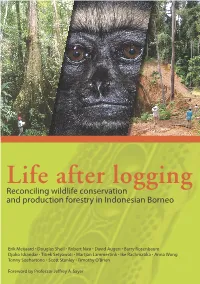
Life After Logging: Reconciling Wildlife Conservation and Production Forestry in Indonesian Borneo
Life after logging Reconciling wildlife conservation and production forestry in Indonesian Borneo Erik Meijaard • Douglas Sheil • Robert Nasi • David Augeri • Barry Rosenbaum Djoko Iskandar • Titiek Setyawati • Martjan Lammertink • Ike Rachmatika • Anna Wong Tonny Soehartono • Scott Stanley • Timothy O’Brien Foreword by Professor Jeffrey A. Sayer Life after logging: Reconciling wildlife conservation and production forestry in Indonesian Borneo Life after logging: Reconciling wildlife conservation and production forestry in Indonesian Borneo Erik Meijaard Douglas Sheil Robert Nasi David Augeri Barry Rosenbaum Djoko Iskandar Titiek Setyawati Martjan Lammertink Ike Rachmatika Anna Wong Tonny Soehartono Scott Stanley Timothy O’Brien With further contributions from Robert Inger, Muchamad Indrawan, Kuswata Kartawinata, Bas van Balen, Gabriella Fredriksson, Rona Dennis, Stephan Wulffraat, Will Duckworth and Tigga Kingston © 2005 by CIFOR and UNESCO All rights reserved. Published in 2005 Printed in Indonesia Printer, Jakarta Design and layout by Catur Wahyu and Gideon Suharyanto Cover photos (from left to right): Large mature trees found in primary forest provide various key habitat functions important for wildlife. (Photo by Herwasono Soedjito) An orphaned Bornean Gibbon (Hylobates muelleri), one of the victims of poor-logging and illegal hunting. (Photo by Kimabajo) Roads lead to various impacts such as the fragmentation of forest cover and the siltation of stream— other impacts are associated with improved accessibility for people. (Photo by Douglas Sheil) This book has been published with fi nancial support from UNESCO, ITTO, and SwedBio. The authors are responsible for the choice and presentation of the facts contained in this book and for the opinions expressed therein, which are not necessarily those of CIFOR, UNESCO, ITTO, and SwedBio and do not commit these organisations. -

The Amphibians and Reptiles of Malinau Region, Bulungan Research Forest, East Kalimantan
TheThe AmphibiansAmphibians Amphibiansandand ReptilesReptiles ofof MalinauMalinau Region,Region, Bulungan ResearchReptiles Forest, East Kalimantan: Annotated checklist with notes on ecological preferences of the species and local utilization Djoko T. Iskandar Edited by Douglas Sheil and Meilinda Wan, CIFOR The Amphibians and Reptiles of Malinau Region, Bulungan Research Forest, East Kalimantan: Annotated checklist with notes on ecological preferences of the species and local utilization Djoko T. Iskandar Edited by Douglas Sheil and Meilinda Wan, CIFOR Cover photo (Rhacophorus pardalis) by Duncan Lang © 2004 by Center for International Forestry Research All rights reserved. Published in 2004 Printed by ??? ISBN 979-3361-65-4 Published by Center for International Forestry Research Mailing address: P.O. Box 6596 JKPWB, Jakarta 10065, Indonesia Offi ce address: Jl. CIFOR, Situ Gede, Sindang Barang, Bogor Barat 16680, Indonesia Tel : +62 (251) 622622 Fax : +62 (251) 622100 E-mail: cifor@cgiar.org Web site: http://www.cifor.cgiar.org Table of of Contents Contents Abstract iv A preamble regarding CIFOR’s work in Malinau v Introduction 1 Aims of This Study 2 Material and Methods 3 Results 4 Conclusions 19 Acknowledgments 20 Literature Cited 21 Abstract The amphibians and reptiles of CIFOR’s field with logging activities because diversity levels are site in Malinau were investigated for a one month similar to those in undisturbed forests. All streams period in June - July 2000, a study which was then contain roughly the same species, indicating that the continued by two interns from Aberdeen, so that the habitat itself is essentially homogenous. Knowledge total length of study was about 72 days. -
An Estimation of Anuran Species Richness and Abundance in The
An estimation of anurans species richness and abundance in Sebangau Peat-Swamp Forest, Indonesia, Borneo Joanna Klys 05196662 1 Acknowledgements This research project would not have been possible without the support of many people. Foremost, I would like to express my sincere gratitude to my supervisor, Dr Caroline Ross, whose encouragement, guidance and support from the initial to the final level enabled me to develop an understanding of the subject. My sincere thanks also goes to, Orangutan Tropical Peatland Project for letting me to undertake research for my undergraduate honours project. In particular, I would like to thank a research assistant Iván Mohedano, for his patience, motivation, enthusiasm, and immense knowledge. His guidance helped me in all the time during project. I would have been lost without him. I would like to thank the staff and volunteers of the Outrop project for providing advice and assistance in data collection. Also I thank all the Indonesian field guides , without whose assistance I would not have been able to carry out my research. Last but not the least, I would like to thank my family: my parents, brother and friends for helping me get through the difficult times. 2 Abstract This report presents the results of the effects of selective logging on anurans in the Sebangau forest in East Kalimantan, Borneo. We assessed the patterns of diversity, richness and abundance in anuran’s communities for four sites in the Sebangau forest in East Kalimantan, an important region given the great number of fauna and flora species. The main objective was to assess anurans community factors relative to different degrees of disturbance for the habitats of the Sebangau Catchment. -
Philippine Frogs of the Genus Leptobrachium (Anura; Megophryidae): Phylogeny-Based Species Delimitation, Taxonomic Review, and Descriptions of Three New Species
Herpetological Monographs, 23, 2009, 1–44 E 2009 by The Herpetologists’ League, Inc. PHILIPPINE FROGS OF THE GENUS LEPTOBRACHIUM (ANURA; MEGOPHRYIDAE): PHYLOGENY-BASED SPECIES DELIMITATION, TAXONOMIC REVIEW, AND DESCRIPTIONS OF THREE NEW SPECIES 1,2,3,4 1 2,3 3 RAFE M. BROWN ,CAMERON D. SILER ,ARVIN C. DIESMOS , AND ANGEL C. ALCALA 1Natural History Museum, Biodiversity Institute and Department of Ecology and Evolutionary Biology; University of Kansas, Dyche Hall, 1345 Jayhawk Blvd, Lawrence, KS 66045-7561, USA 2Herpetology Section, Zoology Division, National Museum of the Philippines, Padre Burgos Avenue, Ermita 1000, Manila, Philippines 3Silliman University-Angelo King Center for Research and Environmental Management, Marine Laboratory Building, Bantayan, Dumaguete City 6200, Philippines ABSTRACT: We review the Philippine frogs of the genus Leptobrachuim. All previous treatments have referred Philippine populations to L. hasseltii, a species we restrict to Java and Bali, Indonesia. We use external morphology, body proportions, color pattern, advertisement calls, and phylogenetic analysis of molecular sequence data to show that Philippine populations of Leptobrachium represent three distinct and formerly unrecognized evolutionary lineages, and we describe each (populations on Mindoro, Palawan, and Mindanao Island groups) as new species. Our findings accentuate the degree to which the biodiversity of Philippine amphibians is currently underestimated and in need of comprehensive review with new and varied types of data. LAGOM: Pinagbalik -
An Updated Checklist of the Amphibian Diversity of Maliau Basin
Evolutionary Systematics 2 2018, 89–114 | DOI 10.3897/evolsyst.2.27020 An updated checklist of the amphibian diversity of Maliau Basin Conservation Area, Sabah, Malaysia Alexander Haas1, Kueh Boon-Hee2, Alvinus Joseph2, Masliadi bin Asri3, Indraneil Das4, Reto Hagmann5, Loraine Schwander6, Stefan T. Hertwig5,6 1 Centrum für Naturkunde, Universität Hamburg, Martin-Luther-King-Platz 3, 20146 Hamburg, Germany 2 Institute for Tropical Biology and Conservation, Universiti Malaysia Sabah, Jalan UMS, 88400 Kota Kinabalu, Sabah, Malaysia 3 Maliau Basin Conservation Area, Pusat Kraftangan Sabah, Peti Surat 961, 89008 Keningau, Sabah, Malaysia 4 Institute for Biodiversity and Environmental Conservation, Universiti Malaysia Sarawak, 94300 Kota Samarahan, Sarawak, Malaysia 5 Naturhistorisches Museum Bern, Bernastraße 15, Ch-3005 Bern, Switzerland 6 Institute of Ecology and Evolution, University of Bern, Baltzerstrasse 6, CH-3012 Bern, Switzerland http://zoobank.org/1E21338D-E8BB-4961-B7E9-7350D3156B4C Corresponding author: Alexander Haas (alexander.haas@uni-hamburg.de) Abstract Received 28 May 2018 Accepted 4 July 2018 The current account presents the results of a 14-day amphibian survey at Maliau Basin Published 13 July 2018 Conservation Area (MBCA). With a total of approximately 170 man-hrs, 44 species were detected at four study sites during the field period; four more species were later discov- Academic editor: ered outside the two-week campaign. The results are compared to the results of previous Andreas Schmidt-Rhaesa surveys. Apart from adults, we present the first photographic documentation of the larval stages of Chiromantis inexpectatus and Bornean Phrynoidis juxtaspera, along with a brief tadpole description; the better-known tadpoles of four more species were recorded. -

Raising Conservation Awareness on Amphibians of Sarawak and Malaysia
66 CONSERVATION Herpetological Review, 2014, 45(1), 66–73. © 2014 by Society for the Study of Amphibians and Reptiles The Bornean Frog Race: Raising Conservation Awareness on Amphibians of Sarawak and Malaysia The second largest (743,380 km2) tropical island (after New Guinea), Borneo straddles the equator between coordinates 04°S–07°N and 10–119°E (Fig. 1). Croizat (1958) described Bor- neo as a geological composite, and the island sits on the eastern margin of the Sunda Shelf, a Laurasian continental plate. Until three decades ago, the island comprised vast swaths of tropical forest, and a diversity of forest types and contrasting habitats, ranging from extensive lowland dipterocarp forests, significant areas of blackwater swamps, and high mountains. The seas around Borneo are generally shallow (< 200 m), contributing to faunal similarities with the faunas of Sumatra (to the west), Java (to the south), and Peninsular Malaysia (in the north), all areas lying on the Sunda Shelf. Exceptionally deep waters (> 2000 m) of the Makassar Strait, to the east of Borneo, separate that island from Sulawesi, which lies on the Sahul Shelf. Wallace’s Line, de- marcating the Oriental fauna from that of Australasia, is posi- tioned across these deep-water straits Apart from contemporary habitat conditions, past climates and land connections are linked to present diversity. During the glaciation events of the Pleistocene, sea levels in the northeast approached 140 m below present level in the Sulu Sea (Linsley 1996), while to the north, the north Sunda Shelf was -116 to -114 m (Hanebuth et al. 2000) when the Sundaland formed a gigantic landmass (Molengraaff 1921; Morley and Flenley 1987). -

Herpetological Journal FULL PAPER
Volume 27 (January 2017), 25–32 Herpetological Journal FULL PAPER Published by the British Environmental correlates of species richness and Herpetological Society composition of riparian anuran communities in rainforests of north- western Borneo: a metacommunity perspective Sandra Goutte1,2, Hanyrol Ahmad Sah3 & T. Ulmar Grafe3 1Ecole Normale Supérieure, 45 rue d'Ulm, Paris, France 2Universidade Estadual de Campinas, Rua Monteiro Lobato, 255, São Paulo, Brazil 3Faculty of Science, Universiti Brunei Darussalam, Tungku Link, Gadong BE 1410, Brunei Darussalam The diversity of stream anurans in Southeast Asia is highly endangered by habitat loss and fragmentation. To optimise conservation planning, their distribution patterns and habitat requirements need to be better understood. In this study, we investigated the distribution and habitat requirements of stream-associated anurans across four sites in north-western Borneo. The sites showed differences in species richness and composition. At a local scale, only microhabitat parameters and stream dynamics had a significant explanatory power on species composition. At a regional scale, environmental variables and geographical distances were both correlated with species composition, with adjacent locations having more similar species assemblages than distant locations. In order to protect the diversity of riparian anurans of north-western Borneo, protected areas need to include distant sites within the same region in addition to a diversity of habitats. Key words: Amphibians, Anura, beta diversity, Borneo, Brunei, ecology, frog, Malaysia, stream Borneo ranks among the most vulnerable biodiversity INTRODUCTION hotspots worldwide (Bellard et al., 2014). Between 1973 and 2010, Borneo has lost 30.2% of its forest cover, mphibians have been identified as the most threatened vertebrate group with nearly a third which is nearly twice the rate of humid tropical forests A . -

Diversity of Frogs in Tawau Hills Park, Sabah, Malaysia
Journal of Tropical Biology and Conservation 16: 229–251, 2019 ISSN 1823-3902 E-ISSN 2550-1909 Research Article Diversity of Frogs in Tawau Hills Park, Sabah, Malaysia Yong Huaimei1, Anna Wong2*, Muhammad Afif Bin Zakaria2 1Wetlands International, 3A31, Block A, Kelana Centre Point, Jalan SS7/19, 47301, Petaling Jaya, Selangor, Malaysia. 2Institute for Tropical Biology and Conservation, Universiti Malaysia Sabah, Jalan UMS, 88400 Kota Kinabalu, Sabah, Malaysia. *Corresponding author: anna888@ums.edu.my Abstract A study on the diversity of anurans was carried out via Visual Encounter Survey (VES) method in Tawau Hills Park (THP), from June 2009 to September 2010. Twenty-eight line transects were established and surveyed, resulting in 925 individuals from 51 species, representing six families. Eighteen species were new locality records for THP, bringing the total number of identified frogs to 68 species. These frogs occupy elevations from lowland area (200 m a.s.l.) at the headquarters of THP, Balong substation and Merotai substation to submontane area (>900 m a.s.l.) at Mount Maria, Mount Lucia and Mount Magdalena. All 68 species recorded represent 62% of the total frog species found in Sabah, with 15% of them endemic to Borneo. Frog species in THP were dominated by Ranidae (39.4%) and Dicroglossidae (24.4%). Limnonectes leporinus was the most abundant species (10.2%), followed by Meristogenys orphnocnemis (10.1%). The high species diversity and richness in THP could be due to the rich topography of this park, which provides ample feeding, breeding and shelter for frogs. Keywords: Anurans, Lowlands, Submontane, Visual Encountered Survey, Endemic, Borneo Introduction Borneo is one of the most important biodiversity hotspots for amphibians where inventory studies have been systematically carried out in Sabah and Sarawak since the late 1850s (Inger & Stuebing, 2005; Matsui 2006, Das and Haas, 2010). -

The Amphibians and Reptiles of Malinau Region
Cover photo by Duncan Lang Published by Center for International Forestry Research Mailing address: P.O. Box 6596 JKPWB, Jakarta 10065, Indonesia Office address: Jl. CIFOR, Situ Gede, Sindang Barang, Bogor Barat 16680, Indonesia Tel : +62 (251) 622622 Fax : +62 (251) 622100 E-mail: cifor@cgiar.org Web site: http://www.cifor.cgiar.org The Amphibians and Reptiles of Malinau Region, Bulungan Research Forest, East Kalimantan: Annotated checklist with notes on ecological preferences of the species and local utilization Djoko T. Iskandar Edited by Douglas Sheil and Meilinda Wan, CIFOR Abstract The amphibians and reptiles of CIFOR’s field site unable to link this fact with logging activities in Malinau were investigated for a one month period because diversity levels are similar to those in in June - July 2000, a study which was then undisturbed forests. All streams contain roughly the continued by two interns from Aberdeen, so that same species, indicating that the habitat itself is the total length of study was about 72 days. A essentially homogenous. Knowledge of the habitat number of amphibian and reptile species were of amphibian species should be explored more directly observed in the area during this time. deeply for future monitoring of logging activities. Following that work and interviews with local The local people used turtles, monitor lizards and people, a total of 97 species are noted, and 76 among pythons as food, but they rarely eat frogs, although them are confirmed. This is an ecologically rich they acknowledge that at least six species are known area for an exploited forest and researchers found to be edible. -
A Bornean Amphibian Hotspot: the Lowland Mixed Dipterocarp Rainforest at Ulu Temburong National Park, Brunei Darussalam
Bornean amphibian hotspot: Ulu Temburong National Park, Brunei Darussalam SALAMANDRA 45 1 25-38 Rheinbach, 20 February 2009 ISSN 0036-3375 A Bornean amphibian hotspot: the lowland mixed dipterocarp rainforest at Ulu Temburong National Park, Brunei Darussalam T. Ulmar Grafe & Alexander Keller Abstract. We investigated the amphibian species richness within the Ulu Temburong National Park, Brunei Darussalam. Standardized visual and acoustic transect sampling and encounter surveys were conducted from April 2005 – October 2006. We identified a total of 54 amphibian species, 53 frogs and caecilian. 5 species were new records for the park while 2 were new records for Brunei Darussalam. This brings the total number of amphibian species in Ulu Temburong to 66 species. Robust abundance measures are provided for 42 of the 66 species. Two-thirds of the regional, lowland and hilly forest frog diversity of Borneo was found within 25 km2 of the Ulu Temburong National Park. This is a remarkable percentage, suggesting that this site deserves high conservation priority. High species richness is likely to result from the high diversity of breeding habitats and the confluence of the regional faunas of two bio- geographical units in Borneo: East Sarawak and the hilly heart of Borneo. Key words. Brunei Darussalam, Borneo, rainforest, amphibians, species richness, abundance. Introduction Das (995) conducted detailed amphibian and reptile surveys within the UTNP (pre- Extensive sampling of the amphibian fau- viously known as the Batu Apoi Forest Re- na of northern Borneo has largely been re- serve) reporting 50 species of amphibians. stricted to the Malaysian states of Sarawak In this study, we update and substantially and Sabah (Inger & Tan 996, Malkmus et expand the amphibian species list for the al.