O Brother, Where Art Thou ? De Joel & Ethan Coen
Total Page:16
File Type:pdf, Size:1020Kb
Load more
Recommended publications
-

Il Cinema Dei Fratelli Coen: Declinazioni Del Vuoto 1
Il cinema dei fratelli Coen: declinazioni del vuoto Introduzione Joel e Ethan Coen esordiscono come registi negli anni Ottanta, epoca in cui è lo stesso concetto di autore – e quindi anche quello di regista – a tornare di moda, ma al tempo stesso si trasforma: l’artista non è più creatore, ma imitatore, in un momento storico in cui si riconosce di non aver più nulla da dire. Come infatti sottolinea Buccheri, “non cerca una voce personale, ma uno stile che gli dia visibilità, un’estetica come marchio e come look – si mette in scena, offrendo il proprio corpo allo “scandalo evangelico”, in una deriva dell’autobiografismo politico degli anni Sessanta”1. E in questo giudizio di valore sono coinvolti anche i fratelli Coen che, come Brian De Palma, o Woody Allen, sono spesso stati definiti manieristi; termine inteso in questo contesto come imitatori prima che della natura, di altro cinema a sé precedente. Tuttavia, nonostante critici come Paolo Cerchi Usai abbia riportato, su “Segnocinema”, come “il loro cinema sia senza motivo, ma abbiano deciso di fare ugualmente cinema nel nome della sua inutilità”2, l’attitudine dei due registi è in realtà profondamente critica riguardo al materiale usato: dietro all’apparenza leggera infatti, si nasconde una critica radicale agli stereotipi e simboli della vita americana e in generale alla vita contemporanea, come il consumismo, la ristrettezza mentale della provincia, la ruralità, la libertà dell’arte, la controcultura stessa. I personaggi che portano in scena hanno corpi sgraziati, spesso grotteschi (si pensi a quelli interpretati da Steve Buscemi, uno degli attori feticcio del cinema dei due fratelli), e sono destinati ad un’irrimediabile alienazione, che arriva a distruggerli, persi nelle rete delle rappresentazioni e leggi sociali. -

Billy Burkhalter: the Maltese Man: a Video Game for Wimps
Billy Burkhalter: The Maltese Man: A Video Game for Wimps Project Paper for CC8096 Communication & Culture: Master's Project Joint Programme in Communication & Culture Ryerson University I York University Sean Springer September 24, 2004 - Table of Contents Acknowledgements .............................................................................. 1 Video Games and Masculinity in the Twenty-First Century ............................ 2 An Alternative Model ........................................................................... 10 Conclusion: Production of the Test Scene ................................................ 28 References ....................................................................................... 30 Notes ............................................................................................... 32 "The Big Lebowski: A Mass-Produced Fantasy for Wimps" .............. Appendix A Plot Outline of Billy Burkhalter: The Maltese Man .......................... Appendix B Flash Postings ..................................................................... Appendix C Script for Billy Burkhalter: The Maltese Man ................................. Appendix D Sketches of the Main Characters ............................................... Appendix E ETER $' Springer Project Paper, Third Draft "Billy Burkhalter, the Maltese Man: A Video Game for Wimps" Page 1 Acknowledgments Billy Burkhalter, the Maltese Man would not have been possible had it not for the help and support of the following people and organizations (in alphabetical -

The Museum of Modern Art Spotlights Filmmaking Partners Joel and Ethan Coen During the Month of August in Ongoing Exhibition from the Collection
THE MUSEUM OF MODERN ART SPOTLIGHTS FILMMAKING PARTNERS JOEL AND ETHAN COEN DURING THE MONTH OF AUGUST IN ONGOING EXHIBITION FROM THE COLLECTION Nine Films from Blood Simple to No Country for Old Men Feature Coens' Core Team of Collaborators Collaborations In The Collection: Joel And Ethan Coen August 2–28, 2008 The Roy and Niuta Titus Theaters New York, July 16, 2008—The Museum of Modern Art showcases the genre-bending films of brothers Joel and Ethan Coen from August 2 through 28, 2008, as part of Collaborations in the Collection, an initiative begun in 2007 to highlight collaborative relationships in cinema that have forged dynamic and memorable films. This ongoing exhibition, drawn from the 22,000 film titles in the Museum’s collection, samples a wide range of classic and contemporary film collaborations, both well-known and rarely noticed. Collaborations in the Collection is organized by Jenny He, Curatorial Assistant, Department of Film, The Museum of Modern Art. Joel and Ethan Coen, whose partnership is one of the most prominent filmmaking collaborations in contemporary cinema, have produced such award-winning films as Barton Fink (1991) and the Academy Award–winning No Country for Old Men (2007). The brothers go beyond writing and directing to also share producing and editing responsibilities, although they frequently go uncredited or use pseudonyms. In addition to collaborating with each other, the Coens repeatedly work with the same actors (Steve Buscemi, John Goodman, Frances McDormand, Jon Polito, John Turturro); casting directors (Donna Isaacson, John Lyons, Ellen Chenoweth); cinematographers (Barry Sonnenfeld, Roger Deakins); composer (Carter Burwell); costume designers (Richard Hornung, Mary Zophres); editor (Roderick Jaynes, a pseudonym for the duo); production designer (Dennis Gassner); and sound editor (Skip Lievsay). -
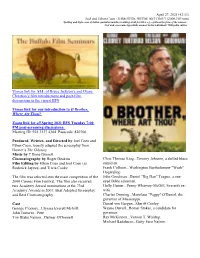
Vimeo Link for ALL of Bruce Jackson's and Diane
April 27, 2021 (42:13) Joel and Ethan Coen : O BROTHER, WHERE ART THOU? (2000,109 min) Spelling and Style—use of italics, quotation marks or nothing at all for titles, e.g.—follows the form of the sources. Cast and crew name hyperlinks connect to the individuals’ Wikipedia entries Vimeo link for ALL of Bruce Jackson’s and Diane Christian’s film introductions and post-film discussions in the virtual BFS Vimeo link for our introduction to O Brother, Where Art Thou? Zoom link for all Spring 2021 BFS Tuesday 7:00 PM post-screening discussions: Meeting ID: 925 3527 4384 Passcode: 820766 Produced, Written, and Directed by Joel Coen and Ethan Coen, loosely adapted the screenplay from Homer’s The Odyssey Music by T Bone Burnett Cinematography by Roger Deakins Chris Thomas King...Tommy Johnson, a skilled blues Film Editing by Ethan Coen and Joel Coen (as musician. Roderick Jaynes) and Tricia Cooke Frank Collison...Washington Bartholomew "Wash" Hogwallop The film was selected into the main competition of the John Goodman...Daniel "Big Dan" Teague, a one- 2000 Cannes Film Festival. The film also received eyed Bible salesman. two Academy Award nominations at the 73rd Holly Hunter...Penny Wharvey-McGill, Everett's ex- Academy Awards in 2001: Best Adapted Screenplay wife. and Best Cinematography. Charles Durning...Menelaus "Pappy" O'Daniel, the governor of Mississippi. Cast Daniel von Bargen...Sheriff Cooley George Clooney...Ulysses Everett McGill. Wayne Duvall...Homer Stokes, a candidate for John Turturro...Pete governor. Tim Blake Nelson...Delmar O'Donnell Ray McKinnon...Vernon T. Waldrip. Michael Badalucco...Baby Face Nelson. -

Joel & Ethan Coen, the BIG LEBOWSKI
November 23, 2010 (XXI:13) Joel & Ethan Coen, THE BIG LEBOWSKI (1998, 117 min) Produced, written and directed by Joel Coen and Ethan Coen Original Music by Carter Burwell Cinematography by Roger Deakins Film Editing by Tricia Cooke, Ethan Coen and Joel Coen Barry Asher....bowling consultant Pattie Cooke....baby wrangler Jeff Bridges...Jeffrey Lebowski - The Dude John Goodman...Walter Sobchak Julianne Moore...Maude Lebowski Steve Buscemi...Theodore Donald 'Donny' Kerabatsos David Huddleston...Jeffrey Lebowski - The Big Lebowski Philip Seymour Hoffman...Brandt Tara Reid...Bunny Lebowski Philip Moon...Woo, Treehorn Thug Mark Pellegrino...Blond Treehorn Thug Peter Stormare...Nihilist #1, Uli Kunkel / 'Karl Hungus' Flea...Nihilist #2, Kieffer Torsten Voges...Nihilist #3, Franz Jimmie Dale Gilmore...Smokey Jack Kehler...Marty Man 1998. They’ve won four Oscars: Best Directing – No Country John Turturro...Jesus Quintana For Old Men, Best Screenplay Based on Previously Published James G. Hoosier...Liam O'Brien, Quintana's Partner Work – No Country For Old Men, Best Original Screenplay – Carlos Leon...Maude's Thug #1 Fargo, and Best Editing – No Country For Old Men. Terrence Burton...Maude's Thug #2 David Thewlis...Knox Harrington CARTER BURKWELL (18 November 1955, New York, NY) has Sam Elliott...The Stranger composed the scores for 78 films & shows, some of which are: True Ben Gazzara...Jackie Treehorn Grit 2010, The Kids Are All Right 2010, Howl 2010, A Serious Man Leon Russom...Malibu Police Chief 2009, Burn After Reading 2008, In Bruges 2008, -

THE COEN BROTHERS FAQ Version 1.0 Last Update: April 5, 2004 Assembled and Edited By: J.D
THE COEN BROTHERS FAQ version 1.0 last update: April 5, 2004 assembled and edited by: J.D. Lafrance email all additions & suggestions to: paul_tweedle@scee.net As you go through this document, you may notice several sections (in particular, the Coens’ most recent films) lacking in information. This FAQ is by no means complete and is considered a constant work in progress. I will try and update it on a semi-regular basis. I must thank Paul for inspiring this FAQ and hosting it on his site. It would have not been possible without his involvement and support. Content of The Coen Brothers FAQ is the copyright of its respective authors. It is not to be re-transmitted, republished, or reformatted by any means electronic or mechanical, without prior permission. THE COENS 1. When and where were the Coen brothers born? Joel was born on November 29, 1954 and Ethan was born on September 21, 1957 in the St. Louis Park suburb of Minneapolis, Minnesota. 2. Who are their parents? Their father, Edward, was an economics professor at the University of Minnesota. Their mother, Rena, was a professor of fine arts at St. Cloud University. 3. Do they have any siblings? Yes. One sister—Debbie who became a doctor and moved to Israel. 4. What kinds of movies did they watch as kids? Joel: "A movie like Boeing Boeing was big with us. And we were into movies like That Touch of Mink, A Global Affair, Bob Hope movies, Jerry Lewis movies, anything with Tony Curtis, Pillow Talk. We tried to see everything with Doris Day.