Ketaklangsungan Ekspresi Dalam Lirik Lagu Yang
Total Page:16
File Type:pdf, Size:1020Kb
Load more
Recommended publications
-

From the Studio of Marjory Halvorson
The Music Department at Gonzaga University presents Isabel Parra Mezzo-soprano Senior Voice Recital with Susan Lim & Annie Flood pianists from the studio of Darnelle Preston Friday, April 24th, 2021 3:00 PM Live Streamed from Robert Frost Auditorium Culver City, California This recital is given in partial fulfillment of a Bachelor of Arts in Music Performance Concentration Program Amore è bandito Barbara Strozzi Ariette a voce sola, Op. 6 (1619-1677) Spesso per entro al petto ****** Du meines Herzens Krӧnelein Richard Strauss Breit‘ über mein Haupt (1864-1949) Cäcilie ****** La Courte Paille Francis Poulenc I. Les Sommeil (1899-1963) II. Quelle Aventure III. La Reine de coer IV. Ba, Be, Bi, Bo, Bu V. Les Anges musiciens VI. La Carafon VII. Lune d‘Avril ****** Eki 駅 Akira Miyoshi (1933-2013) Uguisu 鶯 Fumio Hayasaka (1914-1955) Funauta Katakoi 舟唄片恋 Ikuma Dan (1924-2001) Kojo no Tsuki 荒城の月 Rentarō Taki (1879-1903) ****** Eight Epitaphs Theodore Chanler 1. Alice Rodd (1902-1961) 2. Susannah Fry 3. Three Sisters 4. Thomas Logge 5. A Midget 6. “No Voice to Scold“ 7. Ann Poverty 8. Be Very Quiet Now ****** Palomita Manuel M. Ponce (1882-1948) Ilusión Fantasma Mario Kuri-Aldana (1931-2013) Cantar del Zenzontle Translations Amore è bandito Love is banished Barbara Strozzi (1619-1677) Translation by Martha Gerhart Amore è bandito, Love is banished, amanti su, su. lovers, move on. È fatto un eddito An edict has been made ch'Amor non sia più. that love shall be no more. Forniti gl'amori Finished are the love affairs; l'inganno e la frode, the deception and the fraud ah, ah, più non s'ode Ah, ah, no longer one hears of them tormenti e rancori: of torments and grudges: il caso è spedito. -

Space In-Between: Masumura Yasuzo, Japanese New Wave, And
SPACE IN-BETWEEN: MASUMURA YASUZO, JAPANESE NEW WAVE, AND MASS CULTURE CINEMA by PATRICK ALAN TERRY A THESIS Presented to the Department of East Asian Languages and Literatures and the Graduate School of the University of Oregon in partial fulfillment of the requirements for the degree of Master of Arts June 2011 THESIS APPROVAL PAGE Student: Patrick Alan Terry Title: Space In-Between: Masumura Yasuzo, Japanese New Wave, and Mass Culture Cinema This thesis has been accepted and approved in partial fulfillment of the requirements for the Master of Arts degree in the Department of East Asian Languages and Literatures by: Prof. Steven Brown Chair Dr. Daisuke Miyao Advisor and Richard Linton Vice President for Research and Graduate Studies/Dean of the Graduate School Original approval signatures are on file with the University of Oregon Graduate School. Degree awarded June 2011 ii © 2011 Patrick Alan Terry iii THESIS ABSTRACT Patrick Alan Terry Master of Arts Department of East Asian Languages and Literatures June 2011 Title: Space In-Between: Masumura Yasuzo, Japanese New Wave, and Mass Culture Cinema Approved: ________________________________________________ Dr. Daisuke Miyao During the early stage of Japan’s High Economic Growth Period (1955-1970), a group of directors and films, labeled the Japanese New Wave, emerged to strong critical acclaim and scholarly pursuit. Over time, Japanese New Wave Cinema has come to occupy a central position within the narrative history of Japanese film studies. This position has helped introduce many significant films while inadvertently ostracizing or ignoring the much broader landscape of film at this time. This thesis seeks to complexify the New Wave’s central position through the career of Daiei Studios’ director, Masumura Yasuzo. -

Kanshi, Haiku and Media in Meiji Japan, 1870-1900
The Poetry of Dialogue: Kanshi, Haiku and Media in Meiji Japan, 1870-1900 Robert James Tuck Submitted in partial fulfillment of the requirements for the degree of Doctor of Philosophy in the Graduate School of Arts and Sciences COLUMBIA UNIVERSITY 2012 © 2012 Robert Tuck All Rights Reserved ABSTRACT The Poetry of Dialogue: Kanshi, Haiku and Media in Meiji Japan, 1870-1900 Robert Tuck This dissertation examines the influence of ‘poetic sociality’ during Japan’s Meiji period (1867-1912). ‘Poetic sociality’ denotes a range of practices within poetic composition that depend upon social interaction among individuals, most importantly the tendency to practice poetry as a group activity, pedagogical practices such as mutual critique and the master-disciple relationship, and the exchange among individual poets of textually linked forms of verse. Under the influence of modern European notions of literature, during the late Meiji period both prose fiction and the idea of literature as originating in the subjectivity of the individual assumed hegemonic status. Although often noted as a major characteristic of pre-modern poetry, poetic sociality continued to be enormously influential in the literary and social activities of 19th century Japanese intellectuals despite the rise of prose fiction during late Meiji, and was fundamental to the way in which poetry was written, discussed and circulated. One reason for this was the growth of a mass-circulation print media from early Meiji onward, which provided new venues for the publication of poetry and enabled the expression of poetic sociality across distance and outside of face-to-face gatherings. With poetic exchange increasingly taking place through newspapers and literary journals, poetic sociality acquired a new and openly political aspect. -

Sayuri Arai Dissertation Final Final Final
© 2016 Sayuri Arai MEMORIES OF RACE: REPRESENTATIONS OF MIXED RACE PEOPLE IN GIRLS’ COMIC MAGAZINES IN POST-OCCUPATION JAPAN BY SAYURI ARAI DISSERTATION Submitted in partial fulfillment of the requirements for the degree of Doctor of Philosophy in Communications in the Graduate College of the University of Illinois at Urbana-Chapmpaign, 2016 Urbana, Illinois Doctoral Committee: Professor Clifford G. Christians, Chair Professor Cameron R. McCarthy Professor David R. Roediger, The University of Kansas Professor John G. Russell, Gifu University ABSTRACT As the number of mixed race people grows in Japan, anxieties about miscegenation in today’s context of intensified globalization continue to increase. Indeed, the multiracial reality has recently gotten attention and led to heightened discussions surrounding it in Japanese society, specifically, in the media. Despite the fact that race mixing is not a new phenomenon even in “homogeneous” Japan, where the presence of multiracial people has challenged the prevailing notion of Japaneseness, racially mixed people have been a largely neglected group in both scholarly literature and in wider Japanese society. My dissertation project offers a remedy for this absence by focusing on representations of mixed race people in postwar Japanese popular culture. During and after the U.S. Occupation of Japan (1945-1952), significant numbers of racially mixed children were born of relationships between Japanese women and American servicemen. American-Japanese mixed race children, as products of the occupation, reminded the Japanese of their war defeat. Miscegenation and mixed race people came to be problematized in the immediate postwar years. In the 1960s, when Japan experienced the postwar economic miracle and redefined itself as a great power, mixed race Japanese entertainers (e.g., models, actors, and singers) became popular. -

Fairy Inc. Sheet Music Products List Last Updated [2013/03/018] Price (Japanese Yen) a \525 B \788 C \683
Fairy inc. Sheet Music Products list Last updated [2013/03/018] Price (Japanese Yen) A \525 B \788 C \683 ST : Standard Version , OD : On Demand Version , OD-PS : Piano solo , OD-PV : Piano & Vocal , OD-GS : Guitar solo , OD-GV : Guitar & Vocal A Band Score Piano Guitar Title Artist Tie-up ST OD ST OD-PS OD-PV ST OD-GS OD-GV A I SHI TE RU no Sign~Watashitachi no Shochiku Distributed film "Mirai Yosouzu ~A I DREAMS COME TRUE A A A Mirai Yosouzu~ SHI TE RU no Sign~" Theme song OLIVIA a little pain - B A A A A inspi'REIRA(TRAPNEST) A Song For James ELLEGARDEN From the album "BRING YOUR BOARD!!" B a walk in the park Amuro Namie - A a Wish to the Moon Joe Hisaishi - A A~Yokatta Hana*Hana - A A Aa Superfly 13th Single A A A Aa Hatsu Koi 3B LAB.☆ - B Aa, Seishun no Hibi Yuzu - B Abakareta Sekai thee michelle gun elephant - B Abayo Courreges tact, BABY... Kishidan - B abnormalize Rin Toshite Shigure Anime"PSYCHO-PASS" Opening theme B B Acro no Oka Dir en grey - B Acropolis ELLEGARDEN From the album "ELEVEN FIRE CRACKERS" B Addicted ELLEGARDEN From the album "Pepperoni Quattro" B ASIAN KUNG-FU After Dark - B GENERATION again YUI Anime "Fullmetal Alchemist" Opening theme A B A A A A A A Again 2 Yuzu - B again×again miwa From 2nd album "guitarium" B B Ageha Cho PornoGraffitti - B Ai desita. Kan Jani Eight TBS Thursday drama 9 "Papadoru!" Theme song B B A A A Ai ga Yobu Hou e PornoGraffitti - B A A Ai Nanda V6 - A Ai no Ai no Hoshi the brilliant green - B Ai no Bakudan B'z - B Ai no Kisetsu Angela Aki NHK TV novel series "Tsubasa" Theme song A A -
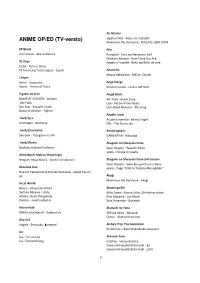
ANIME OP/ED (TV-Versio) Japahari Net - Retsu No Matataki Maximum the Hormone - ROLLING 1000 Toon
Air Master ANIME OP/ED (TV-versio) Japahari Net - Retsu no matataki Maximum the Hormone - ROLLING 1000 tOON 07 Ghost Ajin Yuki Suzuki - Aka no Kakera flumpool - Yoru wa Nemureru kai? Mamoru Miyano - How Close You Are 91 Days Angela x Fripside - Boku wa Boku de atte ELISA - Rain or Shine TK from Ling Tosite Sigure - Signal Amanchu Maaya Sakamoto - Million Clouds 11eyes Asriel - Sequentia Ange Vierge Ayane - Arrival of Tears Konomi Suzuki - Love is MY RAIL 3-gatsu no Lion Angel Beats BUMP OF CHICKEN - Answer Aoi Tada - Brave Song .dot-Hack Lisa - My Soul Your Beats See-Saw - Yasashii Yoake Girls Dead Monster - My Song Bump of chicken - Fighter Angelic Layer .hack//g.u Atsuko Enomoto - Be my Angel Ali Project - God Diva HAL - The Starry sky .hack//Liminality Anime-gataris See-Saw - Tasogare no Umi GARNiDELiA - Aikotoba .hack//Roots Akagami no Shirayuki hime Boukoku Kakusei Catharsis Saori Hayami - Yasashii Kibou eyelis - Kizuna ni nosete Abenobashi Mahou Shoutengai Megumi Hayashibara - Anata no kokoro ni Akagami no Shirayuki hime 2nd season Saori Hayami - Sono Koe ga Chizu ni Naru Absolute Duo eyelis - Page ~Kimi to Tsuzuru Monogatari~ Nozomi Yamamoto & Haruka Yamazaki - Apple Tea no Aji Akagi Maximum the Hormone - Akagi Accel World May'n - Chase the World Akame ga Kill Sachika Misawa - Unite. Miku Sawai - Konna Sekai, Shiritakunakatta Altima - Burst the gravity Rika Mayama - Liar Mask Kotoko - →unfinished→ Sora Amamiya - Skyreach Active Raid Akatsuki no Yona AKINO with bless4 - Golden Life Shikata Akiko - Akatsuki Cyntia - Akatsuki no hana -

Bokura No Hashitte Kita Michi Wa
Bokura no Hashitte kita Michi wa sou desu! sara ni (fu!) hashirou sore shikanai to kagayakitakute hajimaritakutte omotteru kedo nayamu ne nakama ni deai nagara hashitte kita michi bokura (fu!) zettai tomarenai yo zero kara ichi tte nante taihen nandarou datte kanjitai atsuku dakedo sore ga (dakedo sore ga) motto chigatta katachi de tsunagari ni natta yo atarashiku yume mite sou desu! aa doushiyou (ashita e) nani mo wakarazu namida to ase to de aa doushiyou (mukaeba) nakama to hagemashiatte hashitte kita michi wakaru? (wakaru?) oozora miagete katariatta yo mainichi mirai no bokura wa...? dakara minna (dakara minna) ganbatte koreta ne sou desu... jibun rashiku to jumon o tonaete itsumo (fu!) yume ga kokoro ni atta nakama o miokuru koto o ukeire nagara mo miushinaisou ni natte mo zero janai daijoubu! genki dasou waraou yo bokura (fu!) zettai akiramenai! yatte miyou (yatte miyou) datte hikari ga mieta yo madamada ne ganbaru motto muchuu ni naretara kawaru tte sa shinjiteta sara ni (fu!) hashirou sore shikanai to kono minna de omotteru kara hashiru yo bokura (fu!) zettai tomarenai yo sou desu! datte kanjitai atsuku hitotsu futatsu to negai ga kanatte motto chigatta katachi de nakama ga ite yokatta natte hashitte kita michi atarashiku yume mite demo ne wakare wa donna koto ni mo arunda saa maku ga agattara zutto utatte itai ne doko e ikou (doko e ikou) owaranai yume miyou... sorezore no gooru e Thrilling‧One Way watashitachi kagayakitai! harahara (mayoi mo) motomete (michidzure) hashire mirai (mai mirai) mai mirai torai‧torai‧torai rai Thrilling -

Gets Closer Look NEW YORK -Top Executives WASHINGTON - Failure of Court Judge June L
08120 APRIL 29, 1972 $1.25 A BILLBOARD PUBLICATION SEVENTY -EIGHTH YEAR The International Music-Record-Tape Newsweekly HOT 100 PAGE 68 TOP LP'S PAGES 70, 72 O r TAPE CARTRIDGE PAGE 48 Piracy Law's Foes Top Execs Will Co -op Ad Money Charge 'Ambiguity' Attend Meeting By MILDRED HALL Gets Closer Look NEW YORK -Top executives WASHINGTON - Failure of Court Judge June L. Green and from the music- record -talent fields By JOHN SIPPEL the new antipiracy law to designate Howard F. Corcoran and Senior encompassing the global spectrum Record com- pointed out that his firm has songwriters' rights in the new re- Circuit Court Judge Charles Fahy, will converge on the Acapulco LOS ANGELES- cording copyright was the hottest spokesmen for the Attorney Gen- panies are taking a closer look at established placement patterns Princess Hotel, Acapulco, Mexico, through working so many local issue in oral argument before a eral's office, and the Recording for the fourth annual International cooperative advertising appropria- three -judge court in Federal Dis- Industry Association of America tions because of fast -rising costs co -op programs for a variety of Music Industry Conference begin- and the manufacturers in all fields. trict Court here last week. The (RIAA) held that the law was ning Sunday (30) and running in all advertising media case involved was of a new breed of rec- ACB primarily checks all types the Ronald proper and constitutional in every through Saturday (6). emergence Shaab challenge to the constitu- respect, and that Shaab had failed ord /tape marketing executive, a of print media, while DAF checks tionality The turnout will surpass that of revealed. -

Nom De La Série Type Nom De La Musique 1 7 No Mahoutsukai Game
Nom de la série Type Nom de la musique 1 7 no Mahoutsukai Game OP 1 japonais Keep your Promise 3-gatsu no Lion Ending 1 japonais Fighter 3-gatsu no Lion Ending 2 japonais Nyaa Shougi Ondo Ichiban 3-gatsu no Lion Ending 3 japonais orion 3-gatsu no Lion Insert japonais Nyaa Shougi Ondo Niban 3-gatsu no Lion Insert japonais Nyaa Shougi Ondo Sanban 3-gatsu no Lion Opening 1 japonais Answer 3-gatsu no Lion Opening 2 japonais Sayonara Bystander 3-gatsu no Lion Opening 3 japonais Flag wo Tatero 3-gatsu no Lion Opening 4 japonais Haru ga Kite Bokura 7'scarlet Game OP 1 japonais World End Syndrome 07-GHOST Ending 1 japonais Hitomi no Kotae 07-GHOST Opening 1 japonais Aka no Kakera 11eyes Ending 1 japonais Sequentia 11eyes Opening 1 japonais Arrival of tears 11eyes -Tsumi to Batsu to Aganai no Shoujo- Game OP 1 japonais Lunatic Tears... 12-sai. Ending 1 japonais Koi no 12-sai 12-sai. ~Chicchana Mune no Tokimeki~ Opening 1 japonais Sweet Sensation 77 ~And, two stars meet again~ Game OP 1 japonais STAR LEGEND 91Days Opening 1 japonais Signal & – Sora no Mukou de Sakimasu Youni – Game OP 1 japonais The Moon is Not Alone +Tic Neesan Ending 1 japonais Watashi to Watashi ga Shitai Koto +Tic Neesan Opening 1 japonais Plastic Shikou A Channel Ending 1 japonais Humming girl A Channel Opening 1 japonais Morning Arch A.I.C.O. Incarnation Ending 1 japonais Michi no Kanata A.I.C.O. Incarnation Opening 1 japonais A.I.C.O. -

UCLA Electronic Theses and Dissertations
UCLA UCLA Electronic Theses and Dissertations Title Rethinking the Postwar from Outside: Japanese Literature of Decolonization Permalink https://escholarship.org/uc/item/2h9438hb Author Liang, Jiajun Publication Date 2021 Peer reviewed|Thesis/dissertation eScholarship.org Powered by the California Digital Library University of California UNIVERSITY OF CALIFORNIA Los Angeles Rethinking the Postwar from Outside: Japanese Literature of Decolonization A dissertation submitted in partial satisfaction of the requirements for the degree Doctor of Philosophy in Asian Languages and Cultures by Jiajun Liang 2021 © Copyright by Jiajun Liang 2021 ABSTRACT OF THE DISSERTATION Rethinking the Postwar from Outside: Japanese Literature of Decolonization by Jiajun Liang Doctor of Philosophy in Asian Languages and Cultures University of California, Los Angeles, 2021 Professor Michael Emmerich, Chair This dissertation examines the discursive transformations in the postwar Japanese literary terrain through a transnational lens of decolonization. The transition from wartime to postwar Japan was often considered as a rupture which was figured, at the discursive level, as a centripetal turn away from the imperial legacies and toward the brighter future of recovery and development. Beginning in the 1980s, however, scholars questioned the popular conception of postwar Japan as a self- contained, homogenous space, which failed to account for the massive transnational flows such as repatriation, demobilization, and deportation in the aftermath of the collapse of the empire. This dissertation aims to recuperate the multivalence in the postwar cultural landscape through a careful and critical analysis of literary works. In particular, it proposes to attune our interpretative frame to include not only what is explicitly depicted in fictions but also the ostensibly insignificant details that may seem impertinent to the narratives’ development. -

Postwar Industrial Relations and the Origins of Lean
Postwar Industrial Relations and the Origins of Lean Production in Japan (1945-1973) By John Price B.A., The University of British Columbia, 1986 M.A., The University of British Columbia, 1987 A THESIS SUBMITTED IN PARTIAL FULFILLMENT OF THE REQUIREMENTS FOR THE DEGREE OF DOCTOR OF PHILOSOPHY in THE FACULTY OF GRADUATE STUDIES (Department of History) We accept this thesis as conforming Signature(s) removed to protectto privacythe required standard THE UNIVITY OYBRITISH COLUMBIA 1993 @John Price, 1993 in presenting this thesis in partial fulfilment of the requirements for an advanced degree at the University of British Columbia, I agree that the Library shall make it freely available for reference and study. I further agree that permission for extensive copying of this thesis for scholarly purposes may be granted by the head of my department or by his or her representatives. It is understood that copying or publication of this thesis for financial gain shall not be allowed without my written permission. Department of The University of British Columbia Vancouver, Canada Date ‘(a% .9q DE-6 (2/88) Postwar Industrial Relations and the Origins of Lean Production in Japan (1945-1973) by John Price Abstract This thesis examines the evolution of postwar industrial relations in postwar Japan from 1945 to 1973. It analyzes the impact of postwar industrial relations institutions on the origins and development of “lean production” or, as it is otherwise known, the Toyota production system. It uses three case studies, Mitsui Coal’s Miike mine in Kyushu, Suzuki Motors in Hamamatsu, and Moriguchi City Hall as an empirical basis for analysis and constructs a schema of industrial relations institutions that challenges the conventional “three pillars” interpretation (lifetime employment, seniority-based wages, and enterprise unions). -

Exploring the Potential of Satoumi for Implementing the Ecosystem Approach in the Japanese Archipelago
Secretariat of the CBD Technical Series No. 61 Convention on Biological Diversity BIOLOGICAL61 AND CULTURAL DIVERSITY IN COASTAL COMMUNITIES Exploring the Potential of Satoumi for Implementing the Ecosystem Approach in the Japanese Archipelago CBD Technical Series No. 61 Biological and Cultural Diversity in Coastal Communities Exploring the Potential of Satoumi for Implementing the Ecosystem Approach in the Japanese Archipelago Published by the Secretariat of the Convention on Biological Diversity. ISBN: 92-9225-384-0 Copyright © 2011, Secretariat of the Convention on Biological Diversity The designations employed and the presentation of material in this publication do not imply the expression of any opinion whatsoever on the part of the Secretariat of the Convention on Biological Diversity concerning the legal status of any country, territory, city or area or of its authorities, or concerning the delimitation of its frontiers or boundaries. The views reported in this publication do not necessarily represent those of the Convention on Biological Diversity nor those of the reviewers. This publication may be reproduced for educational or non-profit purposes without special permission from the copyright holders, provided acknowledgement of the source is made. The Secretariat of the Convention would appreciate receiving a copy of any publications that uses this document as a source. Citation United Nations University Institute of Advanced Studies Operating Unit Ishikawa/Kanazawa (2011). Biological and Cultural Diversity in Coastal Communities, Exploring the Potential of Satoumi for Implementing the Ecosystem Approach in the Japanese Archipelago. Secretariat of the Convention on Biological Diversity, Montreal, Technical Series no. 61. For further information, please contact: Secretariat of the Convention on Biological Diversity World Trade Centre 413 St.